

Yorkie weight calculator
Estimate your Yorkshire Terrier puppy’s adult weight from current age and weight.
How the Yorkie Weight Calculator Works
Last updated: October 2026
A Yorkie weight calculator estimates how much a Yorkshire Terrier puppy may weigh as an adult using its current weight and age. CanineCalc uses a small-breed growth curve to estimate adult weight, show growth progress, and provide a practical planning range. The result is an estimate, not a guaranteed adult weight.
Yorkshire Terriers are a toy breed, but individual puppies can grow at different rates. The American Kennel Club (AKC) breed standard states that a Yorkshire Terrier’s weight must not exceed seven pounds; the standard does not specify a height. That weight limit is a breed-standard ceiling, not a target every healthy Yorkie must reach. (AKC Yorkshire Terrier breed standard)
How does a Yorkie weight calculator estimate adult weight?
The CanineCalc Puppy Size Calculator divides a puppy’s current weight by the fraction of adult weight expected at its current age. It uses the small-breed growth curve, with linear interpolation between the listed data points for ages between those points. The result is an estimate that can help owners plan for future size.
The calculation method
The formula is:
Estimated adult weight = Current weight ÷ Fraction grown
For example, if a puppy weighs 2.5 pounds and the growth curve indicates that it has reached 52% of its projected adult weight, the calculation is:
2.5 ÷ 0.52 = 4.81 pounds
The estimated adult weight is therefore approximately 4.8 pounds.
The calculator also displays a ±15% planning range around its estimate, along with the puppy’s growth progress percentage. This is a practical planning range, not a statistically validated confidence interval.
To use the calculator:
- Enter your Yorkie puppy’s current weight.
- Enter its age in weeks.
- Review the estimated adult weight, planning range, and growth progress percentage.
Yorkshire Terriers always use the calculator’s SMALL size class, so there is no need to select a different breed-size category.
The Yorkie Growth Curve Behind the Number
CanineCalc uses a small-class growth curve with seven age-and-growth data points. The calculator interpolates between them when a puppy’s age falls between the listed weeks.
The underlying approach of comparing a puppy’s weight with expected growth is consistent with established canine growth-monitoring research. Salt et al. (2017), published in PLOS ONE, developed evidence-based growth standards using records from more than six million young dogs attending veterinary clinics in the United States. The study found that size-category curves could describe growth for many breeds. However, it did not validate CanineCalc’s exact formula or percentages specifically for Yorkshire Terriers. (Salt et al. (2017), PLOS ONE)
Growth curve data used by the calculator
| Age (weeks) | Fraction grown | Growth progress |
|---|---|---|
| 6 | 0.13 | 13% |
| 8 | 0.20 | 20% |
| 12 | 0.34 | 34% |
| 16 | 0.52 | 52% |
| 24 | 0.75 | 75% |
| 36 | 0.91 | 91% |
| 52 | 1.00 | 100% |
These percentages are the calculator’s inputs. They should not be interpreted as breed-specific clinical growth percentiles or proof that every Yorkie puppy follows the same trajectory.
Typical Yorkie weight by age
Published growth charts provide useful context, but their figures differ. The following reference points come from one published Yorkshire Terrier calculator chart; they are illustrative estimates, not an official AKC weight-by-month standard.
| Puppy age | Approximate reference weight |
|---|---|
| 8 weeks | 2.0 lb (0.9 kg) |
| 3 months | 3.0 lb (1.4 kg) |
| 4 months | 3.7 lb (1.7 kg) |
| 5 months | 4.2 lb (1.9 kg) |
| 6 months | 4.7 lb (2.1 kg) |
| 7 months | 5.0 lb (2.3 kg) |
| 8 months | 5.3 lb (2.4 kg) |
| 9 months | 5.5 lb (2.5 kg) |
| Adult reference | 4–7 lb (1.8–3.2 kg) |
Source: PawGauge Yorkshire Terrier growth chart. These values represent that publisher’s growth model, not a universal reference range. The AKC specifies a maximum of 7 pounds; it does not set a minimum adult weight. Other Yorkshire Terrier charts report different predictions, reinforcing the need to interpret any chart cautiously.
Most people assume that a puppy’s weight can be compared with a single universal chart to determine whether it is growing normally. In reality, weight trends, genetics, body condition, and the puppy’s health all matter.
Here’s the thing: a growth chart helps you understand a possible trajectory, but it cannot establish whether an individual dog is healthy. For a broader estimate of your dog’s future size, try our puppy size calculator, which uses the relevant size-class growth curve.
Worked Example: A 16-Week-Old Yorkie
Suppose your Yorkshire Terrier is 16 weeks old and weighs 2.5 pounds. You want to estimate its likely adult weight without relying solely on a breeder’s prediction.
At 16 weeks, CanineCalc’s small-class curve uses a fraction grown of 0.52, or 52%.
The calculation is:
- Current weight: 2.5 lb
- Fraction grown: 0.52
- Estimated adult weight: 2.5 ÷ 0.52 = 4.81 lb
- Rounded adult estimate: 4.8 lb
- Practical planning range: 4.1–5.5 lb
- Growth progress: 52%
The planning range is calculated by taking 85% and 115% of the unrounded estimate, then rounding the resulting bounds to one decimal place.
What does this mean?
The estimate suggests an adult weight of roughly 4.8 pounds, with a planning range of approximately 4.1–5.5 pounds under the calculator’s method. It does not guarantee that your Yorkie will finish within those bounds.
Wondering what size your dog will be as an adult? These clues help.
A puppy’s growth history can be more informative than a single measurement. If weight gain suddenly slows, stops, or accelerates unexpectedly, the calculator cannot determine the cause.
Is My Yorkie Too Big or Too Small?
The AKC Yorkshire Terrier breed standard specifies that the dog should not exceed 7 pounds. This figure describes the breed standard, but it should not be treated as a complete veterinary assessment of an individual pet.
According to the AKC, Yorkshire Terriers are a compact toy breed with a maximum standard weight of 7 pounds. That does not mean every Yorkie should weigh 7 pounds, nor does the standard provide a minimum healthy weight. A smaller adult Yorkie is not automatically defective or unhealthy because it weighs less than the maximum.
The thing is, growth doesn’t happen at a steady pace.

What about a Yorkie weighing more than 7 pounds?
Some pet Yorkies exceed the breed-standard limit. Weight alone cannot tell you whether an individual dog is carrying excess fat, has a larger frame, or differs from the standard for another reason.
If your adult Yorkie weighs more than 7 pounds, consider its body condition, overall health, and weight history rather than assuming it has a medical problem. Your veterinarian can assess whether its weight is appropriate.
Are teacup Yorkies a separate breed or variety?
No. “Teacup” is a marketing term, not an officially recognized size designation for an AKC-recognized breed. No major kennel club registers a “teacup” Yorkshire Terrier variety — the AKC breed standard describes a single Yorkshire Terrier. (AKC Yorkshire Terrier breed standard)
There is no need to aim for the smallest possible adult weight. Healthy growth and an appropriate body condition matter more than achieving an especially tiny number on a scale. Unusually small size can be associated with health concerns, so discuss size expectations with your veterinarian.
When do Yorkies stop growing?
Sources differ in how they describe the end of puppy growth. Yorkshire Terrier-specific growth resources commonly place adult size around 9–12 months, while VCA Animal Hospitals explains that small-breed dogs generally reach mature body size between 6 and 12 months, with very small dogs sometimes reaching maturity earlier. (VCA Puppy Growth and Maturity)
These ranges are not necessarily contradictory: skeletal growth, adult height, final weight, and changes in body composition do not always finish at the same time. Individual development varies.
What the Estimate Can—and Cannot—Tell You
The calculator is most useful when you have an accurate age, a reliable weight measurement, and a puppy that broadly follows the small-breed growth pattern.
Its estimate can help you plan for your dog’s likely adult size and understand its progress. It cannot diagnose a growth problem, assess body condition, or replace regular veterinary examinations.
The popular rule of doubling a Yorkie’s 12-week weight is sometimes used as a breeder rule of thumb. It can serve as a rough cross-check, but it should not replace the calculator’s stated method or be treated as a scientifically validated Yorkie-specific prediction formula.
The best approach is to use the same scale when possible, record weights over time, and ask your veterinarian about a pattern that concerns you. The calculator’s ±15% planning range is useful for planning, but it is not a promise that the final weight will fall inside it.
This guide covers estimated adult weight and general growth-chart interpretation. It does not diagnose medical conditions or determine an individual puppy’s ideal body condition.
Our guide to how big will my puppy get explains the broader factors that influence adult size and why estimates can differ.
Yorkie Weight Calculator FAQs
What’s the best way to estimate my Yorkie’s adult weight?
Enter your puppy’s current weight and age into the Yorkie Weight Calculator above. It uses the small-class growth curve to estimate adult weight and show a practical planning range.
How do I weigh my Yorkie puppy accurately?
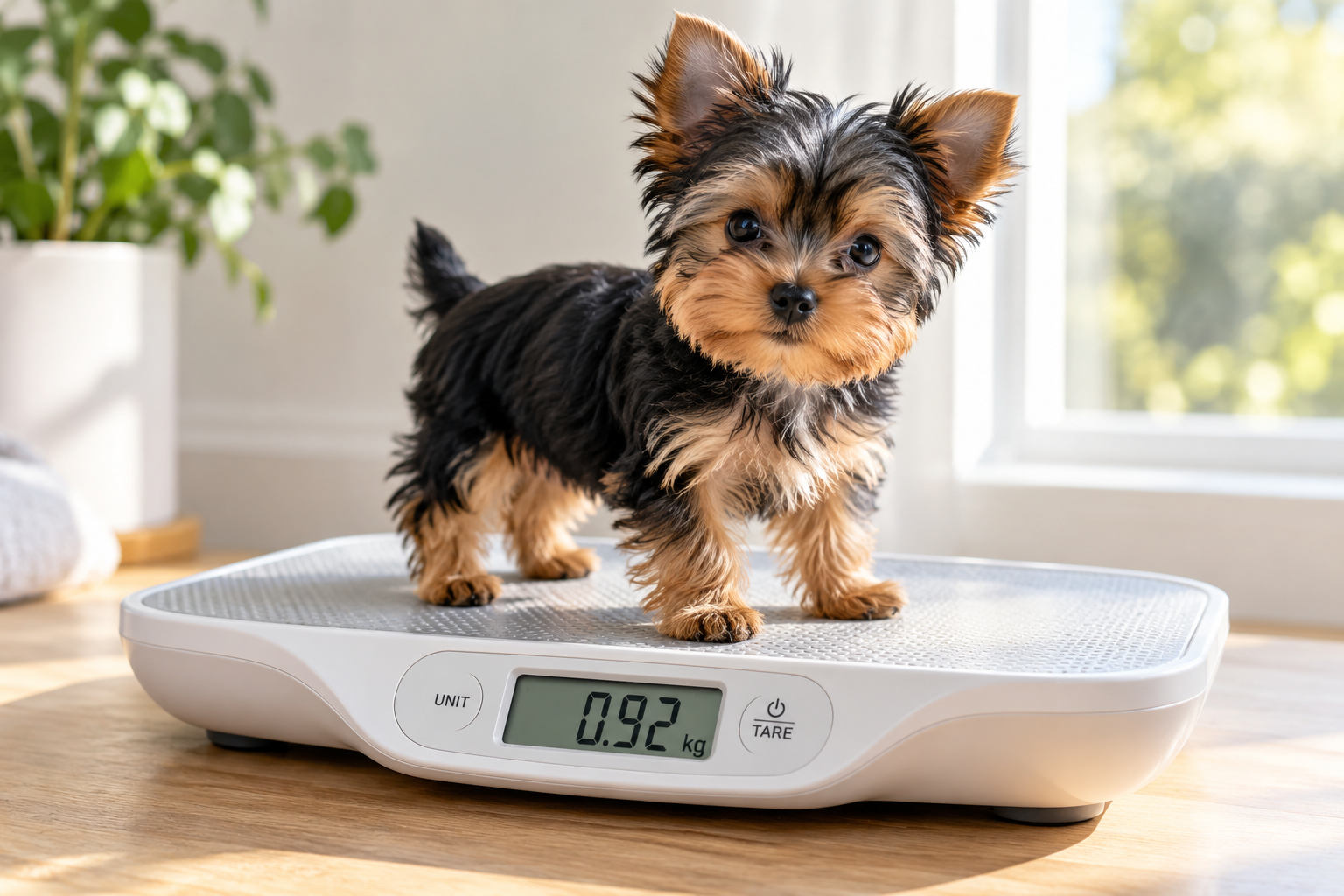
Use a reliable pet or digital scale on a stable surface. Record the weight and measurement date, and use consistent units when comparing readings.
Should I worry if my Yorkie weighs more than 7 pounds?
Not necessarily. Seven pounds is the AKC breed-standard maximum, not a diagnosis of health. Ask your veterinarian to assess body condition and overall health.
Why does my Yorkie weigh more or less than a growth chart suggests?
Individual growth varies with genetics, development, nutrition, and health. Different charts also use different methods, so a mismatch does not automatically indicate a problem.
When should a Yorkie stop growing?
Many Yorkshire Terriers approach adult size between 9 and 12 months, but the timing varies. Your veterinarian can help assess your puppy’s development and whether its growth is on track.