
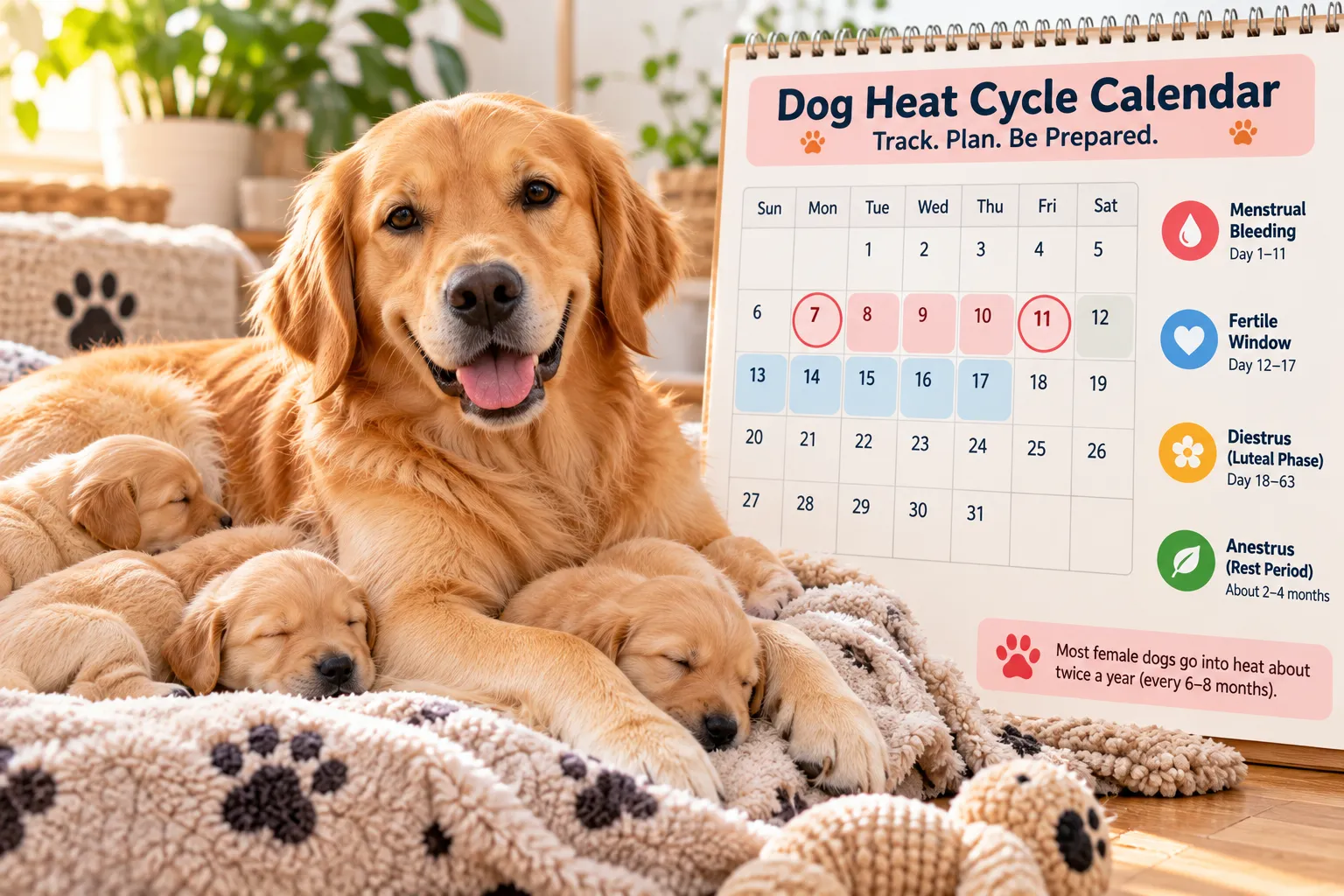
Dog heat cycle calculator
Enter the first day of your dog’s last heat to predict the next cycle.
Last updated: October 2026
A canine heat cycle calculator is a planning tool that estimates when an unspayed female dog may enter her next heat based on the first day of her previous heat and her average cycle length. It also provides an estimated fertile window and heat-end date, helping owners prepare for the weeks ahead.
The goal is simple: fewer surprises and better preparation.
When will your dog go into heat again?
A dog’s next heat depends on her individual reproductive rhythm. Many female dogs cycle about every six months, but the interval can range from roughly four months to a year or longer, depending on the dog. According to the Merck Veterinary Manual, the reproductive stages vary in duration, so six months is a useful starting estimate, not a guaranteed schedule.
The CanineCalc Heat Cycle Calculator turns that estimate into calendar dates. Enter the first day of the last heat, select an average cycle length, and review the predicted dates. The default interval is 180 days, or approximately six months.
Here’s how to use it:
- Enter the first day you noticed your dog’s last heat.
- Choose an average cycle length from 4, 5, 6, 7, 8, 9, or 12 months.
- Review the next-heat estimate, fertile-window dates, heat-end estimate, and today’s cycle-day readout.
The calculator uses these intervals: 120, 150, 180, 210, 240, 270, or 365 days. If the calculated next-heat date has already passed, it rolls the prediction forward by whole cycles until the date is in the future.
That’s useful for recurring reminders. It does not mean your dog will begin bleeding on the predicted day.
What do the predicted dates actually mean?
The tool applies three date calculations to its predicted next heat:
- Next heat: Last heat start date + the selected cycle length.
- Estimated fertile window: Predicted next heat date + 9 to 14 days.
- Estimated heat end: Predicted next heat date + 21 days.
It also displays a cycle-day readout for today. Treat this as calendar information, not a clinical diagnosis of your dog’s reproductive stage.
One subtle detail matters: the 12-month option uses 365 days rather than calculating the same calendar date one year later. That makes it a practical interval, but not an exact calendar-year calculation.
The Four Stages of a Dog’s Heat Cycle
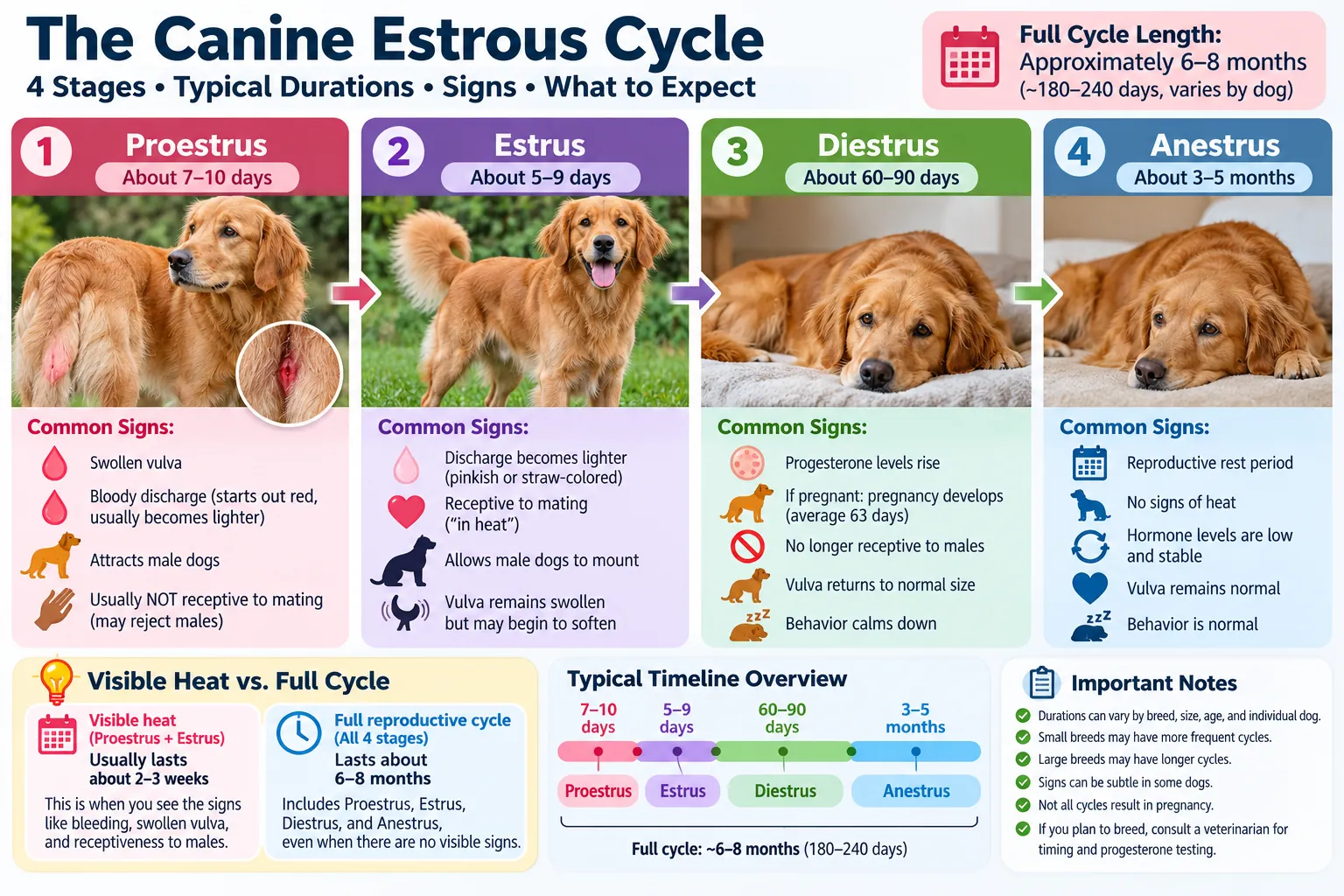
A female dog’s reproductive cycle has four stages: proestrus, estrus, diestrus, and anestrus. Each has different physical signs and a typical duration.
According to the American Kennel Club (AKC), proestrus and estrus average about nine days each, while diestrus lasts around 60 days and anestrus commonly lasts four to six months. Individual dogs can fall outside these averages.
Dog heat cycle stages
| Stage | Typical length | What you may see |
|---|---|---|
| Proestrus | About 9 days | Swollen vulva, bloody discharge, increased interest from male dogs; the female usually rejects mating. |
| Estrus | About 9 days | Discharge may lighten, the vulva may soften, and the female may become receptive to male dogs. |
| Diestrus | About 60 days | Heat-related signs fade; some dogs develop behaviors associated with false pregnancy. |
| Anestrus | Roughly 4–6 months | A quieter reproductive phase with few obvious external signs. |
Proestrus is often the first stage owners recognize because of bleeding and vulvar swelling. Male dogs may become very interested, even when the female is not ready to mate.
During estrus, discharge may become lighter, and the female may accept male attention. Ovulation occurs during this stage, but its timing is not identical in every dog.
The distinction between visible heat and the full reproductive cycle is important. Owners often say their dog is “in heat” for around three weeks, while the entire cycle includes the much longer periods between visible heats.
A dog can also show false-pregnancy signs during diestrus, whether or not she has been pregnant. These may include nesting, changes in behavior, mammary enlargement, or milk production. Contact your veterinarian if symptoms are pronounced or you are uncertain about their cause.
How long is a dog in heat?
Visible heat commonly lasts around two to four weeks, although the timing varies. According to the AKC’s guidance on canine heat cycles, the typical cycle averages about three weeks, and some dogs take longer or shorter. Changes in discharge, swelling, and behavior can help owners recognize the period, but they cannot reliably establish ovulation or the end of fertility.
One common assumption deserves a closer look: a dog with lighter discharge is not necessarily past the risk of pregnancy. Visible signs alone are not a dependable way to identify the start or end of the fertile period.
What most guides skip is that a calendar date and a biological stage are two different things. Your dog’s actual reproductive stage cannot be confirmed by the calculator’s date arithmetic.
Worked Example: January 1 Last Heat
Suppose your dog’s last heat began on January 1, and you select a six-month cycle. For this example, assume a non-leap year.
The calculator adds 180 days to the previous start date. The result is June 30.
It then projects the approximate fertile window and heat-end date using its own fixed offsets. Here is the resulting timeline.
Example cycle timeline
| Date | Event |
|---|---|
| January 1 | Previous heat begins |
| June 30 | Predicted next heat begins |
| July 9 | Estimated fertile window begins |
| July 14 | Estimated fertile window ends |
| July 21 | Estimated heat-end date |
There is one important qualification. In a leap year, adding 180 days to January 1 produces June 29 instead. A calendar-based prediction may therefore differ by a day depending on the year.
These are planning dates—not confirmed biological milestones. The fertile-window estimate does not mean ovulation must happen between July 9 and July 14, and the heat-end estimate does not guarantee your dog is no longer fertile on July 21.
How does the calculator compare with veterinary testing?
Calendar prediction vs. veterinary assessment: A calendar calculator is useful for household preparation, reminders, and tracking patterns because it converts a previous date into an easy-to-read timeline.
Veterinary assessment, including appropriate serial progesterone testing when precise reproductive timing matters, provides more useful information about ovulation than date arithmetic alone. The key difference is that the calculator estimates a recurring schedule, while clinical testing evaluates the dog’s actual reproductive status.
If you are making decisions about possible breeding, consult a veterinarian rather than relying on either a generic date window or visible signs alone.
Breed and Size Differences in Cycle Timing
Not every dog follows a twice-yearly pattern. Breed, body size, age, and individual reproductive differences all influence when heats begin and how often they recur.
Small dogs may cycle three or four times a year, while some large or giant breeds cycle only once a year. First heats also occur at different ages: some small dogs begin around four to six months, while some large breeds may not have their first heat until 18 months to two years of age or later.
That variation explains why choosing six months by default is not suitable for every dog. The better approach is to record the actual start dates and adjust the selected interval to reflect your dog’s observed history.
Why first heats can be harder to predict
Early cycles may be irregular. Some young dogs experience a split heat, in which the early signs appear to fade before the cycle resumes. Others have a relatively subtle or silent heat, with few obvious external signs.
If you have just adopted an intact female or are tracking her first cycle, a prediction based on one date is less informative than a record covering several cycles.
A practical opinion some owners may disagree with: record every heat start, even when your dog’s schedule seems obvious. Written dates are more useful than memory when gaps vary by several weeks or months.
Sources disagree on some cycle intervals and stage durations, which is one reason a single universal timeline can mislead owners. Veterinary references broadly agree on the four stages but describe variation within them. The sensible interpretation is to use typical durations as context, not as promises about an individual dog.
FAQs About Dog Heat Cycles
Q: What’s the best way to estimate my dog’s next heat?
Enter the first day of her last heat and choose the interval that best reflects her history. Use the result as a planning estimate, then record the actual date when the next heat begins.
Q: How do I know when my dog is fertile?
Visible signs can suggest that your dog is in heat, but they cannot reliably confirm ovulation. A veterinarian can advise on reproductive assessment and progesterone testing when more precise timing is needed.
Q: Should I rely on the calculator to prevent pregnancy?
No. The predicted dates are not a reliable method of preventing pregnancy. Keep an intact female away from intact males throughout her heat and follow your veterinarian’s advice.
Q: Why does my dog go into heat at a different interval from six months?
Cycle frequency varies by individual, breed, size, and age. Some dogs cycle more often than twice yearly, while others may cycle approximately once a year.
Q: When should I contact a veterinarian about an irregular heat?
Ask your veterinarian if your dog’s cycles change substantially, you suspect a missed or unusually prolonged heat, or you notice concerning symptoms such as marked discomfort, unusual discharge, lethargy, or increased thirst. A veterinarian can help determine whether further evaluation is needed.
Planning for Heat Weeks: Practical Tips and Limitations
The calculator works best when you have a known last-heat start date and want to prepare for a likely future cycle. It won’t help much when the previous date is unknown, the dog has never had a recognizable heat, or her cycles are highly irregular.
The big question is how much your puppy still has to grow.
You can’t treat a prediction as a promise, you shouldn’t rely on it to prevent pregnancy, and your dog may not follow the expected date.
During the weeks around an expected heat, consider practical preparations:
- Keep a record of the first day of visible signs and how they change.
- Prepare washable bedding or suitable dog diapers for household cleanliness.
- Plan walks and outdoor time to avoid unsupervised contact with intact male dogs.
- Ask your veterinarian about cycle changes, spaying, or any reproductive-health concerns.
Quick note: the calculator is a planning aid, not a diagnostic tool or breeding recommendation. The +9-to-+14-day display is a simplified estimate, not a statistically validated confidence interval or a reliable identification of ovulation. If precise reproductive timing matters, a veterinarian can recommend appropriate testing.
Some owners use a simple six-month reminder, and that can be perfectly reasonable for buying supplies or planning household routines. But irregular cycles, subtle first heats, and individual variation make that approach unsuitable for decisions requiring certainty.
Here’s the important part: growth isn’t always predictable. It is a record that helps you recognize your dog’s own pattern and prepare earlier next time.
For related planning, see the CanineCalc dog pregnancy calculator, the puppy food chart guide, and the when do puppies stop growing guide.