Cane Corso weight chart by age
| Age | Female weight | Male weight |
|---|---|---|
| 8 weeks | ~10-15 lb | ~12-17 lb |
| 3 months | ~20-28 lb | ~22-30 lb |
| 4 months | ~30-40 lb | ~33-43 lb |
| 5 months | ~40-52 lb | ~45-57 lb |
| 6 months | ~50-62 lb | ~56-70 lb |
| 7 months | ~58-70 lb | ~65-80 lb |
| 8 months | ~65-78 lb | ~73-88 lb |
| 10 months | ~75-88 lb | ~85-100 lb |
| 12 months | ~82-95 lb | ~92-108 lb |
| 18 months | ~86-99 lb | ~97-112 lb |
| Adult, 2 years | ~88-99 lb | ~99-110 lb |
These ranges are practical growth references, not strict targets or an official age-by-age breed standard. Your Cane Corso’s sex, parents, genetics, build, and body condition all affect the number you see on the scale.
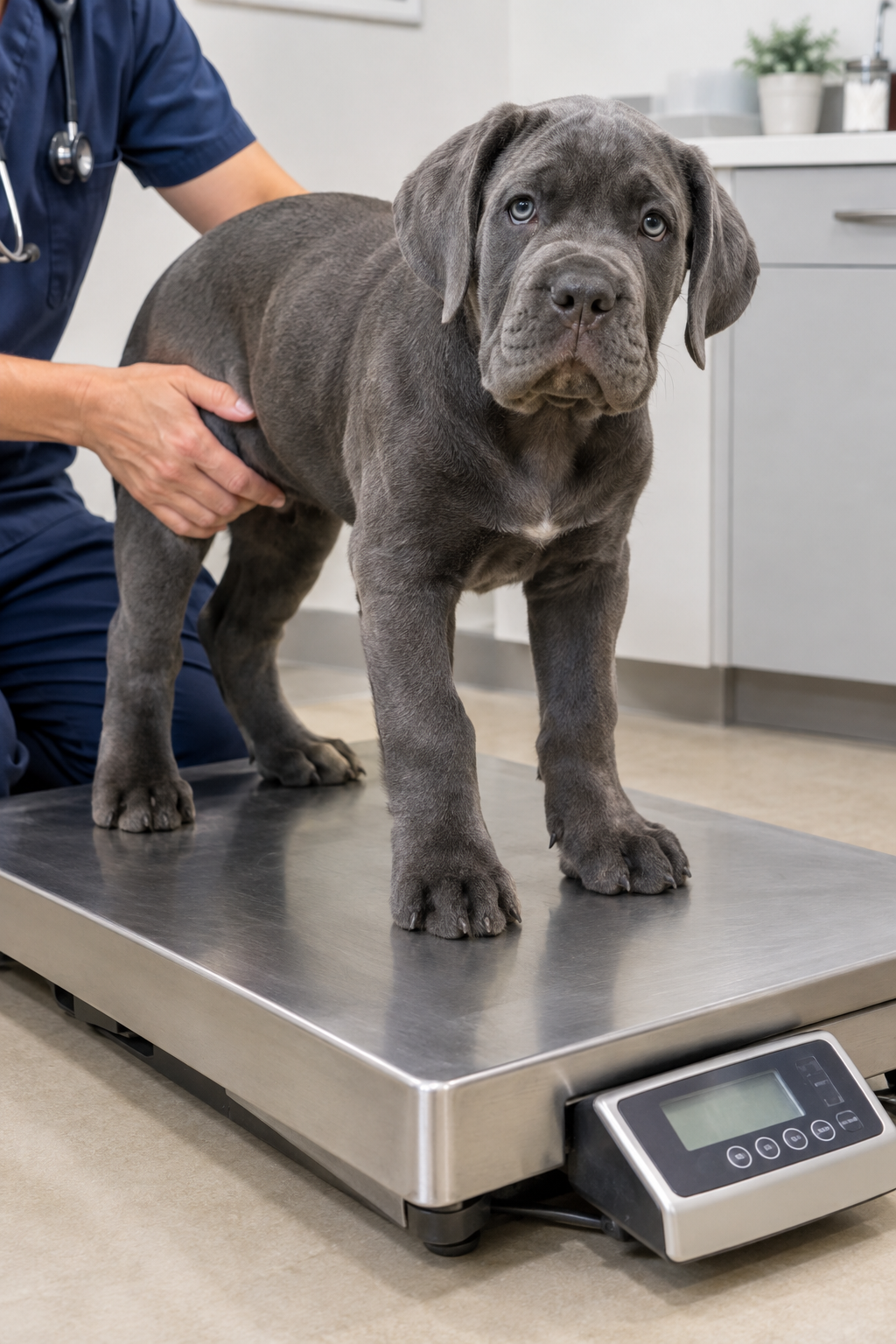
Cane Corso puppies grow rapidly during their first several months. A puppy weighing around a pound at birth can approach 100 pounds or more as an adult, although individual starting weights and growth patterns vary considerably. A healthy puppy does not need to match every number in this chart.
For a broader comparison across breeds, see our dog weight chart by age and breed. For an estimate based on your puppy’s current weight and age, try the free puppy weight calculator.
How big do Cane Corsos get?
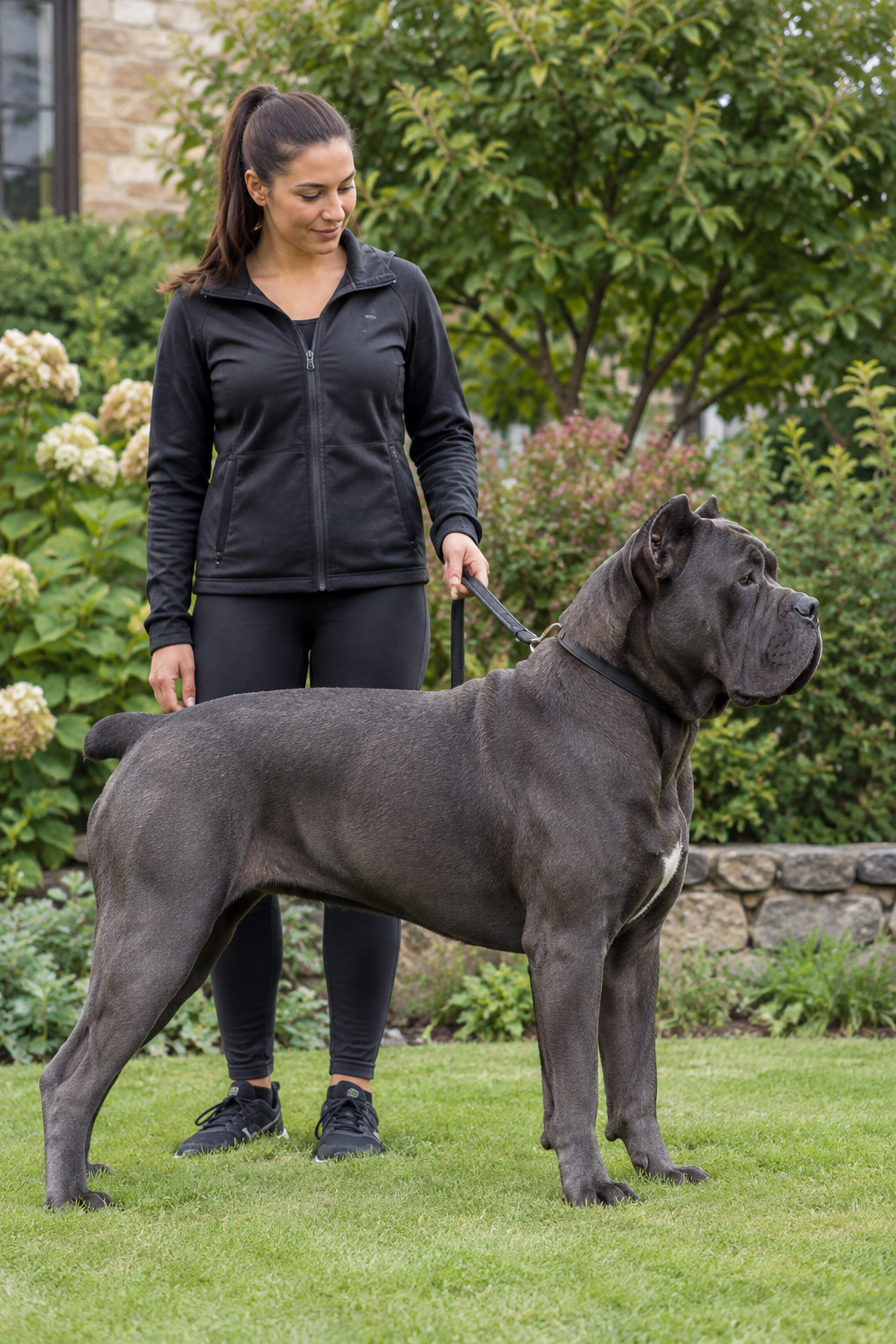
Cane Corsos are powerful, muscular dogs, but the right adult weight depends partly on their height and overall proportions.
According to the American Kennel Club’s Cane Corso breed information, the standard height ranges are:
- Males: 25-27.5 inches at the shoulder.
- Females: 23.5-26 inches at the shoulder.
The AKC standard describes weight as proportionate to height rather than prescribing an exact adult weight range. The adult figures in the chart are therefore useful typical references, not official AKC weight limits.
Two healthy adult Cane Corsos can differ by 20 pounds or more without either automatically being underweight or overweight. A taller, substantial dog may naturally weigh more than a leaner dog with a lighter frame. Working lines may have a leaner build, while some show-line dogs have more mass. Individual genetics and conditioning matter more than the label alone.
Remember that a Corso can look tall and nearly grown before the body has finished developing. The chest may deepen, the shoulders may broaden, and the muscles can continue filling out through the second year and sometimes into the third. Do not try to speed up this process by feeding extra food.
Cane Corso growth timeline
Birth to 8 months: rapid growth. Your puppy may gain weight noticeably from week to week. Legs lengthen, the body changes proportion, and growth can look uneven. Temporary lankiness is common in growing large-breed dogs.
8 to 14 months: growth begins to slow. Many Corsos are approaching much of their adult height by the end of this period. Weight still increases, but the rate may become less dramatic. Compare several weeks of measurements rather than reacting to a single weigh-in.
Around 14 to 18 months: skeletal growth winds down. Growth-plate closure varies by bone, breed, and individual dog. The 14-to-18-month window is a general guide, not a deadline that applies to every Corso.
Neutering before skeletal maturity can delay the closure of some growth plates and influence final limb proportions. Research and veterinary reviews also indicate that potential orthopedic effects differ by breed and timing. Discuss spay or neuter timing with your veterinarian, taking your dog’s development and health risks into account rather than following one universal age recommendation.
Around 2 to 2.5 years: adult maturity. Most height growth has finished earlier, but muscle development, chest depth, and overall body condition may continue changing. Some dogs settle into their adult build sooner than others.
Keep a growing Corso lean: this breed punishes extra weight
A large puppy’s joints have a lot of developing body mass to support. Overfeeding can encourage faster weight gain than the skeleton is ready to handle. Cane Corsos are susceptible to orthopedic problems, including hip and elbow dysplasia, so sensible weight management is an important part of caring for them. It cannot eliminate inherited disease, but it avoids adding unnecessary strain.
Choose a complete, balanced large-breed puppy food. These diets are formulated to support growth with appropriate calorie and mineral levels. Check the food’s nutritional adequacy statement and ask your veterinarian when to transition your puppy to an adult formula.
Do not add calcium supplements unless your veterinarian prescribes them. Extra calcium is not a shortcut to stronger bones. Large and giant-breed puppies need carefully balanced calcium and phosphorus, and unnecessary supplementation can disrupt that balance. The VCA guide to large- and giant-breed nutrition explains why controlled nutrition matters during growth.
Measure meals instead of free-feeding. Use the food label as a starting point, then adjust portions with veterinary guidance based on growth and body condition. For feeding estimates, our dog calorie calculator can provide a starting point, but a growing giant-breed puppy’s needs should be reviewed individually.
Aim for steady, lean growth. You should generally be able to feel your puppy’s ribs easily under a light covering of fat. The last ribs may be visible in a lean puppy, especially at certain angles, but sharply protruding bones or an increasingly bony appearance deserve attention. Avoid forced running, repetitive high-impact exercise, and jumping routines while growth is rapid.
Slow, appropriate growth is healthier than trying to produce the biggest puppy in the litter. The aim is a well-conditioned adult, not the highest possible number on the scale.
Underweight or overweight? Checking your Corso
A Cane Corso’s muscular frame makes weight alone an imperfect guide. Check the fat covering over the ribs and look at the shape of the body from above and from the side.
- Ribs: You should be able to feel them without pressing hard. If thick padding makes them difficult to feel, your dog may be carrying excess fat.
- Waist: Viewed from above, there should be some narrowing behind the ribs. A broad, muscular body is normal, but a waist hidden by fat can signal excess weight.
- Abdominal tuck: From the side, the belly should rise somewhat toward the hind legs rather than hanging level with the chest.
- Growth trend: Weigh your puppy regularly under similar conditions and record the results. A brief pause or an uneven growth spurt is not automatically a problem, but a persistent stall or sudden loss of weight deserves a veterinary check.
Muscle is not the same as fat. A mature Corso can be heavy because of a larger frame and developed muscles while remaining lean. Conversely, a dog that looks impressively bulky may simply have too much body fat. If you are uncertain, ask your veterinarian to assess body condition and muscle condition rather than judging by breed photos.
Contact your veterinarian if your puppy stops growing over repeated checks, loses weight unexpectedly, develops a sustained appetite change, vomits repeatedly, has diarrhea, or seems weak or painful. In a growing giant-breed dog, early assessment is better than trying to fix the issue by changing portions on your own.
Cane Corso weight chart FAQs
How much should a Cane Corso weigh at 6 months?
A six-month-old female Cane Corso typically falls around 50-62 pounds, while a male may weigh around 56-70 pounds. These are broad reference ranges. Parents, frame, health, and body condition help determine what is appropriate for your puppy.
How big will my Cane Corso get?
Typical adult reference weights are approximately 88-99 pounds for females and 99-110 pounds for males, with adult heights varying by sex. The size of both parents is one of the most useful clues, although it cannot predict the exact adult weight.
When do Cane Corsos stop growing?
Most height growth is largely finished around 12-14 months, although timing varies. Skeletal development may continue longer, and muscle, chest depth, and adult body condition can keep changing until roughly 2 to 2.5 years.
How much does a full-grown female Cane Corso weigh?
A typical adult female may weigh around 88-99 pounds. A healthy individual may fall outside this range depending on height, bone structure, muscle, and genetics. Her proportions and body condition are more useful than the scale alone.
Is my Cane Corso overweight?
Check whether you can feel the ribs beneath a light layer of fat, see a waist from above, and notice an abdominal tuck from the side. Because Corsos are muscular, a veterinarian’s body-condition assessment is helpful if you are unsure.
Conclusion
A Cane Corso weight chart gives you a useful reference for the journey from a fast-growing puppy to a powerful adult. Use the ranges to follow the general trend, not to judge your dog against an exact number. Keep meals measured, choose appropriate large-breed puppy food, avoid unnecessary supplements, and check body condition as your Corso develops. When growth changes suddenly or something seems wrong, a veterinarian can help determine whether the cause is normal variation or a concern that needs attention.
By Jennifer, Founder of CanineCalc
Jennifer is a dog owner and researcher who creates practical guides to canine growth and care. She is not a veterinarian, breeder, or certified trainer. This article is for general educational purposes and is not a substitute for veterinary advice.