Get the right crate size for your dog’s breed and measurements.
Crate size helper
Turn your dog’s body measurements into practical minimum interior dimensions.
How the Dog Crate Size Calculator Works
Last updated: October 2026
A dog crate size calculator estimates the minimum crate dimensions for a dog using its body measurements. It then maps the calculated length to a standard crate-size category, giving owners a practical starting point when comparing products.
The formula behind CanineCalc
CanineCalc uses a transparent planning model based on two measurements: nose-to-tail-base length and floor-to-top-of-head height. The model adds clearance to both measurements, applies a growth allowance for puppies, and estimates a suggested width.
Here is the exact formula used by this dog crate size calculator:
Minimum inside length = (nose-to-tail-base length + 4 inches) × growth factor
Minimum inside height = (floor-to-top-of-head height + 3 inches) × growth factor
Suggested width = minimum inside length × 0.62
The growth factor is 1.0 for adult dogs and 1.12 for puppies. This dog crate size calculator selects the smallest standard nominal crate length that equals or exceeds its calculated minimum, using 18, 22, 24, 30, 36, 42, 48, and 54 inches. If the calculated length exceeds 54 inches, the result is 54+.
Why add four inches to length and three inches to height? These allowances provide planning clearance for comfortable movement rather than matching the crate dimensions exactly to the dog’s body.
How does a dog crate size calculator work? It converts body measurements into estimated minimum crate dimensions and a standard size category. According to the Welsh Government’s 2018 Code of Practice for the Welfare of Dogs, a crate should allow a dog to sit, stand, turn around, stretch, and lie down naturally.
The formula is a planning model, not a scientifically validated universal standard. There is no single peer-reviewed formula that establishes the correct crate dimensions for every dog. The calculation helps narrow your options, but the selected crate still needs to provide comfortable movement.
What should the right crate allow a dog to do? The RSPCA’s crate guidance says dogs should be able to stand, turn around, lie down, and stretch. Those movements matter more than a size label alone. A crate that matches a calculation but restricts natural posture is not an appropriate choice.
Sources phrase minimum space requirements slightly differently. Some emphasize standing and turning, while others explicitly include stretching and lying down. The practical approach is to check the full range of movements rather than relying on the shortest interpretation.
How to Measure Your Dog for a Crate
Accurate measurements make this dog crate size calculator more useful. A few inches can change which standard crate class the tool selects.
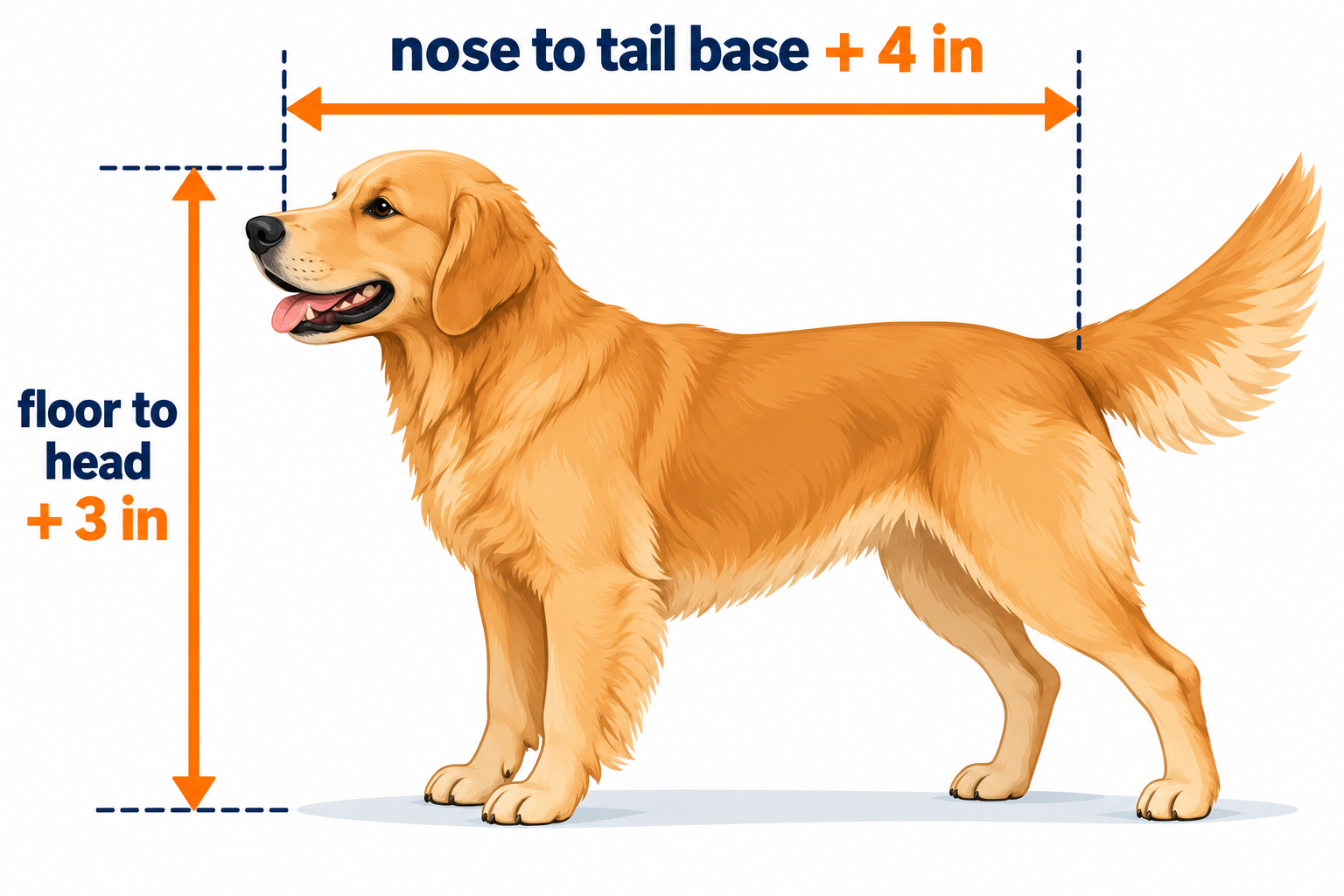
How do you measure a dog for a crate? Measure the dog while standing naturally on a level surface, recording its body length from the nose to the base of the tail and its height from the floor to the top of the head. Use the same units throughout, then compare the result with the manufacturer’s usable interior dimensions before purchasing.
Follow these measuring steps
Measure length: Measure from the tip of the nose to where the tail joins the body. Do not include the full tail.
Measure height: Measure from the floor to the top of the head while the dog stands naturally. Check the complete standing clearance when assessing the actual crate.
Enter the measurements: Enter both values in inches, then note this dog crate size calculator’s length, height, width, and crate-class results.
The big question is how much your puppy still has to grow.
The calculator’s height input uses the top of the head, but your dog must still be able to stand comfortably inside the chosen product. If ears or posture make the dog taller than the measurement suggests, check the available headroom carefully.
A dog’s weight can help describe its general size, but body shape matters too. Two dogs with similar weights may have very different body lengths, heights, and proportions. Measurements are a better starting point than weight alone.
Worked Examples: Adult Dog vs. Puppy
The following examples use the exact CanineCalc formula. Each calculation is shown separately so readers can check the arithmetic.
Example 1: Adult dog
Suppose an adult dog measures:
Nose to tail base: 26 inches
Floor to top of head: 24 inches
Growth factor: 1.0
Step 1 — Calculate minimum inside length
(26 + 4) × 1.0 = 30 × 1.0 = 30.0 inches
Step 2 — Calculate minimum inside height
(24 + 3) × 1.0 = 27 × 1.0 = 27.0 inches
Step 3 — Estimate suggested width
30.0 × 0.62 = 18.6 inches
Result: The dog crate size calculator assigns this dog to the 30-inch crate class, because 30 inches is the smallest standard nominal length that meets the calculated minimum.
That result is a starting point, not a guarantee. If the selected 30-inch model has an interior length below 30 inches, compare its actual internal measurements with the dog’s needs.
Example 2: The same measurements for a puppy
Now apply the puppy growth factor of 1.12 to the same starting measurements.
Step 1 — Calculate minimum inside length
(26 + 4) × 1.12 = 30 × 1.12 = 33.6 inches
Step 2 — Calculate minimum inside height
(24 + 3) × 1.12 = 27 × 1.12 = 30.24 inches = 30.2 inches, rounded to one decimal place.
Step 3 — Estimate suggested width
33.6 × 0.62 = 20.832 inches = 20.8 inches, rounded to one decimal place.
Result: The dog crate size calculator moves up to the 36-inch crate class, since 36 inches is the next standard nominal size above 33.6 inches.
Here’s the thing: a puppy may outgrow its initial setup quickly. Buying an appropriately sized adult crate with a secure divider can let you adjust the usable space as the puppy grows, provided the crate remains suitable and the dog is comfortable.
The 12% growth allowance is a planning adjustment, not a prediction of the puppy’s final adult size. Breed, age, and individual growth can affect how quickly a puppy outgrows its current measurements.
Standard Crate Sizes: Chart and Fit Notes
Crate labels commonly refer to nominal lengths. They are useful for browsing, but they do not guarantee that a crate’s usable inside length equals the number on its label.
Standard crate sizes
The interior figures below are approximate examples from published product and replacement-tray dimensions across different models. They are not universal specifications. Breed examples are also approximate; measure your individual dog.
| Nominal crate size | Approximate interior floor length | Dogs that may suit the size |
|---|---|---|
| 18 inches | Around 17–18 inches; model-dependent | Very small dogs, including some Chihuahuas |
| 22 inches | Around 21–22 inches; model-dependent | Small-bodied dogs, including some Yorkshire Terriers |
| 24 inches | About 22.75–23.5 inches in some models | Small dogs, including some Jack Russell Terriers |
| 30 inches | About 28.75–30 inches in some models | Some Beagles and other compact medium-small dogs |
| 36 inches | About 35–36 inches in some models | Some Cocker Spaniels and Border Collies |
| 42 inches | About 41–42 inches in some models | Some Labrador Retrievers and similarly sized dogs |
| 48 inches | About 47–48 inches in some models | Larger dogs, including some Golden Retrievers and German Shepherds |
| 54 inches | Check the exact model | Giant or especially long-bodied dogs, depending on their measurements |
Do not select a crate solely because your dog’s breed appears in a chart. Individual body dimensions, posture, and the specific product’s internal space should decide the final choice.
30-inch vs. 36-inch crate: A 30-inch crate may suit a dog whose required length fits within the model’s usable interior. A 36-inch crate may be more appropriate when the measured length exceeds that limit or when additional room is needed. The key difference is usable space, not the label by itself.
Limitations: Interior Dimensions, Puppy Growth, and Fit
A dog crate size calculator cannot inspect the product you plan to buy. The final check belongs to the buyer.
Nominal size is not interior size
A crate marketed as 30 inches may not provide 30 inches of uninterrupted usable interior length. Frames, panels, doors, and the crate’s design can affect available space. Width and height can vary too.
Before ordering, check the manufacturer’s internal dimensions for the exact model. Confirm length, width, and height separately, and consider any bedding or floor tray that reduces usable space. The product’s external or shipping dimensions are not a substitute for its interior measurements.
What most guides skip is the borderline case. If this dog crate size calculator’s minimum is close to a crate’s nominal label, the interior could be too short. You may need to compare the next size up instead of assuming the nominal size will work.
In other words, some months bring bigger changes than others.
Growth, shape, and comfort
For puppies, use the growth-adjusted result to start comparing adult-size options. A divider can make a larger crate more practical during growth, but it must be secure and adjusted appropriately. It should never leave the puppy cramped or prevent comfortable movement.
Some owners prefer a tighter crate based on toilet-training advice. That concern can be relevant in a training plan, but deliberately choosing a crate that prevents a dog from standing, turning, stretching, and lying naturally is not a sound sizing solution. Size the crate for welfare first, then address training separately.
This guide covers measurement-based home crate sizing. It does not assess suitability for every dog, resolve distress associated with confinement, or establish airline and vehicle transport requirements. Seek qualified veterinary or behavior advice if your dog shows persistent distress in a crate.
Dog Crate Size Calculator: Common Questions
Q: What’s the best crate size for my dog?
A: Start with your dog’s measured length and height, then compare the calculated result with the manufacturer’s internal dimensions. Confirm that your dog can stand, turn around, stretch, and lie down naturally.
Q: How do I measure my dog for a crate?
A: Measure from the nose to the base of the tail for length, then from the floor to the top of the head for height. Keep the dog standing naturally and use inches consistently.
Q: Should I buy a bigger crate for a puppy?
A: Planning for adult size can reduce repeated purchases. A suitable crate with a secure divider can provide adjustable space as your puppy grows, as long as it remains comfortable and appropriately sized.
Q: Why is a crate’s inside length smaller than its label?
A: Nominal labels are size categories, not guaranteed measurements of usable interior space. Frames and product design affect internal dimensions, so check the manufacturer’s exact specifications before buying.
Q: When should I choose the next crate size up?
A: Compare a larger size when the recommended minimum exceeds the usable interior dimensions of the smaller model, or when the dog cannot move and rest comfortably within it.
Before you buy
Use CanineCalc’s recommendation to narrow the options, verify the exact internal measurements, and check how your dog fits. The best choice is the crate that supports comfortable natural movement—not simply the one whose label matches the calculator’s number.