Mini husky: the short answer
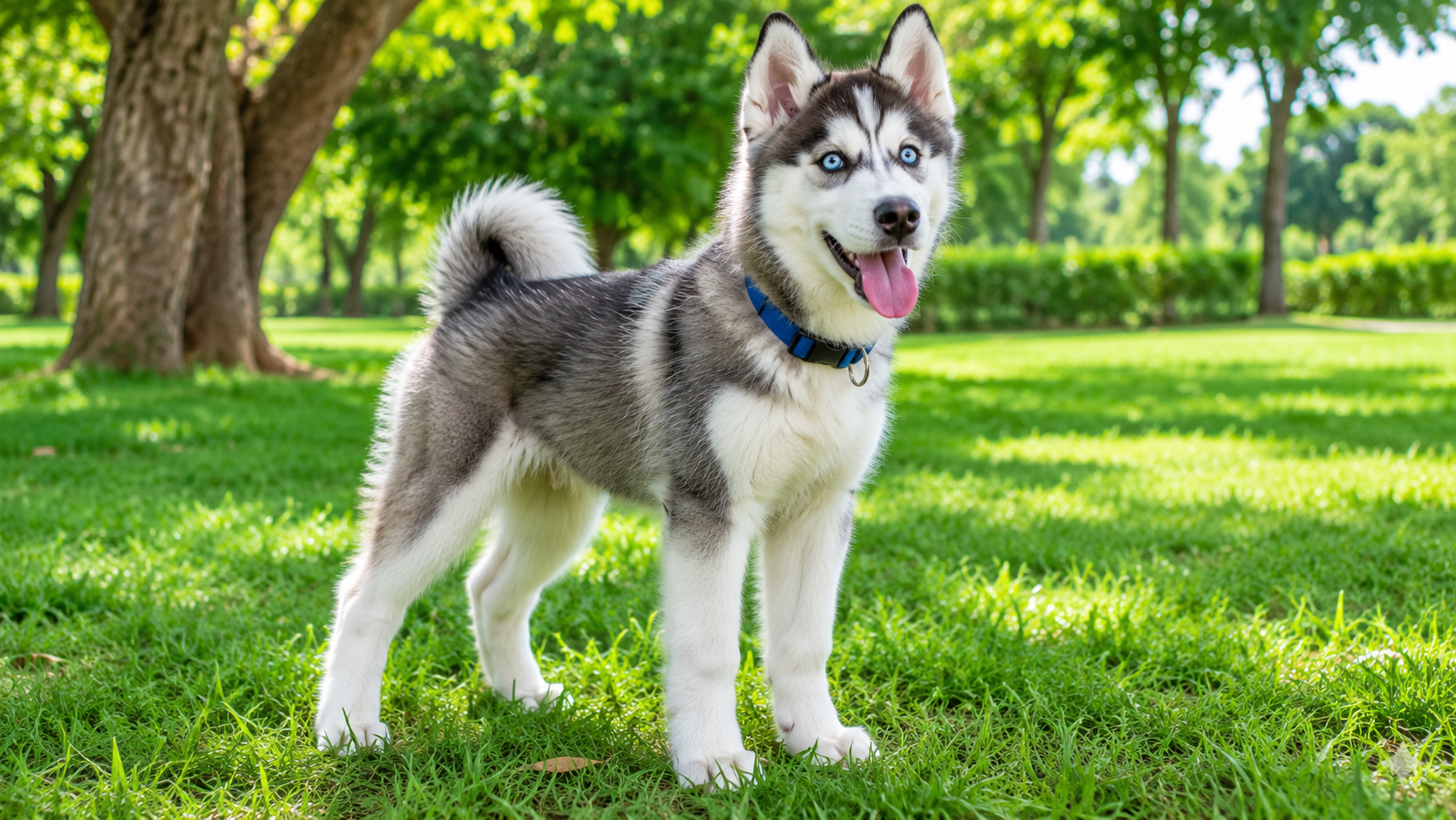
A Miniature Husky is a smaller-sized Siberian Husky, bred to retain the familiar appearance and personality of the standard Siberian Husky in a more compact body. It is not a separate breed in the same sense as the Siberian Husky, and it is not the same dog as an Alaskan Klee Kai.
Most Miniature Huskies weigh around 20–35 pounds (9–16 kg) when fully grown, although individual dogs can fall outside this general range. They usually stand approximately 12–17 inches (30–43 cm) tall at the shoulder. These are broad, commonly quoted size ranges rather than a universally recognised breed standard.
The personality is where prospective owners need to pay attention. A smaller frame does not automatically mean a quieter, easier or less demanding dog. Miniature Huskies can be friendly, affectionate, independent, vocal and exceptionally energetic.
Their smaller size may make everyday handling and living arrangements more convenient, including in some apartments. However, their exercise requirements, strong instincts, shedding and need for mental stimulation remain very much part of the Husky experience.
The important distinction: a Miniature Husky is intended to be a smaller Siberian Husky, not a low-energy companion dog. If you love the Husky personality but want a dog with considerably less exercise and grooming work, this may not be the right match.
Mini husky vs Siberian husky vs Alaskan klee kai
These three dogs can look remarkably similar. They may have upright ears, thick double coats, facial masks and striking eyes. That resemblance is one reason searches for a mini husky dog breed often lead to confusion.
However, their breed identities are different.
| Dog | Typical adult size | Coat | Temperament and honest differences |
|---|---|---|---|
| Miniature Husky | Around 12–17 inches; commonly 20–35 lb (9–16 kg) | Thick double coat | Smaller Siberian Husky type; generally energetic, friendly, vocal and independent |
| Siberian Husky | Males: 21–23.5 inches and 45–60 lb; females: 20–22 inches and 35–50 lb | Thick double coat | Outgoing, athletic, social and strongly motivated to run |
| Alaskan Klee Kai | Approximately 12–17 inches, depending on variety | Thick double coat | Separate companion breed; intelligent, alert, active and often more reserved with strangers |
The biggest difference is breed identity. The Miniature Husky is marketed as a smaller Siberian Husky, whereas the Alaskan Klee Kai is a separately developed breed with its own recognised UKC breed standard. The Klee Kai was developed in Alaska as a companion-sized northern dog and has distinct toy, miniature and standard size varieties.
The Alaskan Klee Kai can also be more cautious around unfamiliar people. Its standard describes an intelligent, curious and active dog that may be aloof with strangers. Siberian Huskies, by comparison, are generally more outgoing and welcoming.
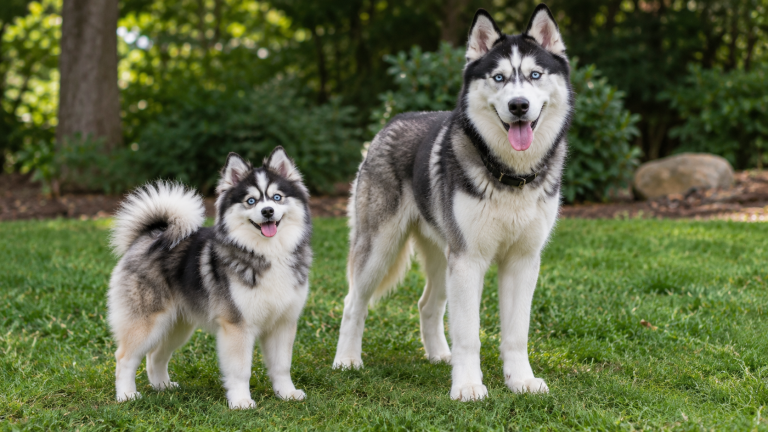
There is another name worth knowing: the Pomsky. This is a Pomeranian × Siberian Husky cross, not a Miniature Husky or an Alaskan Klee Kai. Its adult appearance, size and temperament can vary depending on the dogs behind the cross.
How big do mini huskies get?
A fully grown Miniature Husky is commonly described as standing around 12–17 inches (30–43 cm) at the shoulder and weighing approximately 20–35 pounds (9–16 kg).
These figures are useful planning ranges, not official measurements. Unlike the standard Siberian Husky, the Miniature Husky does not have one universally accepted breed standard defining adult height and weight. Different breeding lines can produce noticeably different-sized dogs.
Males are often toward the larger end of the range, while females may be somewhat smaller. However, sex alone cannot predict an individual dog’s adult size. Parents, genetics, development and overall body condition all matter.
Growth also takes time. A Miniature Husky may reach much of its adult height during the first year, but its frame, muscle and overall body condition can continue developing into the second year. A dog that looks nearly full-sized at 12 months may still fill out.
If you are raising a standard Siberian Husky rather than a miniature, our Husky weight chart provides a broader look at typical growth by age and sex.
You can also use our How Big Will My Puppy Get? guide to understand the factors that influence adult size.
One useful reminder: a smaller dog is not automatically a healthier dog. Look at balanced proportions, sound movement and appropriate body condition rather than treating the lowest possible weight as the ideal.
Temperament: a big personality in a smaller dog
The Miniature Husky’s personality is one of its biggest attractions. It has the familiar northern-dog character that makes Siberian Huskies so recognisable, including friendliness, curiosity, playfulness and plenty of opinions.
But those qualities come with responsibilities.
Friendly and social: Many Miniature Huskies enjoy being around people and can be affectionate family companions. They are not generally dogs to choose for serious guarding duties. Their friendly nature may extend to visitors and unfamiliar people.
Vocal: Expect more than occasional barking. Husky-type dogs can howl, whine, chatter and make a surprising range of sounds. Some seem determined to participate in every household conversation. This can be charming, but it may be difficult in homes with strict noise restrictions.
Independent: These dogs are intelligent, but intelligence does not always translate into unquestioning obedience. A Miniature Husky may understand a command perfectly well and still decide that something more interesting deserves attention.
Escape-prone: A strong desire to explore and run is part of the Husky background. Some dogs become remarkably inventive when they find a weak point in a fence or an open gate.
Prey drive: Smaller animals can trigger chasing behaviour. Cats, rabbits and wildlife may attract a dog’s attention, even when it has grown up in a loving household. Early introductions and supervision matter, and individual compatibility should never be assumed.
Training works best when it starts early and remains consistent. Reward-based methods, short sessions and interesting activities generally make learning more engaging.
The important question is not whether a Miniature Husky is intelligent enough to train. It is whether an owner is prepared to work patiently with an intelligent, independent dog.
Exercise and mental work
A Miniature Husky may have shorter legs than a standard Siberian, but it still needs a meaningful amount of daily activity.
For most healthy adult dogs, well over an hour of combined exercise and mental activity is a sensible starting expectation. The right amount depends on age, fitness, health, weather and the individual dog’s energy level.
A useful daily routine might include:
- A substantial morning walk with opportunities to sniff and explore.
- An afternoon play session or another walk.
- Short training sessions that practise recall, focus and everyday manners.
- Food puzzles, scent games and other activities that encourage problem-solving.
Mental exercise is particularly important. A dog that spends the day with nothing to do may find its own entertainment.
That can mean digging in the garden, chewing household items, excessive vocalising, chasing anything that moves or repeatedly testing boundaries.
Secure fencing is essential. A Husky-type dog should not be trusted to stay within an ordinary garden simply because it has learned its name or responds to commands indoors.
Walks should generally be on a lead unless the dog is in a genuinely secure, appropriate enclosed area. A strong recall is valuable, but it is not a substitute for physical containment.
Apartment living is possible for some Miniature Huskies, provided their daily needs are met. However, a smaller body does not eliminate the need for outdoor activity, enrichment or consideration for neighbours who may hear the dog’s vocalising.
Coat, shedding and grooming
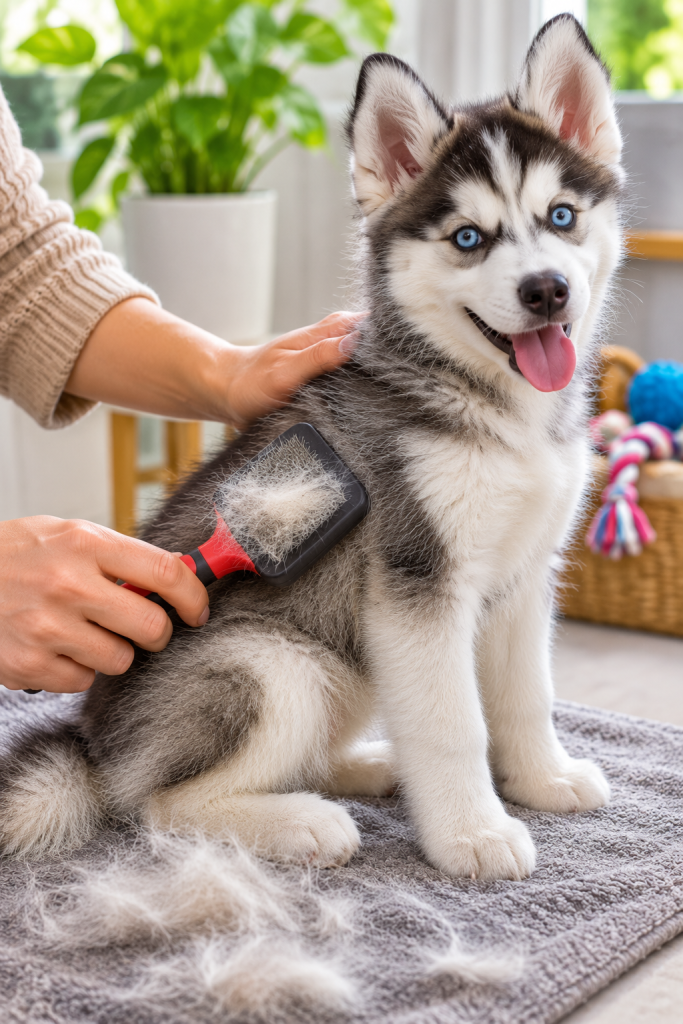
The Miniature Husky has the familiar thick double coat associated with Siberian Huskies. It consists of a soft insulating undercoat and a protective outer coat.
That beautiful coat comes with a substantial grooming commitment.
Expect regular shedding throughout the year, with heavier seasonal shedding periods when the undercoat is released. During these blow-outs, loose hair can accumulate on furniture, floors, clothing and practically every surface the dog visits.
A practical grooming routine includes:
- Weekly brushing: Use a suitable brush and comb to remove loose hair and prevent undercoat build-up.
- More frequent brushing during seasonal shedding: Daily sessions may be helpful when the coat is blowing.
- Occasional bathing: Bathe when needed rather than following an unnecessarily frequent schedule.
- Regular nail checks: Keep nails at a comfortable length.
- Ear and dental care: Include routine checks and cleaning in normal grooming habits.
One important rule applies to all double-coated dogs: do not shave the coat simply because the dog sheds heavily or because summer is approaching.
The double coat provides insulation and helps protect the skin. Shaving it is not a reliable way to keep a dog cool and can interfere with the coat’s normal condition and regrowth.
Instead, focus on removing loose undercoat, providing shade, maintaining access to fresh water and avoiding strenuous exercise during hot parts of the day.
If you dislike dog hair or want a genuinely low-maintenance coat, a Miniature Husky is probably not the right choice.
Health and lifespan in general terms
Miniature Huskies are generally expected to have a lifespan in the region of 12–14 years, broadly similar to the standard Siberian Husky. Individual dogs may live shorter or longer lives depending on genetics, overall health, lifestyle and ongoing care.
Because Miniature Husky is not a universally standardised breed, there is no single health profile that applies to every dog sold under this name. The background of the individual breeding line matters.
Two areas worth asking about when researching a Husky-family dog are:
- Eyes: Responsible health screening may include ophthalmologist examinations to check for inherited eye concerns.
- Hips: Hip evaluation is another recognised screening area for Siberian Huskies.
These are screening considerations, not predictions that an individual Miniature Husky will develop a problem. The American Kennel Club lists hip and ophthalmologist evaluations among the recommended health tests for Siberian Huskies.
It is also worth understanding how a dog was bred rather than relying entirely on a label. Ask about the parents, their health screening and the background of the line. Be cautious of claims that a particular miniature size guarantees better health or a longer lifespan.
For everyday care, maintaining a healthy weight, providing suitable exercise, keeping up with routine veterinary checks and looking after the teeth and coat all contribute to general wellbeing.
Any unexpected change in behaviour, mobility, appetite or energy deserves attention. A veterinarian is the right person to assess individual health concerns.
Is a mini husky right for you?
The best way to decide is to look beyond appearance. A Miniature Husky can be a wonderful companion, but it needs an owner whose daily routine accommodates an active, intelligent and sometimes stubborn dog.
| A Miniature Husky may suit you if… | You may struggle if… |
|---|---|
| You enjoy daily walks and outdoor activities | You prefer a mostly sedentary lifestyle |
| You have time for training and enrichment | You want a dog that learns everything immediately |
| You can provide secure outdoor space or suitable exercise alternatives | You expect an ordinary garden fence to contain every adventurous dog |
| You enjoy playful, social and vocal dogs | You need a consistently quiet companion |
| You can manage regular brushing and heavy seasonal shedding | You want a low-shedding, low-grooming dog |
| You have an active household and understand dog-child supervision | You want a dog that requires very little attention |
What about families with children?
Miniature Huskies can be good family dogs, particularly in active households where children understand how to interact respectfully with animals.
They are often playful and social, which can make them enjoyable companions for families who spend time outdoors.
Older children may be a particularly good match because they can better understand boundaries, training routines and the importance of giving a dog space when it needs rest.
As with any breed, interactions between children and dogs should be supervised. A dog’s individual temperament, socialisation and previous experiences matter more than its size.
The biggest potential mismatch is usually lifestyle. A family looking for an energetic companion to join walks, games and outdoor activities may find a Miniature Husky rewarding. A household wanting a quiet dog that is happy with a short daily walk may find the experience considerably more challenging.
Frequently asked questions
How big do mini huskies get when fully grown?
Miniature Huskies commonly reach around 12–17 inches (30–43 cm) in height and 20–35 pounds (9–16 kg) in weight. Males may be somewhat larger than females, although individual breeding lines vary. These are general estimates rather than measurements from a universally recognised breed standard.
Do mini huskies shed a lot?
Yes. Miniature Huskies have thick double coats and shed throughout the year, with particularly heavy shedding during seasonal coat changes. Regular brushing is important, and owners should be prepared for loose hair around the home. They are not a suitable choice if you want a low-shedding dog.
Are mini huskies good family dogs?
They can be excellent companions for active families. Their playful, friendly personalities can make them enjoyable around older children who understand appropriate dog handling. However, they need exercise, training, supervision and regular interaction. Their energy and vocal nature may not suit every household.
How long do mini huskies live?
A general lifespan expectation is around 12–14 years, similar to that of standard Siberian Huskies. Individual longevity varies with genetics, health, weight management and everyday care. No particular size or breeding label guarantees a specific lifespan.
Is a mini husky the same as an Alaskan Klee Kai?
No. A Miniature Husky is marketed as a smaller Siberian Husky, while the Alaskan Klee Kai is a separate breed developed in Alaska as a smaller northern companion dog. They can look similar, but they have different breed histories and identities. The Klee Kai also has its own recognised breed standard.
Conclusion
A Miniature Husky offers much of the familiar Siberian Husky appearance in a smaller package. For people who love the breed’s expressive face, playful personality and adventurous nature, that can be an appealing combination.
However, the smaller size should not be mistaken for a smaller commitment. These dogs still need substantial daily activity, consistent training, secure surroundings and owners who can handle plenty of shedding and occasional noise.
Before choosing one, make sure you understand the difference between a Miniature Husky, a standard Siberian Husky and an Alaskan Klee Kai. Look beyond marketing descriptions and pay attention to the individual dog’s background, health and temperament.
The right Miniature Husky can be a wonderful long-term companion, but the best match is an owner who wants the Husky personality, not just the Husky appearance.