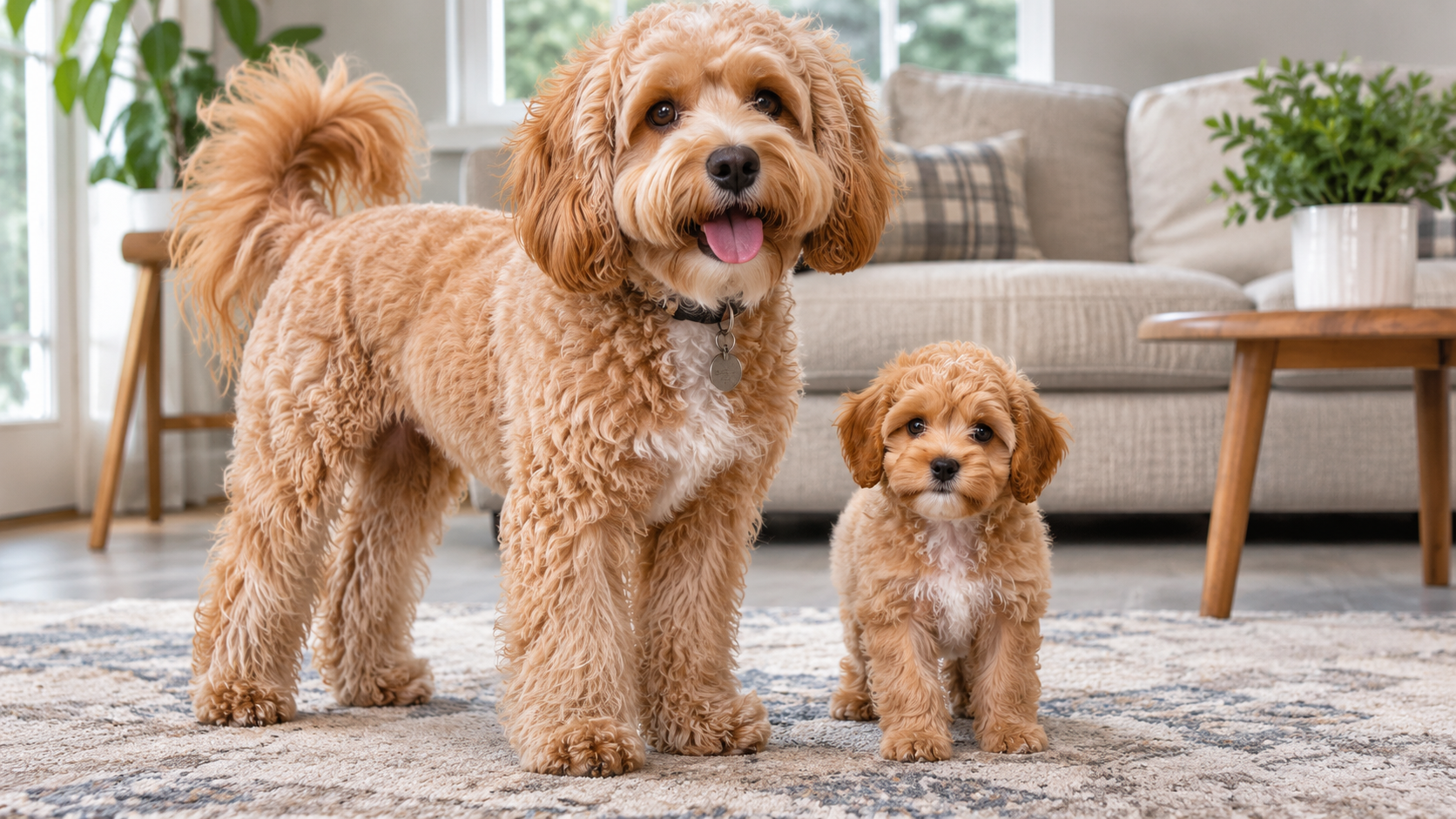
A Cavapoo can be a tiny lap dog or a noticeably sturdier small dog, depending largely on the size of its Poodle parent. That is why two fully grown Cavapoos can look surprisingly different, even when they share the same Cavalier King Charles Spaniel and Poodle mix.
Most full-grown Cavapoos stand around 23–38 cm (9–15 inches) tall at the shoulder and weigh approximately 3.5–11 kg (8–25 lb). Toy Poodle crosses generally fall toward the smaller end, while Miniature Poodle crosses tend to be larger.
Most Cavapoos reach close to their adult height by around 10–12 months, although their bodies can continue filling out for several months afterward.
If you are trying to work out how big your Cavapoo puppy will become, understanding the parents’ sizes, generation and growth pattern will give you a more realistic starting point than relying on one average weight.
Cavapoo full grown: the short answer
A full-grown Cavapoo is generally a small companion dog, but its adult size depends heavily on whether the Poodle parent was a Toy or Miniature.
Here are the broad adult ranges to expect:
- Toy Poodle cross: Approximately 23–30 cm (9–12 inches) tall and 3.5–7 kg (8–15 lb).
- Miniature Poodle cross: Approximately 30–38 cm (12–15 inches) tall and 7–11 kg (15–25 lb).
These are typical estimates, not official breed measurements or guaranteed adult sizes. Individual dogs can fall outside these ranges, and the two groups overlap.
Cavapoos are a cross between a Cavalier King Charles Spaniel and a Poodle. Because they are not a standardized purebred breed, there is no single adult size that applies to every Cavapoo.
Most reach their full height by approximately 10–12 months. Their chest, muscles and overall body condition may continue developing afterward.
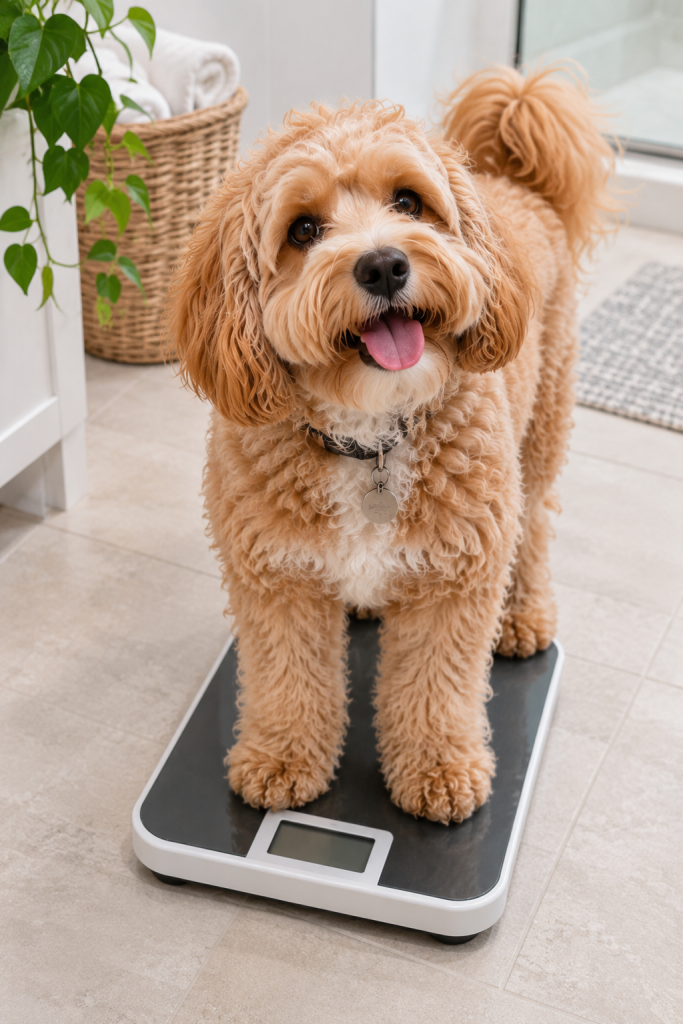
Why full-grown Cavapoos vary so much in size
Two main factors help explain why one Cavapoo stays small while another grows into a heavier, taller companion.
1. The Poodle parent’s size
The Poodle parent is usually the biggest clue when estimating a Cavapoo’s adult size.
Toy Poodles are smaller than Miniature Poodles, so a Cavalier crossed with a Toy Poodle will generally produce smaller puppies than a similar cross involving a Miniature Poodle.
However, puppies do not simply inherit an exact halfway measurement between their parents. Genetics can produce differences in height, weight, leg length and body structure within the same litter.
The Cavalier side also contributes to the final build. Cavaliers have a relatively consistent small companion-dog size, but the Poodle parent’s size can introduce considerable variation.
2. Cavapoo generation
The generation describes how a Cavapoo was bred. It can influence how predictable the adult size and appearance may be, although it does not determine either one.
- F1 Cavapoo: A first-generation cross between a Cavalier King Charles Spaniel and a Poodle. The Poodle can be Toy or Miniature.
- F1b Cavapoo: A Cavapoo crossed back with a Poodle. This increases the Poodle ancestry, but the resulting adult size still depends on the Poodle parent’s size and inherited genes.
- F2 Cavapoo: A second-generation cross between two Cavapoos. Their inherited traits can combine in different ways, creating variation between puppies.
One important point: later generations are not automatically more predictable or smaller. F2 puppies can inherit different combinations of size-related traits from their parents.
Even puppies from the same generation can grow at different rates and finish at different adult weights.
Full-grown Cavapoo size chart
The following chart gives a practical comparison based on the type of Poodle parent.
| Cross type | Typical adult height | Typical adult weight | What to expect |
|---|---|---|---|
| Toy Poodle Cavapoo | 23–30 cm (9–12 in) | 3.5–7 kg (8–15 lb) | Smaller, lighter lap companion |
| Miniature Poodle Cavapoo | 30–38 cm (12–15 in) | 7–11 kg (15–25 lb) | Sturdier small companion |
These ranges are general estimates rather than fixed categories. A Toy Poodle cross may grow larger than expected, while a Miniature Poodle cross may remain relatively small.
Height is measured from the floor to the top of the shoulders, not to the top of the head.
It is also worth remembering that a Cavapoo’s coat can make its body appear larger than it actually is. A fluffy, curly coat may give a small dog a much rounder appearance.
For a more useful size estimate, consider the parents’ actual measurements alongside the puppy’s growth history.
Cavapoo growth timeline: puppy to full grown
Cavapoos develop quickly during their first several months. Their growth gradually slows as they approach adult size, although the timing varies between individual dogs.
| Age | What typically happens |
|---|---|
| 8 weeks | Puppies are still very small and have a substantial amount of growing ahead. |
| 3 months | Rapid weight and height development is usually underway. |
| 6 months | Much of the early growth has happened. Smaller Toy crosses may already be approaching their adult height. |
| 9 months | Height growth generally slows, although larger crosses may still have noticeable development ahead. |
| 12 months | Many Cavapoos are close to their adult height. Their bodies may still be filling out. |
| 18 months | Most have reached their adult proportions, although individual development varies. |
Weight gain does not happen at an even rate throughout puppyhood. Growth is generally fastest during the earlier months and slows as a puppy approaches maturity.
Coat development also changes the way a Cavapoo looks. The puppy coat may gradually transition into a different adult texture, sometimes becoming curlier, wavier or easier to distinguish from the original puppy coat.
For a more individualized estimate, use a puppy growth chart predictor. It can help you interpret your puppy’s current weight and age rather than relying only on a general breed average.
When do Cavapoos stop growing?
Most Cavapoos reach close to their adult height by around 10–12 months of age.
Smaller Toy Poodle crosses may finish their height growth earlier, while some larger Miniature Poodle crosses take longer.
However, reaching adult height does not necessarily mean a dog has finished developing.
There are three things to distinguish:
- Height: Usually approaches its adult measurement by approximately 10–12 months.
- Weight: May continue increasing gradually as the dog develops muscle and body mass.
- Body shape: The chest and overall frame can continue filling out for several months after height growth slows.
By around 18 months, many Cavapoos have settled into their adult proportions, although individual dogs can mature earlier or later.
Neutering is sometimes discussed when owners consider puppy growth and maturity. The timing of neutering can affect growth plate closure in dogs, so it is not something to treat as a simple way to make a Cavapoo smaller or larger.
The appropriate timing depends on the individual dog, its development and other health considerations. Discuss the decision with your veterinarian rather than using a general age recommendation.
Toy vs miniature Cavapoo, fully grown
The difference between a Toy and Miniature Cavapoo is not just the number on the weighing scale. Their size can influence some practical aspects of everyday life.
Living with a Toy Cavapoo
A Toy Poodle cross will generally be lighter and more compact. This can make it easier to carry and accommodate in smaller living spaces.
However, a very small Cavapoo can also be more physically delicate. Accidental falls, rough handling and energetic play can be more concerning, particularly around young children.
Supervised, gentle interactions are important.
Living with a Miniature Cavapoo
A Miniature Poodle cross generally has a sturdier frame and may feel more substantial when walking, playing or being handled.
It can still be a small dog, but its greater size may make everyday activities feel a little less delicate.
Do their exercise needs differ?
Both types need regular exercise, play and mental stimulation.
A Miniature Cavapoo may comfortably handle somewhat longer walks depending on its individual fitness, while a smaller Toy cross may benefit from shorter outings and suitable play sessions.
Neither size should be assumed to need no exercise simply because it is a companion dog.
Is grooming different?
Not necessarily.
Both Toy and Miniature Cavapoos can have wavy or curly coats that require regular brushing and professional grooming.
The amount of grooming depends more on coat length, texture and individual coat characteristics than on the dog’s adult weight.
Do they have different lifespans?
There is no reliable basis for promising that one Cavapoo size will live longer than the other.
Both can enjoy long companion-dog lives. Genetics, overall health, body condition, preventive veterinary care and everyday lifestyle all matter.
How to estimate YOUR Cavapoo puppy’s adult size
If your Cavapoo is still growing, there are several ways to get a more realistic idea of its eventual size. Some methods are much more useful than others.
1. Check the parents’ sizes
This is generally the best starting point.
Ask about the actual adult height and weight of both parents, rather than relying only on descriptions such as Toy Cavapoo or Mini Cavapoo.
If the Poodle parent is a small Toy and the Cavalier parent is also relatively small, you might reasonably expect a smaller puppy.
If the Poodle parent is a larger Miniature, the expected adult range may shift upward.
Remember that puppies can inherit different combinations of traits, so parental measurements provide clues rather than guarantees.
2. Track your puppy’s weight
Regular weighing gives you a clearer picture of how your puppy is developing.
Try weighing your Cavapoo weekly under similar conditions and recording the results. Look at the overall pattern rather than reacting to one unusually high or low measurement.
A puppy that gains weight steadily may be following a typical growth pattern, but its current weight alone cannot tell you exactly how much it will weigh as an adult.
You can also explore our guide to how big will my puppy get for more information about estimating adult size across different dogs.
3. Use a puppy growth predictor
A growth predictor can help put your puppy’s current measurements into context.
Enter the available age and weight information to get a broad adult-size estimate. Treat the result as a planning guide rather than a promise.
Individual growth patterns, parent size and body condition all influence how useful a prediction will be.
4. Treat paw size as a weak clue
You may have heard that puppies with oversized paws will grow into much bigger dogs.
There is a little intuitive appeal to this idea, but paw size is not a reliable measurement of adult weight.
Some puppies simply have larger-looking paws in proportion to their bodies. Others have smaller paws and still grow into relatively substantial adults.
Use paw size as an interesting observation, not an adult-size prediction method.
5. Be cautious with breeder estimates
A breeder who knows the parents and has observed previous litters may be able to offer a useful estimate.
However, no one can guarantee the exact adult weight of a puppy based on its appearance at a few weeks old.
An estimate should account for both parents, their sizes and the puppy’s individual development. Be cautious of claims that promise an exact adult weight.
Keeping a full-grown Cavapoo at a healthy weight
Cavapoos are small dogs, which means even a relatively modest amount of extra weight can make a noticeable difference to their body condition.
A dog that gains weight gradually may not look particularly different from one month to the next. That is why regular weighing and paying attention to body shape are useful habits.
One simple check is whether you can feel your dog’s ribs fairly easily beneath a thin layer of fat without having to press firmly.
When looking from above, there should generally be a visible waist behind the ribs. From the side, the abdomen should usually tuck upward rather than forming a straight line from chest to hindquarters.
These are general body-condition observations, not a substitute for an individual assessment.
A few practical habits can help:
- Measure meals instead of estimating portions by eye.
- Account for treats when considering daily food intake.
- Avoid routinely giving extra food simply because your Cavapoo asks for it.
- Weigh your dog periodically to notice gradual changes.
- Adjust food portions according to body condition, activity and individual needs.
The adult weight ranges in a Cavapoo size chart are only useful when considered alongside the dog’s body condition. A healthy, naturally larger Cavapoo should not be judged against the weight of a much smaller dog.
If you are interested in how Cavapoos compare with other small companion dogs, see our guide to toy dog breeds.
Frequently asked questions
How big do Cavapoos get when fully grown?
Most full-grown Cavapoos stand approximately 23–38 cm (9–15 inches) tall and weigh around 3.5–11 kg (8–25 lb). Toy Poodle crosses generally fall toward the smaller end, while Miniature Poodle crosses tend to be larger. Individual dogs can fall outside these typical ranges.
How much should a full-grown Cavapoo weigh?
A full-grown Cavapoo typically weighs around 3.5–11 kg (8–25 lb). The appropriate weight depends on its parent sizes, frame and body condition. A healthy Toy cross may weigh considerably less than a healthy Miniature cross, so there is no single ideal weight for every Cavapoo.
Is my Cavapoo full grown at 6 months?
Not necessarily. At six months, many Cavapoos have completed a substantial part of their early growth, and some smaller Toy crosses may already be approaching their adult height. However, most still have some development ahead, particularly in weight and body condition.
Do F1b Cavapoos stay smaller than F1 Cavapoos?
Not automatically. An F1b Cavapoo has one Cavapoo parent and one Poodle parent, but its eventual size depends on the Poodle parent’s size and the genes inherited from both parents. An F1b can be smaller or larger than an F1 Cavapoo. Generation alone does not guarantee a particular adult weight.
At what age is a Cavapoo fully grown?
Most Cavapoos reach close to their adult height by around 10–12 months. Their weight and body shape can continue developing afterward, and many settle into their adult proportions by approximately 18 months. The exact timing varies between individual dogs.
Conclusion
A Cavapoo’s full-grown size depends primarily on the size of its Poodle parent, with inherited genetics and generation adding further variation. Most stand around 23–38 cm (9–15 inches) tall and weigh approximately 3.5–11 kg (8–25 lb), but these are broad typical ranges rather than fixed limits.
If you have a growing Cavapoo puppy, start with the parents’ actual measurements, track its weight over time and use a growth predictor as an additional guide. You will get a much more realistic picture than relying on paw size or a single average breed measurement.
Most importantly, remember that adult size is only one part of your dog’s development. Maintaining a healthy body condition, providing appropriate exercise and giving your Cavapoo consistent care matter far more than reaching a particular number on the scale.