
Convert your dog’s age into human years the accurate way, step by step.
Dog age converter
See a more useful human-age estimate than the old “multiply by seven” shortcut.
How the Dog Age Calculator Works
Last updated: October 2026
A dog age calculator converts a dog’s chronological age into an estimated human-equivalent age. Instead of multiplying every birthday by seven, CanineCalc uses a piecewise formula that accounts for rapid early development and different aging rates for small, medium, large, and giant dogs.
The result is an estimate, not a biological measurement. It helps you put your dog’s age into perspective without suggesting that dogs and humans experience aging in exactly the same way.
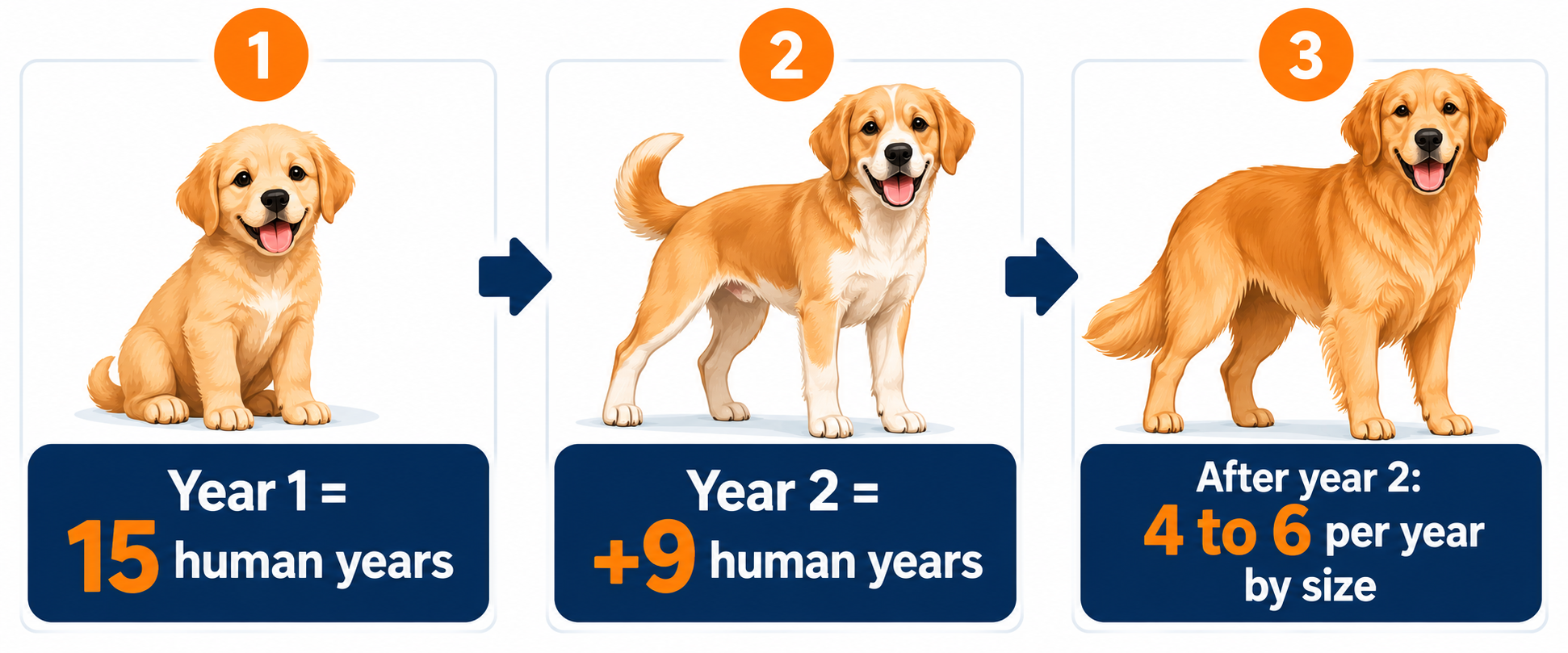
According to the American Veterinary Medical Association, the first year of a medium-sized dog’s life corresponds to approximately 15 human years, while the second adds roughly nine more. After that, the commonly used guideline adds about five human years per dog year. These are practical estimates, not exact conversions for every breed. AVMA
The actual formula behind CanineCalc
This dog age calculator applies three stages. The first two reflect rapid early development; the third uses the selected size category to estimate the years that follow.
At age 1 year or younger: Human-equivalent age = dog age × 15.
Older than 1 year and up to 2 years: Human-equivalent age = 15 + (dog age − 1) × 9.
Older than 2 years: Human-equivalent age = 24 + (dog age − 2) × yearly rate for the dog’s size.
The starting value of 24 matters because the first two years contribute 15 + 9 = 24 human-equivalent years. This dog age calculator then adds the appropriate rate for each additional dog year.
For example, a dog aged 1.5 years has an estimated human-equivalent age of 19.5 years:
15 + (1.5 − 1) × 9 = 15 + 4.5 = 19.5.
The formula also works with fractional ages, provided the calculator accepts them. A dog’s exact birthday or estimated age still matters when entering the starting value.
How to use the calculator:
Enter your dog’s chronological age in years.
Select the size category that matches your dog.
Read the estimated human-equivalent age and check the formula if you want to verify it.
Why You Shouldn’t Simply Multiply Dog Years by Seven
The familiar seven-year rule is easy to remember. It offers a quick mental shortcut, but it assumes dogs age at a constant rate relative to humans. That is the main problem.
A one-year-old dog is not generally comparable to a seven-year-old child in developmental terms. Dogs mature rapidly during their early life, so a straight seven-times calculation seriously understates that early development. The pace of aging also differs between dog sizes and breeds.
Why the multiply-by-seven rule is misleading: A simple seven-times calculation treats every dog birthday equally, even though development changes substantially across a dog’s lifespan. The AVMA’s guidance instead estimates about 15 human years for the first year and nine additional years for the second. This staged approach better reflects early development, though it remains an approximation.
The old rule likely persists because it is memorable and provides a rough comparison between typical human and dog lifespans. A simple rule can be useful as a conversation starter, but it is less useful when someone wants an age estimate for an individual pet.
Here’s the thing: rejecting the seven-year rule does not mean every alternative dog age calculator is scientifically exact.
Research published in Cell Systems in 2020 examined DNA methylation patterns in 104 Labrador Retrievers and humans. The researchers developed a nonlinear formula for comparing biological aging across the two species. The National Institute on Aging reported that the formula mapped an eight-week-old puppy to roughly nine months in human development. The researchers also noted that further testing across dog breeds was needed.
That research supports the idea that aging is nonlinear. It does not validate every simplified calculator or establish that one mathematical formula works perfectly for every dog.
Here’s the important part: growth isn’t always predictable.
How Dog Size Changes the Human-Year Estimate
A dog’s size affects the estimate because small and large dogs often follow different aging and lifespan patterns. The AVMA notes that larger breeds tend to have shorter lifespans than smaller breeds and may be considered seniors earlier. Size is a useful factor, although breed, genetics, and individual health also matter.
Size-based aging rates used by CanineCalc
This dog age calculator uses these rates for every dog year after age two.
| Dog size class | Human years added per dog year after age 2 | Example: a 6-year-old dog |
|---|---|---|
| Small | 4 | 40 human-equivalent years |
| Medium | 5 | 44 human-equivalent years |
| Large | 5.5 | 46 human-equivalent years |
| Giant | 6 | 48 human-equivalent years |
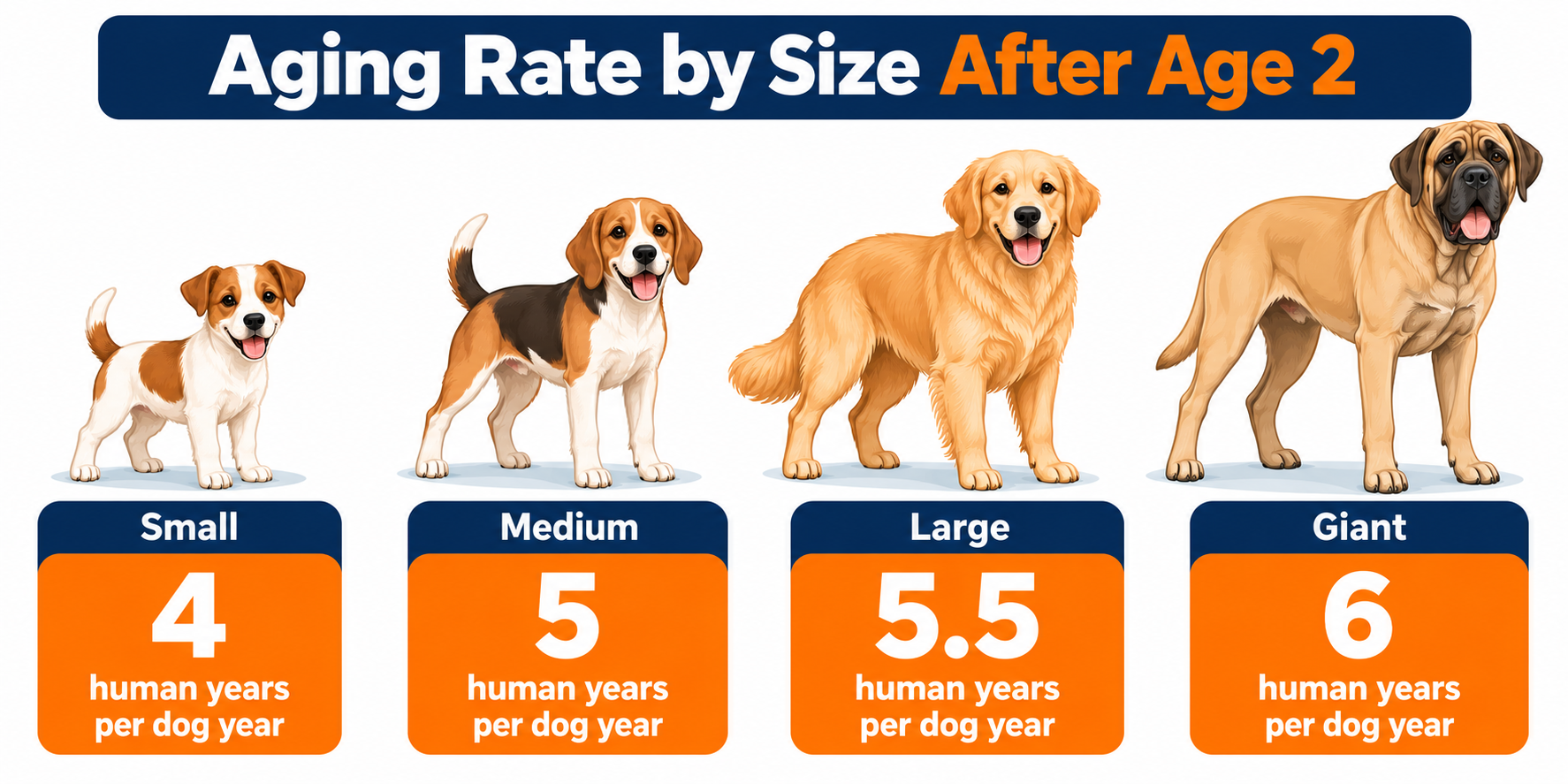
These examples use the same starting value of 24 at age two. The difference comes from the size-specific rate applied to the four years between age two and age six.
For a six-year-old small dog, the calculation is 24 + (6 − 2) × 4 = 40. For a six-year-old giant dog, it is 24 + (6 − 2) × 6 = 48.
Trying to predict your puppy’s adult size? Here’s what to know. Comparing a small dog’s result with a giant dog’s result shows how much the chosen rate influences the estimate.
A size-aware estimate is more informative than a universal seven-times rule. It still cannot account for every difference among individual dogs.
Worked Examples: Check Your Dog’s Human-Equivalent Age
The following examples use the exact CanineCalc dog age calculator formula, with each calculation shown so you can reproduce the result.
Example 1: A 6-year-old medium dog
The medium-size rate is five human years per additional dog year after age two.
Starting value at age two: 24 human-equivalent years.
Remaining dog years: 6 − 2 = 4.
Additional human-equivalent years: 4 × 5 = 20.
Final calculation: 24 + 20 = 44 human-equivalent years.
A six-year-old medium dog therefore receives an estimated age of 44 human years under this dog age calculator’s model.
Example 2: A 10-year-old small dog
Small dogs use a rate of four human years per dog year after age two.
Starting value at age two: 24 human-equivalent years.
Remaining dog years: 10 − 2 = 8.
Additional human-equivalent years: 8 × 4 = 32.
Final calculation: 24 + 32 = 56 human-equivalent years.
The result is 56 human-equivalent years.
Example 3: A 1-year-old dog of any size
All size categories use the same first-year rate in this model.
Dog age: 1 year.
First-year rate: 15.
Calculation: 1 × 15 = 15 human-equivalent years.
This example demonstrates why the calculator does not use a single multiplication rate throughout a dog’s life. The initial stage is handled separately before size-specific rates apply.
Puppy growth and estimated adult size
For owners who are also planning daily feeding, Estimate your dog’s daily calorie needs provides a separate tool for exploring calorie requirements. Age conversion and calorie estimates answer different questions, so one result should not be used as a substitute for the other.
What the Dog Age Calculator Can and Cannot Tell You
A dog age calculator provides an understandable age comparison. It does not measure your dog’s biological age, diagnose a health condition, or predict an exact lifespan.
Its result depends on the age entered and the size category selected. An uncertain adoption date, an estimated birth date, or an incorrect size selection can change the answer. Mixed-breed dogs may also be harder to classify when their adult size is unknown.
There is an important distinction between a practical guideline and a research model. Studies differ in how they translate canine and human aging: the 2020 DNA-methylation study developed a nonlinear research equation, while the AVMA’s everyday guidance uses rounded, stage-based estimates. These methods are not interchangeable, and neither makes every simplified conversion exact.
CanineCalc’s formula is intended to provide a transparent estimate. It should not be described as a clinically validated test. For health decisions, a veterinarian can interpret your dog’s age alongside its breed, weight, medical history, activity, and physical condition.
The most useful approach is to treat the number as context, not a diagnosis. A dog that appears young for its estimated human age can still develop health problems. An older dog can remain active and comfortable, too.
If your dog has changes in mobility, appetite, thirst, weight, behaviour, or energy, the calculator cannot determine the cause. Those changes deserve individual attention rather than an age-based assumption.
Dog Age Calculator: Five Common Questions
Q: What’s the best way to calculate my dog’s age in human years?
A: Enter your dog’s age and choose its size category in the CanineCalc dog age calculator. Its piecewise formula applies different rates during the first two years and after age two.
Q: How do I calculate dog years manually?
A: For dogs over two years old, start with 24, subtract two from the dog’s age, multiply the remainder by the selected size rate, and add the result to 24.
Q: Should I multiply my dog’s age by seven?
A: No. The seven-times rule assumes a constant aging rate. Dogs mature rapidly during their early years, and their later aging patterns vary with size and other factors.
Q: Why does a large dog have a different human-equivalent age?
A: CanineCalc assigns larger dogs higher post-two-year rates. This reflects broad size-related aging patterns, not a precise measurement of every dog’s biological condition.
Q: When should I ask a veterinarian about my dog’s age or health?
A: Ask your veterinarian how age, breed, and individual health affect preventive care, particularly if you notice new symptoms or changes in everyday behaviour.
A dog age calculator is most useful when its assumptions are visible. With the formula, size rates, and limitations explained, you can understand where the number comes from and use it as a reasonable starting point for learning about your dog’s life stage.