Dog water intake calculator
Estimate how much water your dog should drink each day from weight and activity.
Last updated: October 2026
A dog water intake calculator estimates how much water a dog may need daily based on body weight and activity level. It gives owners a practical starting point for understanding hydration needs, not a medical prescription or a guarantee that every dog needs the same amount.
The CanineCalc Water Intake Calculator uses a simple formula:
Daily water estimate = body weight in pounds × 1 fluid ounce × activity multiplier.
The activity multipliers are:
| Activity level | Multiplier | What it means |
|---|---|---|
| Normal | ×1.00 | Everyday activity and regular walks |
| Active | ×1.25 | More exercise or frequent energetic play |
| Very active | ×1.50 | Particularly demanding activity levels |
How much water should a dog drink per day? Most adult dogs can use about 1 fluid ounce per pound of body weight daily as a quick starting point. According to the American Kennel Club (AKC), activity and hot weather can increase water needs, while puppies have different requirements. Keep fresh water available and treat the estimate as guidance rather than a fixed daily quota.
To estimate a healthy adult dog’s daily water target, follow these steps:
- Enter your dog’s weight and choose pounds or kilograms.
- Select normal, active, or very active.
- Read the estimated ounces, cups, and milliliters, then compare with usual drinking habits.
The 1-ounce-per-pound baseline, honestly explained
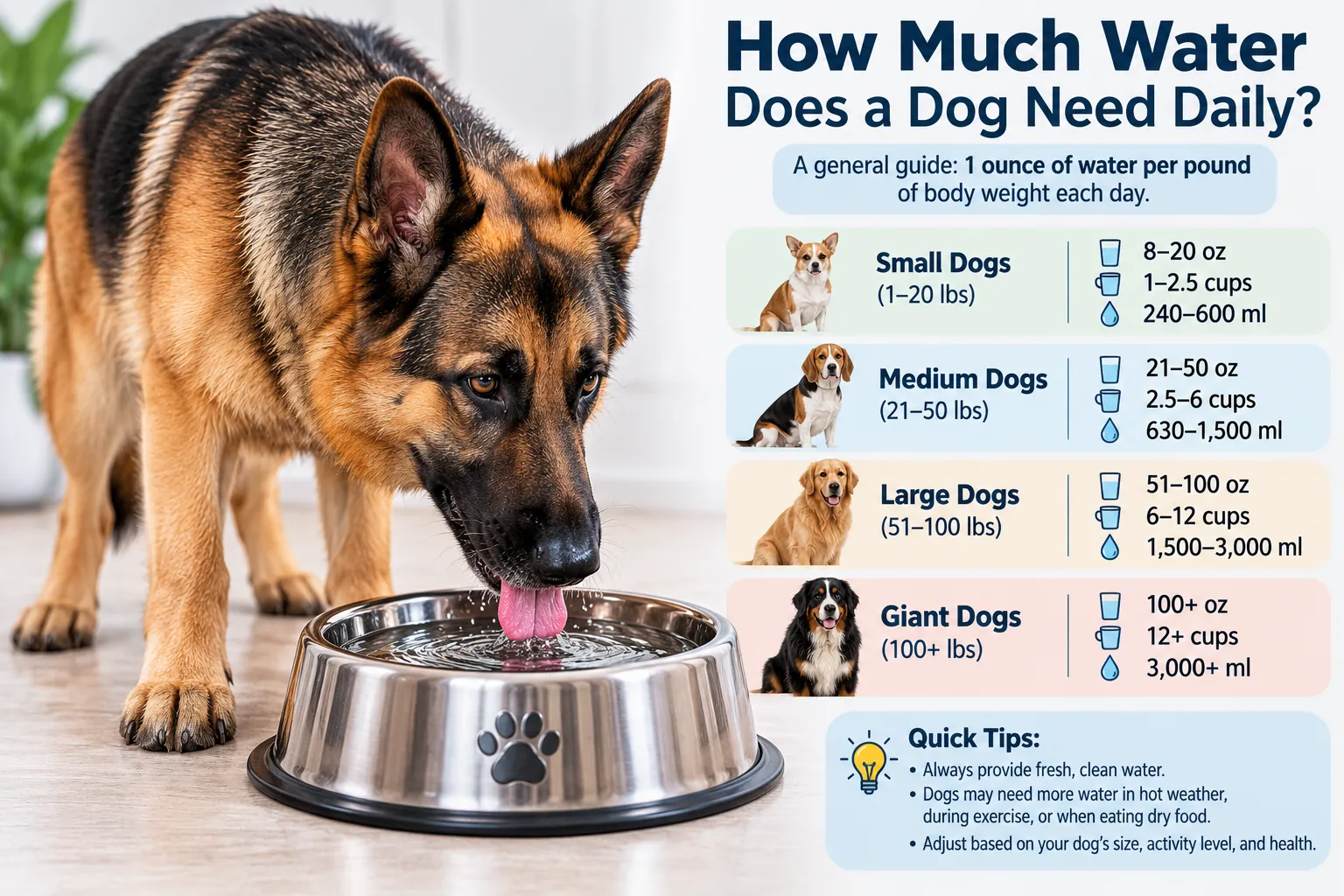
The familiar rule is straightforward: a dog weighing 20 lb has a starting estimate of 20 fluid ounces per day, while an 80 lb dog has a starting estimate of 80 ounces. The rule scales with weight, making it easy to remember.
However, veterinary sources do not give one identical benchmark. The AKC cites roughly 1 ounce per pound daily for adult dogs, whereas Cornell University’s Riney Canine Health Center describes approximately 40–60 milliliters per kilogram as a typical daily intake for healthy dogs. These figures differ, so they should not be treated as interchangeable prescriptions.
How much more water might an active dog need? CanineCalc applies a clear adjustment: normal activity uses ×1, active uses ×1.25, and very active uses ×1.5. This makes estimates easy to compare, but the multipliers are tool-specific planning rules, not a veterinary scale validated for every breed, climate, or workout.
Why can two dogs of the same weight drink different amounts? According to Cornell’s Riney Canine Health Center, daily water consumption varies with factors such as diet and activity, and hot conditions can increase intake. Food moisture also matters: a 2025 study found that dogs eating tested fresh food drank less from the bowl yet consumed more total water than dogs eating the tested dry kibble.
The practical takeaway is simple.
Use the calculator to establish a reference point, then pay attention to your dog’s normal routine. A sudden, sustained change in drinking can matter more than whether your dog matches one general formula exactly.
Worked example: a 50-lb active dog
Suppose your dog weighs 50 lb and has an active lifestyle. Here’s the calculation using CanineCalc’s formula:
- Body weight: 50 lb
- Base rate: 1 fluid ounce per pound
- Activity level: Active, multiplier ×1.25
Calculation: 50 × 1 × 1.25 = 62.5 fluid ounces per day.
Convert that estimate into other units:
- Fluid ounces: 62.5 oz
- US cups: 62.5 ÷ 8 = 7.8125, or approximately 7.8 cups
- Milliliters: 62.5 × 29.5735 = 1,848.34375, or approximately 1,848 mL
The resulting estimate is approximately 7.8 cups or 1.85 liters daily.
Here’s the thing: this is a planning estimate, not an instruction to make your dog finish exactly 62.5 ounces of drinking water. Water contained in food contributes to hydration, and the calculator does not subtract that amount from its result.
Daily water intake by weight and activity
The following reference table applies the tool’s formula consistently. Values are rounded for readability; milliliter calculations use the unrounded fluid-ounce result.
| Dog weight | Activity level | Ounces/day | Cups/day | mL/day |
|---|---|---|---|---|
| 10 lb | Normal | 10 | 1.3 | 296 |
| 10 lb | Active | 12.5 | 1.6 | 370 |
| 10 lb | Very active | 15 | 1.9 | 444 |
| 20 lb | Normal | 20 | 2.5 | 591 |
| 20 lb | Active | 25 | 3.1 | 739 |
| 20 lb | Very active | 30 | 3.8 | 887 |
| 50 lb | Normal | 50 | 6.3 | 1,479 |
| 50 lb | Active | 62.5 | 7.8 | 1,848 |
| 50 lb | Very active | 75 | 9.4 | 2,218 |
| 80 lb | Normal | 80 | 10.0 | 2,366 |
| 80 lb | Active | 100 | 12.5 | 2,957 |
| 80 lb | Very active | 120 | 15.0 | 3,549 |
What moves the number up or down
Weight and activity are only part of the picture. Food moisture, environmental conditions, and health can all affect how much water a dog gets or drinks.
| Factor | Raises or lowers intake | Why |
|---|---|---|
| Hot weather and panting | Usually raises needs | Dogs lose water while panting to regulate body temperature. |
| Exercise and energetic play | Often raises needs | Activity can increase fluid loss and thirst. |
| Dry kibble | Often raises drinking from the bowl | Dry food supplies relatively little moisture. |
| Wet or fresh food | Often lowers drinking from the bowl | More water comes directly from the meal. |
| Vomiting or diarrhea | Can raise fluid needs and loss | Illness may increase dehydration risk and needs veterinary attention. |
| Medications or health conditions | Varies | Some can change thirst or urination. |
Water intake includes more than what disappears from the bowl. Dogs obtain water from drinking, food moisture, and metabolic processes.
A 2025 study in Frontiers in Veterinary Science compared selected fresh and dry diets in small groups of healthy adult dogs. The tested fresh food contained 71.1% moisture, compared with 6.1% in the tested kibble. Dogs eating the fresh food drank less free water but consumed more total water during that study. These findings illustrate why food type matters, although they do not establish the same effect for every diet or dog.
Trying to predict your puppy’s adult size? Here’s what to know.
Keep the water bowl clean and provide fresh water throughout the day. Don’t reduce access simply because a calculator estimate has been reached.
Related: why your dog might be drinking so much water
Related: dog calorie calculator
Related: puppy food chart
Source: American Kennel Club — general water-intake guidance and hydration factors.
Source: Cornell Riney Canine Health Center — excessive drinking, increased urination, and veterinary evaluation.
Drinking too little or too much: warning signs and limitations
The number in your calculator is only one piece of the picture. A dog that suddenly starts drinking far more or far less than usual deserves attention, especially when other symptoms appear.
Signs your dog may not be getting enough water
Possible signs of dehydration include dry or sticky gums, unusual weakness, and changes in normal behavior. Vomiting, diarrhea, fever, and excessive urination can also increase dehydration risk. Puppies, senior dogs, and dogs with certain health conditions may need closer monitoring.
Offer fresh water and contact your veterinarian if your dog appears dehydrated or cannot keep water down. Severe weakness, collapse, or significant illness warrants urgent veterinary care.
When drinking too much becomes a concern
Cornell’s Riney Canine Health Center explains that polydipsia means excessive thirst or drinking, while polyuria refers to increased urine production. Cornell cites more than 100 mL of water per kilogram of body weight daily as a formal threshold for polydipsia. That is approximately 1.5 US fluid ounces per pound.
This is not a threshold you should wait to reach before seeking advice. A significant, sustained change from your dog’s normal habits matters even when measured intake falls below that amount.
Watch for patterns such as repeatedly emptying the bowl, asking to go outside more often, having indoor accidents, or appearing unusually thirsty. Possible medical causes include diabetes, kidney disease, urinary tract infections, and certain hormonal conditions. A veterinarian can determine whether investigation is needed.
If your dog develops vomiting, marked lethargy, loss of coordination, staggering, or bloating after drinking a large amount of water, seek prompt veterinary assessment; serious symptoms may require emergency care.
Do not restrict water to control excessive urination unless your veterinarian specifically directs you to do so. Cornell warns that restricting access before assessment can lead to dehydration or dangerous electrolyte abnormalities.
What the calculator cannot tell you
Put simply, puppies grow in spurts.
This estimate works best as a planning reference for generally healthy adult dogs with reasonably predictable routines. It won’t resolve unusual thirst, illness-related fluid needs, or an individualized veterinary hydration plan.
The calculator does not adjust for moisture in food, diagnose dehydration, account for every medication or health condition, or prescribe fluid replacement during illness. Puppies also have age-specific requirements, and some senior dogs need individualized guidance.
My practical opinion is that observing your dog’s normal habits is more useful than insisting that every dog match a calculator to the last ounce. The estimate should help you notice patterns, not become a reason to police the water bowl.
Dog water intake: five common questions
Q: What’s the best way to measure how much water my dog drinks?
Measure the water you provide and what remains after 24 hours. Account for spills, shared bowls, and other water sources. Water contained in food also contributes to total intake.
Q: How do I know if my dog drinks enough water?
Compare your dog’s habits with the calculator estimate and their usual daily pattern. Look for changes in thirst, energy, and urination, and contact your veterinarian if you suspect dehydration.
Q: Should I limit my dog’s water at night?
Don’t restrict water solely to control nighttime urination. Puppies and dogs with unusual thirst need individualized guidance; ask your veterinarian before making changes to water access.
Q: Why does my dog drink less water from the bowl on wet food?
Wet and fresh foods contain more moisture than dry kibble, so some hydration comes from meals. Lower bowl drinking does not automatically mean your dog is getting too little water overall.
Q: When should I call my vet about my dog’s drinking?
Contact your veterinarian when drinking or urination changes significantly or persistently. Seek urgent care for severe symptoms such as collapse, marked weakness, or loss of coordination.
The goal is a healthy, consistent hydration routine—not a perfect calculator score. Use the estimate as a reference, keep fresh water accessible, consider your dog’s diet and activity, and get veterinary advice when their drinking habits change unexpectedly.