Last updated: October 2026
A new puppy comes with plenty of questions. The food bag has a feeding chart, your puppy seems hungry all the time, and online recommendations rarely agree on exact portions.
You don’t need to guess, you aren’t expected to decode every nutrition term, and it’s reasonable to start with the label.
A reliable feeding plan starts with your puppy’s age and weight, then accounts for the food’s calorie content, growth rate, and body condition. Here’s how to turn a general feeding chart into a practical daily routine.
Definition: What is a puppy food chart?
A puppy food chart is a starting guide that helps owners plan a growing dog’s daily food amount and meal schedule by age, weight, and food type. It cannot give one reliable cup amount for every puppy, because calories per cup and individual growth needs vary between foods and dogs.

How Often Should You Feed a Puppy by Age?
Young puppies need several small meals throughout the day. As they mature, their feeding schedule usually becomes simpler.
According to the Merck Veterinary Manual’s puppy feeding schedule, puppies generally move from four meals daily at 6–12 weeks to three meals at 3–6 months and two meals at 6–12 months. These are common guidelines for healthy puppies, not rigid rules for every breed or individual.
Why meal frequency changes as puppies grow
Very young puppies have small stomachs and substantial energy needs relative to their size. Dividing their daily food allowance into several meals helps spread food intake throughout the day.
As puppies grow, they can usually manage larger portions at each meal. By around six months, many puppies can transition to two meals daily, although small breeds and individual health needs may call for a different schedule.
Sources differ slightly on the exact transition point. Merck’s schedule keeps puppies on three meals through six months, while VCA guidance describes some puppies moving to two meals between four and six months. A reasonable approach is to use the age ranges as a framework and confirm the timing with your veterinarian.
Typical meal-frequency guide
| Puppy age | Typical meals per day | Practical guidance |
|---|---|---|
| 6–12 weeks | 4 | Divide the daily ration into small, measured meals. |
| 3–6 months | 3 | Recheck portions as weight and growth change. |
| 6–12 months | 2 | Continue an appropriate puppy diet while growth continues. |
| Over 12 months | Usually 1–2 | Determine adult-food transition by breed, maturity, and veterinary advice. |
Puppy Food Chart by Age and Weight
The chart below combines age-based meal frequency with the weight considerations that help you determine a daily portion. It deliberately avoids universal cup measurements: a cup of one puppy food can contain substantially different calories from a cup of another.
How much food should a puppy eat each day?
The daily portion depends on age, current weight, expected adult size, activity, and the food’s calorie density. According to VCA’s puppy nutrition guidance, package feeding recommendations are a starting point; portions should be adjusted by monitoring body condition and consulting your veterinary team rather than following a fixed number blindly.
Age and weight feeding chart
| Age | Typical meals/day | Weight-based portion guidance | Food guidance |
|---|---|---|---|
| 6–12 weeks | 4 | Use the food label’s instructions for the puppy’s age and applicable weight category. | Feed a complete, balanced puppy diet. |
| 3–6 months | 3 | Recheck the recommended daily ration as your puppy gains weight. | Adjust gradually using growth and body-condition checks. |
| 6–12 months | 2 | Consider current weight, expected adult size, and how much growth remains. | Large- and giant-breed puppies need an appropriately formulated growth diet. |
| 12 months and older | Usually 1–2 | Do not assume every puppy is fully grown at the same age. | Switch to adult food when appropriate for the breed and growth stage. |
How your puppy’s weight affects the amount
Weight matters, but it isn’t the only variable. A rapidly growing puppy with a large expected adult size may have different nutritional needs from a same-weight puppy that will remain small.
- Toy and small-breed puppies: Smaller stomachs can make more frequent, smaller meals useful. Monitor appetite and weight closely.
- Medium-breed puppies: Use the applicable age and weight guidance on the food package, then adjust portions based on growth and body condition.
- Large- and giant-breed puppies: Choose a complete growth diet formulated for large-size dogs. Avoid deliberately feeding extra food to accelerate growth.
Veterinary guidance emphasizes controlled, appropriate growth rather than the fastest possible weight gain. Overfeeding during growth can contribute to excessive growth and later obesity, and it may interfere with proper skeletal development.
Here’s the thing: a heavier puppy doesn’t automatically need more cups of food than a lighter puppy. Calorie density and the individual dog’s energy needs matter just as much.
Convert daily calories into food portions
How do you convert a calorie target into cups? Find the puppy’s recommended daily calories, then divide that number by the food’s kcal per cup listed on the label; split the total across meals. This creates a brand-neutral estimate, but the result still needs checking against growth and body condition with a veterinary professional.
The formula is:
Daily food in cups = daily calorie target ÷ calories per cup
For example, if a hypothetical food supplies 400 kcal per cup, a daily target of 800 kcal would equal 2 cups per day. Those are example numbers to explain the calculation, not a feeding recommendation for any particular puppy.
Try the CanineCalc Dog Calorie Calculator to estimate daily calorie needs.
The calculator can help estimate daily calorie needs using weight, age, and activity. You can then use the calorie information on your selected food to estimate the corresponding portion.
How to Calculate Your Puppy’s Daily Food Amount
The goal is a repeatable routine, not a perfect number pulled from a generic chart. Start with a reasonable estimate and refine it using your puppy’s progress.
To estimate your puppy’s daily portion, follow these steps:
- Read the food label’s puppy-growth guide for current age and expected adult size.
- Estimate daily calories with the CanineCalc Dog Calorie Calculator.
- Divide daily calories by kcal per cup or gram on the package.
- Split the total into meals, then check growth and body condition with your vet.
This gives you a useful starting point. It does not replace an individualized feeding plan when your puppy has health issues, poor growth, or other nutritional concerns.
Check body condition, not just the scale
A healthy puppy should grow steadily, but the scale alone cannot tell you whether the puppy is carrying an appropriate amount of body fat.
The VCA guide to feeding puppies describes useful body-condition clues: a visible waist when viewed from above, an abdominal tuck from the side, and ribs that are easy to feel without being heavily padded or prominently visible.
Weigh your puppy regularly, ideally weekly during rapid growth, and keep track of changes in appetite, stool quality, and body shape. Ask your veterinarian to review the pattern if weight gain stalls or accelerates unexpectedly.
What most guides skip is that the right portion may change before your puppy changes food brands. Growth rate, activity, and body condition can all shift the amount needed to maintain a healthy trajectory.
Account for treats and extras
Treats, training rewards, chews, and table scraps contribute calories too. A portion that looks correct at mealtime can become excessive when frequent extras are added.
Veterinary nutrition guidance generally recommends keeping treats below about 10% of daily calories, leaving most of the calorie allowance for a complete, balanced diet.
Quick note: use small training rewards, count them as part of the daily intake, and avoid adding vitamin or mineral supplements to a balanced puppy diet unless your veterinarian specifically recommends them.
Related: dog food cost calculator
Once you know approximately how much food your puppy eats each day, the food cost calculator can help estimate the ongoing cost of feeding that amount.
Which Puppy Feeding Guide Should You Trust?
There is a reason puppy food charts do not all agree. Different foods contain different amounts of energy per cup, manufacturers use different feeding tables, and individual puppies grow at different rates.
Some experts and pet owners favor using the food package as the main guide. That’s a valid starting point because the recommendation relates to the specific food’s calorie density. But if you’re dealing with a puppy whose growth or body condition doesn’t fit the chart, follow up with a calorie estimate and veterinary guidance instead of extrapolating the package numbers without checking.
Quick Comparison
| Option | Best For | Key Benefit | Limitation |
|---|---|---|---|
| Food package feeding chart | Starting a new food | Food-specific guidance by age or size | May not match every puppy’s individual needs |
| Calorie calculator | Estimating daily energy needs | Helps translate weight, age, and activity into a calorie target | Produces an estimate, not a veterinary diagnosis |
| Weighed food portions | Maintaining a consistent routine | Makes daily feeding more repeatable | Requires knowing the food’s calorie density |
| Veterinary nutrition plan | Puppies with growth concerns or medical needs | Individualized assessment and adjustments | Requires professional input and follow-up |
Most people assume faster growth means better growth. Veterinary guidance cautions against encouraging rapid growth through overfeeding, particularly in puppies that will become large or giant dogs. A steady, healthy growth pattern is the better goal.
The thing is, growth doesn’t happen at a steady pace. It’s a puppy developing at a healthy rate, with an appropriate body condition and a diet that meets growth requirements.
Choosing food for healthy growth
Choose a complete and balanced food intended for puppy growth. Large- and giant-breed puppies need particular attention to the food’s growth formulation, since their nutritional requirements differ from those of many smaller dogs.
If you’re wondering how big your puppy will get, start here. Persistent hunger, poor appetite, digestive symptoms, or unexpected weight changes deserve a conversation with your veterinarian.
This guide works best for a healthy, weaned puppy eating a complete growth diet. It won’t replace a veterinary feeding plan for a puppy with an illness, poor growth, persistent digestive problems, or a medically prescribed diet. The advice here is general information, not an individual medical or nutritional prescription.
Source: WSAVA Global Nutrition Guidelines — individualized nutritional assessment and body-condition monitoring.
Puppy feeding guide by weight
Age-based feeding charts are useful, but your puppy’s current weight can be a better starting point for estimating daily food portions. Puppies of the same age can weigh very different amounts, especially mixed breeds or puppies growing faster or slower than average. A puppy feeding guide by weight helps you estimate portions using your puppy’s current size, the feeding chart on your dog food label, and the food’s calorie content.
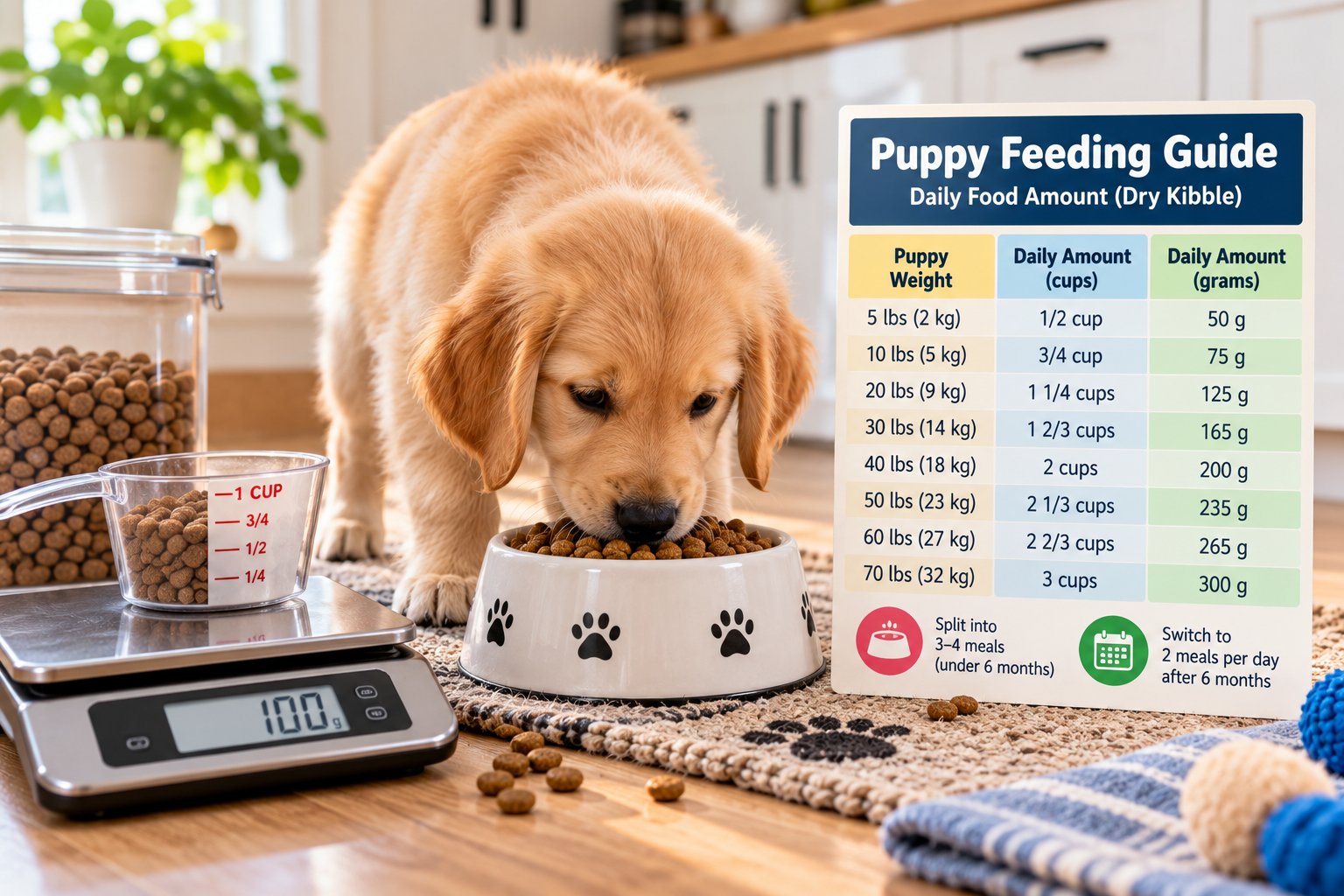
The table below provides approximate daily starting amounts for growing puppies. It assumes puppy food contains around 350–400 calories per cup. Because kibble size and calorie density vary by brand, the same number of cups can provide quite different amounts of energy.
| Puppy’s current weight | Daily food (cups, approx.) | Daily calories (approx.) |
|---|---|---|
| 3 lb | 0.75–1 cup | 300–350 kcal |
| 5 lb | 1–1.25 cups | 375–450 kcal |
| 10 lb | 1.5–2 cups | 550–650 kcal |
| 15 lb | 2–2.5 cups | 750–850 kcal |
| 20 lb | 2.5–3 cups | 900–1,050 kcal |
| 30 lb | 3–3.75 cups | 1,150–1,350 kcal |
| 40 lb | 3.75–4.5 cups | 1,400–1,650 kcal |
| 50 lb | 4.5–5.25 cups | 1,650–1,900 kcal |
These figures are starting ranges, not exact feeding prescriptions. They assume a growing puppy eating a typical puppy formula, and they may not suit every breed, age, or activity level. Growing puppies need more energy per pound than adult dogs in many circumstances; as a rough planning shortcut, their calorie needs can be around twice an adult-maintenance estimate per pound. Actual needs depend on growth stage, expected adult size, activity, and individual metabolism.
For example, a 10-pound puppy might start around 1.5–2 cups daily if its food has a typical calorie density. However, a calorie-dense formula may require fewer cups, while a less energy-dense food may require more. Always compare the estimate with the manufacturer’s feeding instructions and your puppy’s body condition. If your veterinarian has provided a feeding target, use that individualized guidance instead.
Weigh your puppy weekly, using the same scale when possible, and find the row closest to their current weight. Measure the total daily amount rather than serving that amount at every meal. Younger puppies generally do well with 3–4 meals a day, while older puppies may transition to 2–3 meals, depending on their age, breed, and individual needs. Divide the daily portion across those meals and count treats as part of the day’s total food intake.
As your puppy gains weight, check the table again and adjust the portion gradually. Body condition matters just as much as the number on the scale. You should generally be able to feel your puppy’s ribs beneath a thin layer of fat without pressing hard. If the ribs are difficult to feel, consider reducing the daily food amount by around 10%. If the ribs are too prominent or clearly visible beyond what is expected for your puppy’s build, consider increasing it by around 10%. Make small adjustments, then reassess over the following week rather than changing portions dramatically from day to day.
Keep in mind that a puppy can gain weight normally while becoming leaner or heavier-looking as their proportions change. If growth stalls, weight drops unexpectedly, or you are unsure whether your puppy is developing appropriately, contact your veterinarian before making substantial feeding changes.
This puppy feeding guide by weight works best alongside the food label and your puppy’s growth pattern, rather than as a fixed rule. For a more individualized estimate, use the Dog Calorie Calculator. For breed-specific examples, see the Labrador Feeding Chart by Age and the Golden Retriever Feeding Chart by Age.
How much should I feed my puppy by weight?
Start with your puppy’s current weight and the weight-based feeding recommendations on your puppy food label. Check the food’s calories per cup, estimate the appropriate daily portion, and divide it into meals based on age. Monitor body condition and weekly weight changes, adjusting portions gradually as your puppy grows. Your veterinarian can help refine the amount if your puppy has unusual growth needs or is gaining too quickly or slowly.
Should I feed my puppy by age or by weight?
Use both. Weight is often the better day-to-day guide for adjusting food portions because puppies of the same age can have very different sizes and energy needs. Age helps determine meal frequency, the appropriate life-stage food, and the general growth stage your puppy is in. Start with age-appropriate puppy food, estimate portions using current weight and the food label, and adjust based on body condition and growth. Neither age nor weight alone tells the whole story.
Puppy Feeding Questions, Answered
Q: What’s the best puppy feeding schedule by age?
A common schedule is four meals daily at 6–12 weeks, three meals at 3–6 months, and two meals at 6–12 months. Breed, health, and individual needs can change the timing.
Q: How do I know how much food to give my puppy?
Start with the food package’s puppy feeding chart, check its calories per cup or gram, and estimate daily needs using your puppy’s weight and age. Review portions against growth and body condition.
Q: Should I feed my puppy according to current weight or expected adult weight?
Follow the food manufacturer’s instructions carefully. Different feeding charts may use different weight references, so confirm what the specific chart means before selecting a portion.
Q: Why does my puppy food chart recommend a different amount from another website?
Foods differ in calorie density, and puppies vary in growth, activity, age, and size. Different sources may also recommend slightly different meal schedules. Use the specific food’s guidance as a starting point, then individualize it.
Q: When should I switch my puppy to adult dog food?
It depends on the breed and growth stage. Many small and medium breeds mature earlier than large and giant breeds, which may continue growing for considerably longer. Ask your veterinarian when to transition.
A reliable puppy food chart gives you a starting point, not a universal serving size. Combine age-based meal timing with food-specific calorie information, consistent measurements, and regular body-condition checks to build a feeding routine that suits your growing dog.