

A dog breeding chart helps you understand the stages of a female dog’s heat cycle, when fertility is most likely, how pregnancy progresses, and when puppies may arrive. The dates are useful planning guides, but they are not guarantees. Dogs vary considerably in cycle length, ovulation timing, and pregnancy duration.
Whether you are researching canine reproduction or planning a litter with professional support, use this timeline alongside veterinary guidance. A veterinarian can help establish the fertile window, confirm pregnancy, estimate the whelping date, and prepare for potential complications.
The dog breeding chart (full timeline at a glance)
| Stage | Typical timing | What happens |
|---|---|---|
| Proestrus | About 9 days; range of 3 to 17 days | The vulva swells, bloody discharge appears, and male dogs show interest. The female generally is not receptive to mating. |
| Estrus | About 9 days; range of 3 to 21 days | The female becomes receptive. This stage contains the fertile period, but ovulation timing varies. It often occurs around the second day of estrus, depending on how the stage is identified. |
| Breeding window | Varies by dog and cycle | Fertility is centered around ovulation. Veterinary progesterone testing is more reliable for timing than counting calendar days. |
| Diestrus | Roughly 60 days or longer | The reproductive tract enters the progesterone-dominated phase, whether or not pregnancy occurred. Pregnancy and false pregnancy can develop during this period. |
| Gestation | About 58 to 68 days from breeding; approximately 63 days from ovulation | The embryos develop into puppies, followed by fetal growth and preparation for delivery. Breeding dates alone cannot establish an exact due date. |
| Whelping | Near the estimated due date | A temperature drop, nesting, and restlessness may precede labor. Active contractions lead to puppy delivery. |
These are typical reference ranges, not rigid deadlines. Heat-cycle stages overlap in appearance, and the number of days since the first observed discharge does not reliably identify ovulation. Pregnancy dating is most accurate when based on ovulation rather than mating alone.
The heat cycle in four stages
The canine reproductive cycle has four stages: proestrus, estrus, diestrus, and anestrus. Understanding them makes a dog breeding chart much easier to interpret.
1. Proestrus: The beginning of heat
Proestrus is usually the first noticeable stage. The vulva becomes swollen, and bloody discharge commonly appears. Male dogs may become very interested, but the female generally will not accept mating yet. This stage averages about nine days, although individual dogs can fall outside that range.
2. Estrus: The receptive stage
During estrus, the female is more likely to accept a male. Discharge may become lighter, although color and volume vary. Ovulation occurs around this stage, but receptive behavior does not pinpoint the exact day of fertility. Estrus averages about nine days, with substantial variation between dogs.
3. Diestrus: The post-heat stage
Diestrus follows estrus. The female stops being receptive, and the reproductive tract responds to progesterone. This stage occurs after every heat cycle, even when fertilization has not taken place. Some dogs also experience false pregnancy, which can cause pregnancy-like changes without an actual litter.
4. Anestrus: The resting phase
Anestrus is the period of reproductive inactivity between cycles. It commonly lasts around four to five months, but timing varies. Together, the four stages form a cycle that averages about six months between heats, although breed, body size, age, and individual reproductive patterns can affect frequency.
A first heat often occurs between six and 24 months of age. Smaller dogs may cycle earlier, while some large and giant breeds take longer to mature. For tracking an individual dog’s cycle dates and expected timing, use the Canine Heat Cycle Calculator. Its estimates are planning aids, not confirmation of ovulation.
When is the fertile window?
You may see general advice suggesting that days 9 through 14 after the beginning of heat are the best days to breed a dog. This is a rough calendar estimate, not a universal fertile window.
Ovulation does not happen on the same calendar day for every dog. Some females ovulate earlier or later than expected, and visible heat symptoms can begin several days before the most fertile period. A dog’s willingness to mate is not a dependable substitute for determining ovulation.
For planned breeding, veterinary progesterone testing is the preferred way to improve timing accuracy. A veterinarian familiar with canine reproduction can interpret test results alongside the dog’s clinical history and other findings. This helps identify the appropriate breeding window without relying on a calendar guess.
Accurate timing also matters when estimating a due date. Canine pregnancy averages about 63 days from ovulation, whereas dates calculated from mating may be less precise because mating and ovulation do not necessarily occur together. Discuss timing with your veterinarian rather than treating a predicted date as a fixed delivery appointment.
Pregnancy week by week (the short version)
Canine pregnancy lasts roughly nine weeks, but developmental milestones are approximate. This compact pregnancy timeline covers the main stages without replacing veterinary examinations or a detailed guide to pregnancy symptoms.
- Weeks 1 to 2: Fertilization and early embryo development take place. The developing embryos travel toward the uterus and prepare for implantation. Obvious external signs of pregnancy are generally absent.
- Weeks 3 to 4: Implantation and embryonic development progress. Mild changes may occur, but behavior or appetite alone cannot confirm pregnancy. A veterinarian may be able to detect pregnancy by ultrasound from around day 25, depending on the circumstances.
- Weeks 5 to 6: Veterinary confirmation is often possible by this point. Ultrasound and, when appropriate, veterinary palpation can help establish whether the dog is pregnant. The abdomen may begin to enlarge.
- Weeks 7 to 8: Fetal growth continues, and nesting behavior may begin. An X-ray during late pregnancy can reveal mineralized fetal skeletons and is commonly used to help estimate litter size.
- Week 9: The expected whelping window approaches. A dog may show nesting, restlessness, or a temperature drop before labor, but the estimated due date is not an exact prediction.
For an estimated delivery date, use the Dog Pregnancy Calculator. The result should be interpreted with your veterinarian, particularly if the mating date is uncertain or the pregnancy is not progressing as expected.
For a closer look at possible symptoms, see Signs and Symptoms of Dog Pregnancy. A list of symptoms cannot replace veterinary confirmation because false pregnancy and other health conditions can produce similar changes.
Before you breed: the responsibility checklist
Successful breeding involves much more than selecting dates from a dog breeding chart. The health, temperament, maturity, and welfare of both dogs should guide the decision.
- Wait for physical maturity. Do not breed a female on her first heat. For most breeds, approximately two years of age is a common responsible benchmark, especially because some essential health clearances cannot be completed earlier. The right timing depends on the individual dog and breed, so consult your veterinarian and breed club.
- Complete breed-appropriate health screening. Depending on the breed, this may include hip and elbow evaluations, eye and cardiac examinations, patellar assessments, or DNA tests for inherited diseases. Consult the breed’s parent club and the Canine Health Information Center (CHIC) recommendations. Both the female and the male should receive the screenings appropriate to them.
- Arrange veterinary care before mating. Establish a relationship with a veterinarian experienced in reproductive health. A pre-breeding examination can identify concerns, review preventive care, and help determine whether pregnancy would pose an unnecessary risk to either dog.
- Consider temperament and genetic risk. Health testing does not guarantee that every puppy will be free of inherited conditions. Breeding decisions should consider family history, temperament, breed characteristics, and the goal of improving canine health and welfare.
- Prepare for the financial and practical commitment. Pregnancy, delivery, and newborn care require time, suitable facilities, and money. Complications may demand emergency veterinary treatment, including a cesarean section. Some short-nosed breeds have a higher risk of difficult delivery, making advance planning especially important.
- Plan for every puppy. Identify suitable homes, budget for routine and unexpected care, and decide how you will manage puppies who need additional support or take longer to place. Responsible breeding continues long after delivery.
Breeding is not the right choice for every household, and that is perfectly reasonable. If you do not intend to breed your dog, discuss the appropriate timing and benefits and risks of spaying or neutering with your veterinarian. The best decision may depend on breed, size, age, health, and lifestyle. Our guide to Spay vs. Neuter provides a starting point for that conversation.
Whelping day basics
As delivery approaches, prepare a clean, quiet whelping area and make sure you know how to reach your veterinarian or an emergency veterinary clinic. Your veterinarian should also know the estimated due date and any concerns identified during pregnancy.
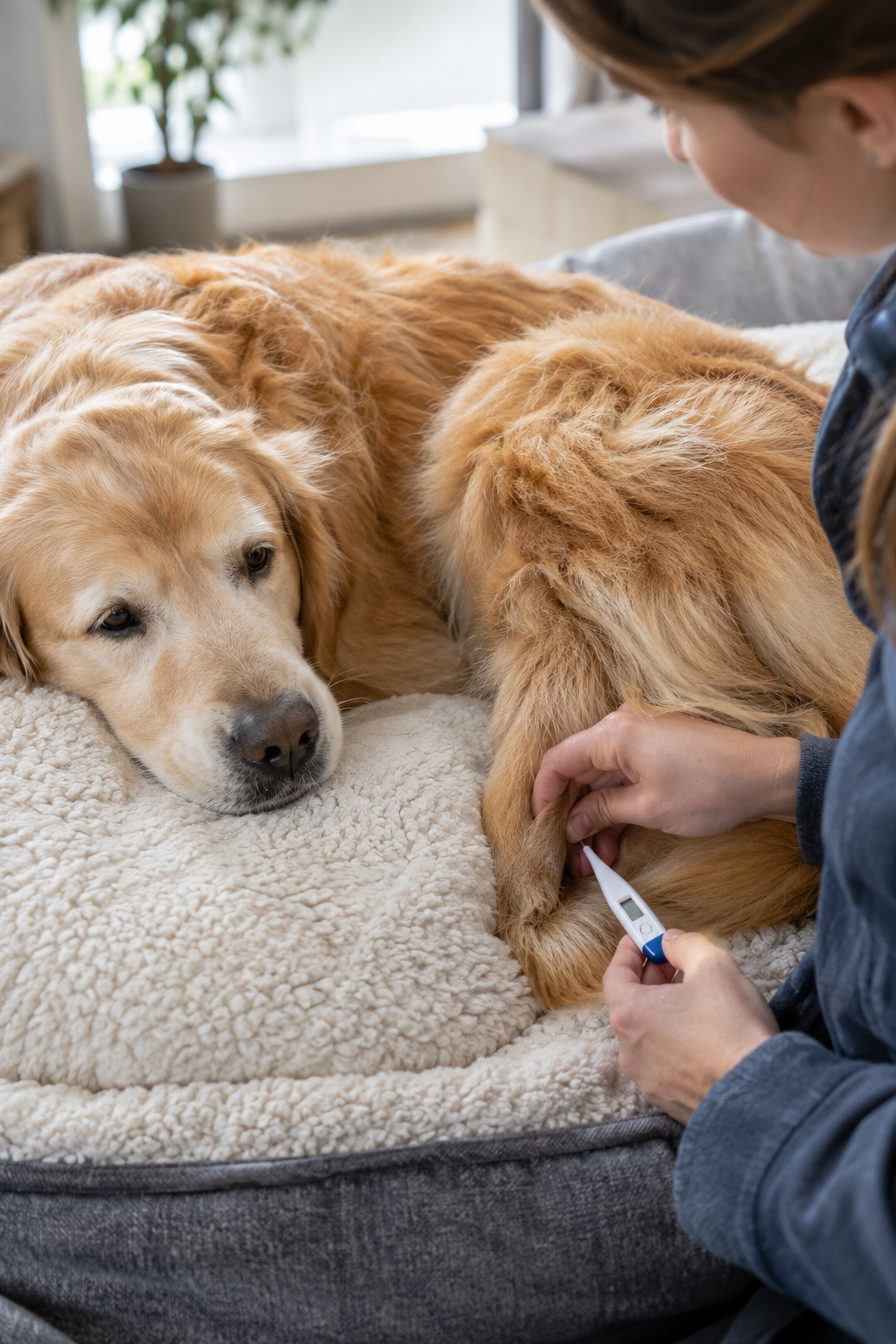
Temperature changes: A dog’s rectal temperature may fall below approximately 99°F (37.2°C) within the 24 hours before labor. Not every dog follows this pattern consistently, so temperature alone cannot predict delivery with certainty.
Stage one labor: This stage often involves restlessness, panting, pacing, hiding, nesting, or reduced appetite. It commonly lasts several hours, sometimes around six to 12 hours, and can last longer. These behaviors are not the same as active pushing.
Stage two labor: Active abdominal contractions deliver the puppies. Remain attentive and keep track of the time, each puppy’s arrival, and any changes in the mother’s condition. The intervals between puppies vary, and a quiet pause does not always mean that labor is finished.
Contact a veterinarian urgently if:
- Your dog has strong, persistent straining for around 20 to 30 minutes without delivering a puppy.
- Green or dark green discharge appears before the first puppy, particularly if a puppy does not follow promptly.
- More than two hours pass between puppies when you know or suspect that more remain.
- Your dog shows obvious distress, severe weakness, collapse, heavy bleeding, or foul-smelling discharge.
- Labor appears to stop progressing, or you are unsure whether the mother or puppies are safe.
These are conservative warning signs, not an exhaustive diagnostic checklist. Do not wait for every listed sign to appear before seeking help. Certain breeds and individual pregnancies can face additional delivery risks, so ask your veterinarian for a plan tailored to your dog before labor begins.
Important: This article provides general educational information only. Your veterinarian is the authority on your dog’s reproductive health, breeding readiness, pregnancy monitoring, and labor. A suspected delivery complication warrants prompt veterinary advice.
Frequently asked questions
How long is a dog pregnant?
Dog pregnancy averages about 63 days from ovulation. When measured from breeding, a commonly used planning range is approximately 58 to 68 days. The actual timing depends on ovulation and the individual pregnancy, so breeding dates alone cannot determine the exact due date.
How often do dogs go into heat?
Many female dogs go into heat about every six months. Smaller and larger breeds can have different patterns, and some individual dogs have longer or shorter intervals. Tracking cycles over time helps establish what is typical for your dog.
What are the best days to breed a dog?
The most appropriate timing depends on ovulation, not a fixed calendar day. Days 9 to 14 are sometimes used as a rough estimate, but veterinary progesterone testing is more reliable for identifying the fertile window in a planned breeding.
At what age can a dog be bred?
A female should not be bred on her first heat. For most breeds, waiting until around two years of age and completing the recommended health testing is a responsible general benchmark. Your veterinarian and breed club can advise on the appropriate timing for an individual dog.
How can I tell if my dog is pregnant?
Behavioral or physical changes alone cannot confirm pregnancy. A veterinarian can recommend an appropriate examination or diagnostic test; ultrasound may detect pregnancy from around day 25 to 30. Read our dog pregnancy signs and symptoms guide for an overview of changes that may occur.
Conclusion
A dog breeding chart gives you a useful overview of heat-cycle stages, fertility, pregnancy milestones, and the approach of whelping. Because the timing varies between dogs, use these ranges for orientation rather than as a substitute for veterinary assessment. Responsible breeding begins with maturity and health screening, continues with appropriate pregnancy monitoring, and includes preparation for the unexpected. Working with a veterinarian helps protect both the mother and her puppies at every stage.
About Jennifer: Jennifer is the founder and owner of CanineCalc, a dog owner and researcher who develops practical educational resources to help people understand canine growth, health, and care. Her articles are intended for general information and do not replace advice from a veterinarian.