Labradors are enthusiastic eaters, and many seem ready for another meal moments after finishing one. That makes choosing the right portion especially important. Feed too little, and a growing puppy may not get the nutrition it needs. Feed too much, and those extra calories can add up quickly.
This Labrador feeding chart by age gives you a starting point for daily food amounts, from an 8-week-old puppy to an adult Lab. You’ll also find typical weights, meal frequencies, and practical ways to tell whether your dog is getting the right amount.
One important note: these are reference ranges, not exact prescriptions. Your Lab’s age, body size, activity level, and food’s calorie content all affect how much it needs to eat.
Labrador feeding chart by age
| Age | Typical weight | Daily food amount | Meals per day |
|---|---|---|---|
| 8 weeks | 10–16 lb (4.5–7.3 kg) | 2½–2¾ cups (214–240 g) | 4 |
| 3 months | 18–30 lb (8–14 kg) | 3–3⅝ cups (264–312 g) | 3–4 |
| 4 months | 25–40 lb (11–18 kg) | 3¼–4 cups (286–343 g) | 3 |
| 6 months | 35–55 lb (16–25 kg) | 3¾–5¼ cups (327–450 g) | 2–3 |
| 9 months | 45–70 lb (20–32 kg) | 3½–4⅞ cups (299–421 g) | 2 |
| 12 months | 55–80 lb (25–36 kg) | 3⅜–4¾ cups (291–406 g) | 2 |
| Adult | 55–80 lb (25–36 kg) | About 3⅜–5½ cups (297–478 g) | 2 |
Sources and interpretation: Typical weights are approximate growth references, not targets for every puppy. Puppy amounts are rounded from Royal Canin’s published Labrador Retriever puppy feeding guide for different expected adult sizes. Adult amounts use its Labrador-specific adult feeding guide across weight and activity levels. The gram figures apply to those food formulations and are not universal kibble conversions. Puppy feeding guide · Adult feeding guide
How to use the chart: Start with the feeding instructions printed on your chosen food, using your puppy’s current age and expected adult size where requested. Compare that recommendation with this reference, then adjust based on body condition and weight trends.
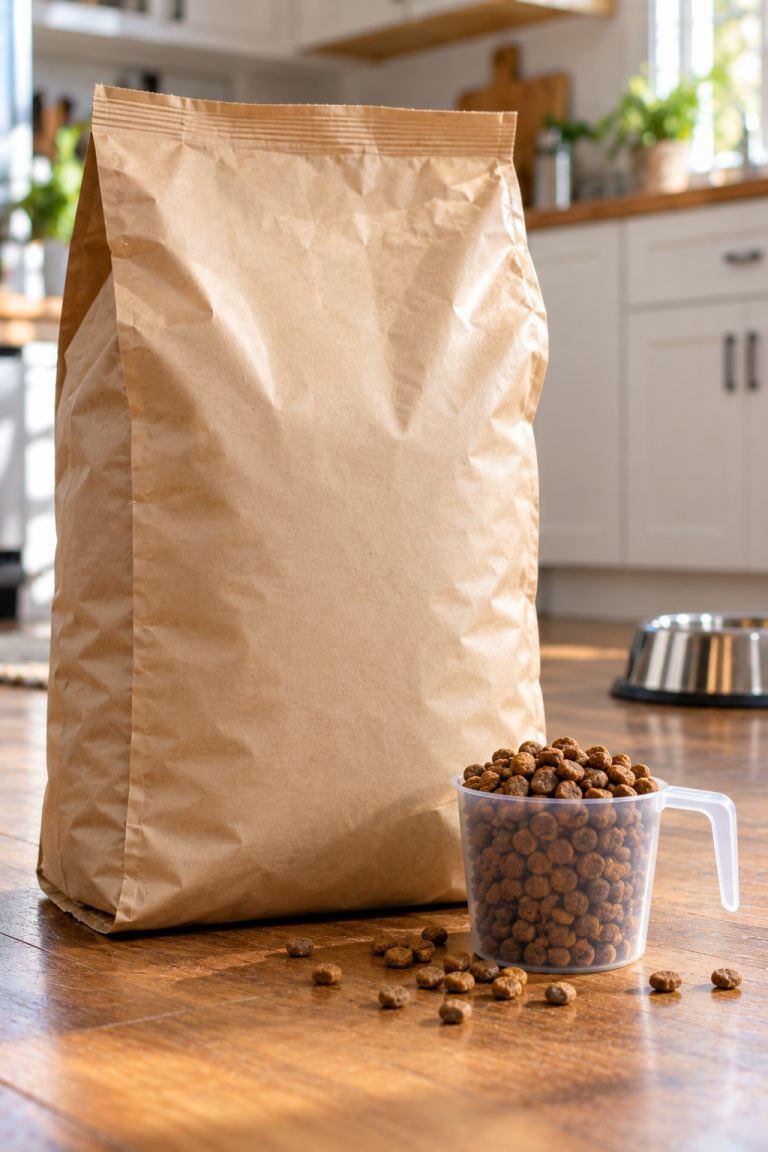
Cups are not interchangeable across foods. A cup of one kibble may contain substantially more calories than a cup of another, and even grams per cup can vary. Weighing food in grams is usually more consistent than measuring it by volume.
For a better sense of your puppy’s expected size, compare its progress with your Labrador weight chart. Growth ranges are guides, not deadlines.
How much should a Labrador puppy eat?
A Lab puppy’s food requirements change quickly during its first year. It needs enough energy and nutrients to support growth, but more food does not automatically mean healthier development.
Between 3 and 6 months, Labradors grow rapidly. Their appetite may appear enormous, but feeding extra portions every time they beg can encourage excess weight gain rather than healthy growth.
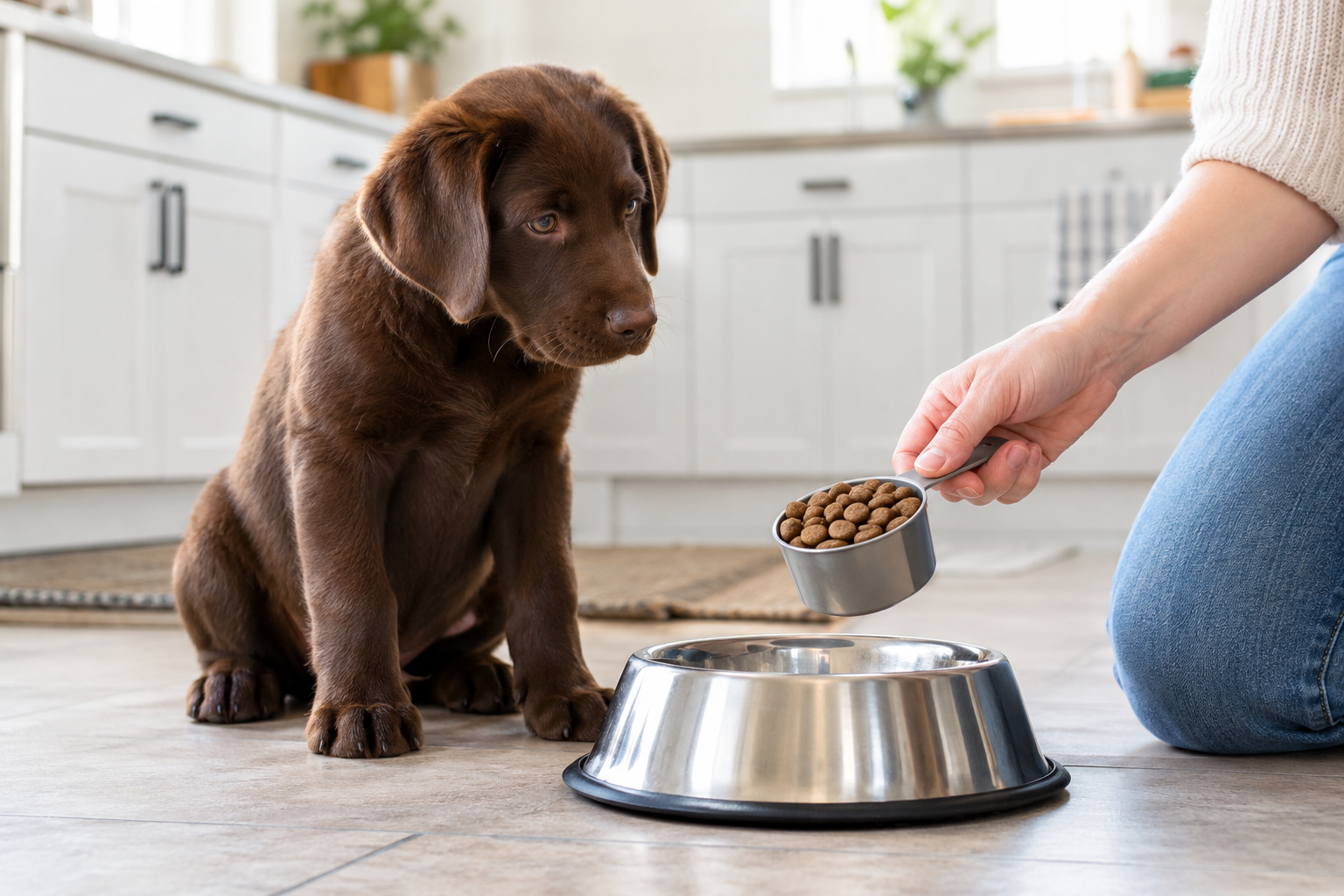
A useful approach is to divide the daily ration into scheduled meals. Measure the day’s total in the morning, then use that amount for meals and appropriate training rewards. This makes it easier to see how much your puppy actually eats.
Pay attention to body shape as well as weight. A growing puppy should develop steadily, with ribs that are easy to feel beneath a thin layer of fat and a visible waist when viewed from above. A rounder belly or a waist that gradually disappears can suggest that portions need reviewing.
Veterinary guidance from VCA Animal Hospitals emphasizes steady, controlled growth rather than maximizing growth speed. If your puppy’s weight changes unexpectedly or you are unsure whether its growth is on track, discuss the pattern with your veterinary team.
Feeding an adult Labrador
Once your Lab reaches adulthood, its daily food requirement depends heavily on its ideal weight and how much energy it uses.
A calmer house dog that enjoys regular walks may need less food than a highly active Lab that spends hours swimming, hiking, retrieving, or working. Two dogs of the same weight can have different calorie requirements.
For example, Royal Canin’s Labrador-specific adult guide gives a dog weighing around 57 lb approximately 3⅜ cups daily at low activity, 3⅞ cups at moderate activity, or 4½ cups at high activity. A heavier dog may require more, depending on its body condition and activity.
Neutered dogs may also need fewer calories after their energy needs change. Rather than automatically keeping the same portion size, monitor your dog’s weight and shape and make small adjustments when needed.
Measured meals are particularly useful for Labradors. Free feeding, or leaving a full bowl available all day, makes it harder to track actual intake. Offering two measured meals, commonly morning and evening, also helps you account for training treats and snacks.
Why Labradors gain weight so easily
Labradors have a well-known appetite, and research suggests genetics can contribute to that tendency.
A 2016 study published in Cell Metabolism by researchers affiliated with the University of Cambridge found that a deletion in the POMC gene was associated with greater food motivation, higher body weight, and increased adiposity in Labradors and closely related flat-coated retrievers. The variant does not occur in every Lab, and it does not mean every Labrador will become overweight. Read the research on PubMed.
In everyday life, that means begging is not a reliable measure of how much food your dog needs. A Lab can act hungry even after eating an appropriate portion.
A few practical habits can make portion control easier:
- Measure every meal. Use a consistent cup measure or, preferably, a kitchen scale.
- Count treats as food. Training rewards, chews, table scraps, and food puzzles can all contribute calories.
- Consider a slow-feeder bowl. It may help a dog that gulps meals quickly eat at a more manageable pace.
These habits help you manage intake without assuming that an eager appetite means your dog is underfed.
How to tell if your Labrador is eating the right amount
You do not need to rely on the scale alone. A simple body check can help you decide whether your Lab’s current portion deserves a closer look.
Check the ribs and waist. Run your hands gently along your dog’s sides. You should be able to feel the ribs without pressing hard, but they should not be prominently visible in a dog with an ideal body condition. Viewed from above, your Lab should have a noticeable waist behind the ribs. From the side, the abdomen should tuck up rather than hang straight down.
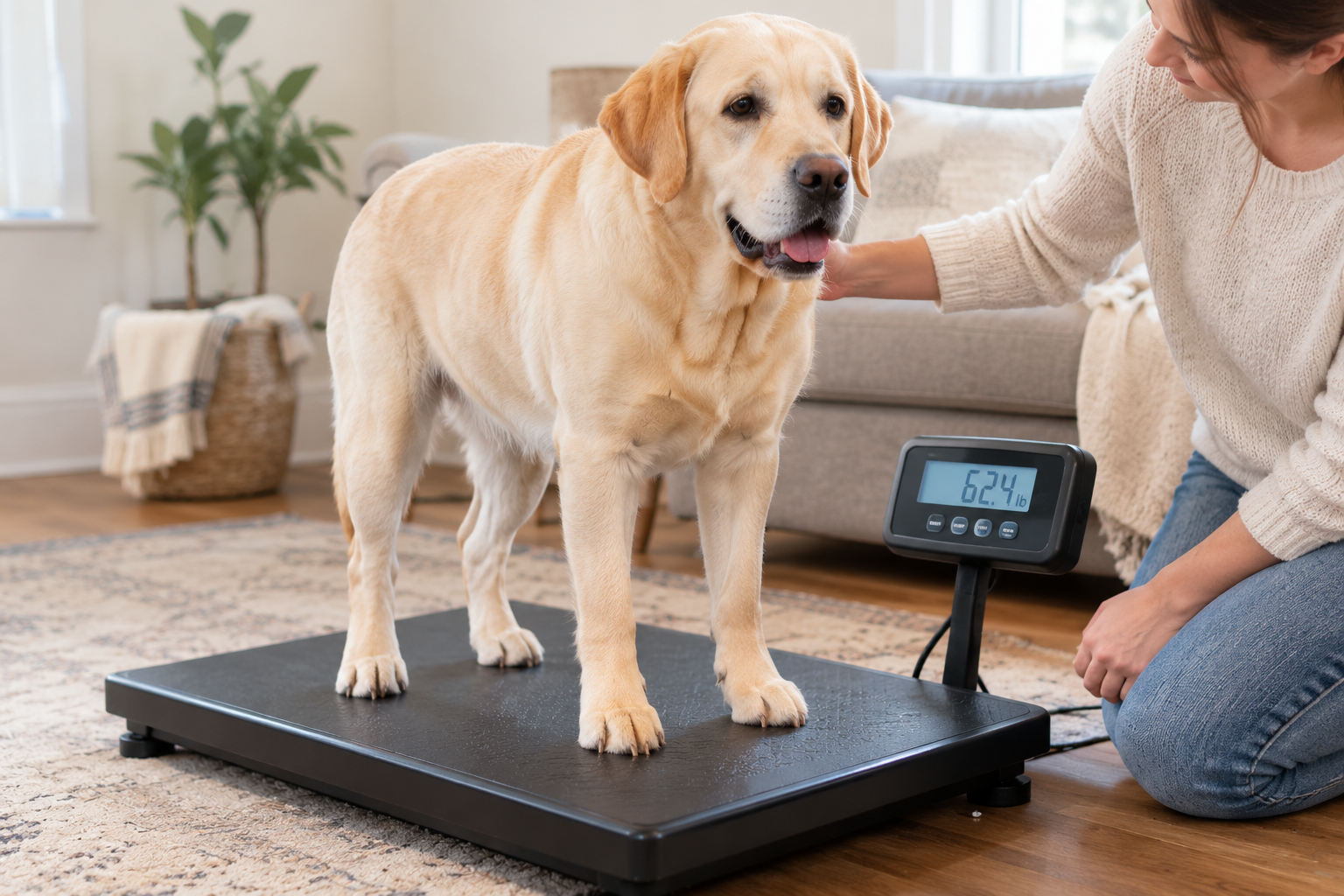
Weigh your dog monthly. Use the same scale when possible and record the result. For puppies, compare the overall growth pattern with an age-appropriate Labrador growth chart instead of expecting every puppy to match one number.
Adjust portions in small steps. If your adult Lab is gradually gaining excess fat, review treats, leftovers, and measured meals before making a modest reduction. Recheck its weight and body shape rather than making repeated large changes. Growing puppies need extra care because their nutritional requirements change as they develop.
Body shape and weight trends provide useful general information, but they cannot diagnose a health problem. Speak with your veterinarian if your Lab loses weight unexpectedly, gains weight rapidly, has a persistent change in appetite, or seems unusually hungry despite measured meals.
Labrador feeding questions and answers
How many times a day should I feed my Labrador puppy?
At around 8 weeks, four small meals a day are a practical starting point. You can generally reduce this to three meals as your puppy grows, then move toward two meals daily around 6–9 months if that schedule suits its needs. Divide the recommended daily amount across meals rather than giving the full daily portion each time.
When should I switch my Lab from puppy food to adult food?
Many Labrador owners begin planning the transition around 12 months, but timing depends on your dog’s development and the food’s specific guidance. Some Labrador puppy formulas recommend feeding through 15 months. Ask your veterinary team when to switch, and transition gradually according to the food manufacturer’s instructions.
Can I follow the amounts on the dog food bag?
Yes. The label is a useful starting point, especially when its instructions account for age, current weight, or expected adult size. However, the recommendations are not exact for every dog. Calorie density and activity levels differ, so monitor body condition and discuss adjustments with your veterinary team. VCA’s feeding guidance explains why individual dogs can need different amounts.
Why is my Labrador always hungry?
Labradors can be highly food-motivated, and the POMC gene research described above helps explain some of that behavior. Begging, licking an empty bowl, or following you into the kitchen does not necessarily mean your Lab needs more food. Check its measured intake, treats, weight trend, and body shape before increasing portions.
How many treats are too many for a Labrador?
A widely used general guideline is to keep treats and other extras to no more than 10% of daily calories, with the rest coming from a complete and balanced diet. For puppies, keep extras modest so they do not displace important nutrients. The World Small Animal Veterinary Association’s treat guidance offers further information.
Conclusion
The best Labrador feeding chart by age is a starting point, not a rule your dog must fit perfectly. Use food-label recommendations to establish portions, divide those portions into appropriate meals, and check your Lab’s weight and body condition regularly.
Because Labradors can be enthusiastic eaters, measured meals and carefully counted treats are especially useful habits. When you are uncertain about growth, weight changes, or feeding amounts, your veterinarian can help you find an appropriate plan for your individual dog.
By Jennifer, founder of CanineCalc. Jennifer is a dog owner and researcher who creates practical, research-informed resources to help dog owners understand their pets’ growth, feeding, and care.