
Last updated: October 2026
A Labrador’s weight changes quickly during puppyhood, then gradually slows as the dog approaches adult size. A Labrador weight chart in kg helps you compare your puppy’s current weight with practical age-based ranges, without converting pounds or chasing one supposedly perfect number.
The key is the growth pattern. A puppy who follows a steady curve may be developing normally even when its weight differs from a published average.
Labrador Weight Chart kg: Male and Female by Age
A Labrador weight chart kg is a reference showing how a Labrador Retriever’s body weight may change as the dog grows. It helps owners compare a puppy’s weight with practical ranges for its age and sex. These ranges are guides, not diagnostic limits or guaranteed targets.
According to the American Kennel Club (AKC), adult male Labradors typically weigh 29.5–36.3 kg, while adult females typically weigh 25–31.8 kg. Those are adult breed-reference ranges, not month-by-month puppy standards.
Labrador puppy weight chart by month
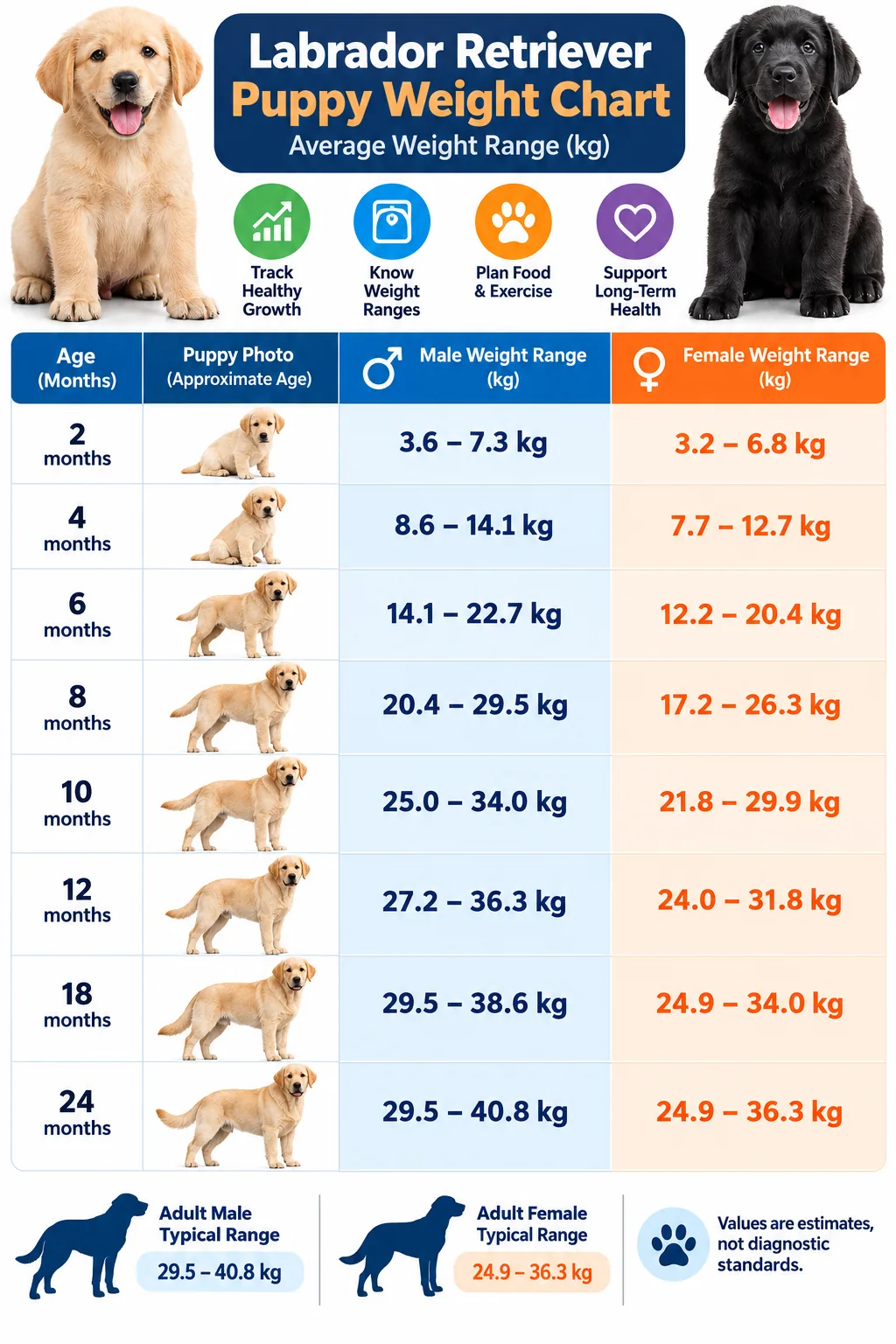
The following chart provides approximate planning bands for Labrador puppies. Monthly weights vary with genetics, body condition, activity, diet, and the timing of individual growth spurts. These are practical reference estimates, not values established by a single large-scale Labrador-specific study.
| Age | Male Labrador (kg) | Female Labrador (kg) |
|---|---|---|
| 2 months | 5–7 | 4–6 |
| 3 months | 8–11 | 7–10 |
| 4 months | 12–16 | 10–14 |
| 5 months | 16–21 | 14–19 |
| 6 months | 20–25 | 17–23 |
| 7 months | 22–28 | 19–25 |
| 8 months | 24–30 | 20–27 |
| 9 months | 25–32 | 21–28 |
| 10 months | 26–34 | 22–29 |
| 12 months | 27–36 | 23–30 |
| 18 months | 29–36 | 25–32 |
| 24 months | 29.5–36.3 | 25–31.8 |
What the chart can and cannot tell you
The chart is useful for spotting broad patterns. It cannot establish whether an individual Labrador is healthy based on weight alone.
Sources disagree on how to present puppy growth: some calculators provide a single projected adult weight, while research-based growth charts compare a dog’s trajectory with reference curves. The research approach is more informative because it accounts for how growth changes with age.
According to Salt et al. (2017), research using records from more than six million young dogs developed evidence-based canine growth standard charts. These charts support tracking growth against reference curves, including size classes relevant to large-breed dogs.
Source: Salt et al. (2017), PLOS ONE — evidence-based canine growth standard charts.
How Labrador Puppies Grow From 2 to 24 Months
Labradors do not gain weight at the same rate throughout puppyhood. Growth is usually faster in the early months and gradually slows as the dog approaches adult size. Many Labradors are around half their eventual adult weight by approximately five to six months, but this is a rough planning observation, not a rule that applies to every puppy.
According to Salt et al. (2017), size-specific growth curves offer a more useful way to evaluate development than treating one weight as the universal target for an age. A Labrador generally belongs to the large size class, although individual growth still varies.
The main growth stages
2–4 months: Rapid early growth
Puppies gain weight quickly during this period. Changes in appetite, feeding routines, and activity can affect individual weigh-ins, so consistent measurement matters more than comparing your puppy with every online chart.
5–6 months: A useful midpoint check
Many Labradors have already completed a substantial part of their weight gain by this stage. Being above or below half of a predicted adult weight does not automatically indicate a problem; the dog’s overall curve and body condition matter.
7–12 months: Growth continues, but the pace changes
Some puppies gain weight steadily, while others experience uneven growth spurts. Their height, muscle development, and body proportions may change at different rates.
12–24 months: Approaching adult size
Many Labradors reach most of their adult height before they finish filling out. Muscle development and changes in body composition can continue after the first birthday, and some dogs take up to 18–24 months to mature fully.
Here’s the thing: adult size and healthy body condition are not the same thing. A heavier Labrador is not necessarily a healthier Labrador.
How to track your puppy’s growth
To compare your puppy’s development with a chart, follow these steps:
- Weigh your puppy on the same scale whenever possible.
- Record its age and weight in kilograms.
- Compare several measurements over time, not just one reading.
- Check body condition alongside the numbers.
- Ask your veterinarian about persistent changes, poor growth, or unexplained weight loss.
Trying to predict your puppy’s adult size? Here’s what to know.
Related: puppy growth chart predictor
English vs American Labrador: Does Build Affect Weight?
Labradors are sometimes described as English or American, usually referring to differences in build and breeding emphasis rather than separate breeds. English-type Labradors are often stockier, with broader heads and heavier-looking bodies. American-type Labradors are often leaner and more athletic in appearance.
These are general tendencies, not reliable ways to predict an individual dog’s healthy weight. Lineage, sex, height, body condition, and genetics can all influence the result.
Quick Comparison
| Option | Best For | Key Benefit | Limitation |
|---|---|---|---|
| English-type Labrador | Owners comparing a stockier build | Helps explain a broader, heavier-looking frame | Does not establish a healthy target weight |
| American-type Labrador | Owners comparing a leaner, athletic build | Helps explain a lighter-looking outline | Individual dogs may differ considerably |
| Male Labrador | Checking male adult reference ranges | AKC adult range: 29.5–36.3 kg | Not a puppy growth standard |
| Female Labrador | Checking female adult reference ranges | AKC adult range: 25–31.8 kg | Not a puppy growth standard |
Here’s the important part: growth isn’t always predictable.
How to Tell Whether Your Labrador Is Growing Well
Weight is only one part of the picture. A Labrador can fall within a reference range and still carry excess body fat, while another may sit near the edge of a range and have an appropriate body condition for its frame.
Look beyond the scale
When checking your Labrador, consider:
- Ribs: You should generally be able to feel the ribs under a light covering of fat.
- Waist: Viewed from above, a healthy dog typically has a visible waist behind the ribs.
- Abdominal tuck: Viewed from the side, the abdomen generally rises toward the hind legs.
- Growth trend: Repeated measurements help reveal whether development is steady or changing unexpectedly.
- Overall condition: Appetite, energy, mobility, and other changes matter alongside weight.
These observations are general body-condition clues, not a diagnosis. Puppies change shape as they develop, so ask a veterinarian to assess your dog’s condition if you are unsure.
What most guides skip
A chart cannot account for every feeding routine, health condition, or difference in body structure. It also cannot distinguish healthy muscle from excess fat using weight alone.
This guide covers approximate Labrador weight ranges, general growth stages, and practical tracking methods. It does not diagnose illness, prescribe feeding amounts, or replace an individual assessment by a veterinarian.
For predicting adult size, the CanineCalc Puppy Size Calculator can be used as a planning aid. It uses age, current weight, and expected size category to estimate a likely growth trajectory, with a practical planning range of approximately ±15%. That range is an estimate, not a guaranteed confidence interval or a medical standard.
Related: how big will my puppy get?
When should you get professional advice?
Contact your veterinarian if your puppy stops gaining weight unexpectedly, loses weight without explanation, has persistent digestive symptoms, shows a marked change in appetite, or seems unusually tired. Rapid weight gain and signs of excess body fat also deserve attention.
A single measurement rarely tells the whole story. Persistent changes are more useful signals to investigate than minor differences from an online estimate.
Frequently Asked Questions About Labrador Weight in kg
Q: What’s the best way to check a Labrador puppy’s weight?
Weigh your puppy consistently, record the result in kilograms, and compare several measurements over time. Use age-based charts as rough references, and consider body condition rather than relying on one number.
Q: How do I know whether my Labrador puppy is underweight?
Consider the dog’s growth trend, appetite, energy, and body condition. If the ribs, waist, or overall appearance concern you, or weight gain stalls, ask a veterinarian to assess the puppy rather than relying on a chart alone.
Q: Should a male Labrador weigh more than a female?
Adult males generally have higher breed-reference weight ranges than females. Individual dogs can overlap, however, and sex alone cannot determine the appropriate weight for a particular Labrador.
Q: Why does my Labrador weigh less than the chart says?
Published charts use different methods and assumptions. Your puppy may have a smaller frame or a different growth pattern. Compare repeated weigh-ins and body condition, and seek veterinary advice if the difference persists or comes with other symptoms.
Q: When should a Labrador reach adult weight?
Many Labradors approach their adult size during the first year, but some continue filling out until around 18–24 months. Maturity varies, so use the growth trend and body condition rather than a strict birthday deadline.
The Bottom Line
A Labrador weight chart in kg is most useful as a tracking tool, not a pass-or-fail test. Compare your puppy with practical male and female ranges, record weight consistently, and pay attention to body condition and the overall direction of growth.
The best target is not necessarily the average printed in a chart. It is a healthy growth pattern for your individual dog, assessed with appropriate professional guidance when concerns arise.
If you are comparing Labradors with another large breed, our Golden Retriever weight chart shows the corresponding ranges for Golden Retrievers by age.