
Last updated: October 2026
A Golden Retriever puppy can gain weight quickly in the first few months, then slow down as adulthood approaches. It’s easy to worry when your puppy weighs less than a number you found online.
The useful question isn’t whether your dog matches one exact number. It’s whether they’re growing steadily, maintaining a healthy body condition, and developing as expected for their age and build.
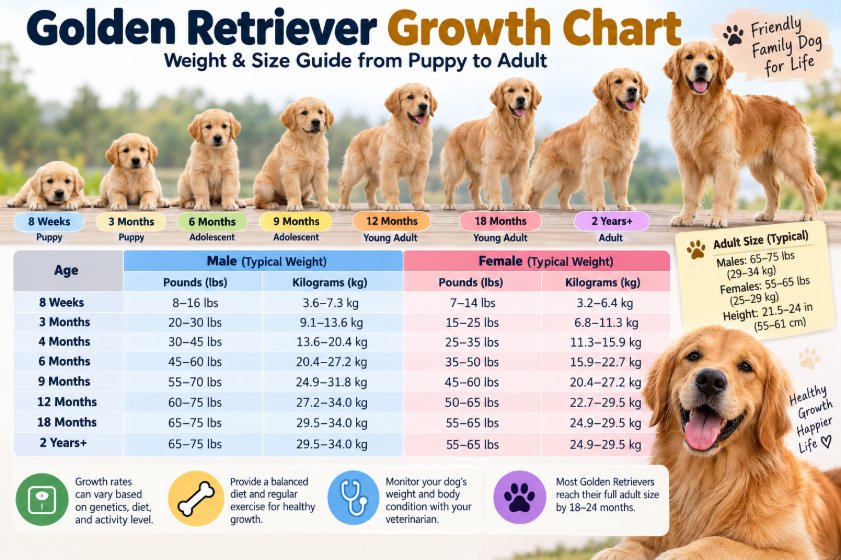
A Golden Retriever weight chart gives you a starting point for that assessment, with separate estimates for males and females and measurements in both pounds and kilograms.
Try the CanineCalc Puppy Size Calculator to estimate your puppy’s projected adult weight.
Golden Retriever Weight Chart by Age
A Golden Retriever weight chart is an age-based reference for comparing your puppy’s weight with typical breed-related estimates. It helps you follow growth over time, but it cannot diagnose poor nutrition, excess weight, or a medical condition. Use the numbers alongside body condition and veterinary guidance.
Male and female Golden Retriever puppy weight chart
The table below provides broad, practical weight bands for common puppy ages. These are approximate planning ranges, not scientifically validated monthly targets for every Golden Retriever.
| Age | Male (lb) | Male (kg) | Female (lb) | Female (kg) |
|---|---|---|---|---|
| 2 months (8 weeks) | 9–13 | 4.1–5.9 | 7–11 | 3.2–5.0 |
| 3 months | 15–25 | 6.8–11.3 | 13–22 | 5.9–10.0 |
| 4 months | 25–35 | 11.3–15.9 | 20–31 | 9.1–14.1 |
| 5 months | 32–44 | 14.5–20.0 | 25–37 | 11.3–16.8 |
| 6 months | 35–50 | 15.9–22.7 | 29–43 | 13.2–19.5 |
| 7 months | 40–55 | 18.1–24.9 | 33–48 | 15.0–21.8 |
| 8 months | 44–60 | 20.0–27.2 | 36–52 | 16.3–23.6 |
| 9 months | 48–62 | 21.8–28.1 | 38–54 | 17.2–24.5 |
| 10 months | 50–65 | 22.7–29.5 | 40–58 | 18.1–26.3 |
| 11 months | 52–68 | 23.6–30.8 | 42–60 | 19.1–27.2 |
| 12 months | 55–72 | 24.9–32.7 | 45–62 | 20.4–28.1 |
| 18–24 months (adult reference) | 65–75 | 29.5–34.0 | 55–65 | 24.9–29.5 |
Individual puppies can fall outside these ranges and still be healthy. Genetics, litter size, body frame, nutrition, and growth timing can all influence weight.
The direction of growth matters more than a single reading.
What the growth pattern should look like
Golden Retrievers generally grow fastest during their early puppy months. Weight gain tends to slow as they approach maturity, although the exact timing differs between dogs.
A puppy that weighs less than the middle of a chart’s range isn’t automatically underweight. A larger puppy isn’t automatically overweight, either.
Research supports looking at growth as a curve rather than a collection of isolated numbers. A 2017 study by Salt and colleagues, published in PLOS ONE, used veterinary records from more than six million young dogs to develop evidence-based canine growth standards. The study supports growth monitoring; it does not establish one universal, month-by-month ideal-weight table for Golden Retrievers. Read the study.
Source: Salt et al. (2017), PLOS ONE — evidence-based canine growth standards.
How Much Should a Golden Retriever Weigh as an Adult?
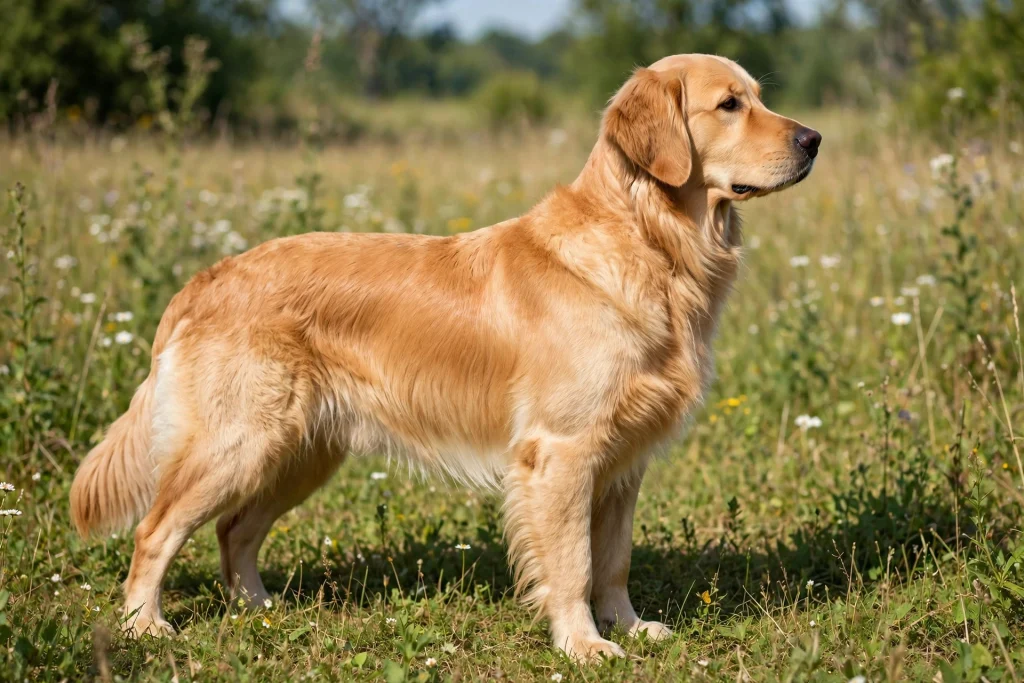
According to the American Kennel Club, adult male Golden Retrievers typically weigh 65–75 pounds (29.5–34 kg), while females typically weigh 55–65 pounds (25–29.5 kg). These are adult breed-standard ranges, not puppy weight targets or stand-alone measures of health. Owners comparing the two retriever breeds can check the same kind of monthly figures in the Labrador weight chart in kilograms.
Male vs. female Golden Retriever weight
| Measurement | Male Golden Retriever | Female Golden Retriever |
|---|---|---|
| Typical adult weight | 65–75 lb (29.5–34 kg) | 55–65 lb (25–29.5 kg) |
| Typical adult height | 23–24 inches | 21.5–22.5 inches |
| Best way to assess weight | Consider frame, body condition, and growth history | Consider frame, body condition, and growth history |
Male Goldens are generally larger than females, but the ranges overlap in practice. A female weighing 60 pounds may be perfectly healthy, and a male weighing 60 pounds may also be healthy, depending on age, development, and body condition.
The scale alone cannot tell you which dog is healthier.
When do Golden Retrievers stop growing?
Golden Retrievers gain much of their height during puppyhood and adolescence, while their bodies continue developing afterward. Many are close to their adult height around 12–18 months, but weight and muscle development may continue settling through roughly 18–24 months.
Don’t confuse reaching adult height with completing physical development. A lanky adolescent Golden can look unusually thin before their chest and overall frame mature.
A 12-month-old dog also doesn’t automatically need to weigh exactly the adult average. Their current growth pattern and body condition offer more useful context.
Quick Comparison
| Option | Best For | Key Benefit | Limitation |
|---|---|---|---|
| AKC adult weight range | Estimating mature breed size | Official breed reference | Doesn’t provide monthly puppy targets |
| Puppy weight chart | Checking approximate age-related ranges | Easy visual reference | Monthly figures vary between publishers |
| Growth calculator | Estimating a possible adult size | Uses current weight and age | Prediction isn’t a guarantee |
| Repeated weight records | Monitoring an individual dog | Shows the direction of growth | Requires consistent measurements |
Estimate your puppy’s adult weight
The [CanineCalc Puppy Size Calculator] uses your puppy’s current weight, age, and expected size category to estimate possible adult size. For a Golden Retriever, choose the large-dog category.
Its projected range of approximately ±15% is a practical planning estimate, not a statistical confidence interval or a guarantee of adult weight.
Try the CanineCalc Puppy Size Calculator to estimate your puppy’s projected adult weight.
Why Golden Retriever Puppy Weights Vary
A puppy’s weight depends on more than its age and sex.
Two healthy Golden Retrievers born in the same litter can develop at different rates. Their adult frames may differ, too. A growth chart should help you recognize a broad pattern, not force every puppy into the same shape.
Genetics, nutrition, and body condition
Several factors can explain differences between your puppy and a published estimate:
- Genetics: Parents, inherited build, and individual growth patterns influence adult size.
- Age and developmental stage: Puppies of the same stated age may be at slightly different points in growth.
- Nutrition: Appropriate food, sufficient calories, and a balanced nutrient profile support normal development.
- Body condition: Muscle, body fat, and frame size all affect how a weight reading should be interpreted.
- Health: Digestive problems, parasites, or other medical issues can affect appetite, weight gain, or growth.
A large-breed puppy food formulated for growth is generally preferable to choosing food or supplements simply to push weight upward. Ask your veterinarian whether the diet meets your puppy’s needs, particularly if growth appears unusually slow or fast.
Why online weight charts disagree
Sources disagree about exact monthly estimates. For example, Devoted to Dog’s Golden Retriever chart gives an 8-week male range of 9–13 pounds, while GoldenRetrieverInsight lists approximately 10–15 pounds for males at that age. Both are published breed-growth estimates, not validated medical targets.
There isn’t enough evidence in those charts to declare one range universally correct.
The more defensible approach is to use a broad range as an initial reference, record repeated measurements, and evaluate the puppy’s own trajectory. The peer-reviewed Salt et al. study provides an important distinction: evidence-based growth standards can track how body weight changes with age, but those standards aren’t the same as a universal breed-specific prescription.
What most guides skip is that a puppy’s current weight becomes much more informative when you know their previous weight, body condition, and age at each measurement.
The steady-climb rule
Think of growth as a trend line.
A puppy who stays near the lower part of a broad chart range while gaining steadily and maintaining healthy body condition may be doing well. A puppy whose weight suddenly stalls or falls away from their previous pattern deserves closer attention, even if the latest number still falls within the table.
When it comes to puppy size, a few things make a real difference.
You don’t need a perfect match, and you shouldn’t try to force the puppy to reach a chart’s midpoint.
How to Track Your Golden Retriever’s Growth
Regular measurements make it easier to recognize changes than occasional weigh-ins do.
A simple puppy-weight tracking method
To track your Golden Retriever’s growth:
- Weigh your puppy on a consistent scale.
- Record their age and weight each time.
- Check body condition and appetite alongside weight.
- Compare measurements over time rather than judging one reading.
- Bring your weight log to routine veterinary visits.
For younger puppies, weekly measurements can offer a useful view of rapid changes. As growth slows, your veterinarian may recommend a different monitoring schedule.
Use the same units consistently, and record the exact age rather than rounding every measurement to the nearest month.
Pounds to kilograms: quick conversion
Use these conversions to check a measurement or compare charts:
- 1 pound = approximately 0.4536 kilograms
- 1 kilogram = approximately 2.2046 pounds
- 50 pounds = approximately 22.7 kilograms
- 60 pounds = approximately 27.2 kilograms
- 70 pounds = approximately 31.8 kilograms
For example, a puppy weighing 40 pounds weighs about 18.1 kg. That conversion doesn’t tell you whether the weight is healthy; age, body condition, and growth history still matter.
Quick note: body condition is often more useful than a small difference between two scale readings.
How to check body condition
A body condition assessment adds useful context to weight records.
In a dog at an appropriate body condition, you should generally be able to feel the ribs without pressing hard, see a waist when looking down from above, and notice an abdominal tuck when viewing the dog from the side.
A thick Golden Retriever coat can make visual assessment tricky, so use gentle palpation and ask your veterinarian to demonstrate the correct assessment if you’re unsure.
A puppy who looks lean during adolescence isn’t necessarily underweight. That’s normal, too. Puppy growth rarely follows a perfectly straight line.
A strong recommendation: don’t adjust portions solely to make your puppy match a weight chart. The reason is simple — pushing a large-breed puppy to gain faster can undermine sensible growth management rather than improve health.
Related: puppy growth chart predictor
When Should You Be Concerned About Your Golden Retriever’s Weight?
A single measurement outside a chart’s range isn’t necessarily an emergency. A change in the growth pattern, particularly alongside other symptoms, deserves more attention.
Contact your veterinarian if you notice:
- Repeated measurements showing little or no expected weight gain during active growth.
- Unexplained weight loss or a noticeable drop in body condition.
- Persistent poor appetite, vomiting, or diarrhea.
- A visibly prominent ribcage, spine, or hip bones alongside other concerns.
- Rapid weight gain accompanied by reduced mobility or an increasingly heavy body condition.
Seek prompt veterinary advice if your puppy has marked weakness, repeated vomiting, significant diarrhea, or other signs of illness. A veterinarian can assess hydration, nutrition, parasites, and other possible causes rather than relying on weight figures alone.
This guide covers routine weight tracking and approximate breed-growth ranges. It does not diagnose medical conditions, prescribe a feeding plan, or establish an individual puppy’s ideal body weight.
Golden Retriever Weight Chart: Common Questions
Q: What’s the normal weight for a 3-month-old Golden Retriever?
Broad published estimates commonly place 3-month-old males around 15–25 pounds and females around 13–22 pounds. These are approximate reference bands, not validated targets. Check growth over time and discuss concerns with your veterinarian.
Q: How do I know if my Golden Retriever puppy is growing normally?
Track weight consistently, assess body condition, and watch for a steady growth pattern. Normal growth varies by genetics and development. A veterinarian can interpret measurements alongside your puppy’s health and physical examination.
Q: Should I worry if my Golden Retriever is smaller than the chart?
Not automatically. A smaller puppy may have a naturally smaller frame or a different growth pattern. Persistent growth changes, weight loss, poor appetite, or other symptoms warrant veterinary attention.
Q: Why does my male Golden Retriever weigh less than some females?
Sex-based adult averages describe populations, not every individual dog. Age, genetics, frame, and development affect weight. A healthy male can weigh less than a female without that difference alone indicating a problem.
Q: When should a Golden Retriever reach adult weight?
Many Golden Retrievers approach mature size during their second year, with weight and muscle development continuing through roughly 18–24 months. Timing varies by individual, so use adult breed ranges as context rather than a deadline.
The Takeaway: Follow the Trend, Not Just the Number
A Golden Retriever weight chart helps you compare your puppy with broad expectations for the breed. It doesn’t determine whether your dog is healthy by itself.
Use the male and female ranges as starting points, keep pounds and kilograms consistent, and record weight changes over time. Most of all, pay attention to body condition, appetite, energy, and the overall growth pattern.
A puppy who develops steadily doesn’t have to match every number on the chart. When growth stalls, weight drops unexpectedly, or symptoms appear, your veterinarian is the right person to help you work out why.