
German Shepherd weight calculator
Estimate your German Shepherd puppy’s adult weight from current age, weight and sex.
Last updated: October 2026
A German Shepherd weight calculator estimates your puppy’s likely adult weight using its current weight, age, and sex. The CanineCalc calculator uses separate male and female growth curves to project adult size and display a practical planning range.
Your puppy doesn’t have to match every growth chart.
According to the American Kennel Club (AKC), the desired shoulder height for male German Shepherd Dogs is 24–26 inches, compared with 22–24 inches for females. These breed-standard measurements describe height, not a prediction for an individual puppy’s adult weight. Genetics, build, and growth patterns all affect the final number.
cdn.akc.org
How the calculator works
The CanineCalc German Shepherd Weight Calculator estimates adult weight with a straightforward formula:
The fraction grown comes from the puppy’s age and sex. Between listed ages, the calculator uses linear interpolation, which estimates an intermediate value between two known growth points.
For example, a male puppy aged 22 weeks has a fraction-grown value of 0.55, or 55%. Dividing its current weight by 0.55 provides the projected adult weight.
The calculator accepts ages from 6 to 104 weeks and displays growth progress plus a ±15% planning range. That range is a practical allowance for planning, not a statistically validated confidence interval.
To estimate your German Shepherd’s adult weight:
- Enter your puppy’s current weight in pounds or kilograms.
- Select its age in weeks and sex.
- Review the adult-weight estimate, planning range, and growth progress.
Here’s the thing: a calculator gives you a useful starting point, not a guarantee. Your dog’s actual weight may differ from its projection.
3. The Sex-Specific Growth Curves Behind the Number
Male and female German Shepherds do not follow identical growth curves in the CanineCalc model. Their estimated fractions grown begin to diverge at 13 weeks, with the female curve reaching higher fractions at several subsequent ages.
According to the AKC’s general breed weight chart, German Shepherd Dogs are listed in a broad 50–90 lb weight range for both sexes. Many breed-specific references instead quote 65–90 lb for males and 50–70 lb for females. This difference illustrates why breed references should be treated as guidelines rather than exact individual targets.
Growth curve data used by the calculator
The following percentages represent the actual fraction-grown data points used by the CanineCalc model. Intermediate ages are calculated by linear interpolation.
| Age (weeks) | Male fraction grown | Female fraction grown |
|---|---|---|
| 6 | 14% | 14% |
| 9 | 22% | 22% |
| 13 | 32% | 34% |
| 17 | 46% | 53% |
| 22 | 55% | 63% |
| 26 | 65% | 74% |
| 30 | 73% | 82% |
| 35 | 79% | 88% |
| 39 | 83% | 92% |
| 43 | 85% | 95% |
| 48 | 87% | 99% |
| 52 | 92% | 99% |
| 78 | 100% | 100% |
Typical German Shepherd weight by age
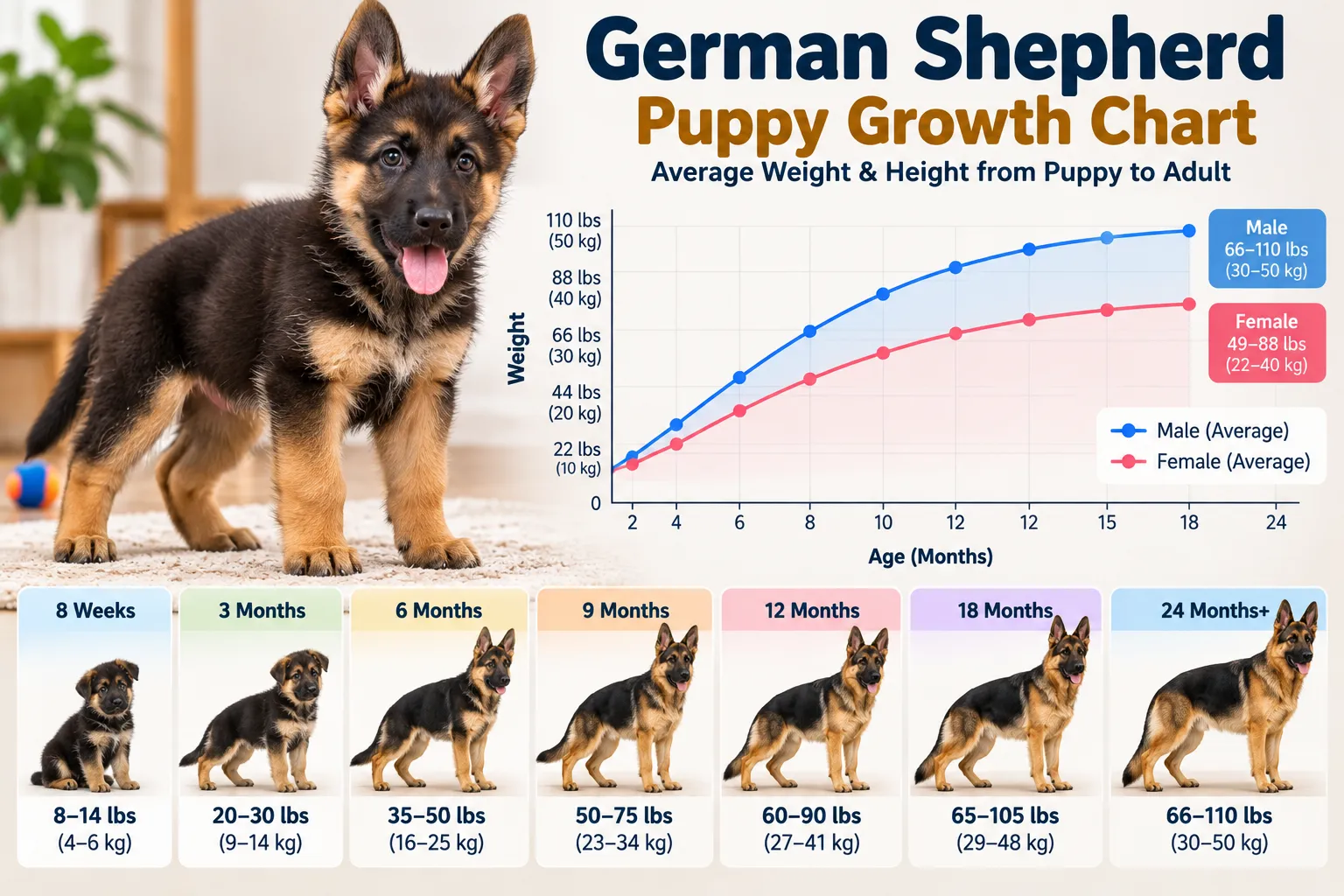
Published German Shepherd puppy weight charts provide a second way to understand your dog’s development. The ranges below come from a published breed-specific reference; they are illustrative benchmarks, not universal targets.
German Shepherd Now
| Age | Male weight range | Female weight range |
|---|---|---|
| 2 months | 16–20 lb | 11–17 lb |
| 3 months | 22–30 lb | 17–26 lb |
| 4 months | 35–40 lb | 31–35 lb |
| 6 months | 49–57 lb | 44–49 lb |
| 9 months | 64–71 lb | 55–60 lb |
| 12 months | 71–79 lb | 60–64 lb |
| 18 months | 71–84 lb | 60–66 lb |
| 24 months | 65–90 lb | 50–70 lb |
Use the table to understand broad patterns. Don’t use it to decide whether your puppy is healthy based on one weigh-in.
Male vs. female growth curves
A sex-specific calculator is better suited to estimating individual growth than a generic calculator that treats all puppies alike, because it uses separate male and female growth assumptions. A printed chart is useful for quick comparisons, while an interactive calculator turns your puppy’s current weight and age into a personalized projection.
4. Worked Example: A 22-Week-Old Male German Shepherd
Suppose your male German Shepherd puppy weighs 40 lb at 22 weeks. The CanineCalc male growth curve assigns that age a fraction-grown value of 0.55.
The calculation is:
Rounded to one decimal place, the estimated adult weight is 72.7 lb.
The calculator’s ±15% planning range works out as follows:
| Calculation | Result |
|---|---|
| Estimated adult weight | 72.7 lb |
| Lower planning estimate | 61.8 lb |
| Upper planning estimate | 83.6 lb |
| Growth progress | 55% |
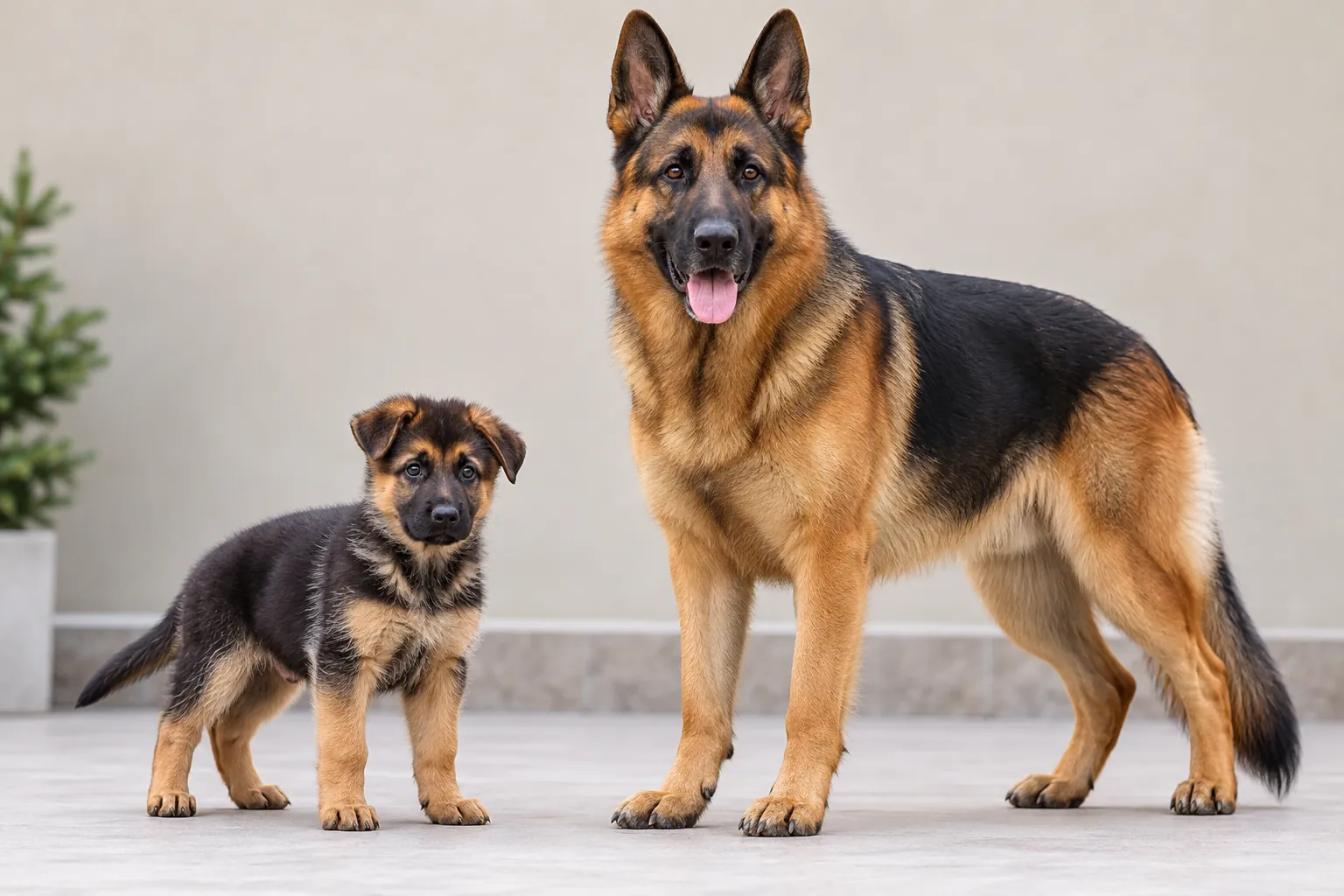
Wondering what size your dog will be as an adult? These clues help.
In other words, some months bring bigger changes than others.
5. Is My German Shepherd Too Big or Too Small?
A puppy that falls outside a published weight range isn’t automatically unhealthy. Growth occurs in spurts, and two puppies of the same age can differ because of genetics, build, sex, and family history.
The most useful question is whether your dog is developing steadily and maintaining an appropriate body condition.
Working lines vs. show lines
German Shepherds bred for different purposes may have different typical builds. Working-line dogs often have a leaner, lighter appearance than some show-line dogs, while show-line breeding may emphasize different structural traits.
The CanineCalc estimate assumes a typical pet-line build. It does not identify your dog’s lineage or adjust for every variation within the breed.
A larger dog is not automatically a healthier one. Some owners understandably want a particularly substantial-looking Shepherd, but pursuing the highest number on a growth chart isn’t a sound health goal. Healthy body condition and comfortable, balanced movement matter more than reaching the top of a weight range.
When should you seek veterinary advice?
A growth calculator cannot diagnose a health problem. Consider discussing your puppy’s growth with a veterinarian if you notice persistent weight loss, failure to gain weight, a sudden unexplained change, reduced appetite, unusual tiredness, or visible changes in body condition.
The same applies if your puppy’s growth pattern concerns you, even when its weight falls inside a published range. Your veterinarian can consider diet, examination findings, body condition, and the dog’s individual history together.
For a broader view of your puppy’s likely adult size, visit the puppy size calculator. You can also compare how breed-specific growth information is presented in the Labrador weight chart guide or read the how big will my puppy get guide.
6. Limitations and Common Questions
What the estimate can and cannot tell you
The CanineCalc German Shepherd Weight Calculator works best when you have an accurate current weight and a reliable age for a growing German Shepherd puppy. It won’t tell you whether a dog has an illness, whether its diet is appropriate, or whether its current body condition is healthy.
The model also cannot account for every genetic difference, mixed breeding, or variation between working and show lines. Its ±15% range is a practical planning range, not a validated confidence interval.
The calculator rejects weights above 200 lb or 90 kg and displays a message asking you to enter a realistic weight. If you receive that message, check the number and the unit you entered.
Quick note: German Shepherds are commonly described as approaching near-full size around 18–24 months, although some males may continue filling out beyond that period. This is a commonly cited range, not a deadline for every individual dog.
German Shepherd Now
This guide covers estimated adult weight and broad growth references. It does NOT address diagnosis, individualized feeding plans, or the assessment of skeletal development. The information is educational and is not a substitute for veterinary advice.
German Shepherd weight questions, answered
Q: What’s the best way to estimate my German Shepherd puppy’s adult weight?
Use its current weight, age in weeks, and sex in the CanineCalc calculator. Treat the result as a projection, then compare it with your puppy’s growth over time.
Q: How do I know whether my GSD is growing normally?
Track weight consistently and look at the overall trend. Discuss sustained growth changes, weight loss, or other concerning signs with your veterinarian.
Q: Should I expect my male German Shepherd to weigh more than a female?
Males are generally heavier on average, but individual weights overlap. Genetics, build, and body condition matter alongside sex.
Q: Why does my puppy weigh less than a German Shepherd weight chart suggests?
Charts represent broad reference ranges, and their estimates differ. Check the puppy’s age and weight measurements, then ask your veterinarian about persistent or unexplained differences.
Q: When should my German Shepherd reach its adult weight?
Many references describe near-full size around 18–24 months, although maturity varies. Some dogs continue filling out beyond that window.
Use the calculator as a starting point, keep track of your puppy’s progress, and focus on healthy development rather than a perfect match with a chart. A realistic estimate is most valuable when you understand what it can—and cannot—tell you.