
Puppy adult weight calculator
Enter your puppy’s current weight, age and likely size class to project adult weight.
How growth-curve estimation works
Last updated: October 2026
A puppy’s adult weight is a prediction, not a promise.
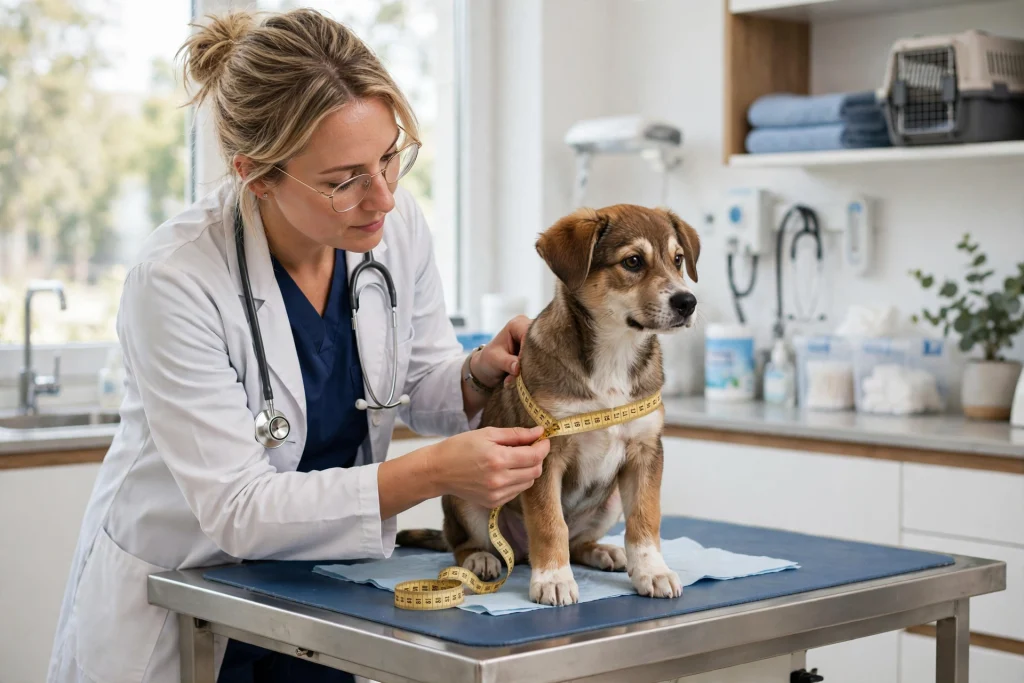
A puppy adult weight calculator estimates how much a puppy may weigh when fully grown by combining its current weight, age, and expected adult size. It compares those inputs with typical canine growth patterns to produce a planning estimate. The result is useful, but individual dogs do not all follow the same curve.
How much will your puppy weigh full grown? The answer depends partly on how quickly dogs of a similar size tend to grow. A puppy’s current weight becomes more informative when considered alongside its age and likely adult size. Breed, parent size, and individual development also matter, so a calculator’s output should be treated as an estimate rather than a measured future fact.
Research supports tracking growth over time instead of relying on one isolated measurement. Salt and colleagues published canine growth-standard charts in PLOS ONE in 2017, using a large dataset of young dogs to develop age- and size-related reference curves. These charts help assess whether a puppy’s growth follows an expected pattern, although they cannot establish the exact adult weight of every individual dog.
How to interpret your estimate
To estimate your puppy’s adult weight, follow these steps:
- Weigh your puppy and record the current weight.
- Enter the puppy’s age in weeks.
- Select the closest expected adult size class.
- Review the projected weight and its planning range.
- Repeat the calculation as your puppy grows.
The quality of the result depends on the quality of the inputs and the suitability of the underlying growth model.
Why the ±15% range exists
A single number can look more certain than it really is.
CanineCalc displays a projected adult weight with a ±15% planning range to make uncertainty visible. For example, if the estimated adult weight is 40 pounds, the displayed range would be 34–46 pounds. This arithmetic range gives owners a practical window for planning rather than suggesting that the puppy will finish at precisely 40 pounds.
Why use a range at all? Puppies vary in their growth rates, and their eventual size depends on factors that a simple calculator cannot fully measure. The selected size class may also be an imperfect match, particularly for mixed-breed puppies or dogs whose parent sizes are unknown.
The distinction matters: Salt et al. (2017) developed growth-reference charts, but their research does not establish that CanineCalc’s particular formula predicts adult weight within 15% for every puppy. That percentage is the tool’s planning allowance, not a universally validated scientific error margin.
If you’re trying to plan for a growing puppy, here’s a practical approach. Treat the central estimate as a starting point, use the range for flexible decisions, and update the inputs as new measurements become available.
Three factors that move puppies off the curve
Genetics set much of the growth potential. A puppy’s breed and parent sizes can help indicate likely adult size, but mixed ancestry makes predictions less certain. Two puppies of the same age and current weight may eventually grow into very different-sized dogs.
Nutrition also matters. Puppies need appropriate energy, protein, minerals, and other nutrients to support healthy development. Too little food can impair growth, while excess calories can encourage unhealthy weight gain. Body condition matters alongside scale weight, so a larger number does not automatically mean a puppy is growing well.
Spay and neuter timing can influence development, too. Research suggests that the effects of gonadectomy on growth and skeletal maturation can vary with breed, size, age, and sex. The evidence does not support one universal adjustment that a basic adult-weight calculator can apply to every dog.
Some owners argue that breed alone is the best predictor of adult size because genetics strongly shape growth. Breed information is useful, but it is not enough on its own when parentage is uncertain or an individual puppy grows differently from the typical pattern.
Sources disagree on some details of how neutering timing affects long-term outcomes across breeds. That uncertainty is a reason to discuss timing with a veterinarian, not to change a puppy’s expected weight using an unsupported correction.
Quick note: an unexpected change in growth deserves attention, especially if it occurs alongside poor appetite, vomiting, diarrhea, low energy, or visible changes in body condition. A calculator cannot diagnose the cause.
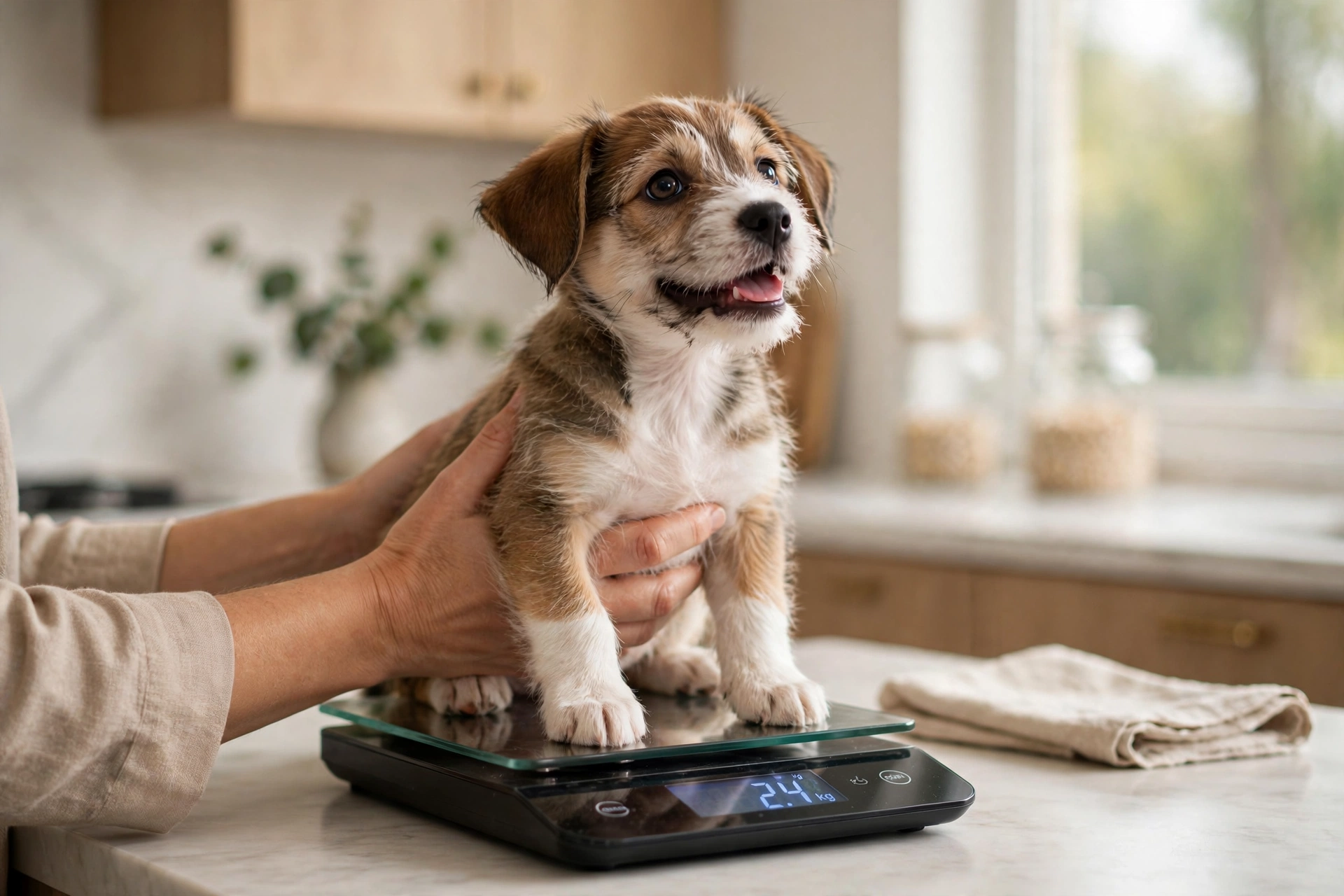
Weighing a squirmy puppy accurately
Small measurement errors can change the estimate.
For a small puppy, use a pet scale or a suitable digital kitchen scale with a stable, secure container. For a larger puppy, weigh yourself while holding the puppy, then weigh yourself alone and subtract the second reading from the first. Use this method only if you can hold the puppy safely.
Try these practical tips:
- Weigh your puppy at roughly the same time of day.
- Use the same scale and units each time.
- Keep the puppy calm with a treat or gentle reassurance.
- Take two or three readings and check whether they agree.
- Record the date, age in weeks, and measured weight.
In other words,… consistency matters more than chasing a perfect reading from a restless puppy. If the measurements differ noticeably, repeat them when the puppy is calmer rather than choosing the number that looks most convenient.
Never leave a puppy unattended on an elevated surface. If handling or weighing causes distress, stop and ask your veterinary team about a safer method.
When to re-check your estimate
Puppies change quickly during early development.
A practical approach is to recalculate every two to four weeks during rapid growth, using a fresh weight and the correct age. This interval is a monitoring suggestion, not a formal veterinary requirement. More frequent checks may be appropriate when a veterinarian is tracking a growth concern.
What matters most is the pattern over time. One reading may be affected by a recent meal, hydration, or a measurement mistake. Several consistent measurements give a clearer picture of whether growth is broadly following expectations.
Use the same calculator and size category when comparing results, unless you have a good reason to correct the category. Switching assumptions between measurements can make an apparent change in projected adult weight harder to interpret.
What the number is actually useful for
An adult-weight estimate can make planning easier.
For crate shopping, it offers an early indication of the space a dog may eventually need. Check the manufacturer’s sizing guidance and the dog’s expected adult dimensions before buying; a puppy must still have a safe, suitable space now. Adjustable crates can be a practical option during growth.
For food budgeting, a projection can help you compare future package sizes and approximate costs. It should not determine how much to feed today. Follow the food’s age- and weight-based guidance, monitor body condition, and ask your veterinarian about appropriate portions.
The estimate can also help you prepare questions for veterinary visits, anticipate harness and bed sizes, and think ahead about travel arrangements. These are planning decisions, not reasons to delay replacing equipment that no longer fits.
Typical adult weight ranges by size class
| Size class | Typical adult weight range | Growth-rate note |
|---|---|---|
| Toy | Up to about 10 lb | Often approaches adult size earlier than larger dogs |
| Small | About 10–25 lb | Many reach most of their adult size within the first year |
| Medium | About 25–50 lb | Growth often continues through much of the first year |
| Large | About 50–90 lb | May take longer to reach adult size |
| Giant | Over about 90 lb | Skeletal and overall development may continue beyond the first year |
These are broad planning categories, not strict breed standards. Individual breeds and mixed-breed dogs can fall outside them.
The calculator works best for rough planning when a puppy’s age and weight are known and the size class is a reasonable fit. It won’t provide a reliable guarantee when growth is affected by illness, poor nutrition, uncertain age, or a poorly matched size category.
Puppy adult-weight calculator: common questions
How accurate is a puppy adult weight calculator?
Accuracy depends on the puppy’s age, current weight, likely adult size, and the calculator’s growth model. Treat the result as a planning estimate, not a guaranteed final weight.
Can I predict my mixed-breed puppy’s adult weight?
Yes, you can estimate it, but uncertainty may be greater when parent sizes and breed ancestry are unknown. Recheck the estimate as new weight measurements become available.
What does the ±15% range mean?
It shows a planning window around the projected weight. For a 40-pound estimate, the range is 34–46 pounds; it is not a guarantee of accuracy.
When do puppies stop growing?
Small dogs often mature sooner than large and giant breeds. Many dogs approach adult height within their first year, while larger dogs may continue developing longer.
Should I change my puppy’s food based on the predicted adult weight?
Not from the estimate alone. Choose an age-appropriate, complete diet and adjust portions based on growth, body condition, feeding guidance, and veterinary advice.
A puppy adult weight calculator gives owners a useful starting point for understanding future size. Its real value comes from combining a transparent estimate with regular measurements, realistic expectations, and professional guidance when growth raises concerns.
Written by Jennifer, founder of CanineCalc, a dog owner and researcher who creates practical calculation tools to help dog owners make sense of everyday questions about their pets.
Guides and tools by Jennifer, founder of CanineCalc.