

Toy Poodle weight calculator
Estimate your Toy Poodle puppy’s adult weight from current age and weight.
How the Toy Poodle Weight Calculator Predicts Adult Size
Last updated: October 2026
A Toy Poodle weight calculator estimates your puppy’s adult weight from its current weight, age in weeks, and expected growth rate. The CanineCalc calculator uses a small-dog growth curve to estimate adult weight, then displays a practical planning range of ±15%. It offers a useful starting point, not a guarantee of your puppy’s final size.
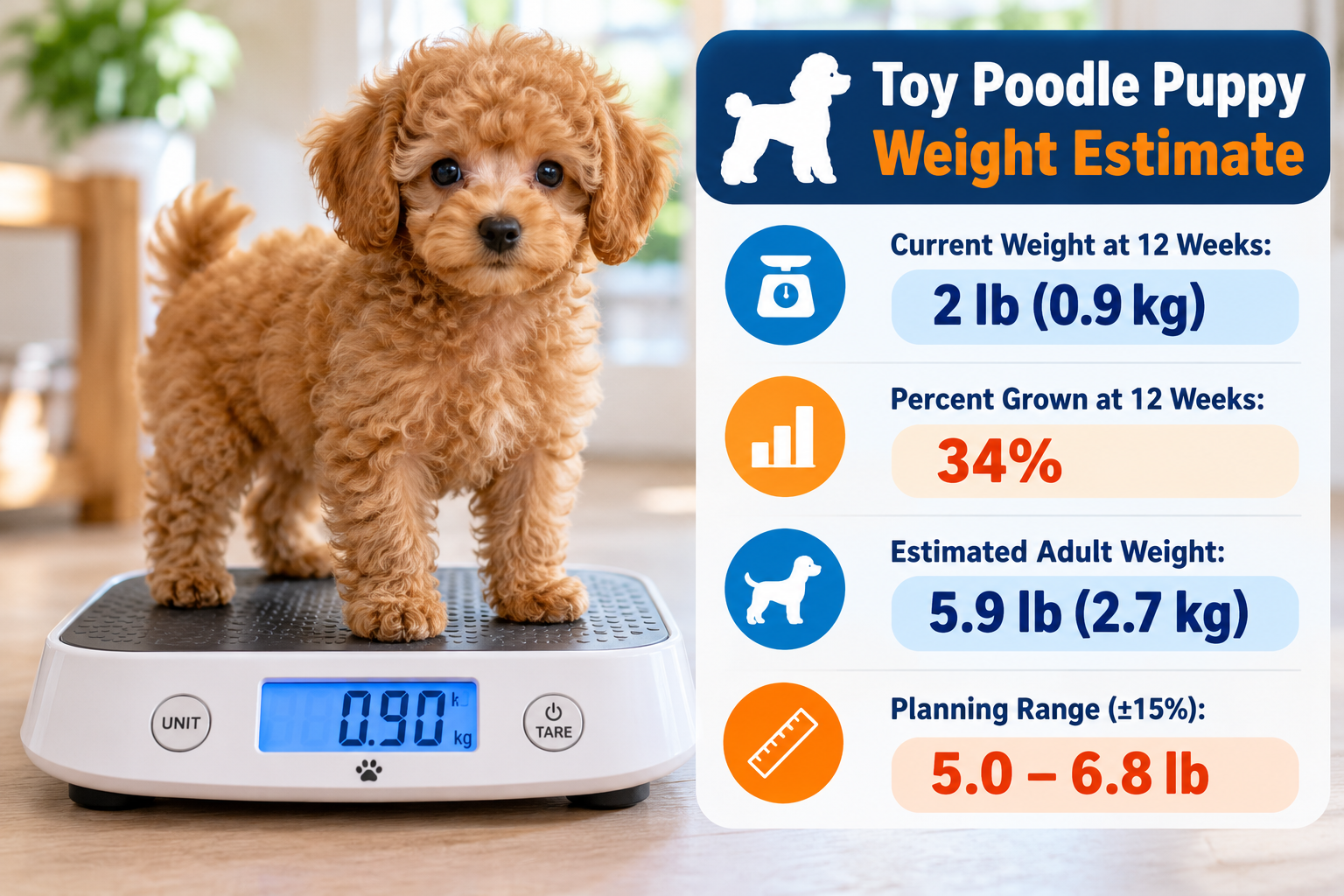
If your puppy weighs 2 pounds at 12 weeks, for example, the calculator estimates an adult weight of about 5.9 pounds. The result depends on how much of its expected growth the puppy has completed at that age.
How to use the calculator
To estimate your Toy Poodle’s adult weight, follow these steps:
- Enter your puppy’s current age in weeks.
- Enter its current weight in pounds.
- Review the estimated adult weight and planning range.
- Check the growth progress percentage.
- Compare future weigh-ins to the puppy’s previous measurements.
If you’re wondering how big your puppy will get, start here.
The tool automatically uses the SMALL size class for Toy Poodles. You don’t need to select a size category.
What does the estimate actually mean?
The calculator estimates the weight your puppy might reach as growth approaches completion. It does not diagnose a weight problem or establish an ideal weight for an individual dog.
According to the American Kennel Club (AKC), Toy Poodles must measure no more than 10 inches at the highest point of the shoulders under the breed standard. The AKC breed information also lists 4–6 pounds as a typical weight reference. Height defines the official size distinction; the weight figure is a useful reference, not a prediction for every puppy.
Source: American Kennel Club: Is the Poodle the Right Dog Breed for You? — official breed size information.
The Toy Poodle Growth Curve Behind the Number
The CanineCalc calculator uses a fraction-grown method. Instead of assuming every puppy doubles its weight at a particular age, it estimates the portion of adult weight a puppy has reached and works backward from the current measurement.
The formula is:
Estimated adult weight = current weight ÷ fraction grown
The fraction grown comes from the calculator’s small-dog growth curve. When your puppy’s age falls between two listed ages, the calculator uses linear interpolation to estimate the fraction for that age. Toy Poodles always use this small-class curve.
Growth curve data used by the calculator
| Age in weeks | Fraction grown |
|---|---|
| 6 | 13% |
| 8 | 20% |
| 12 | 34% |
| 16 | 52% |
| 24 | 75% |
| 36 | 91% |
| 52 | 100% |
The underlying approach is related to growth-curve thinking, but the exact fractions above are the calculator’s own inputs. They should not be mistaken for a Toy Poodle-specific curve validated by a published clinical study.
According to Salt and colleagues’ 2017 study in PLOS ONE, researchers developed canine growth standard charts using records from more than six million young dogs attending veterinary clinics in the United States. Their work supports tracking growth against appropriate reference curves, while also identifying the need for further validation of clinical growth-monitoring tools.
Source: Salt et al. (2017), PLOS ONE — published research on canine growth standard charts.
Why not simply double the puppy’s weight?
Some puppy charts recommend doubling a puppy’s weight at four months to estimate adult size. This is a familiar rule of thumb, but it lacks a cited primary study establishing it as a reliable prediction method for every Toy Poodle.
Sources disagree on the usefulness of simplified growth rules, and a puppy’s development does not follow one universal timetable. The fraction-grown method makes its assumptions visible, although it still cannot account for every individual difference.
Here’s the thing: a transparent estimate is more useful than a precise-looking number with an unexplained formula.
Worked Example: A 12-Week-Old Toy Poodle
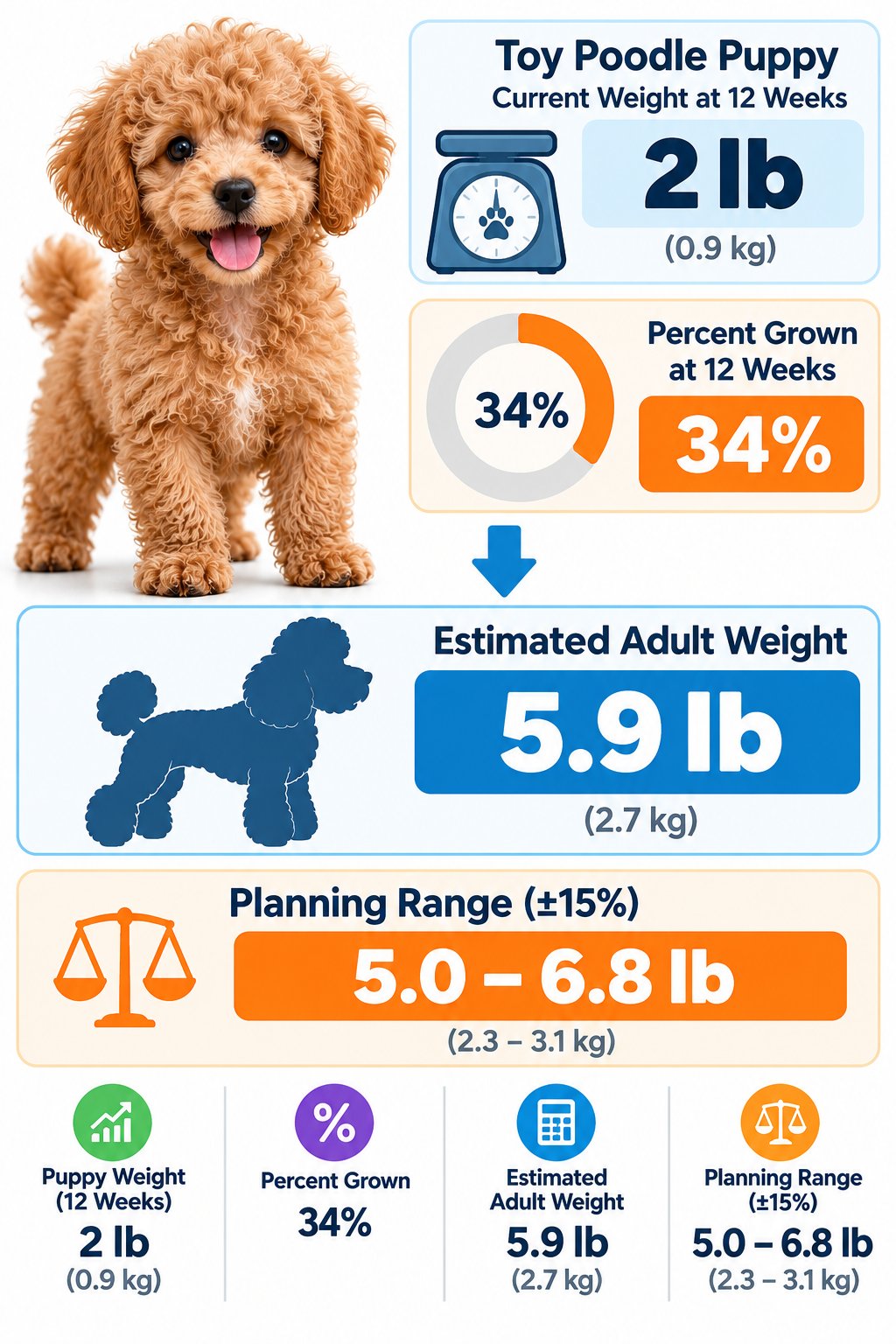
Suppose your Toy Poodle weighs 2 pounds at 12 weeks. The calculator assigns this age a fraction grown of 0.34.
Here is the calculation:
- Current weight: 2 pounds
- Fraction grown: 0.34, or 34%
- Calculation: 2 ÷ 0.34 = 5.88 pounds
- Estimated adult weight: 5.9 pounds
- Practical planning range: 5.0–6.8 pounds
- Growth progress: 34%
The planning range is approximately 15% below and above the rounded estimate. It is a practical allowance for uncertainty, not a statistically validated confidence interval. It does not mean the calculator has established that the puppy’s final weight will fall within those limits.
Typical Toy Poodle weight by age
The following table gives illustrative, commonly cited breeder-chart ranges for context. These are not official AKC growth standards or verified clinical reference intervals. Individual puppies can fall outside them.
| Age | Typical weight range |
|---|---|
| 8 weeks | 0.75–1.5 lb |
| 12 weeks | 1.25–2.5 lb |
| 16 weeks | 1.5–3 lb |
| 20 weeks | 2–4 lb |
| 6 months | 2.5–4.5 lb |
| 9 months | 3–5.5 lb |
| 12 months | 4–6 lb |
Related: How big will my puppy get?
Is My Toy Poodle Too Big or Too Small?
A puppy that weighs more or less than a chart suggests is not automatically unhealthy. Family size, body structure, age, nutrition, and individual development can all affect the result.
Toy Poodles commonly reach most of their adult height around 7–9 months and continue filling out toward adult weight at around 12 months. These are commonly cited ranges, not deadlines that every dog follows.
Toy Poodle vs. Miniature Poodle weight
Toy and Miniature Poodles are distinct AKC size varieties. Toy Poodles are no more than 10 inches tall at the shoulder, while Miniature Poodles are over 10 inches and no more than 15 inches.
A Miniature Poodle may naturally weigh more because of its larger frame. A Toy Poodle’s predicted weight alone cannot establish its official variety, and a puppy that grows beyond an expected range should not be relabeled based on weight alone.
Related: Yorkie weight calculator
What about a “teacup” Toy Poodle?
“Teacup” is a marketing term, not a separate AKC-recognized Poodle variety. It does not establish a predictable adult weight, guarantee a particular temperament, or confirm good health.
Some people prefer the smallest possible dog, and that preference is understandable. Still, prioritizing extreme smallness over sound development is a choice worth questioning: a tiny adult-weight estimate is not evidence that a puppy is healthier or better suited to a home.
Related: Puppy size calculator
Limitations of a Toy Poodle Growth Estimate
The calculator works best when you know your puppy’s age accurately, have a reliable current weight, and want a rough adult-weight estimate for ordinary growth planning. It will not reliably predict unusual growth patterns, identify an underlying illness, or replace an individual assessment by a veterinarian.
The ±15% planning range communicates uncertainty around the estimate. It is not based on a published validation study showing that 85% or 95% of Toy Poodles fall within those bounds.
When should you seek individual guidance?
If your puppy is losing weight, struggling to eat, unusually lethargic, or showing a sudden change in growth, contact your veterinarian rather than relying on a calculator. Very small puppies can be vulnerable to health problems, and an online prediction cannot determine the cause of a change.
For routine monitoring, record weight measurements under similar conditions and review the trend over time. A single weigh-in tells you less than a series of measurements.
This guide covers estimated adult weight and general growth patterns. It does not assess body condition, diagnose disease, or determine an individual puppy’s nutritional needs.
Toy Poodle Weight Calculator: Common Questions
Q: What’s the best way to estimate my Toy Poodle’s adult weight?
Use the CanineCalc calculator with your puppy’s current weight and age in weeks. It applies the small-class growth curve and returns an estimate, planning range, and growth progress percentage.
Q: How do I calculate my puppy’s expected adult weight manually?
Divide its current weight by the fraction grown for its age. For a 2-pound puppy at 12 weeks, calculate 2 ÷ 0.34 to get approximately 5.9 pounds.
Q: Should I double my Toy Poodle’s four-month weight?
Treat doubling as a rough cross-check only. It is a rule of thumb, not a reliably established prediction method for every Toy Poodle.
Q: Why does my Toy Poodle weigh more than a growth chart suggests?
Charts show reference patterns rather than exact limits. Check the puppy’s growth trend and body condition, and ask a veterinarian about persistent or concerning differences.
Q: When should my Toy Poodle reach adult weight?
Toy Poodles commonly approach adult height around 7–9 months and adult weight around 12 months. Individual growth can differ, so these ages are guides rather than guarantees.
Related: How big will my puppy get?