
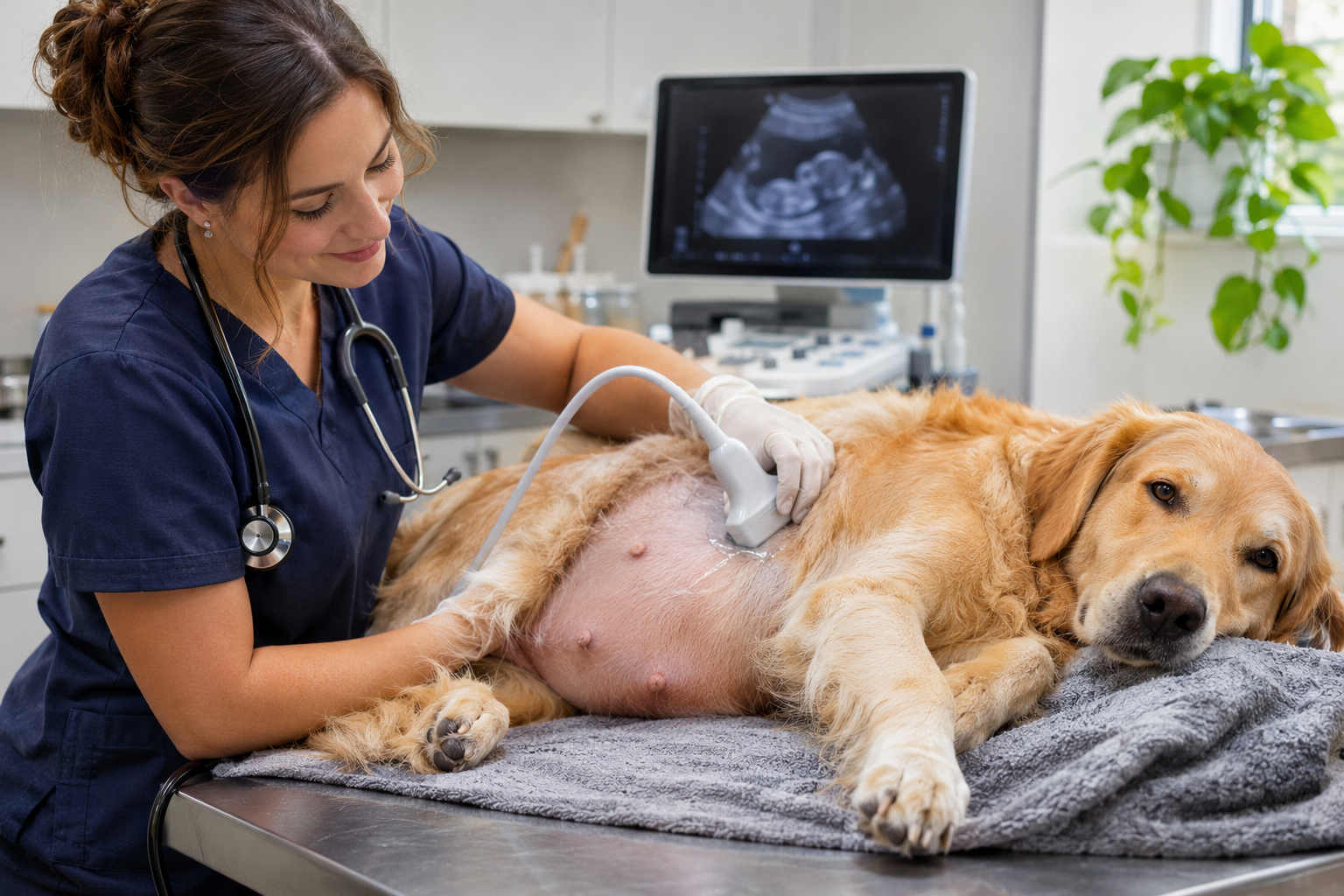
Dog pregnancy test: the short answer
There is no human-style pee-on-a-stick pregnancy test for dogs. A standard human pregnancy test detects a hormone called human chorionic gonadotropin (hCG), which is not the hormone veterinarians use to confirm pregnancy in dogs.
Instead, a dog pregnancy test usually means a blood test that measures relaxin, a hormone produced by the developing placenta. Other veterinary methods include ultrasound, abdominal palpation and X-rays. Each method has a different useful testing window, and choosing the right one matters just as much as choosing the test itself.
For most dogs, a relaxin blood test or ultrasound becomes useful around 25–30 days after mating.
The best choice depends on how long it has been since mating and what you want to find out. Are you simply checking whether your dog is pregnant, looking for confirmation that puppies are developing, or trying to estimate how many puppies to expect?
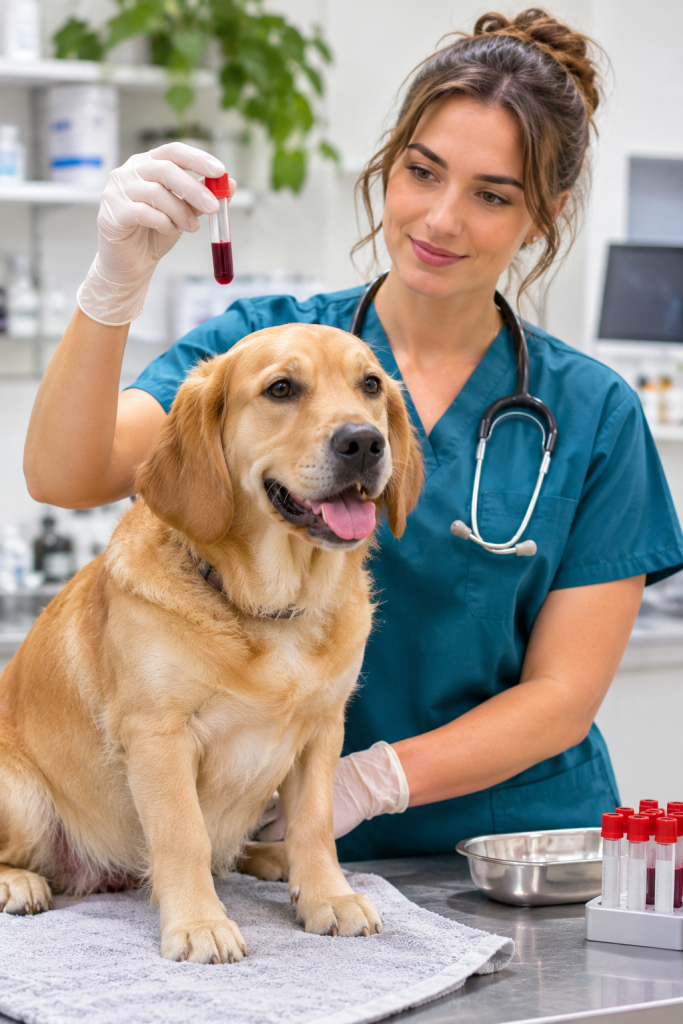
Why human pregnancy tests don’t work on dogs
Human pregnancy tests are designed to detect hCG in urine. During human pregnancy, the developing placenta produces this hormone, which passes into the bloodstream and urine.
Dogs have a different reproductive hormone pattern. Instead of using hCG as the pregnancy marker, veterinarians look for relaxin.
Relaxin is produced by the developing placenta after implantation. Once enough of the hormone is present in the bloodstream, a blood test can identify it as evidence of pregnancy.
This difference explains why a human pregnancy test cannot reliably tell you whether your dog is expecting puppies. Even if your dog has symptoms that resemble human pregnancy symptoms, the hormones behind those changes are not the same.
Relaxin testing also has an important advantage when a dog appears pregnant after a heat cycle. Some female dogs experience a false pregnancy, also called a phantom pregnancy. They may develop enlarged mammary glands, nesting behavior, changes in appetite or even milk production without actually carrying puppies.
Because false pregnancy does not involve developing placentas, it does not produce the relaxin response associated with a true pregnancy. A veterinarian can use this difference to help distinguish the two conditions.
The real tests, and when each one works
Veterinarians have several ways to confirm canine pregnancy. The right option depends on timing, your dog’s health and whether you need to know that puppies are present or how many there are.
The following timing ranges are general guidelines based on the mating date. They can vary because the mating date does not always match the actual date of conception.
| Test method | Earliest useful timing (approx.) | What it confirms | Main limitations |
|---|---|---|---|
| Relaxin blood test | Around 25–30 days after mating | Detects the pregnancy-related hormone | Can be negative if performed too early; does not count puppies or confirm their ongoing viability |
| Ultrasound | Around 25–30 days after mating | Shows pregnancy and can detect fetal heartbeats | Not reliable for counting the entire litter |
| Abdominal palpation | Around days 21–35 | An experienced vet may feel developing pregnancy-related swellings | Requires experience and suitable timing; cannot confirm fetal heartbeats |
| X-ray | After approximately day 45, preferably later | Shows developed puppy skeletons and helps estimate litter size | Too early for dependable counting; does not routinely confirm fetal heartbeats |
1. Relaxin blood test
This is the closest equivalent to a conventional pregnancy test for dogs.
Your veterinarian collects a blood sample and checks it for relaxin. The hormone can sometimes be detected earlier, but results are generally more dependable around 28–30 days after mating.
A positive result indicates that placental development has occurred. However, it does not tell you how many puppies your dog is carrying, and it cannot guarantee that every puppy will survive until delivery.
This is often a practical first choice when you want relatively early confirmation without an imaging appointment.
2. Ultrasound
An ultrasound allows the veterinarian to look directly at the developing pregnancy.
It can usually identify pregnancy around 25–30 days after mating, although the exact timing depends on the stage of development and the equipment and experience of the person performing the scan.
One of its biggest advantages is that the veterinarian can look for fetal heartbeats. This provides useful information about whether the puppies are alive at the time of examination.
Ultrasound is also helpful when a relaxin result is uncertain or when there are concerns about your dog’s reproductive health.
Its main weakness is litter counting. Puppies can overlap on the screen, making it difficult to determine the exact number. If knowing how many puppies to prepare for is important, a later X-ray is generally more useful.
3. Abdominal palpation
Palpation means a veterinarian gently examines your dog’s abdomen with their hands to feel for developing pregnancy-related swellings in the uterus.
These swellings may become detectable around day 21 after mating. The most useful period is generally around days 21–35, depending on the dog.
This method requires experience. Your dog’s body condition, abdominal tension, cooperation and stage of pregnancy can all affect what the veterinarian can feel.
It is not a good method for owners to attempt at home. Pressing or repeatedly squeezing the abdomen is unnecessary and may cause discomfort.
Palpation also cannot confirm heartbeats or reliably establish the number of puppies.
4. X-ray
An X-ray becomes useful later in pregnancy, after the puppies’ skeletons have started to mineralize.
Around day 45 after mating, the bones may be visible, but waiting longer generally makes the images more useful. After approximately day 55, an X-ray is usually a better option for estimating litter size.
This is particularly helpful when you want to know how many puppies to expect before delivery.
Unlike an early blood test or ultrasound, an X-ray is not the usual first choice for early pregnancy confirmation. Its greatest advantage is estimating the number of puppies once their skeletons are sufficiently developed.
Veterinary guidance on these timing windows is available from the Merck Veterinary Manual and the University of California, Davis School of Veterinary Medicine.
Dog pregnancy test kits for home use
You may find products advertised online as at-home dog pregnancy tests. These are not the same as the urine strips used by people.
Most canine pregnancy kits are designed to detect relaxin using a blood sample. Depending on the product, the sample may be collected from a small blood draw or a sampling method described in the kit instructions.
That means the kit still depends on the same pregnancy-related hormone used in veterinary blood testing.
There are a few things worth understanding before purchasing one:
- They are blood-based: A urine sample from your dog will not work with a relaxin blood test.
- Timing matters: Testing too early can produce a negative result even when your dog is pregnant.
- Sample collection matters: Collecting an adequate blood sample can be difficult, particularly if your dog is nervous or uncomfortable.
- A positive result has limitations: It does not establish the number of puppies or confirm their heartbeats.
Some kits are marketed as quick and convenient, but the practical difficulty of collecting blood is why many owners find it easier to arrange testing through their veterinarian.
A vet can also help interpret an unclear result and recommend an ultrasound when additional confirmation is needed.
There is no reason to buy a human pregnancy test or experiment with urine-based methods. They are not designed for canine pregnancy.
How much does a dog pregnancy test cost?
The cost depends on the type of test, the veterinary practice, your location and whether the procedure is performed in-house or through a specialist.
For general U.S. budgeting, the following are broad planning ranges rather than fixed prices:
| Test | Approximate general cost |
|---|---|
| Relaxin blood test | Around $75–$300 |
| Pregnancy ultrasound | Around $150–$600 or more |
| Abdominal palpation | Often included in a veterinary examination |
| Pregnancy X-ray | Around $150–$350 or more |
These estimates can vary considerably between clinics and regions. They are not guaranteed quotes, and some veterinary hospitals charge additional fees for the examination, blood collection, laboratory processing or imaging interpretation.
In most situations, an ultrasound costs more than a relaxin blood test. A specialist or referral hospital may also charge substantially more than a general veterinary practice.
Before booking, ask the clinic what the quoted price includes. For example, does the blood-test estimate cover the blood collection and laboratory processing, or is the examination charged separately?
It is also worth asking whether the clinic recommends an additional ultrasound. Paying for the right test at the right stage is generally more useful than paying for an early test that needs repeating.
How accurate is each test?
The accuracy of a dog pregnancy test depends heavily on when it is performed.
One of the most common mistakes is testing too early and treating a negative result as definite proof that there are no puppies.
Relaxin blood tests
These tests are useful for detecting canine pregnancy, but their sensitivity depends on the amount of hormone present in the blood.
Before the developing placenta produces enough relaxin, the test may return a negative result even though pregnancy has occurred.
Small and toy-breed dogs carrying only one or two puppies may also be more likely to produce an insufficient hormone response for an early test to detect.
A positive result is useful evidence of pregnancy, but it does not confirm the number of puppies or guarantee a healthy litter at delivery.
Ultrasound
Ultrasound is generally the most informative practical option when you want to confirm pregnancy and check for fetal heartbeats.
It gives the veterinarian a direct look at the developing pregnancy instead of relying only on a hormone measurement.
However, the examination is still a snapshot. A heartbeat seen during the scan confirms fetal activity at that time, not a guarantee that every puppy will continue developing normally.
It also cannot reliably establish the exact litter size.
Abdominal palpation
Palpation can be helpful when performed by an experienced veterinarian during the right window. However, it is more dependent on timing and examination technique than a direct imaging test.
It cannot confirm whether the fetuses have heartbeats.
X-ray
X-rays are particularly useful for estimating the number of puppies once their skeletons are visible.
They are not useful for early pregnancy detection, and they are not designed to assess fetal heartbeats in the way ultrasound does.
What if the first test is negative?
A negative test performed too early does not necessarily mean your dog is not pregnant.
For example, if a relaxin test is negative around day 25 after mating, your veterinarian may recommend repeating it approximately one week later.
The extra time allows relaxin levels to increase if pregnancy is present.
If the second result is still negative but pregnancy remains a concern, the vet may recommend ultrasound or another examination. This is especially relevant when mating dates are uncertain or your dog is carrying a very small litter.
The important point is not to rely on a single early negative result.
Frequently asked questions
Can I use a human pregnancy test on my dog?
No. Human pregnancy tests detect hCG in urine, while canine pregnancy testing relies on relaxin produced by developing placental tissue. A human urine test cannot reliably confirm pregnancy in a dog.
When can a vet confirm dog pregnancy?
A veterinarian can often begin checking for pregnancy around 21–30 days after mating. Relaxin blood tests and ultrasound are generally useful around 25–30 days, although the precise timing varies. X-rays are more useful after approximately day 45 and especially closer to day 55.
Is there a dog pregnancy test at home that works?
Yes, some at-home kits test for relaxin using a blood sample. They are not urine tests, and correct blood collection and testing time are important. Many owners prefer veterinary testing because the clinic can collect the sample and explain the result.
How does a dog pregnancy test work?
A canine relaxin test measures a hormone produced by the developing placenta. Once enough relaxin enters the bloodstream, a blood test can detect it. Other methods work differently: ultrasound visualizes the pregnancy, palpation checks for developing uterine swellings, and X-rays show puppy skeletons later in pregnancy.
What if the test is negative but my dog still looks pregnant?
A negative result does not always rule out pregnancy, particularly if testing happened too early. Your dog may also be experiencing a false pregnancy after her heat cycle. Both situations can produce signs that resemble pregnancy. Ask your veterinarian about repeating the relaxin test in approximately a week or arranging an ultrasound. A veterinary examination is especially important if your dog seems unwell or develops unusual discharge, abdominal pain or significant changes in behavior.
The bottom line
There is no reliable human-style urine pregnancy test for dogs. The most useful confirmation methods are relaxin blood testing and ultrasound, generally starting around 25–30 days after mating. Palpation may also help during an appropriate mid-pregnancy window, while a later X-ray is usually the better choice for estimating how many puppies are on the way.
A negative early test is not always the final answer. Timing matters, and repeating a test or choosing a different method can prevent confusion. Rather than relying on physical signs or an online urine test, work with your veterinarian to choose the right pregnancy test for your dog’s stage of development.