
Choosing the best dog food can feel surprisingly complicated. Walk down a pet-food aisle or browse online, and you’ll find hundreds of options promising better digestion, shinier coats, healthier joints, and longer lives. Some emphasize high protein, others advertise natural ingredients, and many use words such as premium, holistic, or human-grade.
But choosing a good food doesn’t have to mean choosing the most expensive bag or following the latest feeding trend.
The important questions are simpler: Is the food nutritionally complete for your dog’s life stage? Does the manufacturer have the expertise and quality controls to make it consistently? Does the ingredient information make sense? And does your dog maintain a healthy weight, good energy, and comfortable digestion while eating it?
This guide explains how to evaluate dog food using practical criteria rather than marketing claims. It covers dry, wet, and fresh formats, what veterinarians generally look for, how to compare labels, and how to choose a food that fits your dog’s needs and your budget.
Best dog food: the short answer
There is no single best dog food for every dog. A growing puppy, an active adult, a senior dog, and a dog that needs to manage its weight can have different nutritional requirements.
The best food is one that:
- Is labeled complete and balanced for your dog’s current life stage.
- Meets an appropriate nutritional standard, such as an applicable AAFCO nutrient profile.
- Comes from a manufacturer with qualified nutrition expertise and reliable quality-control procedures.
- Provides clear information about its ingredients, nutritional adequacy, and feeding instructions.
- Supplies appropriate calories and nutrients for your dog’s size and activity level.
- Is something your dog eats willingly and tolerates comfortably.
- Helps your dog maintain a healthy body condition over time.
A long ingredient list doesn’t automatically mean better nutrition. Neither does a high price, an attractive package, or a claim that a food is made with premium ingredients.
Think of choosing food as evaluating the finished diet and the company behind it, not simply judging individual ingredients.
A food that works beautifully for one dog might not suit another. Your goal is to find a nutritionally appropriate option that fits your dog’s individual needs and remains practical to feed consistently.
What vets look for in a dog food
When veterinarians discuss food quality, the conversation is generally more technical than comparing packaging or looking for fashionable ingredients.
Veterinary nutrition guidance commonly emphasizes nutritional adequacy, the manufacturer’s expertise, quality control, and evidence that the food provides appropriate nutrition.
Here are the main criteria worth checking.
1. A nutritional adequacy statement
Look for a statement confirming that the food is complete and balanced for a particular life stage or is intended for intermittent or supplemental feeding.
This is more useful than relying on front-of-package descriptions such as natural, premium, or high protein.
2. Feeding trials versus formulated foods
Some foods meet an established nutrient profile through formulation. Others have undergone feeding trials designed to evaluate how dogs respond when eating the food under specified conditions.
Both approaches can support nutritional adequacy, but they are not identical.
A formulated food is designed to meet defined nutrient requirements based on its formulation and analysis. A feeding-trial food has additional evidence from feeding dogs the finished diet under the trial conditions.
Neither phrase should be interpreted as a guarantee that a food is perfect for every individual dog. They are useful pieces of information when evaluating the manufacturer.
3. Qualified nutrition professionals
Ask whether the manufacturer employs qualified animal nutrition professionals, such as board-certified veterinary nutritionists or appropriately trained PhD animal nutritionists.
The important distinction is whether someone with relevant expertise is involved in formulating and evaluating the food, rather than whether the packaging simply mentions veterinary approval.
4. Quality control and manufacturing
A responsible manufacturer should be able to explain how ingredients are sourced, how finished batches are checked, and how nutritional consistency is maintained.
Questions worth asking include:
- Does the company manufacture its own food or use a contract manufacturer?
- Does it conduct finished-product nutrient testing?
- Are suppliers and ingredients evaluated for quality?
- Can the company explain its procedures for handling manufacturing problems?
5. Recall history and transparency
A recall deserves attention, but it should not be the only factor in your decision. Look at whether the manufacturer communicates clearly, investigates problems, and explains corrective actions.
A company that provides meaningful answers about its food and manufacturing process gives owners more useful information than one relying entirely on advertising.
How to read a dog food label in 2 minutes
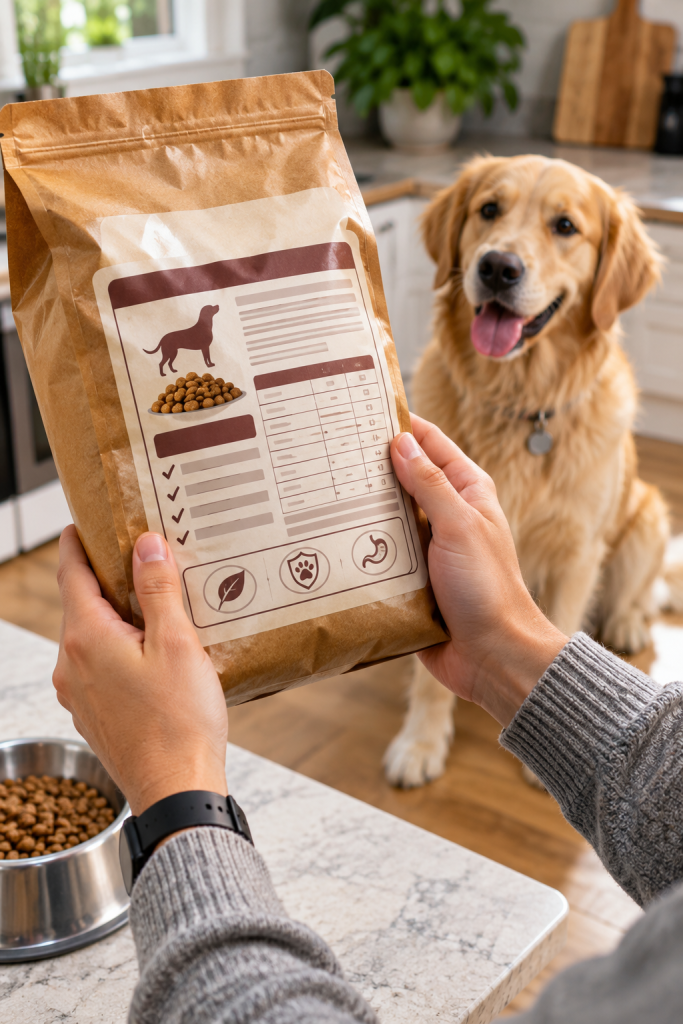
You don’t need a nutrition degree to screen a dog food label. Start with the back of the package rather than the marketing on the front.
Use this quick checklist:
| Label element | What to look for | Potential red flag |
|---|---|---|
| AAFCO nutritional adequacy statement | Complete and balanced for your dog’s life stage | Intermittent or supplemental feeding only |
| First ingredients | Clearly named animal protein sources, where appropriate | Vague descriptions that make the source difficult to identify |
| Guaranteed analysis | Crude protein and fat minimums, plus fiber and moisture information | Comparing percentages without considering moisture |
| Ingredient list | Specific, understandable ingredient names | Marketing claims that distract from the actual formulation |
| Feeding guide | Daily portions and calorie information | Instructions that don’t account for your dog’s size or condition |
Check the AAFCO statement first. It should identify whether the food is suitable for growth, adult maintenance, or all life stages. A puppy food should not be selected simply because the front says it contains extra protein.
Look at the first ingredients. Ingredients are generally listed in descending order by weight before processing. A named animal protein, such as chicken, beef, or salmon, makes the source clearer. However, the first ingredient alone cannot tell you whether the finished food is nutritionally complete.
Understand guaranteed analysis. Crude protein and crude fat are listed as minimums, while crude fiber and moisture are generally listed as maximums. These numbers are useful, but they don’t reveal the complete nutrient profile or how digestible the food is.
One important detail: dry and wet foods contain very different amounts of water. A wet food can appear lower in protein percentage simply because more of its weight comes from moisture. You cannot fairly compare their protein percentages without adjusting for moisture content.
Don’t automatically reject an ingredient because it says meal. Named meat meals are concentrated animal ingredients and can be useful sources of protein. The more important question is whether the source is identified clearly. A named chicken meal tells you more than an unspecified meat meal.
Ingredient splitting also deserves some perspective. Manufacturers may list different forms of a similar ingredient separately. That can affect where each appears in the ingredient list, but it doesn’t independently prove that a food is poor quality.
Finally, check the feeding guide. Look for calories per cup, can, pouch, or kilogram, and compare the suggested daily amount with your dog’s actual needs. Feeding instructions are starting points, not universal prescriptions.
Dry, wet and fresh food compared
The format of a food matters for convenience, moisture intake, storage, and cost. It doesn’t automatically determine nutritional quality.
| Food format | Strengths | Trade-offs | Who it may suit |
|---|---|---|---|
| Dry kibble | Convenient, easy to store, often economical, simple to portion | Lower moisture; some dogs find it less appealing | Owners looking for convenience and predictable portions |
| Wet food | Higher moisture, often more appealing to selective eaters, softer texture | Higher cost per calorie, refrigeration after opening | Dogs that prefer softer food or benefit from additional dietary moisture |
| Fresh or gently cooked | Often appealing, recognizable food textures, can be portioned easily | Higher price, refrigeration or freezing, careful handling | Owners who prefer this format and can manage its storage requirements |
Does dry food clean your dog’s teeth?
This is a common misconception. Ordinary kibble does not reliably clean a dog’s teeth simply because it is crunchy. Some specially designed dental diets have demonstrated dental benefits, but regular dry food should not replace toothbrushing or appropriate dental care.
Is wet food less nutritious?
Not necessarily. A complete and balanced wet food can provide appropriate nutrition just as a complete and balanced dry food can. Compare the nutritional adequacy statement and calorie content rather than assuming one format is superior.
What about fresh food?
Fresh and gently cooked diets vary considerably. Some are formulated to be complete and balanced, while others are intended as toppers or supplemental foods. Check the same nutritional adequacy information you would check on any other food.
The most practical format is one that meets your dog’s nutritional needs, is stored and handled safely, and fits your household budget.
The best food changes with life stage
A dog’s nutritional requirements change as it grows and ages. One of the easiest ways to narrow down your choices is to start with the life-stage statement.
Puppies: Choose a growth formulation
Puppies need food formulated for growth, which includes the appropriate balance of energy, protein, minerals, and other essential nutrients.
Large-breed puppies need particular attention because excessive or inappropriate nutrient intake, especially involving calcium and energy, can affect skeletal development.
Don’t assume that an adult maintenance food is suitable for a growing puppy. If you’re comparing puppy feeding amounts, see the puppy food chart for age-based feeding guidance.
Adult dogs: Focus on maintenance
Once a dog has finished growing, an adult maintenance food is generally the appropriate starting point.
The right amount depends on several factors:
- Current body weight and body condition.
- Daily exercise and activity.
- Age and individual metabolism.
- Whether the dog is spayed or neutered.
- Any special nutritional requirements.
An active dog may need more calories than a less active dog of the same weight. Watch body condition rather than relying entirely on the recommended portion printed on the package.
Senior dogs: Adjust for changing needs
There isn’t one universal senior-dog formula that every older dog needs.
Some senior dogs become less active and need fewer calories to avoid gaining weight. Others lose muscle or become less interested in food. Joint comfort, dental health, digestion, and existing medical conditions can also influence dietary choices.
A senior food may be useful when its nutritional profile matches the dog’s needs, but the word senior alone doesn’t make it a better choice.
What does all life stages mean?
An all-life-stages food is formulated to meet nutritional requirements across multiple life stages, including growth and reproduction. It isn’t simply an adult food with a broader label.
For dogs expected to weigh 70 pounds or more as adults, check whether the statement specifically includes growth of large-size dogs. Some all-life-stages formulations exclude that category.
If your puppy is approaching adulthood, don’t switch based only on age or the fact that the bag is nearly empty. Read the guide to when to switch from puppy food to adult food for guidance based on expected adult size.
What good food actually costs
Price matters because dog food is a recurring household expense. But comparing package prices alone can be misleading.
A large bag may look expensive but last longer, while a cheaper food may require larger daily portions because of differences in calorie density.
The more useful measurement is cost per day.
For a broad US household budgeting estimate, consider these illustrative daily ranges for dry food:
| Dog size | Approximate daily dry-food budget |
|---|---|
| Small dog | $0.50–$1.50 |
| Medium dog | $1–$3 |
| Large dog | $2–$5 |
| Giant dog | $3–$7+ |
These are planning estimates, not current market quotations or nutritional recommendations. Actual costs depend on calorie requirements, food density, portion size, and the food’s price.
Wet and fresh diets can cost considerably more per day, particularly for medium, large, and giant dogs.
To compare two options properly:
- Find the calories per cup, can, or package.
- Estimate how many calories your dog needs daily.
- Calculate how much food that represents.
- Multiply the daily portion by the cost per unit.
The dog food cost calculator can help estimate the ongoing expense.
Remember that cheap food your dog eats poorly, refuses regularly, or needs unusually large portions of isn’t necessarily economical. The goal is to find a food that provides appropriate nutrition at a sustainable daily cost.
How to switch to a better food safely
Even when you’ve found a food that looks like a better fit, don’t rush the change. Switching suddenly can upset some dogs’ digestive systems.
A gradual seven-day transition is a practical starting point:
| Transition period | Old food | New food |
|---|---|---|
| Days 1–2 | 75% | 25% |
| Days 3–4 | 50% | 50% |
| Days 5–6 | 25% | 75% |
| Day 7 onward | 0% | 100% |
These percentages refer to the portions of the daily food ration, not necessarily equal weights or volumes. Different foods have different calorie densities, so check the feeding amounts.
What changes are normal during the first week?
Some dogs experience temporary changes in stool consistency, appetite, or how enthusiastically they approach the new food.
A small adjustment in stool consistency doesn’t automatically mean the food is unsuitable. However, persistent diarrhea, repeated vomiting, refusal to eat, or other concerning symptoms shouldn’t be dismissed as ordinary transition effects.
Dogs with sensitive digestion may benefit from a slower transition over 10–14 days or longer, depending on individual circumstances.
If your dog has an existing medical condition, a history of food-related problems, or develops significant symptoms during the switch, ask your veterinarian how to proceed.
For the complete day-by-day process, use the dog food transition schedule.
Frequently asked questions
What is the single best dog food?
There isn’t one food that is best for every dog. The right choice depends on life stage, calorie needs, nutritional adequacy, and individual tolerance. Start by checking the AAFCO statement, evaluating the manufacturer, and choosing a food your dog eats comfortably while maintaining a healthy body condition.
What dog food do veterinarians actually recommend?
Veterinarians generally encourage owners to evaluate nutritional adequacy, qualified formulation expertise, feeding-trial evidence, manufacturing quality control, and manufacturer transparency. They may also recommend a particular nutritional approach based on a dog’s age, weight, or medical needs. There isn’t one universal veterinary recommendation that applies to every dog.
Is expensive dog food always better?
No. Price doesn’t automatically reflect nutritional quality. An expensive food may have attractive ingredients or a particular preparation method, but those features don’t guarantee better nutrition. A reasonably priced food with appropriate nutritional adequacy and reliable manufacturing can be a perfectly sensible choice.
Compare the cost per day, calorie content, and nutritional information instead of assuming a higher price means a healthier dog.
Is grain-free food better for dogs?
Not automatically. Most dogs can digest properly prepared grains, and grains can provide useful nutrients. Grain-free food isn’t inherently healthier or more digestible for every dog.
The FDA has investigated reports of canine dilated cardiomyopathy (DCM) involving certain diets, many of which contained substantial amounts of peas, lentils, and other pulses. The exact relationship remains unresolved, and the reports do not establish that every grain-free diet causes heart disease.
The FDA has also received reports involving grain-containing diets. If you’re considering a grain-free diet without a specific medical reason, discuss the nutritional choice with your veterinarian rather than assuming grain-free is better.
How do I know if dog food is complete and balanced?
Look for the nutritional adequacy statement on the package, usually printed on the back or side.
It should say that the food is formulated to meet the relevant AAFCO nutrient profile or that animal feeding tests using AAFCO procedures substantiate complete and balanced nutrition for the specified life stage.
Check that the statement matches your dog’s needs. A food labeled for adult maintenance isn’t automatically appropriate for a growing puppy. Foods labeled for intermittent or supplemental feeding only aren’t intended to provide your dog’s entire daily diet.
Conclusion
Choosing the best dog food is less about finding a perfect ingredient list and more about understanding what makes a diet nutritionally appropriate.
Start with the nutritional adequacy statement, check the life-stage formulation, look beyond marketing claims, and consider the manufacturer’s expertise and quality-control practices. Then compare calories, feeding portions, format, and daily cost.
Most importantly, pay attention to your individual dog. Healthy body condition, consistent appetite, comfortable digestion, and appropriate energy are useful signs that the food and feeding routine are working.
You don’t need the most expensive food or the trendiest formula. You need a complete and balanced diet that suits your dog’s needs and that you can confidently feed consistently.