Doberman weight chart: the short answer
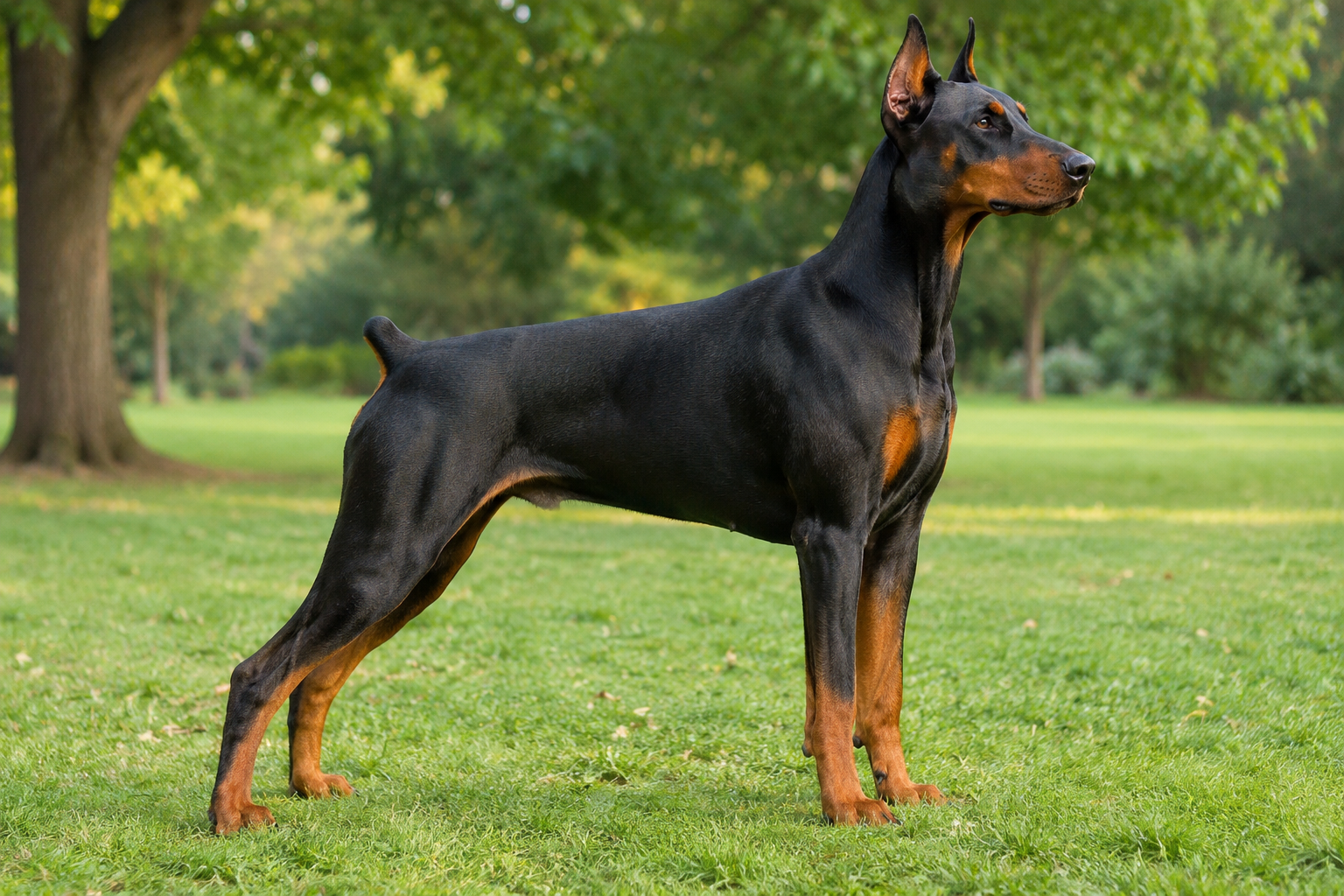
A healthy adult Doberman Pinscher typically weighs 75–100 pounds (34–45.4 kg) for males and 60–90 pounds (27.2–40.8 kg) for females. Males are generally taller and heavier, although individual dogs can fall outside these ranges without automatically having a weight problem.
According to the American Kennel Club (AKC), the typical adult height is:
Male Doberman: 26–28 inches (66–71 cm) at the shoulder.
Female Doberman: 24–26 inches (61–66 cm) at the shoulder.
These are breed-standard ranges, not exact measurements every Doberman must reach.
Doberman puppies grow quickly during their first several months, particularly between 2 and 8 months of age. Their weight gain gradually slows as they approach adulthood. Many are close to their adult weight by 12–18 months, although males may continue developing muscle and filling out into their second year.
The chart below gives you a general idea of how Doberman puppies grow from 8 weeks to adulthood. Use it as a rough guide rather than a strict rule, and remember that individual dogs vary. You do not need your dog to meet every number.

Doberman weight chart by age
The following Doberman weight chart separates male and female growth estimates from 8 weeks through adulthood. All weights are approximate and shown in both pounds and kilograms.
| Age | Male lb | Male kg | Female lb | Female kg |
|---|---|---|---|---|
| 8 weeks | 11–15 | 5.0–6.8 | 9–14 | 4.1–6.4 |
| 3 months | 21–28 | 9.5–12.7 | 17–25 | 7.7–11.3 |
| 4 months | 30–40 | 13.6–18.1 | 24–36 | 10.9–16.3 |
| 5 months | 39–52 | 17.7–23.6 | 31–47 | 14.1–21.3 |
| 6 months | 47–62 | 21.3–28.1 | 37–56 | 16.8–25.4 |
| 8 months | 60–80 | 27.2–36.3 | 48–72 | 21.8–32.7 |
| 10 months | 67–89 | 30.4–40.4 | 53–80 | 24.0–36.3 |
| 12 months | 71–95 | 32.2–43.1 | 57–86 | 25.9–39.0 |
| 18 months | 74–99 | 33.6–44.9 | 59–89 | 26.8–40.4 |
| Adult | 75–100 | 34.0–45.4 | 60–90 | 27.2–40.8 |
Important: These are broad, illustrative growth estimates, not official AKC puppy-weight percentiles or guaranteed targets. The adult endpoints follow the widely published AKC size ranges. Published puppy growth estimates differ, and genetics, birth size, nutrition, body structure, and individual development all influence the numbers.
A puppy consistently following the lighter end of the chart may simply be smaller-framed than another Doberman of the same age. Similarly, a puppy near the upper end is not automatically overweight.
How to use the chart
Weigh your puppy regularly and record the results alongside their age. Comparing several measurements over time is more useful than worrying about one reading.
For example, a male Doberman weighing 35 pounds at 4 months falls comfortably within the estimated range. A female weighing 30 pounds at the same age also falls within her expected range.
Notice whether your puppy is gaining steadily, maintaining a healthy body condition, eating normally, and developing appropriately. These observations provide a better picture than an isolated number.
Doberman growth milestones
Dobermans develop quickly as puppies, but their growth does not happen at the same speed throughout their lives. Understanding the main stages can help you interpret changes in their weight and appearance.
8 weeks to 3 months: Early puppy growth
At this stage, Dobermans are still relatively small but begin gaining weight rapidly. Their legs, chest, and overall body length develop noticeably.
They also become more active and curious as they settle into their new surroundings. Consistent nutrition is especially important during this early period.
3 to 6 months: Rapid growth
This is one of the most noticeable growth stages. Your Doberman may gain several pounds between weigh-ins, and their body can change considerably from one month to the next.
Their legs often appear longer, their frame becomes more athletic, and their appetite may increase as activity levels rise.
Teething also occurs during puppyhood. Puppies gradually lose their baby teeth and develop their permanent teeth, which can temporarily affect their chewing habits and eating preferences.
6 to 12 months: Adolescent development
Growth continues, although the rate gradually slows compared with the earlier puppy months.
Your Doberman may look tall and lean, with a relatively narrow chest and less developed muscle. This is a normal appearance for many adolescent dogs.
They are also entering adolescence, so you may notice changes in energy, attention, confidence, and behavior.
12 to 18 months: Approaching adult size
Many Dobermans are close to their adult height and weight during this period. Females often approach physical maturity earlier, while males may take longer to develop their full muscular appearance.
Some dogs continue gaining healthy muscle and body substance after their first birthday.
18 to 24 months: Filling out
Although many Dobermans are near their mature weight by 18 months, some continue developing through their second year.
This later development is especially noticeable in males that have a naturally larger frame. Their chest, shoulders, and overall muscular appearance may become more substantial.
VCA notes that large-breed puppies can take 18–24 months to reach full physical maturity, depending on the breed and individual dog.
How much should a Doberman weigh?
The best weight for your Doberman depends on more than age and sex.
Two healthy adult male Dobermans could differ by 15 pounds or more while both maintaining an appropriate body condition. Differences in height, frame size, genetics, muscle development, and activity levels can all influence their weight.
Rather than focusing entirely on the scale, pay attention to your dog’s body shape.
Check your Doberman’s ribs. You should be able to feel the ribs easily beneath a light covering of fat. They should not require excessive pressure to locate.
Look for a visible waist. Viewed from above, the body should narrow behind the rib cage. A healthy Doberman generally has a noticeable waist rather than a straight-sided or rounded appearance.
Check the abdominal tuck. From the side, the abdomen should slope upward toward the hind legs rather than hanging down in a rounded shape.
These observations are consistent with the general canine body-condition assessment used by veterinary professionals. An ideal body condition is commonly placed around 4–5 on the nine-point body-condition scale.
American vs. European Doberman builds
You may also notice differences between American and European Dobermans.
European-line dogs are often described as having heavier bone structure, greater muscular substance, and a more substantial overall build. American-line dogs are often described as having a more refined or lighter outline.
However, these are general tendencies, not rules. There is considerable variation within both populations, and individual dogs do not always match these descriptions.
This is another reason a single weight target cannot work for every Doberman. A larger-framed dog may naturally weigh more than a leaner dog of the same height.
Feeding a growing Doberman
Proper nutrition helps your Doberman develop steadily without encouraging unnecessary weight gain.
Because this breed can reach well over 70 pounds as an adult, choosing an appropriate large-breed puppy diet is worth discussing when selecting their food.
Choose suitable large-breed puppy food.
Look for a complete and balanced food formulated for puppy growth, including the nutritional requirements of large-breed dogs. These diets account for the controlled calcium, phosphorus, and energy levels needed during skeletal development.
A regular adult maintenance food is not an appropriate substitute for a growing puppy’s nutritional requirements.
Measure daily portions.
Avoid filling your puppy’s bowl based entirely on appearance or appetite. Follow the feeding guidance on the food packaging as a starting point, then adjust according to your dog’s body condition, growth pattern, and veterinary guidance.
A kitchen food scale can provide more consistent portions than estimating with a cup.
Feed appropriate meals throughout the day.
Younger puppies generally benefit from several smaller meals rather than one large serving. As they mature, the feeding schedule can be adjusted to suit their needs.
Consistency also makes it easier to monitor appetite and recognize changes in eating habits.
Prioritize steady growth, not maximum weight.
It can be tempting to encourage a Doberman puppy to grow bigger as quickly as possible. However, rapid weight gain is not the goal.
Overfeeding large-breed puppies may increase the risk of developmental orthopedic problems. A lean, steadily growing puppy is generally a better target than one gaining weight too quickly.
Be careful with calcium supplements.
Calcium is important for healthy bone development, but extra calcium is not automatically beneficial. Excessive amounts can interfere with normal skeletal development in growing large-breed puppies.
A complete and balanced puppy diet should provide the necessary nutrients. Avoid adding calcium or other mineral supplements unless your veterinarian specifically recommends them.
When to worry
A Doberman falling outside the weight chart does not automatically have a health problem. However, certain patterns deserve attention.
Your puppy is not gaining weight.
If your puppy stops gaining weight, consistently falls away from their previous growth pattern, or loses weight unexpectedly, discuss it with your veterinarian.
Changes in appetite, digestive problems, parasites, and other health issues can affect growth.
Your Doberman looks unusually thin.
Some adolescent Dobermans naturally have a slim appearance, but prominent bones, a visibly deteriorating body condition, or significant muscle loss should not simply be dismissed as normal puppy development.
Your dog has no visible waist.
An absent waist, difficulty feeling the ribs, and increasing fat deposits can indicate excess body weight.
Carrying unnecessary weight puts additional pressure on joints and can make activity less comfortable.
There are sudden changes in weight or appetite.
Unexpected weight loss, rapid weight gain, persistent vomiting or diarrhea, reduced appetite, or unusual tiredness are reasons to seek veterinary advice.
A veterinarian can evaluate your Doberman’s body condition, review their growth history, and determine whether their current weight is appropriate.
Remember that a growth chart is a screening reference, not a diagnostic tool. Your dog’s overall condition matters more than matching a particular number.
Frequently asked questions
How much should a 4 month old Doberman weigh?
A 4-month-old male Doberman typically weighs around 30–40 pounds (13.6–18.1 kg). A female of the same age generally weighs around 24–36 pounds (10.9–16.3 kg).
These are approximate ranges. A puppy outside them is not automatically unhealthy, especially when their overall growth and body condition are appropriate.
How big do Dobermans get?
Adult male Dobermans typically weigh 75–100 pounds, while females generally weigh 60–90 pounds.
Males usually stand 26–28 inches at the shoulder, compared with 24–26 inches for females. Their final size depends on genetics, frame, and individual development.
When do Dobermans stop growing?
Most Dobermans approach their adult height and weight between 12 and 18 months. However, some continue developing muscle and filling out until around 18–24 months.
Males may take longer than females to develop their mature body substance. Their weight can therefore continue changing after their height has largely stabilized.
Is my Doberman too skinny?
A slim appearance is common in adolescent Dobermans, particularly while their legs and body frame are developing.
Check whether you can easily feel their ribs without seeing excessive bone prominence. Your dog should also have a visible waist and an abdominal tuck.
If the ribs, spine, or hip bones are becoming prominently visible, or your dog is losing weight, arrange a veterinary assessment rather than assuming it is simply a growth stage.
How much does a full-grown Doberman weigh?
A full-grown male Doberman typically weighs 75–100 pounds (34–45.4 kg). A full-grown female generally weighs 60–90 pounds (27.2–40.8 kg).
The correct weight for an individual dog depends on height, frame, muscle development, and body condition. A healthy Doberman does not need to reach the highest end of the breed’s weight range.
Conclusion
Dobermans grow rapidly during their early months, gradually slowing down as they approach adulthood. Males typically reach 75–100 pounds, while females generally finish around 60–90 pounds.
Use this Doberman weight chart as a helpful starting point when monitoring your puppy’s development, but do not treat its numbers as strict targets. Genetics, body structure, nutrition, and individual growth patterns all influence adult size.
The most important goal is a strong, lean, well-developed Doberman with a healthy body condition. Track their weight over time, provide appropriate large-breed nutrition, and discuss unusual changes with your veterinarian. A steady growth pattern and healthy body shape matter much more than reaching a particular number on the scale.