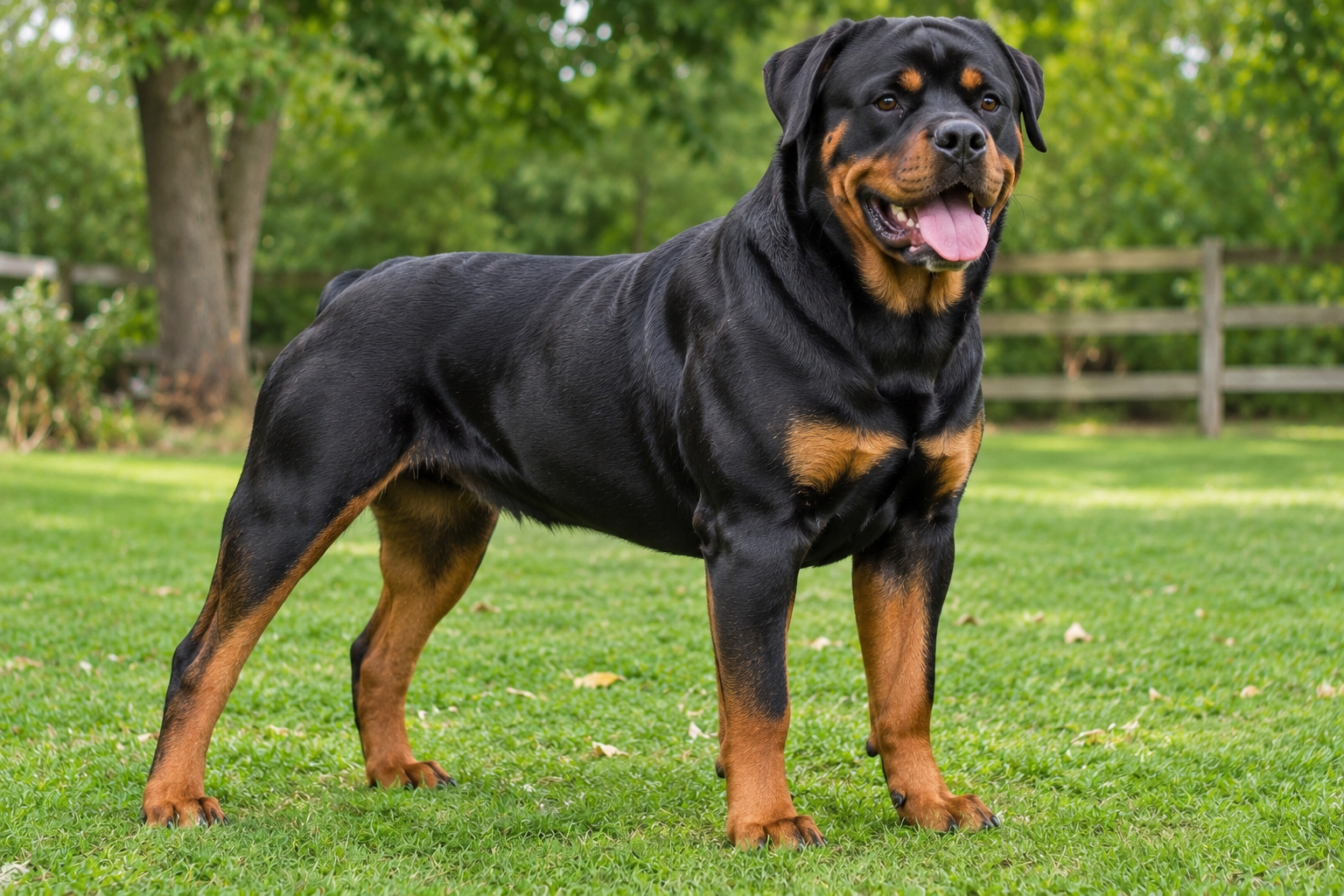
Rottweiler weight chart: the short answer
A healthy adult Rottweiler can weigh quite a bit, but males and females generally have different size ranges. As a broad guide, adult males typically weigh around 95–135 lb (43–61 kg), while females commonly fall around 80–110 lb (36–50 kg). Some breed references use a narrower female range of 80–100 lb, so these figures should be treated as general guidance rather than strict limits.
Height is another useful part of the picture. The American Rottweiler Club breed standard places males around 24–27 inches at the shoulder and females around 22–25 inches. Males are generally heavier-boned and more massive, while females tend to have a somewhat lighter frame.
Rottweiler puppies grow quickly during their first year. They may reach most of their adult height by around 12 months, but their bodies continue developing afterward. Many keep gaining muscle and filling out through their second year, particularly males.
The chart below gives approximate male and female weight ranges at common ages. Your puppy does not need to match a particular number to be growing normally. Genetics, body structure, nutrition, and individual development all influence the final result.
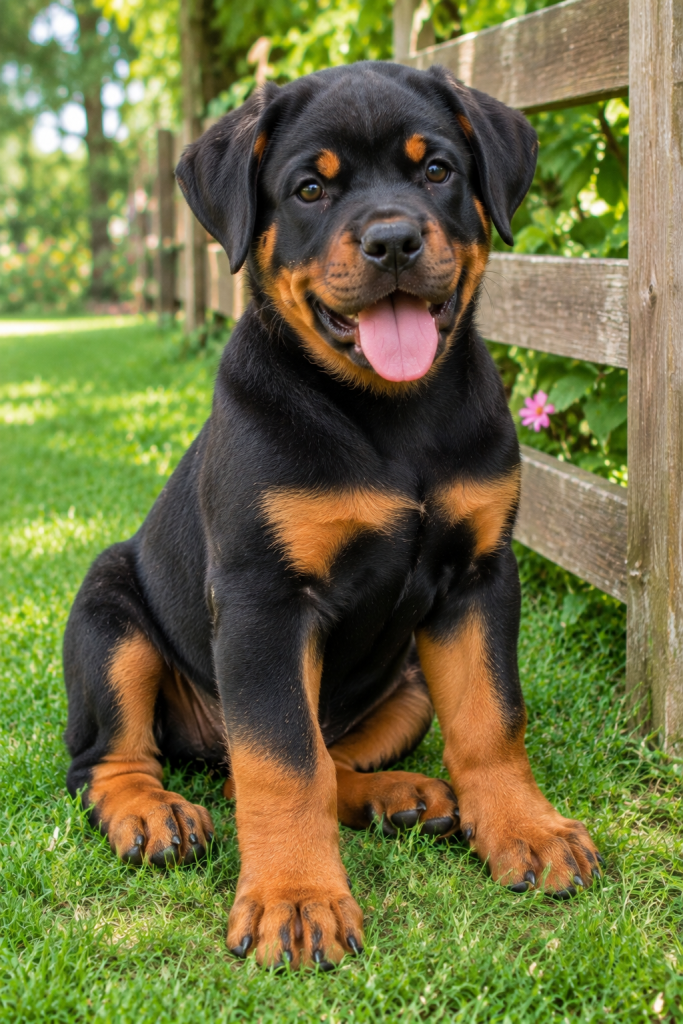
Rottweiler weight chart by age
Use this Rottweiler weight chart as a general reference when monitoring your puppy’s development. It includes pounds and kilograms so you can compare your dog’s weight with either measurement system.
| Age | Male lb | Male kg | Female lb | Female kg |
|---|---|---|---|---|
| 8 weeks | 13–18 | 5.9–8.2 | 11–14 | 5.0–6.4 |
| 3 months | 21–30 | 9.5–13.6 | 18–24 | 8.2–10.9 |
| 4 months | 32–45 | 14.5–20.4 | 27–36 | 12.2–16.3 |
| 5 months | 41–58 | 18.6–26.3 | 35–47 | 15.9–21.3 |
| 6 months | 49–70 | 22.2–31.8 | 42–57 | 19.1–25.9 |
| 8 months | 63–90 | 28.6–40.8 | 53–73 | 24.0–33.1 |
| 10 months | 74–106 | 33.6–48.1 | 63–86 | 28.6–39.0 |
| 12 months | 82–116 | 37.2–52.6 | 69–95 | 31.3–43.1 |
| 18 months | 93–132 | 42.2–59.9 | 78–108 | 35.4–49.0 |
| Adult | 95–135 | 43.1–61.2 | 80–110 | 36.3–49.9 |
Important: These are approximate planning ranges, not official breed-specific growth percentiles or guaranteed weight targets. They reflect the general progression shown in published Rottweiler growth guides, adjusted to the broad adult ranges above. Studies differ, and published charts do not always use the same growth estimates or methods. A puppy may fall outside a listed range and still develop normally.
A useful way to read the table is to look at the overall direction of growth. Your puppy should generally gain weight as they mature, although the rate will not be identical every month. A temporary slowdown does not automatically mean something is wrong.
For a more meaningful comparison, record your dog’s weight every few weeks and look at the trend over time. Also consider body condition, height, muscle development, and how your puppy feels during everyday activity.
Rottweiler growth milestones
Rottweilers are large dogs, and their development takes longer than it does for many smaller breeds. Weight is only one part of that process.
Early puppy growth: 8 weeks to 6 months
The first six months usually bring noticeable changes. Your puppy gains weight, grows taller, develops stronger legs, and becomes more coordinated. During this period, regular meals and suitable large-breed puppy nutrition help support steady development.
It is normal for two puppies of the same age to look quite different. One may have a heavier frame, while another may appear leaner or taller. Their family background and individual growth patterns both matter.
The lanky stage: 6 to 12 months
Many young Rottweilers go through a stage when their bodies look a little out of proportion. Their legs may seem long, their chest may not yet be broad, and their overall appearance can look lean compared with a mature dog.
This does not mean you need to increase food simply to make your puppy look heavier. Trying to speed up growth or add extra weight can put unnecessary stress on developing joints.
Late filling-out: 12 to 24 months
After the first birthday, much of a Rottweiler’s height growth may be complete, but physical development continues. The chest broadens, muscles become more developed, and the body gradually takes on a more mature shape.
Females may reach physical maturity somewhat earlier, while larger males can take longer to develop their full size and substance. Some males continue filling out beyond two years.
The important distinction is between healthy muscle development and excess body fat. A mature Rottweiler should look strong and balanced, not simply heavy.
How much should a Rottweiler weigh?
The right weight for your Rottweiler depends on more than age and sex. A naturally large-framed dog may weigh more than another Rottweiler of the same age without being overweight. A smaller-framed dog may be perfectly healthy at the lower end of the range.
Use the chart as a starting point, then check your dog’s body condition.
A healthy Rottweiler should generally have:
- Ribs that are easy to feel beneath a thin layer of fat.
- A visible waist when viewed from above.
- An abdomen that rises slightly behind the rib cage when viewed from the side.
- Good muscle development without heavy fat deposits.
You should not have to press hard to locate the ribs. On the other hand, prominent ribs, spine, or hip bones can indicate that a dog is too thin or has lost muscle or fat. Body condition is best assessed by looking at your dog and gently feeling their body, not by relying on appearance alone.
Why a heavier Rottweiler is not always healthier
Rottweilers naturally have substantial frames, but extra weight is not proof of better muscle or stronger bones. Carrying excess body fat can place additional pressure on joints that already support a large body.
This matters during puppyhood, when bones and joints are still developing. Keeping a young Rottweiler lean and growing steadily is generally a better goal than trying to reach the highest number on a chart.
German and American Rottweiler lines
You may also hear owners compare German and American Rottweilers. These labels are often used to describe breeding backgrounds and perceived differences in appearance. Some dogs may have a more substantial, compact build, while others may look somewhat lighter or taller.
However, these labels do not provide a separate, dependable weight formula. Individual pedigree, proportions, sex, and body condition matter more than the label alone. Do not assume that a dog is overweight simply because it is heavier than another Rottweiler.
Feeding a growing Rottweiler
Good nutrition supports healthy development, but feeding more does not necessarily produce a better-grown dog. Large-breed puppies need a balanced diet that supports controlled growth rather than rapid weight gain.
Choose a complete food formulated for large-breed puppy growth. These diets are designed with the nutritional needs of larger puppies in mind, including the balance of minerals involved in bone development.
Measure meals instead of guessing portions. Follow the feeding guidance on the food packaging as a starting point, then adjust with your veterinarian’s advice according to your puppy’s age, activity, body condition, and growth pattern.
Younger puppies often do better with several smaller meals throughout the day. As they mature, their schedule can usually move toward fewer meals. Keep treats and table scraps in mind when estimating total daily food intake.
Why slow, steady growth matters
Rottweilers have substantial skeletal and muscular development ahead of them. Encouraging excessive weight gain during puppyhood can increase the load on developing joints. A lean, steadily growing puppy is a more sensible goal than one that gains weight as quickly as possible.
Calcium deserves particular attention. Large-breed puppies need an appropriate balance of calcium and phosphorus, and excess calcium can be harmful during growth. Avoid adding calcium or mineral supplements unless your veterinarian specifically recommends them. A complete, appropriately formulated puppy diet should provide the necessary nutrients when fed correctly.
Your veterinarian can help you decide when to transition from puppy food to adult food. The timing depends on your dog’s development and the food’s intended life stage, rather than a birthday alone.
When to worry
A single weight measurement rarely tells the whole story. What matters is whether your Rottweiler is following a reasonably steady growth pattern and maintaining good body condition.
Growth that seems too fast: A puppy gaining weight rapidly while losing a visible waist or developing ribs that are difficult to feel may be gaining excess fat. Sudden increases in weight also deserve attention, particularly if your puppy seems uncomfortable or reluctant to move normally.
Growth that seems too slow: A puppy that consistently falls behind its previous growth pattern, stops gaining weight, or loses weight should be assessed. Appetite changes, persistent digestive problems, low energy, or a noticeable change in physical condition are additional reasons to contact your veterinarian.
Visible ribs or no waist: A little rib visibility can vary with coat and body shape, but prominent bones and a very pronounced waist may suggest that your dog is too thin. On the other hand, ribs that are difficult to feel and a waist that has disappeared can indicate excess body fat.
Contact your veterinarian if your puppy’s growth pattern changes significantly, weight loss occurs without an obvious explanation, or you notice persistent lameness, stiffness, pain, or difficulty getting up. Sudden weakness, severe discomfort, or an inability to bear weight needs prompt veterinary attention.
A veterinary check is also worthwhile when your puppy repeatedly falls well outside the chart ranges. The goal is not to force the dog into a table. It is to understand whether growth, nutrition, and overall condition are appropriate for that individual.
Frequently asked questions
How much should a 4 month old Rottweiler weigh?
At four months, a male Rottweiler may weigh around 32–45 lb (14.5–20.4 kg), while a female may weigh around 27–36 lb (12.2–16.3 kg). These are broad estimates, not exact targets. Your puppy’s frame, parents, and individual growth pattern can influence the number.
A four-month-old puppy who weighs slightly outside these ranges is not automatically unhealthy. Compare their weight over several weeks and pay attention to body condition as well.
How big do Rottweilers get?
Adult male Rottweilers commonly weigh around 95–135 lb (43–61 kg), while females are often around 80–110 lb (36–50 kg) as a broad reference. The breed standard places males around 24–27 inches tall and females around 22–25 inches at the shoulder.
Their final size depends on genetics, sex, frame, and overall development. Not every Rottweiler will reach the upper end of these ranges.
When do Rottweilers stop growing?
Most Rottweilers approach their adult height by around 12 months, but they can continue gaining muscle and filling out through approximately two years. Larger males may take longer to develop their mature build.
This is why a one-year-old Rottweiler can look noticeably different from an adult dog, even if much of the height growth is already complete.
Is my Rottweiler too skinny?
Start by gently feeling the ribs and looking at your dog’s waist. A healthy Rottweiler should usually have ribs that are easy to feel beneath a thin fat covering, a visible waist from above, and a slight abdominal tuck from the side.
Ribs, spine, and hip bones that are very prominent may indicate that your dog is underweight. However, a naturally lean frame is not the same as poor body condition. Ask your veterinarian to assess your dog’s weight and muscle condition if you are unsure.
How much does a full grown Rottweiler weigh?
A full-grown male commonly weighs around 95–135 lb (43–61 kg), while a female may weigh around 80–110 lb (36–50 kg). Some published references use narrower ranges, so these numbers are best treated as general guidance.
A healthy adult weight is the one that suits your dog’s frame and body condition. A well-muscled Rottweiler with a visible waist may be healthier than a heavier dog carrying excess fat.
Conclusion
A Rottweiler weight chart is useful for understanding how your puppy may grow, but it should never become a strict target. Males typically finish larger than females, and both sexes continue developing well beyond their first birthday. Use the age ranges as a guide, monitor your dog’s weight and body condition over time, and focus on steady growth rather than maximum size. With appropriate large-breed nutrition and regular veterinary checkups, you can support a strong, healthy Rottweiler as they mature.