Find your dog’s daily calorie needs and right-size every meal.
Daily calorie calculator
Get a starting estimate for maintenance energy, portions and treat allowance.
Feeding a puppy? Portions change month to month, so check the puppy food chart for daily amounts that match your puppy’s age. Owners also ask about grass: grazing between meals adds almost no calories, but there are a few common reasons why dogs eat grass in the first place.
How Does a Dog Calorie Calculator Work?
Last updated: October 2026
A dog calorie calculator estimates how much energy a dog may need each day using body weight, life stage, and activity level. The result is a starting estimate for a healthy dog — not a prescription, and not a substitute for veterinary nutrition advice.
A dog’s daily calorie need depends on more than weight: age, neuter status, activity, body condition, and health all shift the number. The dog calorie calculator below handles the biggest factors; the article explains the math behind them.
The resting energy requirement formula
This dog calorie calculator begins with the resting energy requirement (RER) equation:
RER = 70 × (body weight in kg)^0.75
RER estimates the energy needed by a healthy animal at rest under specified environmental conditions. The exponent of 0.75 represents metabolic body weight — a scaling factor that reflects how energy needs change with body size.
A dog weighing twice as much as another dog will not necessarily need twice as many calories. Body size and energy requirements follow a curved relationship, which is why the equation uses an exponent rather than simple multiplication.
According to the Merck Veterinary Manual, RER is a starting point for estimating a dog’s daily energy needs, and maintenance requirements are then derived by applying multipliers for life stage and activity.
Here’s the thing: RER and daily maintenance calories are not the same number. RER provides the foundation. The life-stage factor adjusts it to match the dog’s actual daily life.
Which Life-Stage Factors Does the Calculator Use?
A dog’s calorie multiplier changes with life stage and reproductive status because an adult maintenance routine, a growing puppy, and a highly active dog burn energy at very different rates.
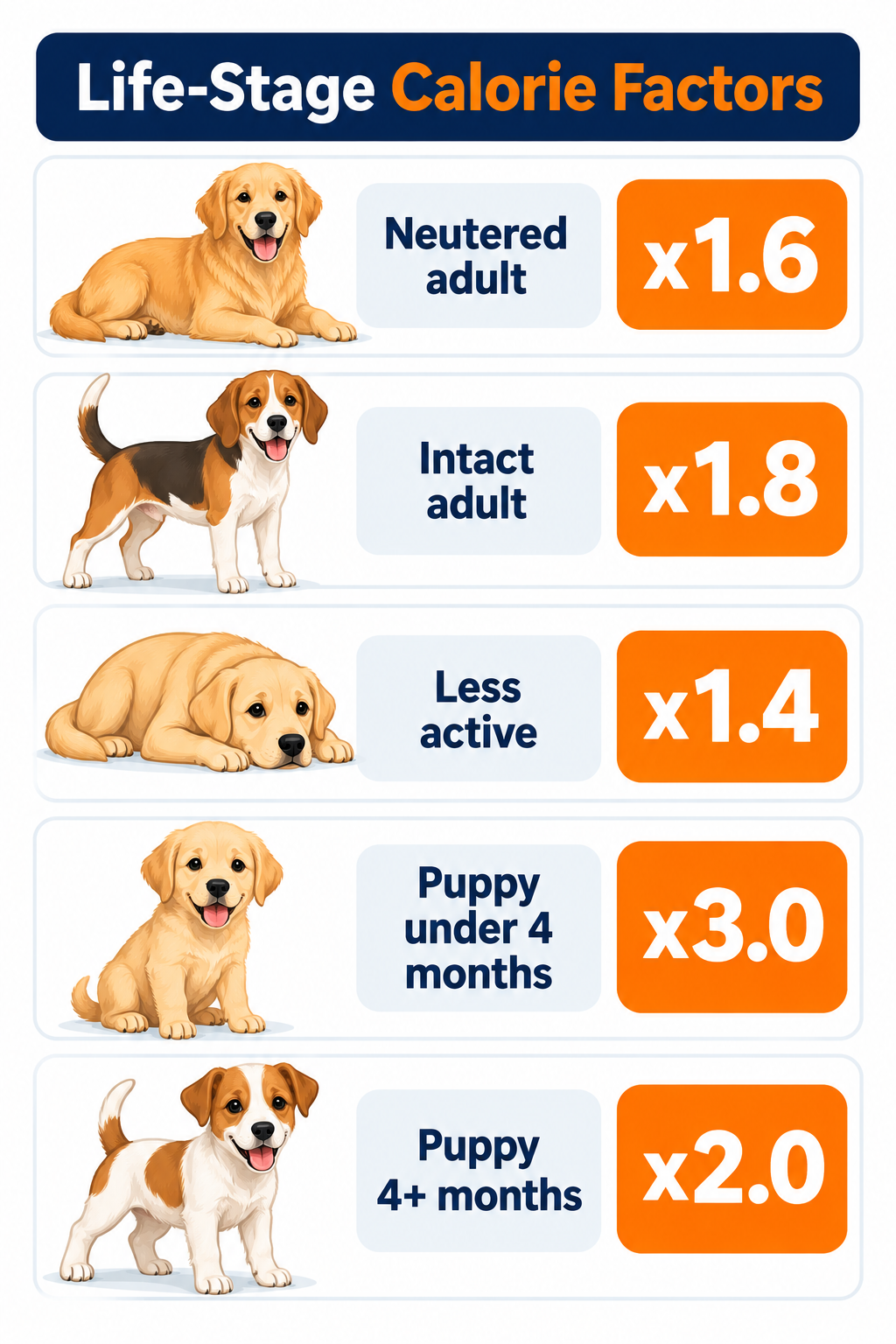
Life-stage factors used by CanineCalc
These are the exact multipliers used by CanineCalc. The 1.4 multiplier appears in veterinary maintenance equations for less active or obesity-prone dogs; the puppy factors reflect the high energy cost of growth.
| Life stage | Factor | What it means |
|---|---|---|
| Neutered adult | 1.6 | Typical healthy adult dog that has been spayed or neutered |
| Intact adult | 1.8 | Healthy adult dog that has not been spayed or neutered |
| Less active / obesity-prone | 1.4 | Adult dog with low activity or a tendency to gain weight |
| Puppy under 4 months | 3.0 | Very young puppy with rapid growth and high energy needs |
| Puppy 4 months and older | 2.0 | Older puppy still growing but past the fastest growth phase |
How the calculation works
To estimate daily calories with a dog calorie calculator, follow these three steps:
Convert your dog’s weight from pounds to kilograms.
Calculate RER using \(70\times\text{kg}^{0.75}\), then multiply by the selected life-stage factor.
Divide the estimated daily calories by the food’s kcal per cup to calculate the daily portion.
The result becomes more useful when you also know how many meals your dog eats and how many calories come from treats.
RER vs. daily maintenance calories: RER estimates resting energy requirements. Maintenance calories adjust RER for the dog’s life stage. Neither number is a guaranteed exact requirement — both are evidence-based starting points.
Worked Example: How Many Calories Does a 22 lb Dog Need?
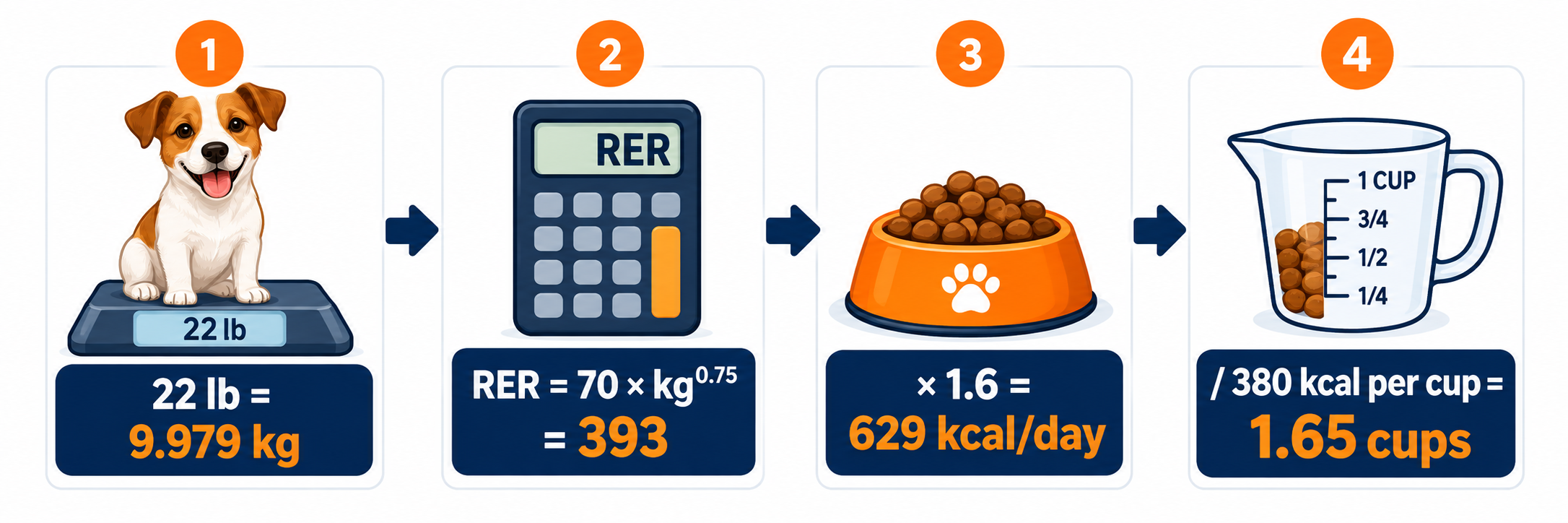
Let’s run this dog calorie calculator through a full example: a healthy, neutered adult dog weighing 22 lb, eating food with 380 kcal per cup, split across two meals daily.
Step 1: Convert pounds to kilograms
The RER equation uses kilograms.
The dog’s weight is approximately 9.979 kg.
Step 2: Calculate RER
Insert the converted weight into the standard equation:
Calculate RER: 70 × 9.979^0.75 ≈ 393 kcal/day.
Rounded for display, the resting energy requirement is approximately 393 kcal/day.
Step 3: Estimate daily maintenance calories
For a neutered adult dog, CanineCalc uses a factor of 1.6.
The estimated daily calorie target is approximately 629 kcal/day.
Step 4: Convert calories into cups
The food contains 380 kcal per cup.
The dog would receive approximately 1.66 cups per day.
Step 5: Divide into two meals
That works out to approximately 0.83 cups per meal.
Step 6: Calculate the treat allowance
The general veterinary guideline is to keep treats and additional foods within 10% of daily calories.
The treat allowance is approximately 63 kcal per day.
The complete estimate is therefore 629 kcal daily, about 1.66 cups of the specified food, 0.83 cups per meal, and no more than about 63 kcal from treats.
Rounding note: The calculator rounds daily calories to the nearest whole kcal first (629), then derives cups from that rounded value — so 629 ÷ 380 = 1.66 cups, exactly as displayed.
How to Turn the Calorie Result Into a Feeding Plan
A dog calorie calculator result is only useful when you can apply it to the food your dog actually eats.
Check the food label
Find the product’s stated calorie content, usually expressed as kcal per cup or kcal per kilogram. Dog foods vary widely — from under 300 to over 500 kcal per cup — so the label matters more than any generic chart.
Divide the daily amount into meals
For consistency, measure the same way each day. Weighing food in grams can be more precise than using cups, because kibble size and settling change what a “cup” holds.
If you’re wondering how big your puppy will get, start here.
You’re not expected to memorize the formula, and you don’t have to guess at portions once you’ve checked the label.
The number of meals does not change the estimated daily calories. It changes how those calories are distributed across the day.
Account for treats and extra foods
The UC Davis School of Veterinary Medicine’s treat guidelines, published in 2019, recommends that treats stay within 10% of daily calories.
For a dog with an estimated daily target of 629 kcal, the general treat ceiling is approximately 63 kcal from treats and table scraps combined.
Should you follow the food bag or the calculator?
Some owners prefer package feeding charts because they are tailored to the food’s calorie density. That approach is valid when the chart’s assumptions match the dog.
A slightly unpopular opinion: the feeding guide on a bag should be a starting clue, not the final authority. Bag charts cover wide weight ranges and average dogs; this dog calorie calculator adjusts for your dog’s specific life stage.
Put simply, puppies grow in spurts.
For related planning, see the Dog Food Cost Calculator to estimate feeding expenses and the Puppy Size Calculator to estimate adult weight.
Limitations, Veterinary Guidance, and FAQs
What this estimate cannot tell you
Energy formulas are useful, but the number is not guaranteed to match a dog’s actual daily needs. The estimate assumes a healthy dog and a typical activity level within its life stage.
Sources also differ in how they establish the starting point. Merck presents standard maintenance multipliers; other references adjust for body condition scores or activity tiers. CanineCalc keeps to the five factors above for transparency.
What most guides skip is the importance of reassessment. A dog that consistently gains or loses weight on the calculated portion needs the portion adjusted — the formula is a starting point, not a verdict.
This guide covers general calorie estimation for dogs. It does not determine disease-specific nutrition, weight-loss prescriptions, or feeding plans for working and sporting dogs.
Puppies, pregnant or nursing dogs, and dogs with health conditions need veterinary guidance to establish safe calorie targets.
Frequently asked questions
Q: What’s the best way to estimate my dog’s daily calories?
A: Use an evidence-based starting point like the RER equation with a life-stage multiplier, then adjust based on body condition over two to three weeks.
Q: How do I convert daily calories into cups of dog food?
A: Divide the estimated daily calories by the food’s kcal per cup. Divide that daily amount by the number of meals for the per-meal portion.
Q: Should I feed my dog exactly what the dog calorie calculator recommends?
A: Not automatically. The calculation estimates energy needs, but individual requirements vary. Monitor your dog’s condition and seek veterinary guidance when adjustments are needed.
Q: Why does my dog need a different number of calories from another dog of the same weight?
A: Activity, age, neuter status, body composition, health, and individual metabolism influence energy needs. Two dogs of the same weight can have genuinely different requirements.
Q: When should I ask a veterinarian about my dog’s calorie target?
A: Seek veterinary guidance for puppies, pregnant or nursing dogs, dogs with health conditions, and any planned weight-loss program.
A dog calorie calculator gives you a practical place to start. Use the formula transparently, measure portions carefully, and reassess the result against your dog’s individual needs.