Last updated: October 2026
Multiplying your dog’s age by seven won’t give you a reliable human-age equivalent. Dogs mature quickly during their early years, and their size and breed influence how they age later in life. The practical alternative is to use a size-adjusted age chart, understand how its estimates work, and recognize where the numbers stop being useful.
Here’s the actual method, with calculations you can follow.
How to Calculate Dog Years Without the Seven-Year Rule
How to calculate dog years means estimating a dog’s human-age equivalent from chronological age and adult size, rather than multiplying age by seven. According to the 2019 AAHA Canine Life Stage Guidelines, age, size, lifestyle, health status, and breed all shape life-stage assessment, so a human-age number is an estimate, not a clinical label.
No single conversion is official.
The seven-times rule became popular around the middle of the 20th century. One commonly offered explanation is that people compared an assumed human lifespan of 70 years with a dog lifespan of 10 years, then used the resulting ratio as a shortcut. It was simple to remember, but it didn’t account for differences in development, adult size, or breed. The American Kennel Club’s explanation of dog-year calculations discusses this history and the limitations of the traditional rule.
Why the seven-year rule fails is that canine development is nonlinear. In a 2020 study published in Cell Systems, researchers compared DNA-methylation patterns in 104 Labrador Retrievers with patterns in humans and developed a nonlinear age formula. That research offers a different perspective, but it does not establish one universal formula for every breed.
The early years matter most.
A common practical chart estimates a dog’s first year at approximately 15 human years and its second year at about 24 human years cumulatively. After that, the estimates begin to diverge by size. These are chart-based approximations, not a biological clock that ticks at one fixed rate for every dog.
If you’re wondering how big your puppy will get, start here. Start with the dog’s real age, select the correct adult-size category, and use one consistent chart instead of mixing numbers from different calculators.
The Size-Based Calculation, Step by Step
To calculate dog years with a size-based chart, follow these steps: 1. Record your dog’s age in years and months. 2. Choose the adult size category. 3. Find the matching age and size on the chart. 4. For part-years, interpolate between neighboring rows. According to the AAHA, life-stage assessment should also account for characteristics beyond age alone.
Step 1: Record your dog’s chronological age
Use the dog’s actual age, not the age you believe it represents in human years. If your dog is seven years and six months old, record 7.5 years for an interpolation calculation.
You don’t need to convert dog years into human years first.
Step 2: Identify adult size
Choose the size category that matches your dog’s expected or established adult size. This matters for puppies whose current weight doesn’t yet reflect their eventual size.
Use the weight definitions specified by your selected chart. Small, medium, large, and giant categories aren’t defined identically in every reference, so switching categories between methods can change the answer.
Step 3: Read the age-and-size chart
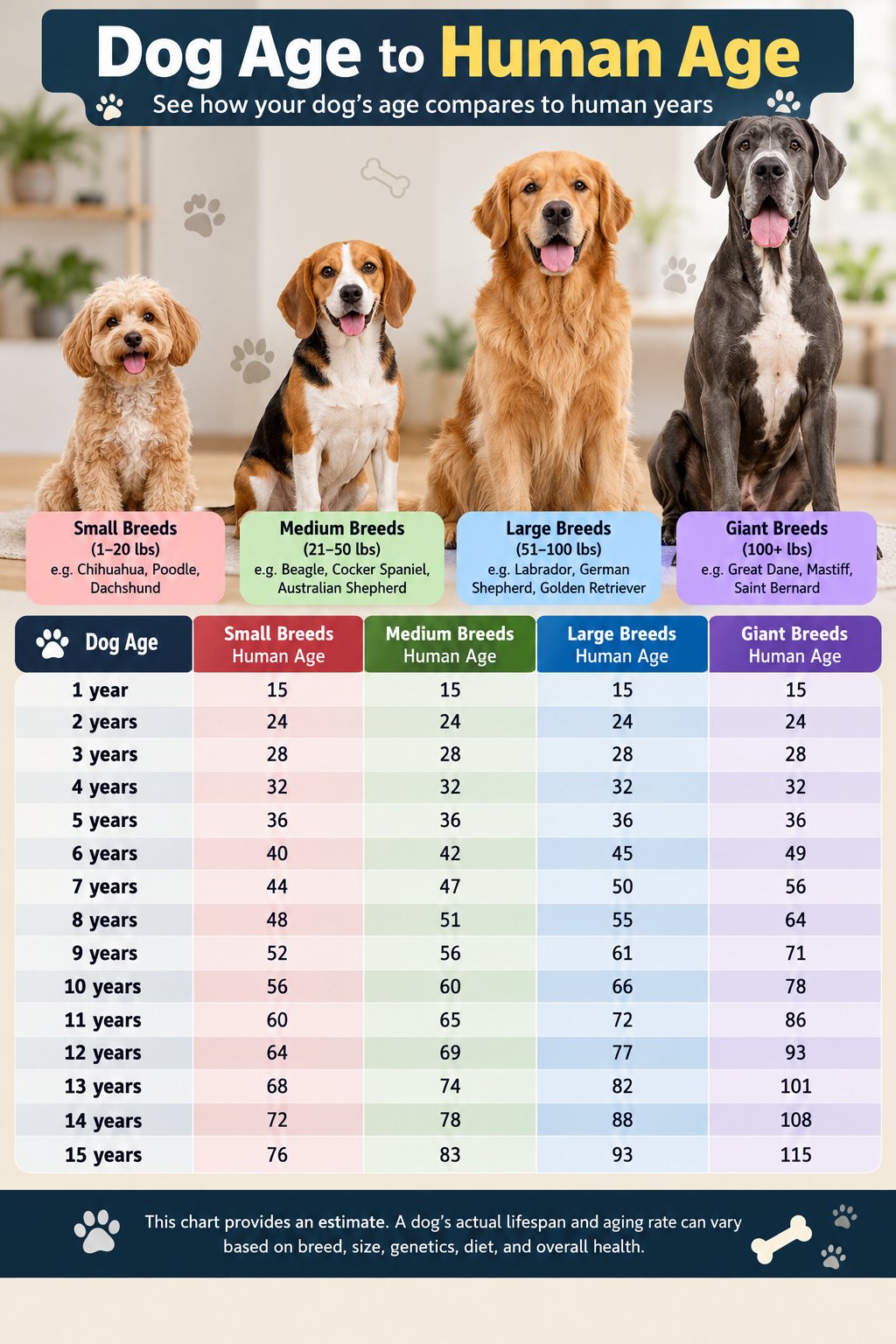
The following examples illustrate values from a commonly used size-adjusted chart presented in AKC’s dog-age guidance.
Dog Years Chart by Breed Size
| Dog’s Actual Age | Small Dog | Medium Dog | Large Dog | Giant Dog |
|---|---|---|---|---|
| 1 year | 15 | 15 | 15 | 15 |
| 2 years | 24 | 24 | 24 | 24 |
| 3 years | 28 | 28 | 30 | 31 |
| 5 years | 36 | 37 | 40 | 45 |
| 7 years | 44 | 47 | 50 | 56 |
| 10 years | 56 | 60 | 66 | 79 |
Here’s what those numbers mean in practice. A seven-year-old small dog might be estimated at 44 human years, while a seven-year-old large dog might be estimated at 50. A giant dog’s estimate is higher still.
The chronological age is identical.
The size-adjusted estimate isn’t.
Step 4: Calculate an age between chart entries
Suppose your medium-sized dog is seven years and six months old. Your selected chart gives an estimate of 47 human years at age seven and 51 at age eight.
You can estimate the halfway point using linear interpolation:
Estimated human age = lower value + (fraction of year × difference between values)
For this example:
(47 + (0.5 times (51-47)) = 49)
The result is approximately 49 human years.
This arithmetic provides a consistent way to read between chart entries. It does not mean a dog’s biological aging follows a perfectly linear path during those six months.
Try the calculation yourself
The CanineCalc Dog Age Calculator is the companion tool for checking a dog’s human-age equivalent using age and size category.
Try the CanineCalc Dog Age Calculator to run your own numbers.
Quick note: Use the calculator’s estimate consistently rather than combining its result with a different chart’s values. The size-based approach is intended to make the comparison more meaningful, not to predict an individual dog’s exact biological age.
Why Small and Large Dogs Get Different Estimates
Adult size changes the comparison because dogs do not all share the same aging pattern. Smaller breeds generally live longer than many large and giant breeds, and differences in lifespan affect how researchers and veterinarians interpret later-life aging.
The underlying biology is still being investigated.
A 2026 study published in Science analyzed 1,640 DNA-methylation profiles from 894 dogs. The researchers found that larger and male dogs showed accelerated molecular aging patterns, with size-related differences particularly pronounced in regions of DNA involved in regulating transposable elements.
That finding helps explain why size matters beyond a simple mathematical convention. However, molecular-aging research does not automatically translate into a universally accepted human-age conversion chart.
Why the first two years matter
Puppies pass through major developmental changes quickly. Physical growth, sexual maturity, and behavioral development occur on a different timeline from human childhood.
A seven-year multiplier treats all twelve months alike. A size-based chart does not.
Here’s the thing: two dogs can reach the same chronological age without having the same expected lifespan or age-related health risks. Their breed, body size, existing medical conditions, and individual history all affect the bigger picture.
What most guides skip
What most guides skip is that the boundary between size categories varies among charts. A dog near a category cutoff might receive a different estimate simply because two references classify adult weight differently.
Studies differ in their approaches to aging, too. Some sources emphasize practical life-stage categories, while others develop mathematical models using biological markers. These methods answer related but distinct questions.
For everyday comparison, consistency matters more than choosing the most impressive-looking formula.
This works best for dogs with a reasonably known age and adult size. It won’t help if you need to identify an unknown dog’s age from appearance alone. A veterinarian can assess dental development, physical condition, and medical history when estimating an unknown age.

Source: AAHA 2019 Canine Life Stage Guidelines — explains how age, size, lifestyle, health, and breed shape a dog’s life stage.
Which Dog-Age Calculation Method Should You Trust?
Size-based chart vs. epigenetic formula: a size-based chart is better suited to a quick household estimate because it accounts for size and is easy to interpret. The 2020 DNA-methylation formula supports research into biological aging, but it was derived from Labrador Retrievers. The key difference is practical age mapping versus a molecular research model.
The three main approaches
1. Size-based age chart
This method translates chronological age into an approximate human-age equivalent using an age row and an adult-size category. It’s straightforward, reproducible, and useful for everyday comparisons.
2. The seven-year rule
This method multiplies the dog’s chronological age by seven. It is easy to calculate mentally, but it fails to reflect rapid early development and differences between dog sizes.
3. The DNA-methylation formula
Researchers proposed the following relationship in a 2020 study published in Cell Systems:
[
text{Human-age estimate}=16ln(text{dog age})+31
Here, dog age is expressed in years and (ln) represents the natural logarithm. The study by Wang and colleagues compared DNA-methylation patterns in dogs and humans to estimate corresponding molecular-aging patterns.
The equation is scientifically interesting, but the original canine sample consisted of Labrador Retrievers. It should not be treated as a universal formula that accounts for every breed and size.
Source: Wang et al. (2020), Cell Systems — the DNA-methylation study behind the nonlinear dog-age formula.
Quick Comparison
| Option | Best For | Key Benefit | Limitation |
|---|---|---|---|
| Size-based chart | Everyday age comparisons | Accounts for adult size | Values differ among charts |
| Seven-year rule | A quick mental shortcut | Very easy arithmetic | Ignores development and size |
| DNA-methylation formula | Understanding aging research | Based on measured biological markers | Original dog study focused on Labradors |
The most useful default for most owners is a transparent size-adjusted chart, not the most complicated equation available. A more technical formula may sound more exact, but its precision is only as useful as the population and assumptions behind it.
Put simply, puppies grow in spurts.
The AAHA’s 2019 Canine Life Stage Guidelines make an important distinction. They recommend considering a dog’s actual life stage and characteristics instead of relying on human-age equivalents alone. In veterinary care, an appropriate assessment is more useful than a single converted number.
Dog-Years Questions, Answered
What’s the best way to calculate dog years?
Use a size-adjusted age chart. Find your dog’s chronological age, choose its adult-size category, and read the corresponding human-age estimate. Keep in mind that different charts can produce slightly different results.
How do I calculate dog age in human years without a calculator?
Use a printed size-based chart. Find your dog’s age in the first column and match it with the appropriate size column. If the age falls between entries, estimate the value between them.
Should I use the DNA formula or a size chart?
Use a size chart for a practical everyday estimate. The DNA-methylation formula is valuable in aging research, but the original 2020 study used Labrador Retrievers, so its results should not be assumed to apply precisely to all breeds.
Why does my large dog get an older human-age estimate than a small dog?
Large and giant dogs often have shorter lifespans than small breeds. Research into DNA-methylation patterns also indicates differences in molecular aging, although these findings do not create an exact prediction for every individual dog.
When should I consider my dog a senior?
Senior status depends on breed, expected lifespan, and individual health. The AAHA guidelines define the senior stage in relation to the last 25% of a dog’s estimated lifespan, rather than assigning every dog the same age threshold.
Use the Number as a Guide, Not a Verdict
Calculating dog years starts with one important correction: chronological age does not translate into human age through a single universal multiplier. A size-adjusted chart gives a practical estimate, and interpolation lets you calculate values between whole-year entries.
You’re not missing a secret equation, and you don’t need to convert every month perfectly; you’ll get a useful estimate by pairing age with adult size and using a consistent method.
The estimate has limits. It cannot tell you whether your dog is healthy, how long your dog will live, or exactly when age-related conditions will develop. For those decisions, your veterinarian should assess your dog as an individual.
Use the CanineCalc Dog Age Calculator to check your dog’s age-and-size estimate, then interpret that number in the context of your dog’s actual life stage and care needs.