Are puppy weight calculators accurate: the short answer
Yes — within limits. A good puppy weight calculator can give you a sensible, useful estimate of your puppy’s likely adult weight, especially when you know the breed, or at least the size class, and you have a reasonably accurate age and current weight.
But it is an estimate, not a measurement. No calculator can look at a puppy today and tell you exactly how much that individual dog will weigh as an adult. The honest answer is that a calculator is good at placing your puppy in the right ballpark, and much less good at giving you a precise final number.
That distinction matters. If you are choosing a crate, estimating food amounts, or just satisfying your curiosity, a sensible range is genuinely helpful. If you need an exact adult weight for a medical decision, a calculator is not the right tool. Your vet is.
So, are puppy weight calculators accurate? Yes, in the way a good weather forecast is accurate: useful, broadly right for most typical puppies, and still capable of being off — especially for mixed breeds, rescue puppies with an unknown age, and puppies whose growth does not follow the usual pattern.

How puppy weight calculators actually work
A puppy weight calculator does something simple, and that simplicity is both its strength and its limit.
It takes your puppy’s current weight and age, then compares those numbers with the typical growth patterns of puppies of a similar size. In plain terms, it asks: “For a puppy this old and this heavy, what do puppies like this usually weigh when they finish growing?”
That comparison is based on a few well-established patterns.
Puppies grow fastest early on, then slow down. A very young puppy can put on weight quickly in a matter of weeks, while an older puppy closer to adult size grows much more slowly. A calculator has to account for that change in pace, otherwise an early weigh-in would suggest an impossibly large adult dog.
Puppies reach roughly half their adult weight partway through puppyhood. That is why age matters just as much as weight. A 10 lb puppy at 12 weeks is on a very different path from a 10 lb puppy at 6 months, even though the scale shows the same number.
Puppies of different sizes follow different curves. A small breed reaches its adult weight much earlier than a large or giant breed, which keeps growing for longer. A responsible calculator therefore does not use one rule for every dog. It adjusts for size class, and, when the breed is known, for that breed’s typical growth.
A published study used records from more than six million young dogs to develop canine growth-standard charts. These charts put weight into context, but cannot make an individual dog’s final size certain. The researchers said further validation was needed before the standards could be used as a clinical monitoring tool.
That last point is important. A good calculator should show you a range, not a single, confident number. A range is honest. It says: “Based on typical growth, this puppy is likely to land somewhere around here.” A single number looks more precise than the science allows.
That is also why a calculator is not a prediction about your puppy alone. It is a comparison with other puppies. If your puppy is typical for its breed and age, the comparison works well. If your puppy is not typical, the comparison is weaker — and the estimate should be treated with more caution.
What makes an estimate more (or less) accurate
Several things push an estimate toward “helpfully close” or toward “take this with a pinch of salt.”
Known breed and parent size help a lot. If you know your puppy is a Labrador, a French Bulldog, or a German Shepherd, the calculator can compare your puppy with the usual growth pattern for that breed. Knowing the parents’ adult weights helps even more, because puppies often land somewhere near their parents’ size.
Mixed breed or unknown background makes it harder. A mixed-breed puppy may inherit the growth pattern of one parent more than the other, or fall somewhere between the two. The calculator has to guess which pattern to use, and that guess widens the margin. The same is true for a rescue puppy, where even the breed mix may be a best guess.
An unknown or estimated age is a bigger problem than most people realise. Because growth is so fast in the early months, being out by even a few weeks can change the estimate noticeably. An age given as “about four months” is less useful than an exact birth date, especially for a young puppy.
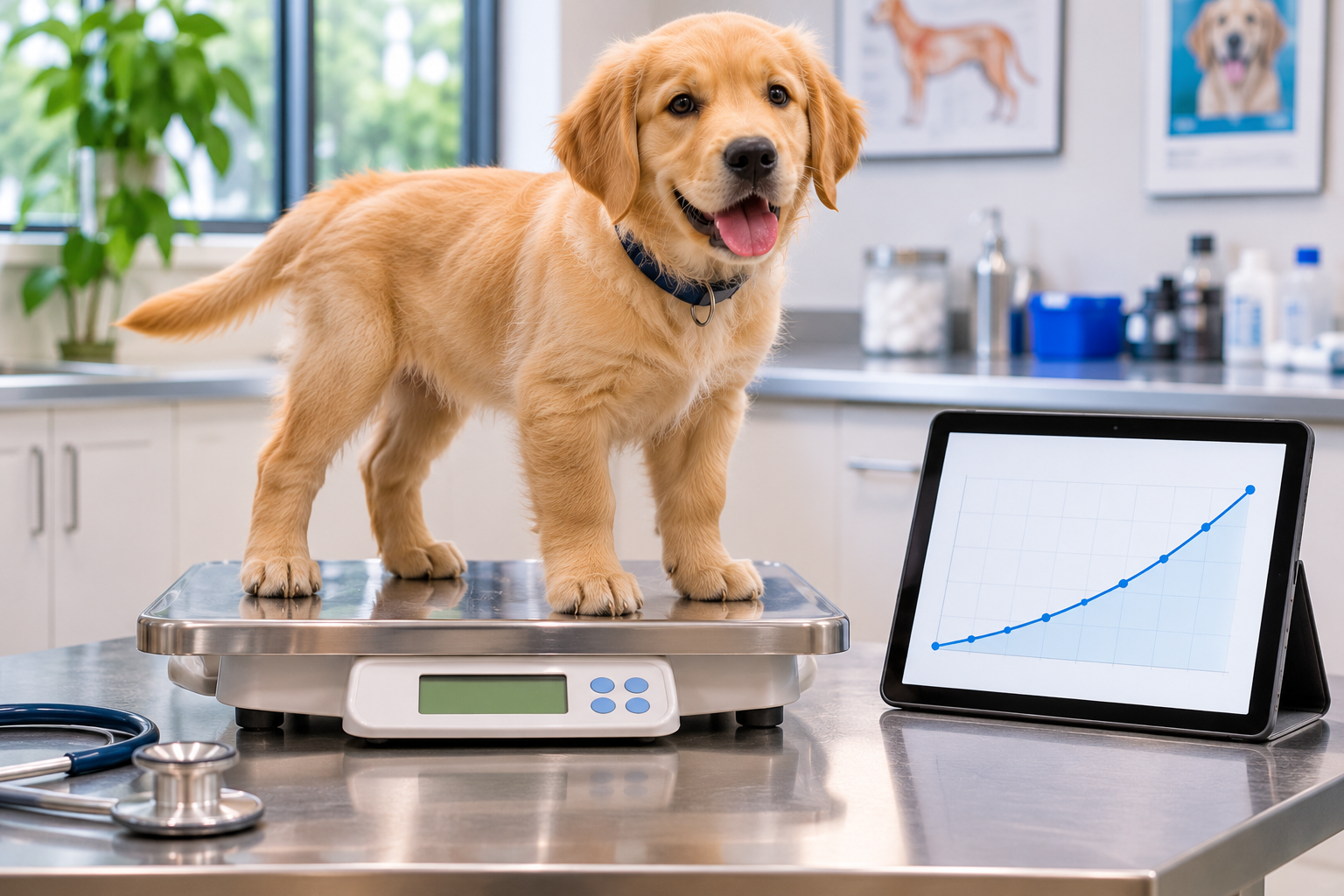
Weighing accuracy matters, too. A puppy weighed on a bathroom scale while being held, then weighed again on a different scale at the vet, can produce two quite different numbers. Small errors at this stage are carried forward into the adult estimate. Weighing on the same flat scale, in the same way each time, gives the calculator cleaner information to work with.
Early growth and later growth are not the same. In the first few months, puppies grow rapidly, and a small change in weight can look like a large change in trajectory. Later, growth slows, and the estimate usually becomes steadier. That is why an estimate made at eight weeks is more uncertain than one made at eight months, when much of the growing is already done.
None of this means a calculator is useless for mixed breeds or rescue puppies. It means the result should be read as a broad guide, not a promise.
Puppy weight calculator vs the alternatives
| Method | What it gives you | Accuracy | Cost / effort |
|---|---|---|---|
| Online puppy weight calculator | An estimated adult weight range from current weight and age | Good general guide for typical puppies; wider margin for mixed breeds or unknown age | Free; takes a minute |
| Growth chart | A way to plot your puppy’s weight over time against breed or size standards | Useful for tracking whether growth is steady; does not predict a final weight on its own | Free; needs regular weigh-ins |
| Vet weigh-in and assessment | A professional check of weight, body condition, and growth, in context | The most reliable in-person check, especially when combined with breed and parent information | Vet visit fee; most useful at routine check-ups |
| DNA test | Breed mix information, and sometimes an estimated adult weight range based on genetics | Can narrow the breed picture for mixed breeds, but still an estimate, not a certainty | Paid test; results take time |
No single method is perfect. A calculator is the quickest way to get a sense of adult size. A growth chart is better for watching the pattern over time. A vet can put both into context and spot anything that needs attention. A DNA test can help when the breed mix is genuinely unknown. For most owners, the calculator plus regular weigh-ins is enough to plan sensibly, without pretending to know more than the information allows.
How to get the most accurate estimate
You cannot make a calculator exact, but you can give it the best possible starting point.
Weigh on a flat scale, the same way each time. Use the same scale, on a hard, flat floor, and weigh your puppy in the same way — for example, standing on the scale alone if possible, or held by the same person if your puppy is too small to stand still. Write down the number and the date.
Use the closest age you know. If you have a birth date, use it. If you only have an estimate, use the best estimate you have and remember that the result will be less certain. Do not round a young puppy’s age up or down by a month if you can avoid it.
Pick the right size class. If the calculator asks for small, medium, large, or giant, choose the class that best fits your puppy’s breed or expected size, not the size your puppy is today. A large-breed puppy is small at eight weeks, but it is still a large breed.
Re-check monthly as your puppy grows. One weigh-in gives you one snapshot. Monthly weigh-ins show you the trend, and the estimate usually becomes more stable as your puppy gets older. If the estimate changes a lot from month to month, that is a sign to treat the range as broad, not to trust the newest number more.
Compare with the breed chart if the breed is known. If you know the breed, look at its typical adult weight range as a cross-check. If the calculator’s range and the breed range broadly agree, you can be more confident. If they disagree, the breed range is a useful reality check.
Try it: our puppy weight calculator
If you would like a quick estimate for your own puppy, you can try the CanineCalc puppy weight calculator on our homepage.
It is simple to use. Enter your puppy’s current weight and age, and it will give you an estimated adult weight range based on typical growth patterns for puppies of a similar size. You do not need to know anything technical to use it, and the result is ready in a few moments.
What it will do is give you a sensible starting point: a range to plan around, whether you are thinking about a crate, food amounts, or simply wondering how big that little puppy is likely to become.
What it will not do is promise an exact adult weight. It cannot know your puppy’s genetics, health, or individual growth pattern, and it does not pretend to. It works from the information you give it, and from how puppies usually grow. If your puppy is a mixed breed or a rescue with an unknown age, the range will be wider, and that is honest.
Try it when your puppy is weighed, note the result, then try it again in a month with a fresh weight. Watching how the estimate settles over time is often more useful than any single result.
You can find it on the CanineCalc homepage.
Frequently asked questions
Are puppy weight calculators accurate?
Yes, for most typical puppies. A good calculator gives a sensible adult weight range when the breed or size class, age, and current weight are known. It is an estimate, though, not an exact prediction, and the margin is wider for mixed breeds, rescue puppies with an unknown age, and puppies growing unusually fast or slowly.
How accurate are puppy weight predictors?
They are best understood as a general guide rather than a precise forecast. A predictor compares your puppy with typical growth patterns, so it tends to be closer for puppies that follow the usual pattern for their breed or size, and less close for puppies that do not. A range is more honest than a single number, and re-checking as your puppy grows usually gives a steadier picture.
Can a calculator predict a mixed breed puppy’s adult weight?
It can give you an estimate, but with a wider margin than for a purebred puppy. A mixed-breed puppy may follow the growth pattern of one parent more than the other, or fall between the two, and the calculator has to make an assumption about which pattern fits best. That makes the result a broad guide rather than a close prediction. Knowing the parent breeds, if you can, narrows the range.
What is the most accurate way to predict adult dog weight?
The most reliable approach is to combine methods: a good estimate from current weight and age, regular weigh-ins plotted on a growth chart, and a vet’s assessment of breed, parent size, body condition, and overall growth. For some mixed-breed dogs, a DNA test can also add useful information about the breed mix, but even that does not give an exact adult weight. Your vet can also give advice about the right food and feeding amounts as your puppy grows.
Why did my puppy outgrow the calculator estimate?
It usually comes down to the starting information or an unusual growth pattern. The age may have been estimated, the breed mix may have been different from the one used for the calculation, or your puppy may simply have grown faster or for longer than the typical pattern for its size. A single early weigh-in is also more uncertain than a later one, so an estimate made at eight weeks can shift as your puppy grows. Re-checking with a fresh weight and age will usually give a more settled range, and your vet can help you understand whether your puppy’s growth is within a healthy pattern.
Conclusion
A puppy weight calculator is a helpful tool when you use it for what it is: a way to turn your puppy’s current weight and age into a sensible adult weight range, based on how puppies usually grow.
It is not a promise, and it should not be treated as one. The best calculators are honest about that. They show a range, they depend on good information, and they become more useful as your puppy grows and you re-check the estimate.
If you know your puppy’s breed and age, and you weigh carefully and regularly, a calculator can give you a genuinely useful guide for planning. If your puppy is a mixed breed or a rescue with an unknown age, the guide will be broader, but it is still a better starting point than guessing.
Use the estimate to plan, keep weighing, and let your vet help you read the pattern. That is the most honest way to answer the question, “Are puppy weight calculators accurate?” — yes, within limits, and most useful when you know what those limits are.