
Veterinary Disclaimer: This article provides general canine developmental estimates for healthy dogs on balanced diets. It does not replace individualized diagnostic care or evaluate underlying health conditions.
Last updated: October 2026
Adopting a mixed-breed puppy comes with one big question: how large will this little dog eventually become?
A puppy may have the face of a terrier, the paws of a retriever, and an ancestry that nobody knows for certain. That makes choosing a realistic adult-weight estimate more complicated than entering a recognized breed into a calculator.
The good news? You can still make a useful estimate without knowing the exact breed. This puppy weight calculator mixed breed guide walks through the clues that matter: age, current weight, parent sizes when known, and a simple tracking routine.
A puppy to dog weight calculator for mixed breeds uses the puppy’s age, current weight, and estimated adult-size category to predict its likely mature weight. Parent weights and repeated measurements can help refine that prediction, but the result should be treated as a range rather than a guaranteed number.
Can a Calculator Predict a Mixed-Breed Puppy’s Adult Weight?
A puppy weight calculator mixed breed puppy owners rely on is a tool that estimates a puppy’s likely adult weight using its age, current weight, and estimated adult-size category. It works without an exact breed label, but it cannot identify a puppy’s complete genetic background or guarantee its final size.
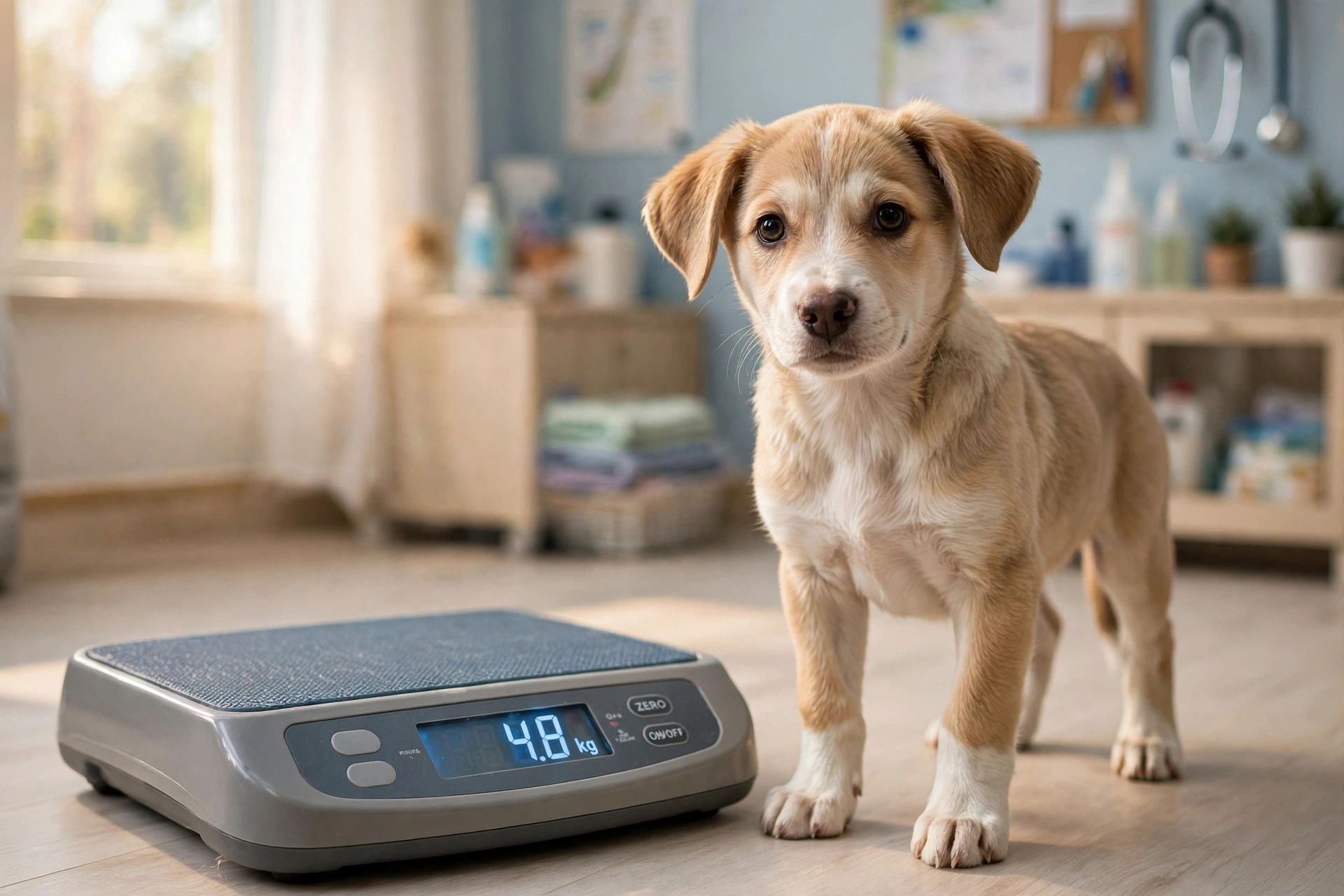
Using CanineCalc’s Puppy Size Calculator
CanineCalc’s Puppy Size Calculator works as a puppy weight calculator mixed breed puppy owners can use without selecting an exact breed. Its inputs include the puppy’s age, current weight, and expected adult-size category, with size-class growth curves used to produce a practical estimate.
Puppy adult-weight estimator
Use current age, weight and expected size class to produce a broad planning range.
CanineCalc’s Puppy Size Calculator shows a ±15% planning range around its estimate. Treat that range as a tool-specific planning estimate, not a statistically validated confidence interval for mixed-breed puppies. The cited growth-standard study did not establish that a mixed-breed calculator will predict every puppy within 15% of its final weight.
Here’s the thing: a useful estimate is one you can revise as your puppy grows, not a number you have to defend when the measurements change.
For example, suppose a puppy weight calculator mixed breed owners use estimates an adult weight of 30 pounds. A 15% range around that estimate would be approximately 25.5–34.5 pounds. This is an illustration of the mathematics, not an assurance that the puppy’s actual adult weight will fall inside that interval.
Quick reminder: A puppy weight calculator mixed breed tool is an educational planning tool. It cannot diagnose poor growth, explain unexplained weight changes, or replace veterinary assessment.
What the Research Tells Us About Mixed-Breed Growth
How big a mixed-breed puppy will get depends on the clues available: parent sizes when known, the puppy’s age, its current weight, and its growth pattern over time. A calculator organizes these clues into an estimate. It cannot remove uncertainty, especially when both parentage and the puppy’s true adult-size category are unknown.
A useful starting point is the 2017 study by Salt and colleagues, published in PLOS ONE. Researchers used records from more than six million young dogs attending veterinary hospitals in the United States to develop canine growth standards. Their size-category growth curves overall agreed well with breed-specific curves. Read the published study.
There is an important limitation, though: mixed-breed dogs were excluded from the study’s growth-curve models. The research supports the general idea that growth can be tracked by size category instead of requiring an individual breed chart, but it does not directly validate a mixed-breed adult-weight calculator.
That distinction matters. A puppy weight calculator mixed breed tool can offer a useful planning estimate, but a number displayed to one decimal place should not be mistaken for scientific certainty. A puppy with unknown parents may ultimately fall outside the initial predicted range.
According to Salt et al. (2017), size-category curves tracked many purebred breeds reasonably well, but mixed-breed puppies were excluded from the study. Applying those curves to mutts is therefore an extrapolation, not direct validation.
How to Estimate Adult Weight Without Knowing the Breed
The practical challenge of any puppy weight calculator mixed breed estimate is choosing a reasonable size category when your puppy’s background is a mystery. According to Salt et al., canine growth trajectories vary substantially with adult size, which is why their research developed different size-category curves rather than one universal curve. These curves were developed from purebred populations, however, so their application to mixed breeds requires caution.
The big question is how much your puppy still has to grow.
To estimate your puppy’s likely adult weight, follow these steps:
- Record the puppy’s age in weeks or months.
- Weigh the puppy using a reliable scale.
- Estimate its adult-size category using known parent sizes or the available growth history.
- Enter the measurements into a puppy weight calculator mixed breed tool.
- Repeat the measurements regularly and compare the results.

For a deeper look at tracking weight by age, see our puppy growth chart predictor guide.
Which Clues Best Predict Your Puppy’s Adult Size?
Estimating a mutt’s adult weight means working with incomplete information. Some clues deserve more attention than others. (For the purebred side of this question, see how big will my puppy get.)
1. Adult weight of the parents
When the parents are known, their adult sizes provide useful context for estimating how large the puppy may become. Information about previous puppies from the same parents can also help. A Mini Goldendoodle is a familiar example, since both parent breeds are known and their sizes feed into the Mini Goldendoodle monthly weight chart.
However, offspring from the same litter can differ in size. Do not assume that averaging the parents’ weights produces an exact prediction.
2. Age and current weight
A puppy’s present weight becomes more useful when considered alongside its age and subsequent measurements. A single reading tells you how heavy the puppy is today; repeated readings provide a clearer picture of the growth trajectory.
What most guides skip is that the predicted adult-size category itself can influence the result. If you classify a puppy as small when it is likely to become large, the calculator may produce a misleading estimate even when the age and weight are entered correctly.
3. Paw size and body proportions
Large paws can make a puppy look destined to become a large dog. That impression is common, but it is not a dependable prediction method on its own.
Sources disagree about how much attention owners should give paw size. Some online calculators include it as an optional clue, while veterinary commentary summarized by PetMD describes paws and ears as unreliable indicators of adult size. The sensible approach is to give paw size little weight compared with parent information and a repeated growth record.
In other words, some months bring bigger changes than others.
4. Growth over time
Consistent measurements help reveal whether the puppy is gaining weight along a relatively steady trajectory or moving away from its earlier pattern.
For practical planning, keep a simple record containing:
- Date and age at each measurement.
- Current weight and measurement units.
- The calculator’s predicted adult-weight range.
- Notes from routine veterinary visits.
A sudden change in growth, persistent failure to gain weight, or other signs of illness deserves veterinary attention rather than repeated calculator adjustments.
A consistent weight record deserves more trust than a confident guess based on appearance. The record measures what this puppy is actually doing; appearance only suggests what it might become.
Quick Comparison: Mixed-Breed Puppy Weight Estimation Methods
Different methods answer slightly different questions. Use the table to decide which evidence deserves the most attention in your situation.
| Option | Best For | Key Benefit | Limitation |
|---|---|---|---|
| Parent-weight information | Puppies with known parents | Provides useful family-size context | Parent information may be unavailable or incomplete |
| Age-and-weight growth calculator | Puppies with reliable measurements | Produces a structured adult-size estimate | Depends on selecting a reasonable size category |
| Repeated weight tracking | Puppies observed over several weeks or months | Shows the puppy’s actual growth pattern | Does not independently reveal genetic ancestry |
| Paw-size comparison | Informal observation only | Easy to check without equipment | Not reliable enough for a standalone estimate |
| Veterinary assessment | Unusual growth or health concerns | Helps evaluate growth and possible health issues | A visit may not establish an exact adult weight |
A puppy weight calculator mixed breed tool provides a prediction based on the information available now. Weight tracking shows how the puppy’s growth develops over time. The two work best together: use the initial estimate for planning, then update your understanding as you collect more measurements. Neither method promises an exact adult weight for an unknown mix.
Mixed-Breed Puppy Weight Calculator: Common Questions
What’s the best way to estimate my mixed-breed puppy’s adult weight?
Start with any known parent-size information, the puppy’s age, and its current weight. Use a calculator as a starting estimate, then refine your expectations with repeated measurements.
How do I use a puppy weight calculator without knowing the breed?
Enter the puppy’s age and current weight, then choose the most plausible adult-size category. If its ancestry is completely unknown, keep the result provisional and revisit it as the puppy grows.
Should I trust my puppy’s paw size to predict adult weight?
No. Paw size alone cannot reliably determine adult weight. Parent-size information and a documented growth pattern are more useful clues.
Why does my puppy weigh more or less than the calculator predicts?
Mixed ancestry, an incorrect size-category selection, measurement differences, and individual growth variation can all affect the result. A persistent or concerning change should be discussed with a veterinarian.
When should I ask a veterinarian about my puppy’s growth?
Seek veterinary guidance when growth slows unexpectedly, weight changes sharply, or your puppy shows signs of illness. A calculator cannot determine whether an unusual growth pattern has a medical cause.
What Should You Do Next?
You do not need to know every breed in your puppy’s ancestry to make sensible plans for its adult size. You need the best available information, a reasonable starting estimate, and a willingness to revise that estimate when the evidence changes.
This method works best when your puppy is healthy, its age and current weight are reasonably reliable, and you can continue recording its growth. It will not determine an exact adult weight when the genetic background is unknown, and it does not address medical causes of abnormal growth or weight gain. (For a broader look at estimation methods, see how big will my dog be.)
Use CanineCalc’s Puppy Size Calculator as a starting point, not a final verdict. Keep the measurements, compare the trend, and ask your veterinarian to assess concerns about your puppy’s development.
The goal is not to guess your puppy’s future perfectly. It is to make better decisions while that puppy is growing.