Veterinary Disclaimer: This article provides general canine developmental estimates for healthy dogs on balanced diets. It does not replace individualized diagnostic care or evaluate underlying health conditions.
How big will my dog be refers to predicting an adult dog’s mature weight and frame based on genetics, current growth milestones, and breed category trends. Most dogs reach their final adult height and skeletal frame between 10 and 24 months, depending heavily on their size classification.
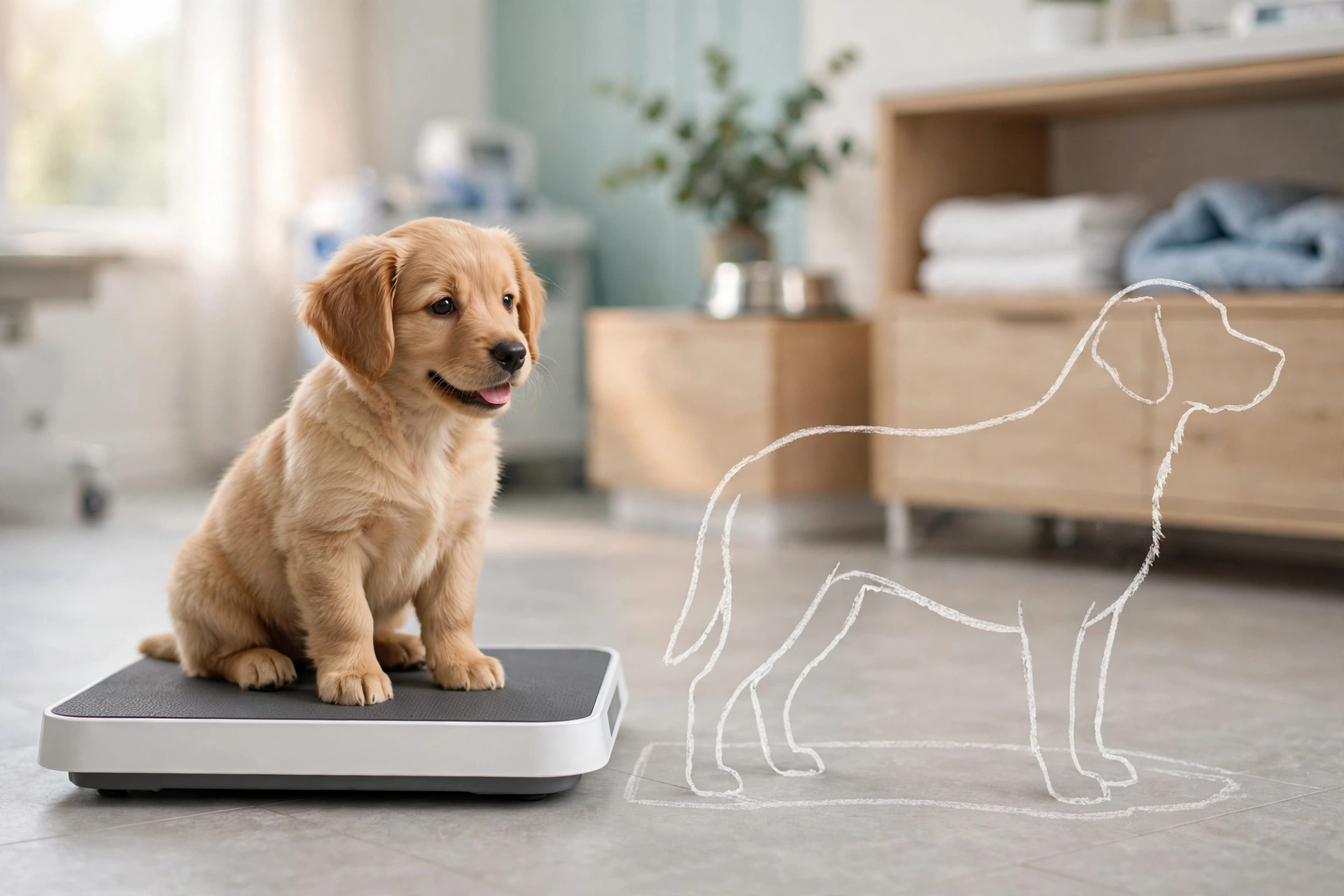
Predicting adult dog size comes down to understanding growth rates across distinct weight classes. According to American Kennel Club growth data, toy breeds frequently reach 75 percent of their adult weight by five months, whereas giant breeds like Great Danes often take 18 to 24 months to finish filling out their frame.
CanineCalc Puppy Size Calculator
Estimating your puppy’s adult weight requires tracking age-specific milestones against established canine developmental stages rather than relying on folklore. Healthy puppies follow distinct growth trajectories that differ significantly between toy and giant classifications after the first few months of life.
1. Weight-at-Age Multipliers (The Traditional Rules of Thumb)
You have probably heard the common advice to take your puppy’s weight at 16 weeks and double it. That shortcut works decently for a standard 45-pound medium dog. It tends to fall apart for a toy breed or a giant breed. Small dogs finish bone development early, while giant breeds experience sustained musculoskeletal growth well into their second year.
| Size Classification | Typical Adult Range | Common Rule of Thumb |
|---|---|---|
| Toy | Under 12 lbs (5 kg) | Weight at 6 wks x 4 |
| Small | 13–25 lbs (6–11 kg) | Weight at 12 wks x 2 |
| Medium Breeds | 20 to 50 lbs (9-23 kg) | Weight at 16 wks x 2 |
| Large Breeds | 51 to 90 lbs (23-41 kg) | Weight at 20 wks x 2 |
| Giant Breeds | 91 – 150+ lbs (41+ kg) | Weight at 16 wks x 2.5 to 3 (broad estimate) |
Here’s the thing: biological growth rate is not uniform across all dogs. If you’re wondering why she didn’t grow like they’d predicted, look at the breed’s broader growth curve rather than relying entirely on a flat multiplier.
To estimate your puppy’s adult weight using age milestones, follow these steps:
- Weigh your puppy accurately on a scale at an exact weekly milestone to track how big will my dog be.
- Identify their size category based on breed background or parentage, a key factor in how big will my dog be.
- Apply the category-specific milestone multiplier as a baseline estimate of how big will my dog be.
- Check their weight monthly to see if their pace remains consistent as you monitor how big will my dog be.
2. Using Interactive Growth Calculators
Tracking growth milestones manually takes work, which is why a dog weight estimator is so popular. The CanineCalc Puppy Size Calculator works by interpolating size-class growth curves and generating a practical ±15% planning range based on your puppy’s current age and weight.
Puppy adult-weight estimator
Use current age, weight and expected size class to produce a broad planning range.

Puppy growth tracking works best when owners log regular weight intervals between 8 and 24 weeks of age. According to veterinary guidelines, evaluating body condition alongside weight ensures that steady gains reflect lean skeletal growth rather than juvenile excess. If you’re wondering how big your puppy will get, start here. Enter their exact age in weeks and current weight into the calculator to get a realistic projected weight bracket.
3. Paw Size and Loose Skin: Fact Versus Fiction
Almost every puppy owner inspects the paws first. Big paws mean a big dog, right? Not necessarily. Growth curve tracking vs paw size estimation: Growth curve tracking is better suited for realistic adult weight forecasting because it uses actual weight milestones over time. Paw size estimation works better as a casual visual hint for bone thickness. The key difference is that paw cartilage develops independently from overall skeletal mass.
American Kennel Club: when do puppies finish growing?
Certain breeds, such as Basset Hounds, English Bulldogs, and Great Pyrenees, naturally possess heavy bone structure, wide foot pads, or loose skin folds as distinct breed traits. A four-month-old mixed-breed puppy with large paws might simply inherit thick joints without ever growing into a 70-pound dog. Paws indicate bone thickness, not final height. What most guides skip is that distal leg growth plates close earlier than axial body plates. You can get an exaggerated impression of future size during the gangly four-to-six-month stage when legs grow faster than the torso.
4. Parental Lineage and DNA Percentages for Mixed Breeds
When both purebred parents are known, predicting mature weight is straightforward. You add the sire’s weight and dam’s weight, divide by two, and factor in a 5 to 10 percent variance for sex (males usually finish slightly heavier than females). In mixed-breed rescue dogs, genetic inheritance is far more complex. Sources conflict on multi-generational mutts — some say maternal size sets the ceiling, others claim dominant breed markers dictate mature weight. In practice, actual weighed growth between 12 and 20 weeks is a more useful indicator than breed percentages alone. Some dog owners lean entirely on commercial canine DNA tests to estimate adult size. While DNA testing identifies ancestry, I’d argue that relying solely on DNA breed percentages for adult weight predictions is overrated because polygenic traits like body mass express unpredictably across mixed litters.
5. Skeletal Markers and Growth Plate Biology
Puppies do not stop growing all at once. Skeletal growth occurs at specialized cartilaginous zones near the ends of long bones called epiphyseal plates. Small dogs typically see their growth plates seal between 9 and 12 months of age. Giant breeds often have open, active distal femoral and tibial growth plates until 18 to 24 months.
| Size Group | Skeletal Height Finished | Muscle & Chest Filled |
|---|---|---|
| Toy (<12 lbs) | 7 – 9 Months | 9 – 11 Months |
| Small (13 – 25 lbs) | 9 – 11 Months | 9–12 Months |
| Medium (26 – 50 lbs) | 12 – 14 Months | 14 – 16 Months |
| Large (51 – 90 lbs) | 14 – 16 Months | 18 – 20 Months |
| Giant (90+ lbs) | 18 – 20 Months | 18–24 Months (larger breeds mature slower; ranges approximate) |
Put simply, puppies grow in spurts.
Quick Comparison: 5 Ways to Tell How Big Will My Dog Be
| Method | Best For | Key Benefit | Limitation |
|---|---|---|---|
| Interactive Calculator | Mixed breeds and rescue pups | Uses size-class curves with a ±15% planning range | Requires accurate puppy age in weeks |
| Parental Averages | Puppies from registered litters | High accuracy for purebred sizing | Useless when parents are unknown |
| Growth Plate Timeline | Adolescent dogs (6-18 mos) | Identifies when skeletal growth has peaked | Requires vet evaluation to verify closure |
| Category Multipliers | Known purebred puppies | Quick calculation at routine vet visits | Fails if breed size category is misjudged |
| Paw & Physical Markers | Casual visual ballpark | Zero calculations needed | Highly unreliable for heavy-boned breeds |
Voice Search Answers: Common Dog Growth Questions
What’s the best way to tell how big a mixed puppy will get?
Track your puppy’s weight at 16 weeks and use a size-bracket growth calculator. For medium dogs, doubling their 16-week weight provides a dependable starting estimate.
How do I know when my dog has stopped growing?
Small dogs stop growing around 10 to 12 months. Large and giant dogs continue gaining skeletal height and chest breadth until 18 to 24 months.
Should I trust my puppy’s paw size to predict adult weight?
Paw size indicates bone structure rather than total mass. Many breeds naturally have large paws without reaching a heavy adult weight.
Why does my puppy seem to grow in spurts?
Canine growth occurs in uneven developmental stages where long leg bones elongate before the ribcage and spine widen into mature proportions.
When should I switch my puppy to adult dog food?
Transition small breeds at 10 to 12 months and large or giant breeds between 14 and 24 months, once growth plates have fully closed.
Planning for Your Dog’s Adult Needs
Knowing your dog’s future weight helps you select the right crate size, buy durable car harnesses, and budget for adult feeding amounts. Track their weight every few weeks, plug the numbers into an adult size predictor, and consult your veterinarian if their growth trajectory shifts unexpectedly.
Related: How Big Will My Puppy Get? — our practical guide with a growth chart and breed tips.