

Last updated: October 2026
A mini Goldendoodle can weigh around 15–35 pounds (7–16 kg) as an adult, although some dogs fall outside that range. Your puppy’s age, current weight, Poodle parent’s size, and genetic background all influence how big they’ll become.
The tricky part? There is no official Mini Goldendoodle breed weight standard. That makes a range of plausible weights more useful than a chart promising an exact number.
A puppy’s growth curve tells a more meaningful story than one weigh-in.
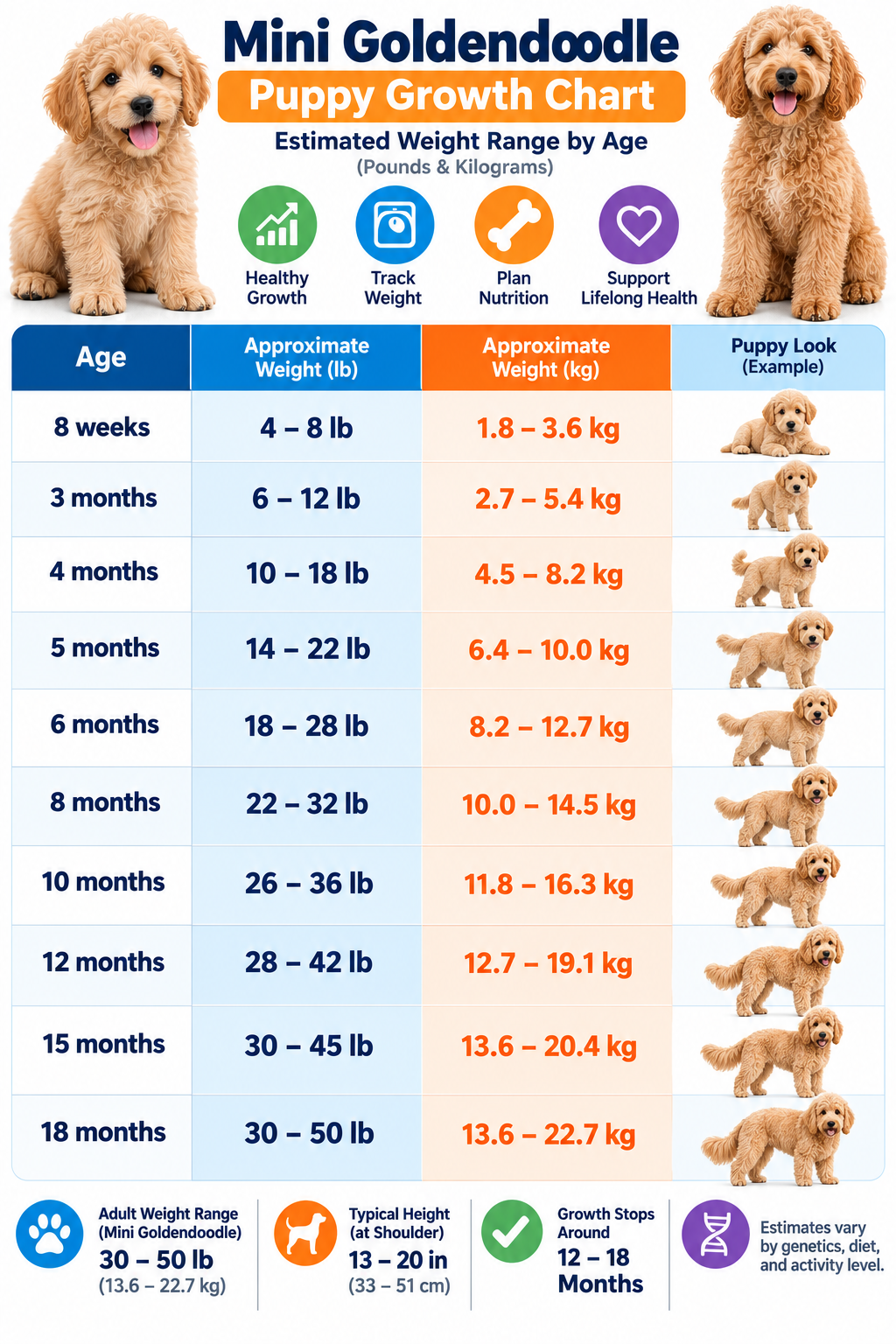
Mini Goldendoodle Weight Chart by Age (lbs & kg)
A Mini Goldendoodle weight chart by age estimates how a puppy’s weight may change from the early weeks through adulthood. Because Mini Goldendoodles are crossbreeds, the figures below are practical planning estimates, not measurements from a validated Mini Goldendoodle growth study.
According to Salt et al. (2017), canine growth standards can help assess puppy development using size-related growth curves. Their research supports a useful principle: compare a puppy’s growth over time instead of treating a single weight as a verdict.
Mini Goldendoodle weight chart
The following chart provides broad, illustrative estimates for a Mini Goldendoodle expected to reach approximately 15–35 lb (7–16 kg). Individual puppies can fall outside these bands, especially when their parents differ substantially in size.
| Age | Approximate weight (lb) | Approximate weight (kg) |
|---|---|---|
| 8 weeks | 3–8 lb | 1.4–3.6 kg |
| 3 months | 5–12 lb | 2.3–5.4 kg |
| 4 months | 7–16 lb | 3.2–7.3 kg |
| 5 months | 9–20 lb | 4.1–9.1 kg |
| 6 months | 10–24 lb | 4.5–10.9 kg |
| 7 months | 11–27 lb | 5.0–12.2 kg |
| 8 months | 12–29 lb | 5.4–13.2 kg |
| 9 months | 13–31 lb | 5.9–14.1 kg |
| 10 months | 14–33 lb | 6.4–15.0 kg |
| 11 months | 14–34 lb | 6.4–15.4 kg |
| 12 months | 15–35 lb | 6.8–15.9 kg |
| 18 months | 15–35 lb | 6.8–15.9 kg |
| Adult | 15–35 lb | 6.8–15.9 kg |
How to interpret your puppy’s weight
Don’t panic if your puppy weighs less than the midpoint of a chart. A naturally small puppy can grow steadily and remain healthy without ever reaching the average adult weight.
Look at three things together: the puppy’s age, their recent weight history, and their expected adult-size category. A puppy who has consistently tracked near the lower end of a reasonable range may be following their own normal pattern.
Quick note: Weight alone cannot establish whether a puppy is healthy. Body condition, appetite, energy, and veterinary assessments also matter.
How big will my Mini Goldendoodle get?
Adult size depends on inherited traits from both parent breeds, the size of the Poodle parent, and the particular cross. The word mini describes a general size category rather than a tightly defined genetic outcome.
According to the American Kennel Club’s breed information, Golden Retrievers and Poodles have their own recognized breed standards, but a Goldendoodle does not have an equivalent AKC breed standard. That distinction matters: a Mini Goldendoodle weight chart is a guide, not an official reference table.
Some breeder references put adult Mini Goldendoodles at roughly 15–35 lb (7–16 kg) and 13–20 inches tall. Those figures reflect common breeder conventions, not a guaranteed outcome for every dog.
In other words, some months bring bigger changes than others.
Why Mini Goldendoodle Weights Vary So Much
Mini Goldendoodles are Golden Retriever–Poodle crosses. Their size can vary even among puppies from the same litter, which explains why different charts may show different estimates for the same age.
F1, F1B, and F2 generations explained
These labels describe a dog’s breeding generation. They can offer clues about ancestry, but they do not guarantee a specific adult weight.
- F1: A first-generation cross between a Golden Retriever and a Poodle.
- F1B: A first-generation Goldendoodle crossed back to a Poodle, commonly resulting in a higher proportion of Poodle ancestry.
- F2: A cross between two first-generation Goldendoodles.
An F1B puppy may inherit more Poodle-associated traits, but that doesn’t automatically mean it will be smaller. The actual size of the Poodle parent and the puppy’s inherited genes still matter.
The Poodle parent’s size matters
Poodles come in different size varieties. A Mini Goldendoodle bred from a smaller Poodle may have a different adult-size outlook from one whose Poodle parent is near the upper end of the miniature range.
Ask for the actual weights and heights of both parents when that information is available. Parent measurements can help narrow expectations, although they cannot determine a puppy’s final size precisely.
Quick Comparison
| Option | Best For | Key Benefit | Limitation |
|---|---|---|---|
| Monthly weight chart | Early planning | Easy age-by-age reference | Not an individual prediction |
| Parent-size estimates | Narrowing adult-size expectations | Uses family information | Genetics remain variable |
| Growth-curve tracking | Monitoring development over time | Reveals the puppy’s individual trend | Requires repeated measurements |
| Size-prediction calculator | Getting a planning estimate | Combines age and current weight | Output depends on assumptions and model limits |
What most guides skip is this: even a sensible prediction can change as more growth data becomes available.
What research can and cannot tell us
Studies differ in how they classify canine size and interpret growth patterns. Salt and colleagues published research in PLOS ONE in 2017 describing evidence-based canine growth standards developed from veterinary-clinic records covering more than six million young dogs. These standards are useful background for understanding growth, but they are not a validated monthly weight chart specifically for Mini Goldendoodles.
The distinction is important. A size-class growth reference can help contextualize a puppy’s progress, but it should not be presented as proof that a crossbreed will weigh a particular amount at a particular month.
Source: Salt et al. (2017), PLOS ONE — evidence-based canine growth standards.
How to Track Your Mini Goldendoodle’s Growth
A chart is most useful when you pair it with regular measurements. One number tells you how much your puppy weighs today; a series of measurements shows how that weight changes over time.
The big question is how much your puppy still has to grow.
Three steps to track growth
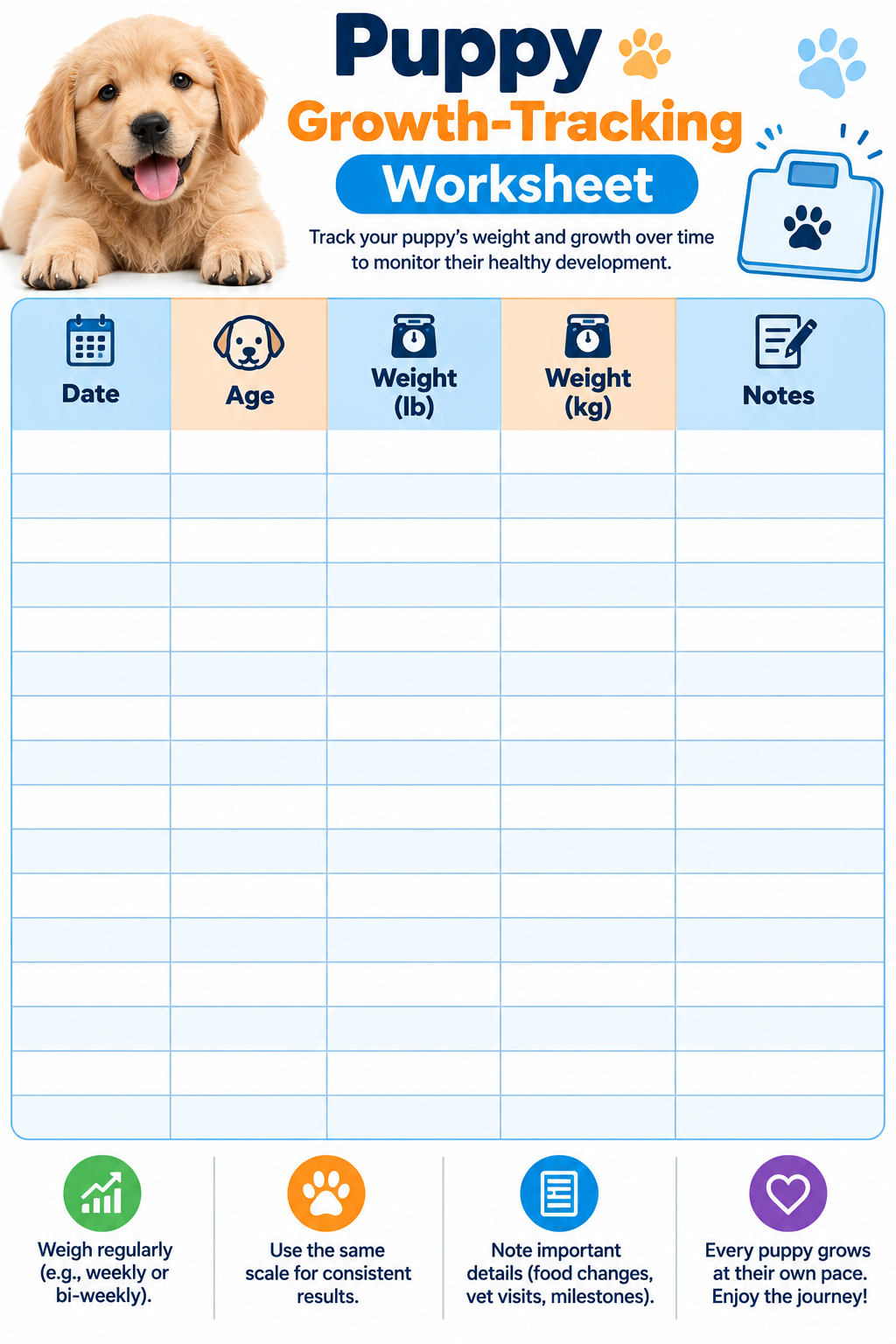
To track your Mini Goldendoodle’s growth, follow these steps:
- Weigh your puppy on a consistent schedule using the same scale when possible.
- Record their age, weight, and date for each measurement.
- Compare the results over time and discuss unexpected changes with your veterinarian.
Convert pounds to kilograms
Use this conversion when your scale reports pounds but your preferred chart uses kilograms:
- Pounds to kilograms: multiply pounds by 0.4536.
- Kilograms to pounds: multiply kilograms by 2.2046.
For example, a puppy weighing 12 lb weighs approximately 5.4 kg.
You don’t need to convert every measurement manually if your tracking tool already supports both units. Consistency matters more than the format you choose.
Use a puppy-size calculator
The CanineCalc Puppy Size Calculator is designed to estimate adult size from a puppy’s age, current weight, and expected size category. Its size-class method offers an alternative when a breed-specific formula is unavailable.
For a Mini Goldendoodle, the supplied calculator guidance uses the medium-size class and provides a practical planning range of approximately ±15%. Treat that range as a model estimate, not a validated guarantee of individual accuracy.
Related: puppy growth chart predictor
Related: How big will my puppy get?
When Should You Be Concerned About Your Puppy’s Weight?
A Mini Goldendoodle can be smaller or larger than a chart suggests without automatically having a health problem. What matters is the full picture, including whether the puppy is growing steadily and maintaining an appropriate body condition.
Contact your veterinarian if your puppy loses weight unexpectedly, stops gaining weight while still growing, has a persistent loss of appetite, develops vomiting or diarrhea, or seems unusually tired. A sudden change deserves more attention than a small difference from an illustrative chart.
Some experts emphasize comparison with average breed weights. That’s useful when a breed has reliable standards and reference data. But for a crossbreed such as the Mini Goldendoodle, an individual growth history and a professional assessment may be more informative than comparing the puppy with a single target number.
This guide covers general weight estimates, inherited size variation, and growth tracking. It does NOT diagnose medical conditions or establish whether an individual puppy is growing normally.
Common mistakes to avoid
- Treating the upper or lower end of a chart as a required target.
- Assuming F1B or F2 automatically means a smaller adult dog.
- Comparing puppies of different ages without accounting for their growth stages.
- Changing food portions simply to force a puppy toward a chart’s midpoint.
- Ignoring an unexplained change in weight because the puppy still falls inside a broad range.
Your veterinarian can help assess body condition, nutrition, and growth when the pattern raises questions.
Mini Goldendoodle Weight Chart: Questions and Answers
Q: What’s the average weight of a Mini Goldendoodle?
Common breeder references put adult Mini Goldendoodles around 15–35 lb (7–16 kg). Individual dogs can fall outside this range because the crossbreed has no official AKC weight standard.
Q: How do I estimate my Mini Goldendoodle’s adult weight?
Combine your puppy’s current age and weight with the sizes of both parents. A growth calculator can provide a planning estimate, but repeated measurements and genetic variation limit precision.
Q: Should my Mini Goldendoodle weigh a certain amount at six months?
There is no universally correct six-month weight for every Mini Goldendoodle. Use broad estimates as context and track your puppy’s own growth pattern rather than treating one number as a requirement.
Q: Why does my Mini Goldendoodle weigh more than another puppy of the same age?
Differences in inherited size, parent measurements, and growth patterns can produce different weights at the same age. A higher number alone does not establish that either puppy has a problem.
Q: When should I ask a veterinarian about my puppy’s weight?
Ask your veterinarian about unexpected weight loss, stalled growth, persistent appetite changes, digestive symptoms, or unusual lethargy. A professional can assess your puppy’s overall health rather than relying on weight alone.
Final takeaway
A Mini Goldendoodle weight chart by age is a starting point, not a promise. Use the monthly estimates to understand possible growth patterns, consider the sizes of both parents, and track your puppy’s own measurements over time.
The goal isn’t to match a chart perfectly. It’s to understand your puppy’s growth and recognize when a change deserves attention.