Chihuahua weight chart by age
Chihuahuas are tiny dogs, so even a small change on the scale can be worth paying attention to. Whether you have a young puppy or a nearly grown Chihuahua, this weight chart gives you a useful starting point for understanding your dog’s growth.
The ranges below reflect commonly published Chihuahua growth charts and are estimates, not guarantees. Puppies from different bloodlines can grow at different rates, and published charts do not always agree. The American Kennel Club (AKC) breed standard sets a maximum weight of 6 pounds (2.7 kg) for show dogs, but pet Chihuahuas can weigh more. Body condition and growth over time matter more than a single number.
| Age | Male (lb) | Male (kg) | Female (lb) | Female (kg) |
|---|---|---|---|---|
| 2 months | 1–2 | 0.5–0.9 | 1–2 | 0.5–0.9 |
| 3 months | 1.5–2.5 | 0.7–1.1 | 1.5–2.5 | 0.7–1.1 |
| 4 months | 2–4 | 0.9–1.8 | 2–4 | 0.9–1.8 |
| 5 months | 2–4 | 0.9–1.8 | 2–4 | 0.9–1.8 |
| 6 months | 2.5–4.5 | 1.1–2.0 | 2.5–4.5 | 1.1–2.0 |
| 7 months | 2.5–5 | 1.1–2.3 | 2.5–5 | 1.1–2.3 |
| 8 months | 2.5–5.5 | 1.1–2.5 | 2.5–5.5 | 1.1–2.5 |
| 9 months | 2.5–6 | 1.1–2.7 | 2.5–6 | 1.1–2.7 |
| 10 months | 2.5–6 | 1.1–2.7 | 2.5–6 | 1.1–2.7 |
| 11 months | 2.5–6.5 | 1.1–2.9 | 2.5–6.5 | 1.1–2.9 |
| 12 months | 2.5–7 | 1.1–3.2 | 2.5–7 | 1.1–3.2 |
| Adult | 2.5–7 | 1.1–3.2 | 2.5–7 | 1.1–3.2 |


How to read this chart: These are broad guide ranges, not confirmed healthy limits for every Chihuahua. The later puppy ranges are estimates between commonly published age milestones, rounded for easy comparison. Male and female ranges are shown separately for convenience, but reliable breed-wide data do not establish a consistent weight difference between the sexes. Your veterinarian can help assess your puppy’s individual growth pattern.
Apple head vs. deer head: does type affect size?
You may hear Chihuahua owners describe their dogs as either apple-head or deer-head Chihuahuas. These labels refer to head shape rather than separate breeds, and neither tells you exactly how much a dog will weigh as an adult.
An apple-head Chihuahua has a rounded, domed skull, a pronounced stop where the forehead meets the muzzle, and a relatively short muzzle. This is the head shape described in the AKC breed standard. A deer-head Chihuahua typically has a flatter forehead, a longer muzzle, and a more gradual slope from the forehead to the nose. Deer-head dogs may also have longer legs or a less compact build.
Some deer-head Chihuahuas are taller or heavier than apple-head dogs, but there is plenty of overlap. Genetics, the size of the parents, overall body frame, nutrition, and health all influence adult weight. Use your dog’s own growth history and body condition rather than assuming a particular head shape means your Chihuahua should weigh a certain amount.
The teacup Chihuahua myth
The term “teacup Chihuahua” sounds like a special variety, but it is a marketing label, not a recognized Chihuahua variety or official size category. There is no universally accepted adult weight that makes a Chihuahua a teacup dog.
Chihuahuas are already one of the smallest dog breeds. Deliberately prioritizing extreme smallness can come at the expense of health. Exceptionally tiny dogs may be more vulnerable to low blood sugar, fragile bones, dental problems, and other complications, particularly when poor breeding practices are involved. Puppies can also be sold as teacups based on an early weight that does not reliably predict their adult size.
A Chihuahua weighing less than the usual range is not automatically unhealthy, just as a larger Chihuahua is not automatically overweight. What matters is how the dog is growing, whether they maintain a suitable body condition, and whether they are thriving. Be cautious of sellers who promise a specific tiny adult weight or charge extra simply for a “teacup” label. The PetMD guide to teacup dogs explains the health concerns associated with breeding for extreme smallness.
When do Chihuahuas stop growing?
Most Chihuahuas reach most of their adult height by around 6 to 8 months, although timing varies. Their weight and body shape may continue changing as they develop muscle and fill out. Many are close to their adult size between 10 and 12 months, while some continue to mature a little longer.
Males may finish toward the heavier end of the usual range, and females may finish toward the lighter end, but this is not a dependable rule for individual dogs. The AKC does not set separate adult weight limits for males and females. If your puppy is still gaining gradually at 10 months, that alone does not mean anything is wrong. A slowing growth rate is expected as adulthood approaches.
For more useful comparisons, look at several weigh-ins rather than expecting your Chihuahua to match every row of a chart. A steady growth pattern can be more informative than whether your dog happens to sit near the upper or lower end of the range. Owners of another toy breed can do the same for a Yorkshire Terrier puppy using the calculator that estimates a Yorkie puppy’s adult weight.
Is my Chihuahua underweight or overweight?
A scale is useful, but it cannot tell the whole story. You can make a basic body-condition check at home by gently feeling along your Chihuahua’s ribs. You should generally be able to feel them beneath a thin layer of fat without pressing hard. From above, your dog should have a visible waist, and from the side, the abdomen should tuck upward rather than hang in a straight line.
Very prominent ribs, hips, or a backbone may suggest your dog is too thin. If the ribs are difficult to feel and the waist is hard to see, your Chihuahua may be carrying excess weight. Long coats can hide changes in body shape, so use your hands as well as your eyes.
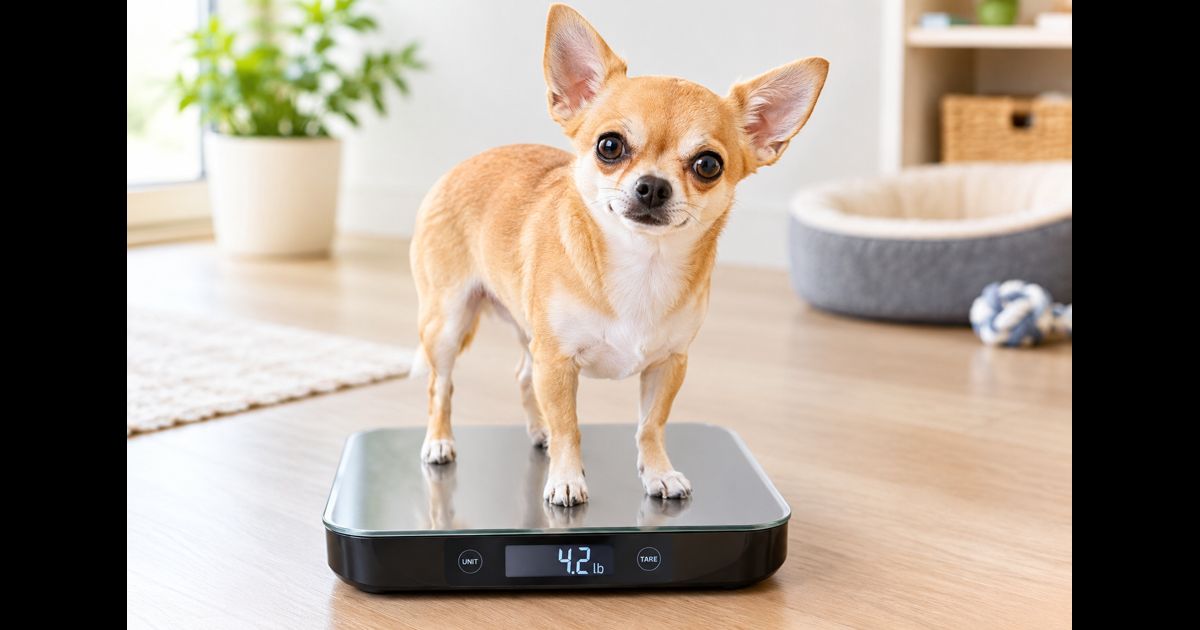
At this size, one pound can be a substantial difference. For a 4-pound Chihuahua, an extra pound represents 25% of their starting body weight. That is why gradual weight changes deserve attention even when they seem small. Weigh your dog regularly on a consistent scale and keep a simple log with the date, age, and weight.
Contact your veterinarian if your puppy stops gaining weight, loses weight unexpectedly, or moves away from their usual growth pattern. It is also worth asking for a weight and body-condition assessment if you are unsure whether your adult Chihuahua is too thin or too heavy. A chart is a reference, not a diagnosis, and your dog’s age, build, and overall health all matter.
Chihuahua weight chart FAQs
What is the average adult Chihuahua weight?
The AKC breed standard specifies that a Chihuahua should not exceed 6 pounds (2.7 kg). Many household Chihuahuas weigh around 2.5 to 7 pounds (1.1 to 3.2 kg), though individual dogs can fall outside that range. Weight alone does not establish whether a dog is healthy.
Why is my Chihuahua so small or so big?
Family genetics and the size of the parents can strongly influence adult size. Age, nutrition, and general health also matter. A Chihuahua outside a published range is not automatically a problem, but an unexpected change in growth or weight is worth discussing with your veterinarian.
How fast do Chihuahua puppies grow?
Growth is usually fastest during the first several months, then gradually slows as the puppy approaches adult size. Many Chihuahuas are close to their adult weight by 9 to 12 months. Individual puppies do not all follow the same timetable, so look for a consistent pattern rather than a precise monthly target.
When should I switch my Chihuahua from puppy food to adult food?
Small-breed puppies may be ready for adult food at around 7 to 9 months, but the right timing depends on the individual puppy’s development and nutritional needs. Ask your veterinarian when to make the change, and transition gradually rather than switching foods all at once. Until then, feed a complete and balanced puppy food appropriate for growth.
Conclusion
A Chihuahua weight chart can help you understand how your puppy is developing, but it should never be treated as a strict test your dog has to pass. These tiny dogs naturally vary in size, and healthy adults do not all weigh the same. Track weight over time, pay attention to body condition, and speak with your veterinarian whenever growth or weight changes concern you.
About Jennifer: Jennifer is the founder of CanineCalc, a dog owner and researcher who creates practical resources to help people understand their dogs’ growth and size. Her goal is to make breed information easier to use in everyday life, while encouraging owners to seek veterinary guidance for individual health concerns.