
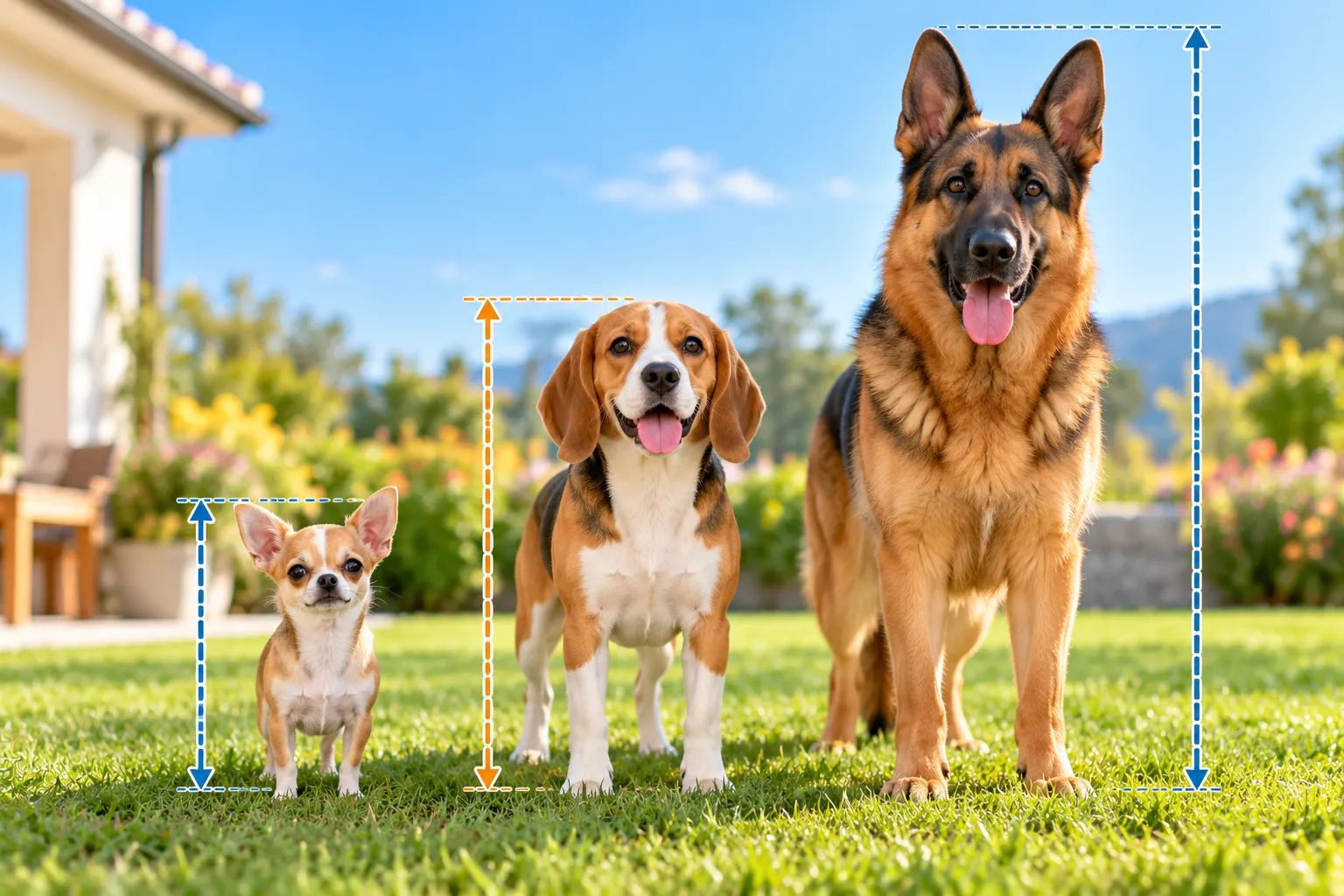
What size is your dog?
Enter your dog’s weight and, if you know it, height at the shoulder. We’ll place them in a size category with practical gear guidance.
How the size categories work
Last updated: October 2026
A dog size calculator answers “what size is my dog?” by using weight, and sometimes shoulder height, to assign a shopping category. It can narrow down collar, harness, and crate options, but it cannot replace product measurements or a veterinarian’s advice. Use the category as a starting point, not a universal standard.
Whether a dog counts as small, medium, or large depends on the sizing system in use. Sources disagree on the edges: PetMD describes medium-sized dogs as roughly 20–60 pounds, while CanineCalc uses 25–50 pounds for shopping. That makes a size label a shortcut, not a guarantee of fit; actual collar, harness, and crate measurements should decide the purchase.
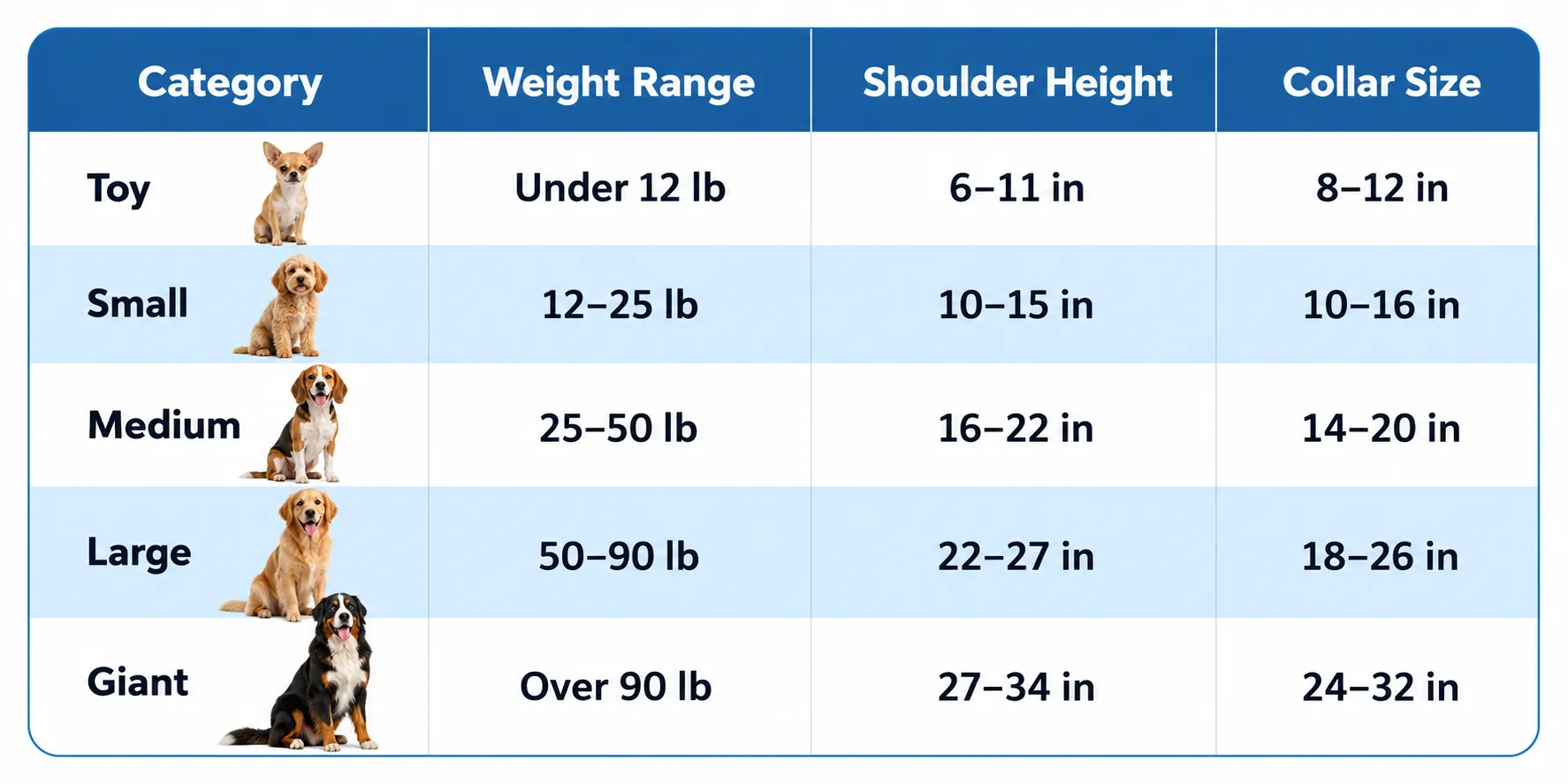
CanineCalc uses five practical weight bands to make the first decision easier. These are retail-style groupings, not official American Kennel Club classifications.
Dog size categories at a glance
| Category | Weight range | Typical shoulder height | Estimated collar size range |
|---|---|---|---|
| Toy | Under 12 lb | 6–11 in | 8–12 in |
| Small | 12–25 lb | 10–15 in | 10–16 in |
| Medium | 25–50 lb | 16–22 in | 14–20 in |
| Large | 50–90 lb | 22–27 in | 18–26 in |
| Giant | Over 90 lb | 27–34 in | 24–32 in |
These height and collar ranges are broad shopping estimates, not universal standards. The weight bands have rounded boundaries, so follow the calculator’s category result at a boundary and check the measurements required by your chosen product.
A dog’s proportions matter just as much as the number on the scale. Two dogs weighing 35 pounds can have very different chest widths, neck circumferences, and shoulder heights.
Get your dog’s category
To identify your dog’s shopping size, follow these steps:
- Weigh your dog on a reliable scale.
- Enter the weight in pounds or kilograms.
- Add shoulder height if you can measure it accurately.
- Use the category to shortlist products, then check exact measurements.
The CanineCalc Dog Size Calculator, placed at the top of this page, accepts weight in lb or kg and optional shoulder height in inches or centimeters. It returns the category, typical shoulder-height range, estimated collar range, and weight range, with a note when height and weight appear inconsistent.
What your dog’s category tells you
What your dog’s size category tells you is where to start, not which product to buy without checking the fit. According to the American Kennel Club (AKC), collars depend on neck circumference, while harnesses often require chest and neck measurements; sizing also varies across brands. Check the chart attached to the exact product before ordering.
Small, medium, and large are useful shopping shortcuts, but they are not measurements. You don’t need a pedigree, you won’t need a perfect chart, and you’re not trying to establish an official breed class. You need enough information to narrow the options without buying something that pinches, slips, or leaves your dog cramped.
Consider the three main gear types:
- Collars: The neck measurement is the key number. A dog’s weight cannot tell you whether a particular collar will fit comfortably.
- Harnesses: Chest girth and neck girth help you compare products. Adjustable designs are useful when a dog sits between two sizes.
- Crates: Measure your dog’s length and height instead of choosing a crate from the weight category alone.
The AKC recommends checking your dog’s actual measurements against the sizing information supplied with the product. For many harnesses and garments, chest girth is especially useful; collars rely primarily on neck circumference.
Gear starting points by size
| Category | Crate class to look at | Harness style tip |
|---|---|---|
| Toy | XS or compact | Lightweight, adjustable harness; check chest girth |
| Small | Small | Adjustable H-front or Y-front design; check chest and neck |
| Medium | Medium | Adjustable harness with room for normal movement |
| Large | Large | Sturdy, adjustable harness; check chest and neck |
| Giant | XL or larger | Robust, adjustable design; confirm the full fit in motion |
These are browsing starting points, not crate-size instructions. A broad-chested medium dog may need a different harness cut from a lean dog of the same weight.
For crates, measure your dog from nose to tail and from the floor to the top of the head while standing. The AKC recommends adding about 3–4 inches to those measurements when calculating a suitable crate length and height. The finished crate should allow your dog to stand, turn around, and lie down comfortably.
American Kennel Club — How to Measure Your Dog for Clothes and Gear
American Kennel Club — How to Choose the Best Dog Crate
Measuring shoulder height correctly
Shoulder height adds useful context when a dog’s weight does not tell the whole story. It is measured at the withers, the highest point of the shoulders near the base of the neck, rather than at the top of the head.
When buying gear for a mixed-breed dog, measure on a flat floor while your dog stands naturally. Take the measurement on a flat floor while your dog stands naturally, then compare it with the calculator’s expected range.
Follow this simple process:
- Stand your dog on a level, firm surface.
- Locate the highest point between the shoulder blades.
- Hold a ruler or straight edge level at that point.
- Measure vertically from the floor to the straight edge.
- Record the height in inches or centimeters.
Keep your dog standing squarely, with all four paws on the floor. A raised head, bent legs, or sloping surface can affect the measurement, so repeat it if the result looks unusual.
Shoulder height is particularly helpful when shopping for products that depend on body dimensions. However, it is not a substitute for measuring neck circumference for a collar or chest girth for a harness.
For those measurements, use a flexible tape. Keep it snug without squeezing the body, and follow the specific product’s sizing instructions. The AKC also recommends checking individual brand charts because sizes do not always transfer from one product to another.
When height and weight disagree
A mismatch does not automatically mean your dog’s weight is wrong. It means you should check both measurements before relying on the category to make a purchase.
Here is the required CanineCalc example:
Example: A 30 lb dog
- Weight entered: 30 lb
- Shoulder height: Not entered
- Calculator result: Medium, within the 25–50 lb band
- Typical shoulder height: 16–22 inches
- Estimated collar range: 14–20 inches
Now enter a shoulder height of 24 inches.
The calculator should flag the difference with this note:
Unusual for a medium-size dog by weight — double-check measurements.
That message is a prompt to verify the figures, not a diagnosis or proof that the dog belongs in another category. A dog can have proportions that differ from the typical range.
Check the weight on a reliable scale, then measure height again on a level surface. If both numbers are correct, use the product’s own sizing chart rather than forcing the dog into a label that does not match its measurements.
A 24-inch shoulder height also does not determine collar size. Measure the neck separately before choosing a collar.
This is where the calculator’s mismatch note is useful. It helps identify cases where a single number could send an owner toward unsuitable gear.
Size vs breed: why labels mislead
Breed labels can be useful background information, but they do not reliably settle the size question for every individual dog. Mixed-breed dogs may inherit different body proportions, and individual dogs of the same breed can vary.
The AKC organizes registered breeds into groups such as Toy, Hound, Working, and Sporting. Those groups reflect breed function and heritage, rather than the five shopping weight bands used by CanineCalc.
Size category vs breed label: A breed label is useful for understanding a dog’s background and typical traits. A weight-based category is more useful for narrowing down gear. Actual body measurements are the better guide for choosing the final product.
Put simply,… use the category to choose which product charts to inspect, and use the measurements to decide what fits.
This distinction also separates CanineCalc from puppy-growth predictors. For example, PuppyChart asks for a puppy’s breed, age, and current weight to estimate adult weight. That answers “How big might my puppy become?” rather than “What size category does my dog fit today?”
If your dog is still growing, try the puppy size calculator to estimate future size. For crate selection, use the dog crate size calculator and confirm the dog’s physical measurements. The dog weight calculator can help with the separate question of weight.
Limitations and FAQs
A size category is a practical aid, not a complete description of a dog’s needs. It does not determine an ideal body weight, diagnose a health concern, or establish the correct daily food portion.
This works best for choosing everyday gear for a dog whose approximate weight is known. It won’t help if you need a veterinary assessment, a precise feeding plan, or an estimate of a growing puppy’s adult weight.
The bands also cannot account for every body shape. A long-bodied dog, a broad-chested dog, and a lean dog can need different product dimensions even when they weigh the same amount.
Frequently asked questions
What’s the best way to find my dog’s collar size?
Measure the circumference of your dog’s neck where the collar rests, then compare it with the manufacturer’s size chart. Check the fit after putting the collar on.
How do I know whether my dog is small, medium, or large?
Start with the weight bands in the Dog Size Calculator. Add shoulder height when possible, then use actual product measurements to confirm the right fit.
Should I buy a larger harness if my dog is between sizes?
Not automatically. Compare your dog’s neck and chest measurements with the manufacturer’s chart and choose a design that fits securely without restricting movement.
Why does my 35 lb dog fit a large harness?
Harness sizing depends on chest girth, neck measurements, and body shape as well as weight. Brands also use different sizing charts, so a large harness may fit better than a medium one.
When should I use a puppy size calculator instead?
Use a puppy size calculator when you want an estimate of adult size. Use the current dog size calculator when you need a present-day shopping category.
The most reliable approach is straightforward: start with weight, check height when available, and measure your dog for the product you plan to buy. A category makes shopping easier, but a proper fit is what matters.
Written by Jennifer, founder of CanineCalc, a dog owner and researcher who creates practical calculation tools to help dog owners make sense of everyday questions about their pets.
Guides and tools by Jennifer, founder of CanineCalc.