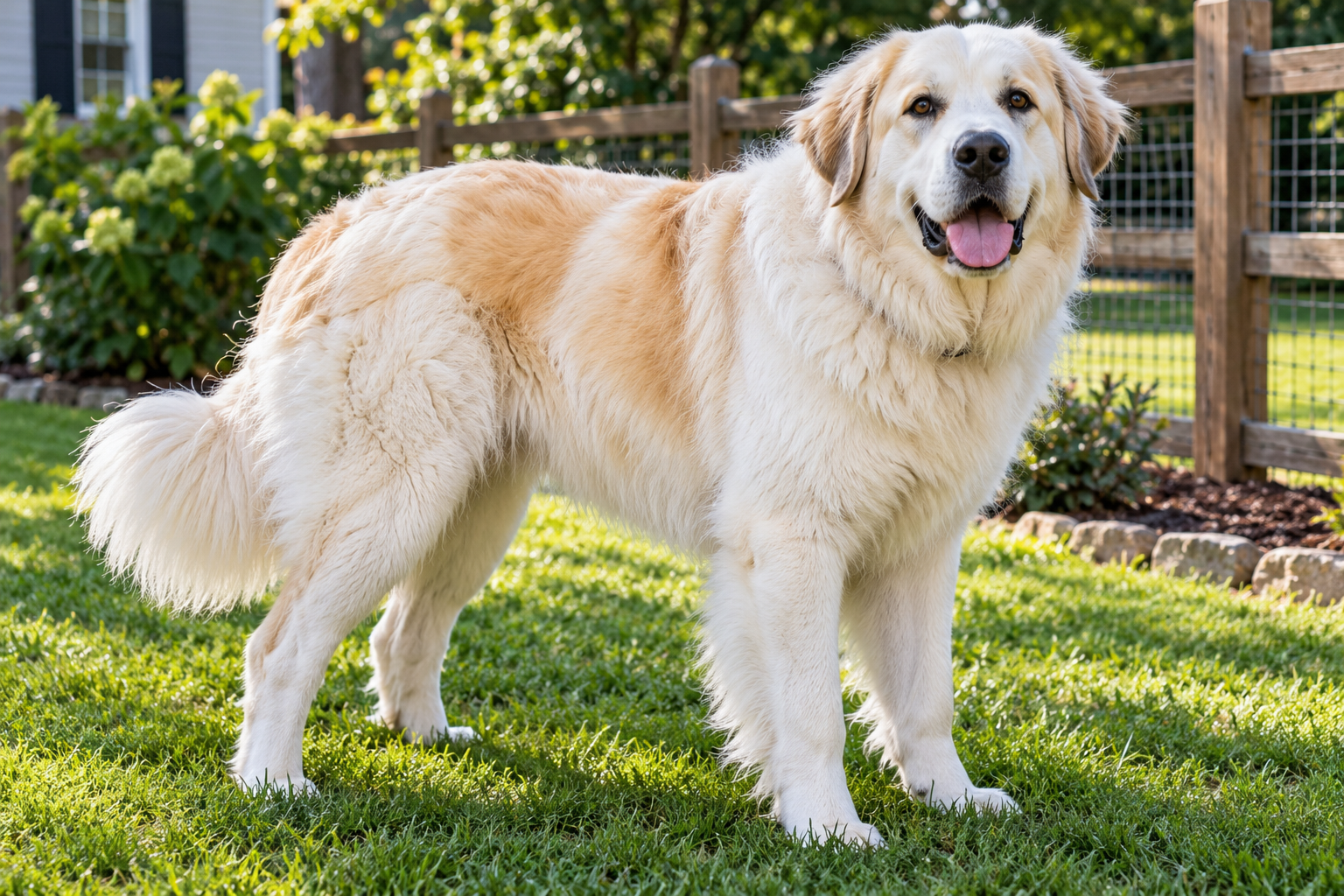
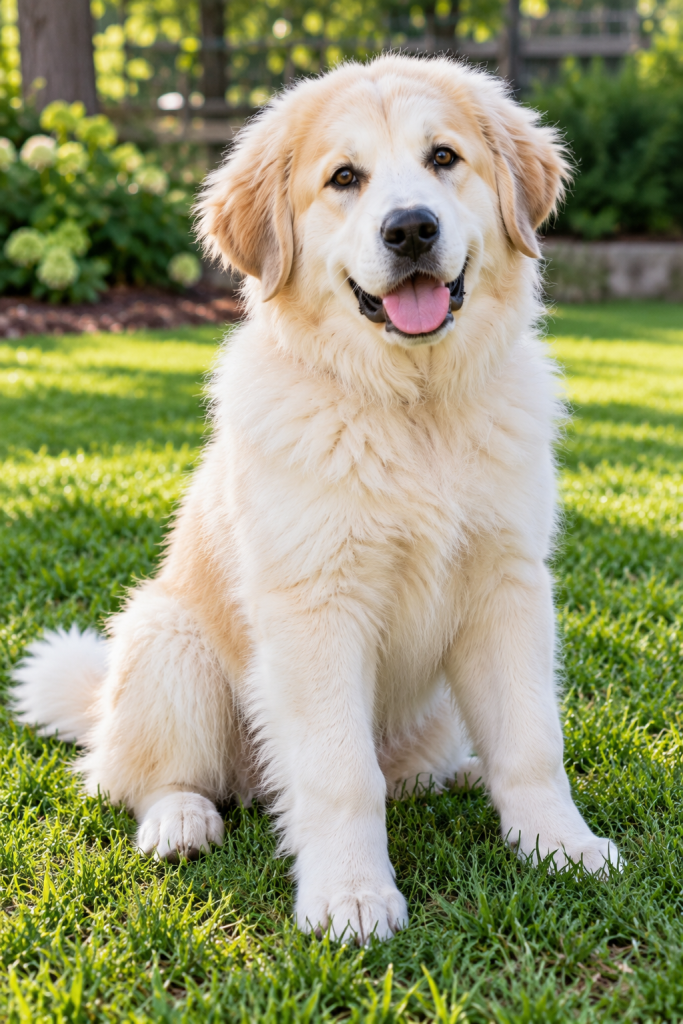
A Great Pyrenees Lab mix, often called a Pyrador, combines two very different working backgrounds: the Great Pyrenees, a livestock guardian, and the Labrador Retriever, a friendly, energetic retrieving dog. The result can be a large, affectionate companion with a protective streak, a thick coat, and a personality that depends heavily on which parent it takes after.
Pyradors can make wonderful family dogs, but they are not automatically easygoing Labs in a bigger body. Their size, barking, independence, shedding, and need for consistent training deserve careful consideration before bringing one home.
This guide covers the Great Pyrenees Lab mix’s size and weight by age, temperament, grooming, exercise, feeding, lifespan, and everyday care so you can decide whether this cross suits your household.
Great Pyrenees Lab mix: the short answer
The Great Pyrenees Lab mix is a large mixed-breed dog produced by crossing a Great Pyrenees with a Labrador Retriever. The nickname Pyrador is commonly used for this cross, although individual dogs can vary considerably in appearance and behavior.
| Trait | What to expect |
|---|---|
| Other common name | Pyrador |
| Adult weight | Roughly 70–120 pounds |
| Adult height | Approximately 24–32 inches at the shoulder |
| Lifespan | Around 10–12 years |
| Coat | Usually dense, with possible double-coat characteristics |
| Shedding | Moderate to heavy, depending on the coat |
| Temperament | Loyal, affectionate, watchful, potentially independent |
| Exercise | Daily walks, play, and mental stimulation |
| Best suited to | Households prepared for a large, strong dog |
These figures are broad planning estimates, not an official breed standard. A Pyrador may be smaller and more Labrador-like or larger and more Great Pyrenees-like. Even puppies from the same litter can grow into noticeably different adults.
The Labrador contributes enthusiasm, sociability, and a willingness to engage with people. The Great Pyrenees contributes a guardian’s instincts, independence, and a thick weather-resistant coat. Understanding both sides is key to setting realistic expectations. The American Kennel Club’s breed profiles describe these distinct backgrounds and their associated traits.
Great Pyrenees Lab mix size and weight
A Pyrador is generally a large dog, so prospective owners should plan for substantial adult weight, strength, and space requirements.
For context, the AKC lists typical Labrador Retriever weights at 55–80 pounds, while Great Pyrenees dogs commonly weigh 85 pounds and up for females and 100 pounds and up for males. A cross between them does not necessarily fall halfway between those figures.
Great Pyrenees Lab mix weight chart by age
The following table offers a broad, illustrative guide to growth in a large Pyrador. Mixed-breed puppies do not follow one standardized growth chart, so use these ranges as orientation rather than targets.
| Age or stage | Broad estimated weight |
|---|---|
| 8 weeks | 10–20 lb |
| 3 months | 20–35 lb |
| 6 months | 45–75 lb |
| 9 months | 60–90 lb |
| 12 months | 65–110 lb |
| 18–24 months | 70–120 lb or more |
Important: These are approximate planning ranges, not validated Pyrador-specific averages. A puppy’s actual weight depends on its parents, sex, body structure, nutrition, and individual growth pattern.
Many large dogs reach much of their adult size during the first year but continue filling out and maturing afterward. A Pyrador with a stronger Great Pyrenees build may take longer to finish developing than a smaller, more Labrador-like dog.
Track your puppy’s weight over time rather than judging progress from a single number. Your veterinarian can help assess body condition and whether growth is appropriate. For broader comparisons, see our dog weight chart by age and breed.
Temperament: guardian instincts meet family dog
The Pyrador’s temperament is one of the most important things to understand before choosing this mix.
Both parent breeds can form strong family bonds, but they may approach their surroundings differently. Labradors are generally outgoing, energetic, and eager to participate. Great Pyrenees dogs were developed to guard livestock and are known for independent decision-making.
A Pyrador may inherit a combination of these traits.
Loyalty and affection: Many Pyradors enjoy spending time with their families and can be gentle, affectionate companions. Some prefer staying close to their people, while others are content to watch what is happening around the home.
A watchful nature: The Great Pyrenees influence can make a Pyrador alert to visitors, unfamiliar animals, and noises outside. This may be useful in a household looking for a watchful companion, but it does not mean the dog should be encouraged to act aggressively.
Barking: This is worth considering seriously. Great Pyrenees dogs may bark to alert their household or respond to activity around their territory. Some Pyradors inherit that tendency and can be vocal at night or whenever they hear something outside. Training, enrichment, and thoughtful management can help, but a naturally vocal dog may never become completely quiet.
Independence: A Labrador’s enthusiasm for training does not guarantee that a Pyrador will follow every cue immediately. A dog with stronger guardian instincts may prefer to assess a situation before responding.
With consistent training, early socialization, and realistic expectations, this cross can suit many families. However, large size matters. Even a friendly, well-meaning dog can accidentally knock over a toddler or overwhelm a smaller pet during play.
Coat, shedding and grooming
The Pyrador’s coat can range from shorter and more Labrador-like to longer, thicker, and more Great Pyrenees-like. Many have a dense coat, and some inherit the pronounced double coat of the Great Pyrenees.
Expect regular grooming rather than a low-maintenance coat.
- Brush at least weekly. Use a suitable brush or undercoat tool for the coat your dog actually has.
- Increase brushing during seasonal shedding. Dogs with a thick undercoat may shed heavily during seasonal coat changes.
- Check behind the ears and around the tail. These areas can develop tangles, especially in longer-coated dogs.
- Maintain nails, ears, and teeth. Nail trimming, ear checks, and regular tooth brushing belong in the routine.
- Bathe when necessary. Frequent bathing usually is not required unless the dog gets dirty or has another specific grooming need.
Great Pyrenees dogs are known for heavy shedding and a substantial double coat, while Labradors also shed despite their shorter fur. A Pyrador may therefore leave plenty of hair around furniture and clothing.
Do not shave a double coat simply to reduce shedding. Ask a veterinarian or qualified groomer about appropriate coat care if you are unsure what type of coat your dog has.
Exercise, training and space needs
A Pyrador needs regular physical activity and mental engagement, but the right routine depends on its energy level, age, health, and temperament.
Most adults benefit from daily walks, opportunities to sniff and explore, interactive games, and short training sessions. A dog that takes after the Labrador may enjoy retrieving games or swimming, while one with stronger guardian instincts may prefer a predictable routine and time to observe its surroundings.
Puppies need age-appropriate movement, rest, and play. Avoid forcing long runs or strenuous repetitive exercise while a large-breed puppy is still developing. Your veterinarian can advise on suitable activity for your dog’s growth stage.
Training should begin early, with particular attention to:
- Loose-leash walking and calm greetings.
- Reliable recall, practiced safely before expecting it outdoors.
- Settling quietly when visitors arrive.
- Appropriate responses to unfamiliar people and animals.
- Reward-based manners around children, food, and household activity.
Keep sessions short, consistent, and rewarding. Food rewards, toys, praise, and varied exercises can help maintain engagement. If independence, guarding behavior, or pulling becomes difficult to manage, seek help from a qualified trainer experienced with large dogs.
Space also deserves an honest assessment. A Pyrador can physically live in a smaller home if its needs are met, but a cramped apartment, narrow shared hallways, and limited outdoor access can make life harder for both dog and owner. A secure fenced area is particularly useful because guardian instincts and independent decision-making may make unrestricted roaming risky.
A large home does not replace walks or training, and a yard does not make a dog safe to leave unsupervised for long periods.
Feeding and everyday care
Feed your Pyrador a complete, balanced diet appropriate for its life stage, body condition, and activity level.
Growing puppies generally need food formulated for large-breed puppy growth. The goal is steady, appropriate development rather than rapid weight gain. Adult dogs need portions adjusted to their energy expenditure and body condition, not simply to their size or appetite.
A few habits make everyday care easier:
- Measure meals instead of repeatedly topping up the bowl.
- Account for training treats when managing total food intake.
- Keep fresh water available.
- Reassess portions as activity levels or body weight change.
- Discuss feeding amounts and diet changes with your veterinarian.
Large dogs can be expensive to maintain. Food portions may be substantial, and routine expenses such as parasite prevention, veterinary care, grooming supplies, boarding, and medication can cost more than they would for a smaller dog. Individual costs vary with location, food choice, health needs, and lifestyle.
Use our dog food cost calculator to estimate food expenses using your own feeding and price assumptions.
Lifespan and health in general terms
A practical planning estimate for a Great Pyrenees Lab mix is around 10–12 years, although individual dogs may live for less or more time. The Great Pyrenees is generally listed with a 10–12-year life expectancy, and the Labrador Retriever with 11–13 years. The AKC gives a broader average of 8–12 years for large dogs overall. None of these figures guarantees an individual Pyrador’s lifespan.
As a large mixed-breed dog, a Pyrador benefits from routine veterinary care and attention to weight, mobility, dental health, and general fitness.
Keep these points in mind:
- Joint health: Large dogs can be affected by hip or elbow problems. Healthy growth and appropriate body weight are important parts of routine care.
- Weight management: Excess weight adds strain to joints and can interfere with mobility. Monitor body condition rather than relying on a scale alone.
- Digestive emergencies: Large and deep-chested dogs can be at risk of serious stomach conditions, including bloat. Know the warning signs and where to seek emergency veterinary care.
- Preventive care: Keep up with veterinary examinations, vaccinations, parasite prevention, and individualized screening recommendations.
A mixed pedigree does not guarantee freedom from inherited conditions, and not every Pyrador will experience the same health problems. If you are adopting a puppy, ask about the parents’ known health history and any relevant screening. Contact your veterinarian about symptoms, screening, or concerns specific to your dog.
Frequently asked questions
How big does a Great Pyrenees Lab mix get?
Many Pyradors weigh roughly 70–120 pounds and stand around 24–32 inches at the shoulder, although some fall outside these estimates. Adult size depends on the parents, genetics, sex, and individual development.
Do Great Pyrenees Lab mixes shed a lot?
They can. Both parent breeds shed, and a Pyrador with a thick double coat may shed heavily during seasonal changes. Regular brushing is important, with more frequent grooming during heavy shedding periods.
Are Pyrador dogs good family dogs?
They can be affectionate, loyal family companions when well socialized and trained. However, their size, strength, potential barking, and protective instincts may not suit every household. Supervise interactions with young children and introduce other pets carefully.
How long do Great Pyrenees Lab mixes live?
Around 10–12 years is a reasonable general planning estimate for this large cross. Genetics, size, body condition, veterinary care, and other individual factors influence lifespan.
Are Great Pyrenees Lab mixes easy to train?
Not always. A Pyrador that inherits more Labrador traits may be eager to learn, while one with stronger Great Pyrenees instincts may be more independent. Early socialization, patient reward-based training, consistency, and good leash manners are especially important.
Is a Pyrador the right dog for you?
The Great Pyrenees Lab mix can be a rewarding companion for people who appreciate a loyal, substantial dog and are prepared for regular training, grooming, exercise, and the practical demands of a large breed. Its guardian heritage also means that barking, independence, and protective behavior should be considered before adoption, not treated as unexpected surprises later.
The best fit is not necessarily the biggest, fluffiest, or friendliest-looking puppy. It is the individual dog whose adult size, activity needs, and temperament fit your household. Meeting the dog, learning about its parents when possible, and discussing its needs with a veterinarian or experienced rescue professional can help you make a more informed decision.
By Jennifer, Founder and Owner of CanineCalc
Jennifer is a dog owner and researcher who develops practical, research-informed dog-care resources. She is not a veterinarian, breeder, or certified dog trainer. This guide provides general educational information and does not replace individualized veterinary advice.