Dog sleeping positions and their meanings: the short answer
The meaning of your dog’s sleeping position usually comes down to three things: comfort, temperature, and how safe your dog feels in the surroundings. A dog stretched out on its side may be enjoying a deeply relaxed nap, while one curled into a tight ball may be conserving warmth. A dog resting with its head on its paws may simply be taking a lighter rest rather than settling into a deeper sleep.
However, there is no universal code that explains exactly what every sleeping position means. As VCA Animal Hospitals explains in its guide to dog sleeping positions, the science behind assigning specific meanings to individual poses is limited. These interpretations are useful possibilities, not proven rules.
The most important clue is your dog’s normal behavior. If your dog has always slept with its paws in the air and wakes up happy, there is usually no reason to worry about that position. If your dog suddenly cannot find a comfortable position or begins sleeping differently alongside changes in appetite or energy, pay closer attention.
Dog sleeping positions chart
Use this chart as a quick guide to common sleeping positions and what they may suggest about your dog’s comfort and surroundings.
| Sleeping position | What it usually signals | Comfort or temperature note |
|---|---|---|
| Side sleeper | Relaxation and comfort | Often suits longer, restful sleep |
| Superman | A comfortable belly-down stretch | Common during naps; a cool floor may feel good |
| Curled up or donut | Warmth, coziness, or a preference for a compact position | Helps conserve body heat |
| On the back, paws up | Relaxation and possibly feeling secure | Exposes less-furred areas that can release heat |
| Lion pose | Light rest while remaining ready to move | Often seen when a dog is resting but not fully settled |
| Head on paws | A convenient resting position | May indicate a brief nap or a comfortable way to settle |
| Cuddling or back-to-back | Contact, warmth, or social comfort | Shared body heat may help keep dogs warm |
| Burrowing under covers | A preference for enclosed, cozy spaces | Blankets provide warmth and a sheltered feeling |
Remember that your dog’s surroundings, usual habits, and overall behavior matter more than any single pose.
What each position means, one by one
1. Side sleeper
A side-sleeping dog lies on its side with its legs extended or loosely stretched out. Sometimes the paws twitch gently, the face relaxes, or the dog begins dreaming.
This position often suggests that the dog is comfortable enough to relax without keeping all four legs tucked underneath its body. It may be especially common when your dog is taking a long nap in a familiar room.
Side sleeping can also make it easier to stretch out and release body heat. Still, a dog choosing this position does not automatically prove that it feels completely secure. Look at the full picture, including its surroundings and behavior.
2. Superman sleeping position
The superman position looks much like its name suggests. Your dog lies on its belly, stretches its front legs forward, and extends its back legs behind its body.
You may notice this pose during daytime naps, particularly after play. It allows a dog to rest while keeping its body in a position from which it can get moving without much effort.
Some dogs also seem to enjoy stretching out on cool flooring. Puppies and flexible dogs may use this position frequently, although there is no rule that only young dogs should sleep this way.
If your dog has always been comfortable stretching out like this, it is generally just another normal resting preference.
3. Curled up or donut position
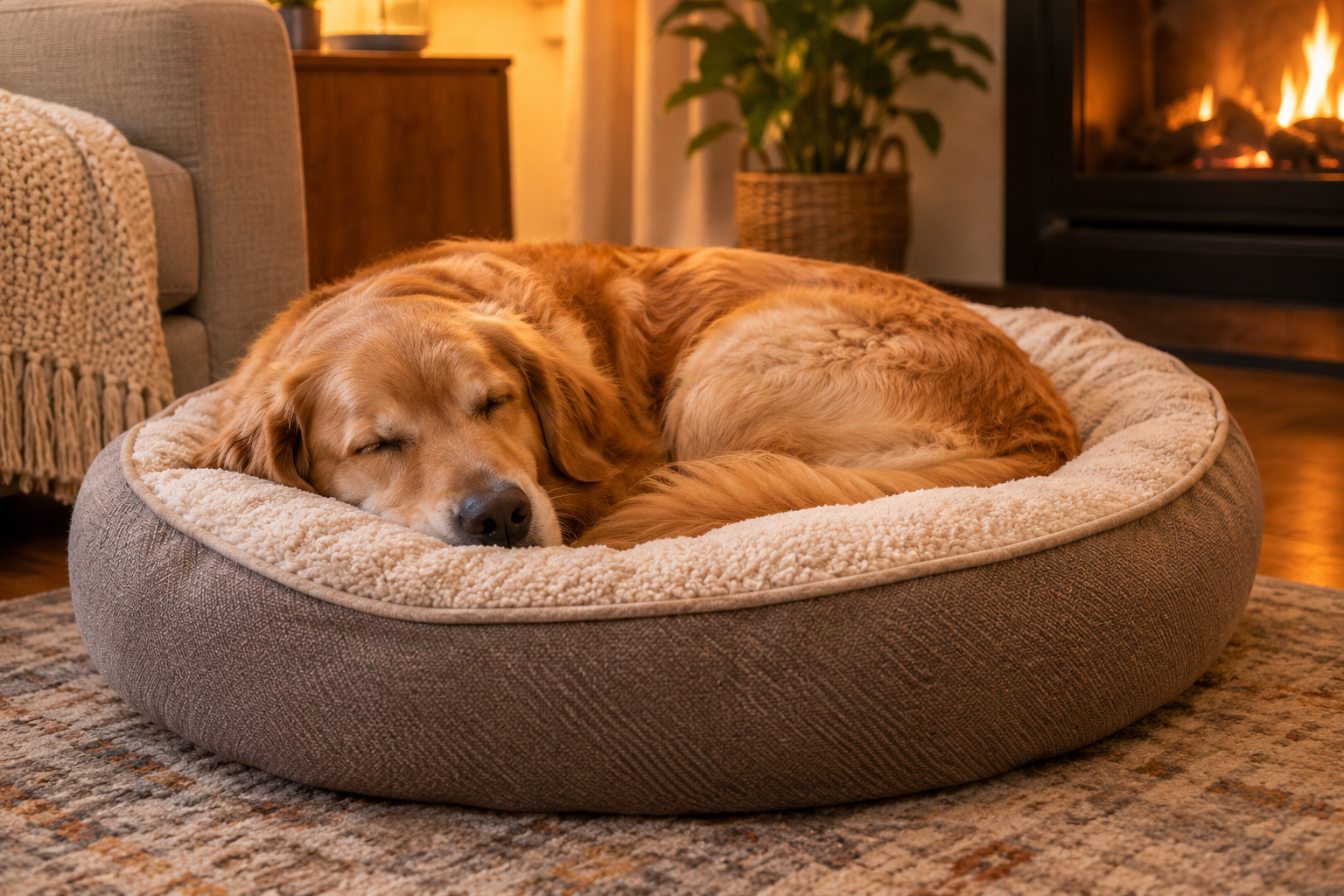
A curled-up dog tucks its legs close to its body, often bringing its nose toward its tail. Some dogs form a neat circle, while others curl only slightly.
This position helps conserve warmth and creates a compact resting shape. It may be especially appealing in a cool room, on a chilly floor, or when a dog is sleeping somewhere unfamiliar.
A curled position can also be a simple preference. Do not automatically assume that a dog curled into a ball is frightened, anxious, or unhappy. A relaxed dog may choose this position even in a familiar and comfortable home.
Offering a cozy bed or blanket can help, provided your dog can move away if it becomes too warm.
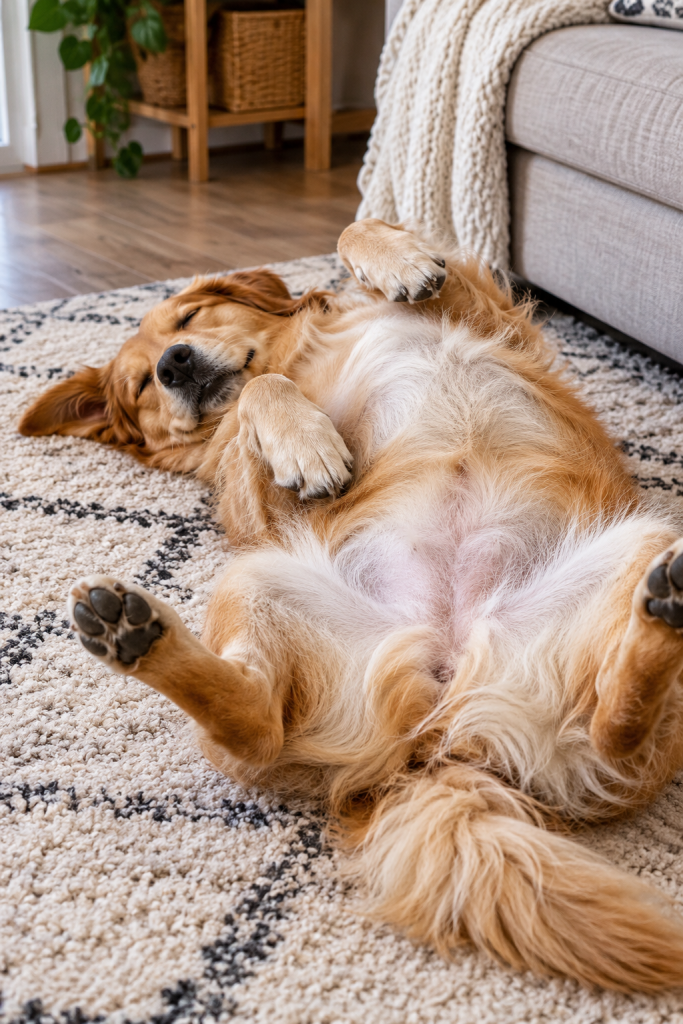
4. On the back with paws up
Few dog sleeping positions attract more attention than a dog lying flat on its back with all four paws in the air. Some dogs stretch their legs straight upward, while others bend them loosely at the joints.
This pose can reflect relaxation and a comfortable environment. It may also help release heat because the belly and other less-furred areas are exposed.
According to the American Kennel Club’s guide to dogs sleeping on their backs, belly-up sleeping is generally safe for dogs that choose the position comfortably.
Not every dog enjoys sleeping this way, though. A dog that prefers curling up is not necessarily less trusting, and a dog showing its belly while awake may be communicating something different from a dog peacefully asleep.
5. Lion pose
In the lion pose, a dog lies with its chest against the floor and its front legs underneath or extended in front. Its head stays raised or rests lightly above its paws, giving it a statue-like appearance.
This posture can mean your dog is resting without fully settling into a deeper sleep. It can get up quickly if someone enters the room or another interesting sound catches its attention.
You may notice it when your dog is tired but still interested in what is happening nearby. Some dogs also use it briefly before changing into a side-sleeping or curled position.
The pose alone does not mean your dog is anxious or uncomfortable. However, a sudden, persistent preference for sitting upright or keeping the head raised, particularly with changes in breathing or the ability to settle, deserves attention.
6. Head on paws
A dog in this position rests its muzzle directly on its front paws. Its body may be stretched out behind it, tucked underneath it, or lying comfortably on one side.
Unlike the more alert lion pose, a dog resting its head fully on its paws may be winding down for a nap. It may also simply find the position convenient.
This pose is common on dog beds, rugs, and other surfaces that provide a comfortable place to rest the head. Some dogs alternate between lifting their heads to look around and lowering them again.
Watch for the difference between relaxed resting and a posture that appears forced. If your dog repeatedly struggles to put its head down or cannot settle into its usual position, contact your veterinarian.
7. Cuddling or sleeping back-to-back
Some dogs sleep pressed against their owners, tucked beside another dog, or leaning back-to-back with a familiar companion.
Physical contact can provide warmth and comfort. It may also reflect a dog’s preference for resting near familiar people or animals.
Sleeping against you can be a sign that your dog enjoys your company, but it is not a precise measurement of trust or attachment. Some affectionate dogs prefer their own beds, while others seek contact whenever the opportunity arises.
If two dogs share a sleeping space, make sure both have enough room to change positions and move away when they want to. Comfortable contact should remain a choice.
8. Burrowing under covers
Burrowing dogs push their noses beneath blankets, crawl under a duvet, or nestle between pillows. Some disappear almost entirely, leaving only their noses or paws visible.
The enclosed space may feel cozy and sheltered, and the blanket can help retain warmth. Dogs may also enjoy the familiar smell and texture of their bedding.
You can accommodate this preference with a lightweight blanket or a covered bed that allows easy entry and exit. Make sure your dog can move freely, is not trapped beneath heavy bedding, and does not become overheated.
For a dog that suddenly begins hiding under covers while also showing fear, restlessness, or other unusual behavior, consider what else has changed in its environment.
Sleeping positions by age and size
Puppies: Young dogs often change positions throughout the day as they nap around playtime. You may see them stretched into the superman position, curled up beside a sibling, or sprawled across a soft bed. Their habits can change as they grow.
Adult dogs: Adult dogs often settle into familiar routines, but their preferred position may vary with the weather, activity level, sleeping surface, and time of day. One dog may sprawl across a cool floor in summer and curl up on a cushion in winter.
Senior dogs: Older dogs may prefer a different bed or position as their comfort needs change. Some take longer to lie down or stand up, and some experience changes in their sleep patterns. A new preference is not automatically a problem, but a persistent change deserves attention, especially when accompanied by restlessness or reduced activity.
Small and large dogs: Some small dogs seek blankets and compact beds, while larger dogs may appreciate extra space to stretch out. These are broad tendencies, not reliable breed-specific rules. Coat type, individual preference, room temperature, and the available sleeping area can all influence the position a dog chooses.
When a new sleeping position is worth watching
A different sleeping pose by itself usually does not tell you whether something is wrong. The reason to pay attention is a noticeable change from your dog’s normal habits.
Watch for persistent restlessness, repeated attempts to lie down, difficulty getting comfortable, reluctance to get up, or a marked change in sleeping patterns. Changes alongside reduced appetite, lower energy, or unusual behavior are also worth discussing with a veterinarian.
Veterinary guidance from VCA Animal Hospitals identifies restlessness, repeated position changes, and changes in sleep or daily activity as possible signs that warrant veterinary attention. These signs have many possible explanations, so a sleeping position cannot establish a diagnosis.
If your dog has difficulty breathing, is breathing with obvious effort, or cannot settle while appearing distressed, seek urgent veterinary care. Otherwise, record what has changed, when it started, and whether eating, walking, and energy levels have changed. That information can help your veterinarian assess the situation.
Setting up a better sleep spot
A comfortable sleeping area should support the position your dog naturally prefers.
- Choose a suitable bed. A flat, roomy mattress suits dogs that stretch out. A bolster bed may appeal to dogs that rest their heads on an edge, while a soft, cozy bed may suit curlers. Older dogs may benefit from a supportive surface that makes lying down and getting up easier.
- Provide a quiet corner. Choose a spot away from heavy foot traffic and loud household activity, while keeping your dog connected to the family if that is what it prefers.
- Offer temperature choices. Provide a comfortable bed and access to a cooler surface when practical. Avoid making the sleeping area too hot or forcing a dog to remain under blankets.
- Keep a predictable routine. Regular opportunities for exercise, bathroom breaks, and rest can make settling down easier.
- Allow room to move. Your dog should be able to stretch, turn around, and change positions without falling off a raised bed or getting trapped between furniture.
For dogs sleeping in crates, choose a space that allows them to stand, turn around, and lie down comfortably. Use the dog crate sizes guide to compare common sizing recommendations, or try the dog crate size calculator to help narrow down a suitable crate size.
Frequently asked questions
What does it mean when a dog sleeps on its back?
Sleeping on the back with the paws raised often indicates relaxation and may help a dog release heat. It can suggest that the dog feels comfortable in its surroundings, but it does not prove trust on its own.
Why does my dog sleep curled up?
Curling into a ball helps conserve body heat and creates a compact resting position. Your dog may prefer it when the room is cool or simply find it comfortable. Curling up alone is not a reliable sign of anxiety.
What is the superman sleeping position in dogs?
The superman position is when a dog lies on its belly with its front legs stretched forward and its back legs extended behind. It is a common resting posture, especially during naps, and may let a dog get up quickly.
Why does my dog sleep pressed against me?
Your dog may enjoy the warmth, physical contact, familiar scent, or security of sleeping near you. Some dogs naturally seek close contact, while others prefer their own sleeping spaces. Both preferences can be normal.
Do dogs change sleeping positions as they age?
Yes. Sleeping preferences may change with comfort, activity, temperature, and age. However, a sudden or persistent change, particularly with difficulty settling or reduced energy, should not automatically be dismissed as normal aging. Ask your veterinarian about changes that concern you.
Conclusion
The meaning of dog sleeping positions is best understood through comfort, temperature, surroundings, and your dog’s usual behavior. A curled-up dog may be keeping warm, a side sleeper may be deeply relaxed, and a dog pressed against you may simply enjoy being close.
There is no need to interpret every pose as a hidden message. Learn what is normal for your dog, provide a comfortable place to rest, and pay attention when familiar habits change alongside other signs of discomfort.
By Jennifer, Founder and Owner of CanineCalc
Jennifer is a dog owner and researcher who develops practical, research-informed resources to help dog owners better understand their pets. CanineCalc content is intended for general educational purposes and is not a substitute for individualized veterinary advice.