Last updated: October 2026
Choosing a dog crate sounds simple until you start shopping. One brand calls a crate Large, another calls almost the same dimensions Medium, and breed charts don’t always agree.
The good news? You don’t need to guess based on a label.
This dog crate size chart gives you practical starting points by breed, adult weight, and typical crate length. You’ll also learn how to measure your dog, choose a crate for a growing puppy, and check whether the actual interior dimensions offer enough room.
Dog Crate Size Chart by Breed and Weight
Dog crate sizes describe the dimensions of a crate intended to accommodate a dog’s body comfortably. The correct fit depends on the dog’s measurements, posture, and intended use, not just its breed or weight. A dog should be able to stand naturally, turn around, and lie down comfortably inside.
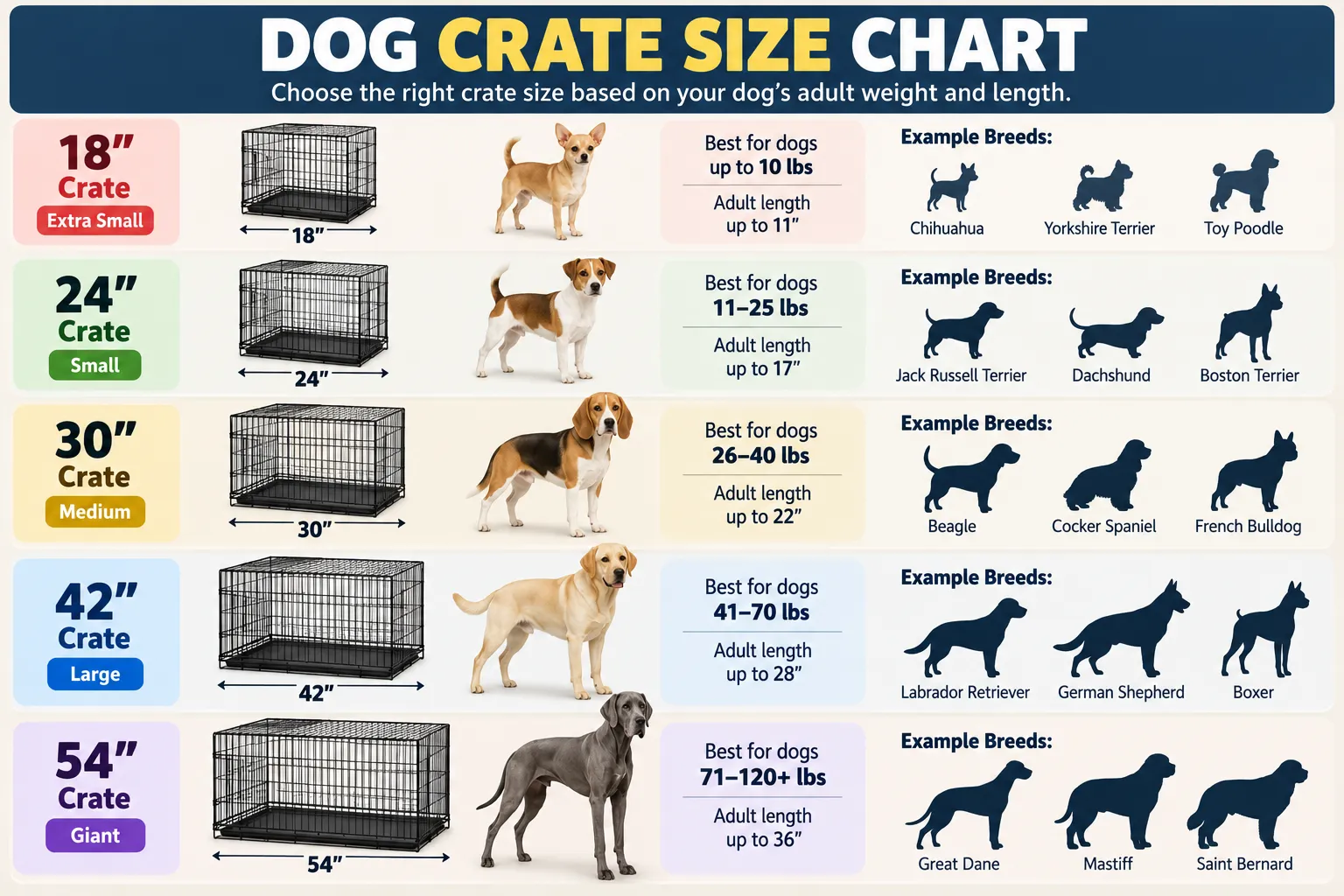
Quick dog crate size chart
Use this chart to narrow your options before checking the manufacturer’s measurements. The dimensions below are approximate starting points, not universal breed requirements.
| Crate length | Approximate adult weight | Example breeds | General size category |
|---|---|---|---|
| 18 inches | Up to 10 lb | Chihuahua, Maltese, Toy Poodle | Extra small |
| 22 inches | 10–20 lb | Yorkshire Terrier, Pomeranian, Papillon | Small |
| 24 inches | 15–30 lb | Shih Tzu, Boston Terrier, smaller French Bulldog | Small to medium |
| 30 inches | 25–40 lb | Beagle, Cocker Spaniel, smaller Australian Shepherd mixes | Medium |
| 36 inches | 40–70 lb | Border Collie, Australian Shepherd, larger Standard Poodles | Medium to large |
| 42 inches | 60–90 lb | Labrador Retriever, Golden Retriever, German Shepherd | Large |
| 48 inches | 80–110 lb | Large German Shepherds, larger retriever types, some giant-breed dogs | Extra large |
| 54 inches | 100 lb and above | Great Dane, Mastiff, Saint Bernard, Newfoundland | Giant |
The listed lengths refer to approximate crate lengths, not exterior measurements. Always confirm the usable interior dimensions before ordering.
What size crate should you get for your dog?
The right dog crate size is the smallest suitable option that still allows your dog to stand without crouching, turn around without struggling, and lie down comfortably. Begin with your dog’s actual measurements, then compare them with the crate’s usable interior dimensions. Breed and weight charts help narrow the search but cannot guarantee a correct fit.
Dog crate sizes by breed: what the chart can and cannot tell you
Breed is useful as a starting point. It isn’t a measurement.
According to Cornell University’s Richard P. Riney Canine Health Center, dogs need enough space to stand without ducking their heads, turn around, and lie down comfortably. The center also explains that a divider can help a puppy use an adult-sized crate as it grows. Cornell University College of Veterinary Medicine.
Consider two dogs weighing 50 pounds. A compact, stocky dog and a tall, long-legged dog may need different crate dimensions despite weighing the same amount. The taller dog may need more headroom, while the longer dog may need extra floor space.
Most people assume breed is the best clue. Your dog’s actual measurements are more useful.
For a practical next step, use this chart to shortlist a size, then verify that the crate meets your dog’s length and height requirements. If you’re between sizes, compare interior dimensions instead of relying on S, M, L, or XL labels.
Try the CanineCalc Dog Crate Size Calculator to get a size recommendation from your dog’s measurements.
How to Measure Your Dog for a Crate
Measuring your dog takes only a few minutes. A flexible tape measure works well, although asking someone to help keep your dog standing still makes the task easier.
The goal is to calculate a suitable interior length and height, then confirm that the shape of the crate accommodates your dog’s natural posture.
A simple three-step measuring method
To choose an appropriately sized crate, follow these steps:
- Measure length: With your dog standing, measure from the tip of the nose to the base of the tail. Add 2–4 inches.
- Measure height: Measure from the floor to the top of the head, or the ears when they naturally stand erect. Add 2–4 inches.
- Check the interior: Compare both results with the crate’s usable interior dimensions and confirm your dog can turn around and lie down comfortably.
These calculations give you a starting point for minimum length and height. They don’t replace a physical fit check.
How to use your measurements
Suppose your dog measures 29 inches from nose to tail base and 23 inches from the floor to the top of the head.
Using the guidance above, your starting target would be approximately:
- Crate length: 31–33 inches.
- Crate height: 25–27 inches.
You would then compare these figures with the manufacturer’s interior dimensions. A crate advertised as 36 inches long might have less usable space inside, so don’t assume its label tells you everything.
One detail deserves attention: measurement conventions differ across guides. The American Kennel Club’s published guidance measures length from the tip of the nose to the tip of the tail and recommends adding 3–4 inches to the length and height measurements. This differs from methods that measure body length to the tail base.
Sources disagree on the exact measuring convention, so be consistent with the method you use and follow any specific measuring instructions provided by the crate manufacturer. If you use the tail-base method in this guide, verify the final fit carefully rather than treating the calculated length as a guarantee.
What if your dog is between crate sizes?
Wondering what size your dog will be as an adult? These clues help.
A slightly larger crate may be the sensible choice when a fully grown dog sits near the upper limit of a size range. You still need enough room for the crate to fit safely in your home or vehicle.
Quick note: the measurement formula is a guide, not a universal manufacturing standard. If the dog cannot stand naturally or turn around comfortably in the proposed crate, move to an option with more usable space.
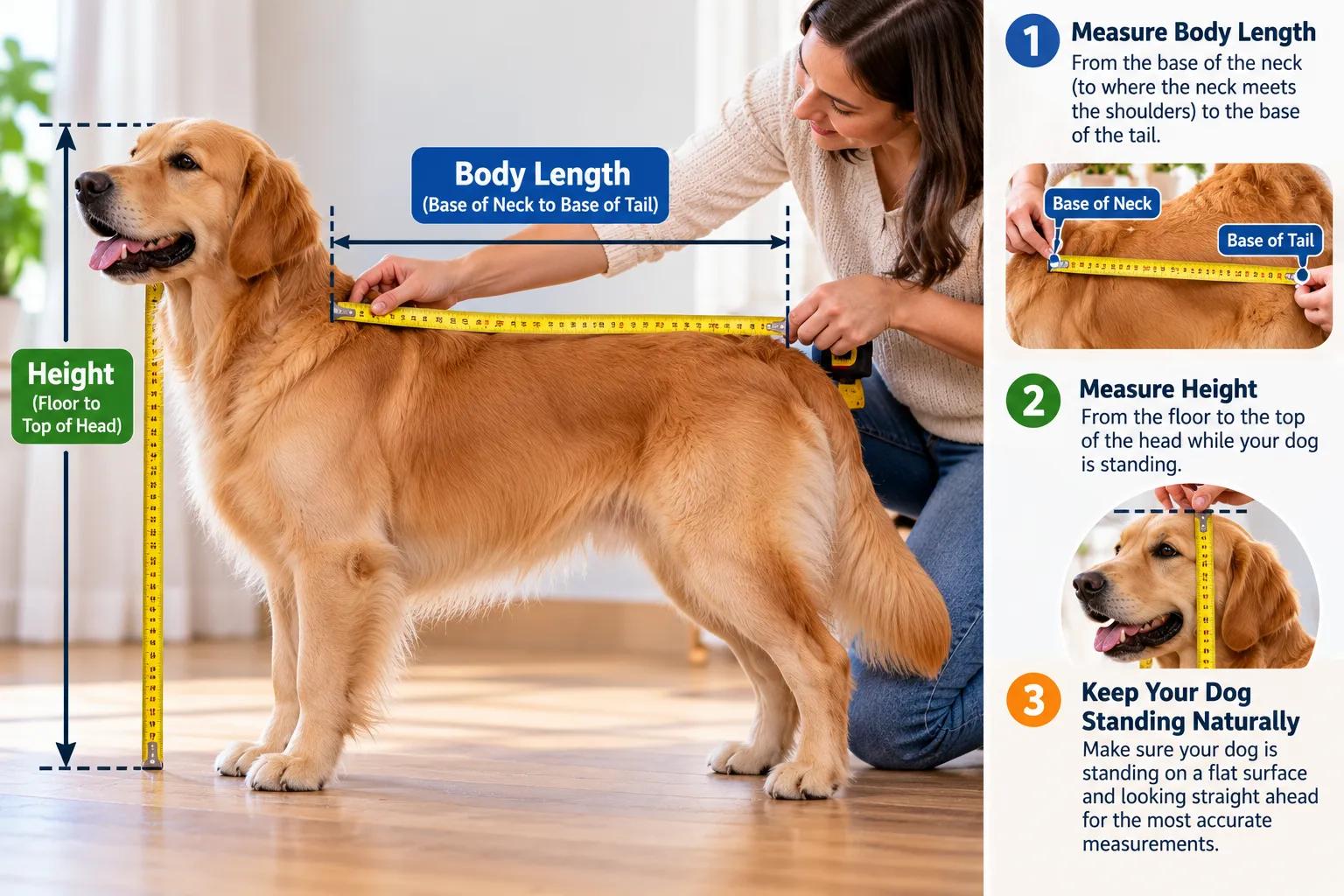
Source: American Kennel Club: How to Choose the Best Crate for Your Dog — measurement recommendations and crate fit guidance.
What Size Crate Does a Puppy Need?
Puppies grow quickly, which makes crate shopping a moving target. Buying a separate crate every time your puppy gains several pounds can become expensive, but placing a small puppy in a large, undivided crate can also complicate house-training.
A practical option is to choose a crate that accommodates your puppy’s expected adult size, then use an adjustable divider to limit the usable space while the puppy grows.
How to choose a crate for a growing puppy
According to Cornell University’s Richard P. Riney Canine Health Center, a divider allows a growing puppy to use a larger crate while reducing the available space during house-training. The puppy can gradually have more room as its body grows.
Choose a suitable adult-sized crate first. Adjust the divider so the puppy can stand, turn around, and lie down comfortably without having excessive unused space.
Then reassess the fit as your puppy grows. A divider is adjustable, but it doesn’t remove the need to check your puppy’s posture and available room.
Why an adult-sized crate with a divider can make sense
Some owners prefer purchasing a series of smaller crates because each one fits their puppy at that moment. That’s a reasonable approach when space, portability, or the puppy’s expected adult size is uncertain.
For many owners, though, an adult-sized crate with a divider offers a practical alternative. It can reduce the need to buy multiple crates while allowing the puppy’s living space to expand gradually. This approach is particularly useful when the puppy’s likely adult size is reasonably predictable.
Here’s the thing: the adult-size estimate is only a planning tool. Mixed-breed puppies, dogs with uncertain backgrounds, and puppies whose eventual size is unclear may need periodic reassessment.
Use a divider that fits the crate securely and cannot easily be displaced. Remove or adjust it as your puppy grows, and make sure the available space remains appropriate at every stage.
The crate should be a safe resting place, not a substitute for exercise, bathroom breaks, play, or social interaction.
Related: puppy adult weight calculator
Crate Options, Sizing Labels, and Common Mistakes
Once you know the approximate size, consider how you plan to use the crate. A wire crate, plastic kennel, and fabric crate can have similar advertised lengths but very different usable space, durability, and purposes.
Quick Comparison
| Option | Best For | Key Benefit | Limitation |
|---|---|---|---|
| Wire crate with divider | Growing puppies and home use | Adjustable interior space | Requires a suitable, secure divider |
| Plastic kennel | Dogs needing a more enclosed space or some travel uses | Solid sides and a contained feel | Interior space may be reduced by the shape of the shell |
| Fabric or mesh crate | Suitable small dogs and supervised, short-term use | Lightweight and portable | May not suit puppies or dogs that chew |
| Furniture-style crate | Homeowners prioritizing appearance | Can blend into home furnishings | Interior dimensions and durability vary by design |
Common mistakes when choosing dog crate sizes
- Buying by weight alone. Weight is useful context, but it doesn’t tell you everything about body length, height, or width.
- Trusting the size label. A Large crate from one company might have different interior dimensions from another company’s Large. Compare the measurements in inches.
- Measuring only while your dog is lying down. A dog may appear to fit while resting but lack enough headroom when standing.
- Forgetting breed-specific body proportions. Long-bodied dogs may need more length than their weight suggests. Tall dogs may need more headroom.
- Buying a puppy crate without a growth plan. Decide whether you’ll replace the crate as the puppy grows or use an adult-sized model with an adjustable divider.
- Ignoring the intended use. A home crate and an airline-compliant travel kennel aren’t automatically interchangeable. Check applicable airline and transport requirements separately.
What most sizing guides skip
A crate’s listed exterior dimensions don’t necessarily equal its usable interior space. Thick walls, molded shapes, doors, and other construction features can affect the room available to your dog.
Check all three dimensions whenever they are available. Length and height calculations are helpful, but the crate must also offer enough room across the body for comfortable movement.
Some owners favor choosing the largest possible crate for extra comfort. That can make sense for an already house-trained adult dog whose crate is used as a resting place. However, when a puppy is learning house-training habits, an appropriately adjusted divider can help limit excessive unused space while still allowing comfortable movement.
My recommendation is to prioritize fit over the size label. A dog at the upper limit of a chart deserves a more careful measurement check, not an automatic assumption that the smaller model will work.
When this guidance may not be enough
This guide covers typical home-crate sizing, broad breed and weight ranges, and measuring methods. It does not determine airline-specific kennel eligibility, vehicle-restraint safety, or the best confinement arrangement for a dog with severe confinement distress.
According to Cornell’s canine health guidance, dogs showing excessive distress in confinement may need alternatives such as a pet-proof exercise pen, along with help from a veterinarian or qualified trainer. A correctly sized crate does not automatically make confinement suitable for every dog.
Dog Crate Size Questions
Q: What’s the best way to choose a dog crate size?
Measure your dog’s length and height, add suitable allowance, and compare the results with the crate’s interior dimensions. Then confirm that your dog can stand, turn around, and lie down comfortably.
Q: How do I know if my dog’s crate is too small?
If your dog must duck its head while standing, struggles to turn around, or cannot lie down comfortably, the crate may be too small. Recheck measurements and compare a larger model.
Q: Should I buy a crate based on my puppy’s adult size?
Usually, an adult-sized crate with a suitable adjustable divider is a practical option. Adjust the available space as your puppy grows and reassess the fit regularly.
Q: Why do dog crate sizes differ between brands?
Brands use different dimensions and size labels. Compare actual interior measurements rather than assuming every Small, Medium, or Large crate provides the same usable space.
Q: When should I move my dog to a larger crate?
Move to a larger option when your dog can no longer stand, turn around, or lie down comfortably in the current space. For puppies, adjust the divider as growth requires.
Choosing the right crate doesn’t have to be complicated. Start with the chart, measure your dog, and confirm the available interior dimensions before buying.
For an extra check, use the [CanineCalc Dog Crate Size Calculator → dog crate size calculator] to compare your measurements with a recommended crate size. Treat the result as a guide, then confirm the final fit against the specific crate you plan to purchase.
A good fit is more useful than a familiar label.