How much weight should a puppy gain per week? The short answer
There isn’t one weekly weight-gain number that fits every puppy. A Chihuahua puppy and a Great Dane puppy can be growing normally while adding very different amounts of weight. Even puppies of the same breed may follow slightly different growth curves.
A more useful way to think about puppy growth is as a percentage of current body weight, alongside the puppy’s age and expected adult size. A small puppy can make noticeable progress on the scale with a relatively small gain in ounces. A giant-breed puppy may add much more actual weight while gaining a smaller percentage of its body weight.
The most important thing is the pattern over time. A puppy should generally follow a rising growth curve, although the pace will change as the puppy gets older. One weigh-in cannot tell you as much as several consistent measurements.
As a broad guide, newborn puppies often gain around 5%–10% of their body weight per day after the initial newborn period. That rapid percentage-based growth does not continue at the same pace throughout puppyhood. Once puppies are older, their weekly gain depends much more on breed, current size, age, and individual development.

Puppy weight gain chart by size and age
The chart below gives a general picture of how quickly puppies tend to gain weight at different stages. The percentages represent an approximate average weekly increase relative to the puppy’s current weight, inferred from typical size-specific growth curves. They are not required weekly targets.
| Expected adult size | 8–12 weeks | 3–6 months | 6–12 months |
|---|---|---|---|
| Toy (under 12 lb) | Around 12–13%/week | Around 4.5–5.5%/week | Around 0.5–1%/week |
| Small (12–25 lb) | Around 13–14%/week | Around 5–5.5%/week | Around 0.5–1%/week |
| Medium (25–50 lb) | Around 14–15%/week | Around 5–6%/week | Around 0.75–1.25%/week |
| Large (50–100 lb) | Around 14–15%/week | Around 6–6.5%/week | Around 1–1.5%/week |
| Giant (over 100 lb) | Around 14–15%/week | Around 6–7%/week | Around 1.25–2%/week |
These are rounded, illustrative growth-curve averages, not breed-specific predictions. Actual weekly changes can vary considerably. Size categories and expected adult weights are broad groupings.
Here’s how to read the pattern:
Toy and small puppies: They can make rapid progress relative to their starting weight, but usually approach adult size earlier. Their weekly gains become quite small as they mature.
Medium puppies: They generally maintain a noticeable growth pace through the first several months, then gradually slow as they approach adult size.
Large and giant puppies: They can continue adding meaningful weight for longer. Their absolute gains may look impressive, even when their percentage growth is slowing.
For example, a puppy weighing 5 kg that gains 5% in a week adds about 0.25 kg. A puppy weighing 30 kg that gains the same percentage adds 1.5 kg. The percentage is identical, but the difference on the scale is substantial.
The figures are best used to understand the shape of growth, not to judge a puppy against a fixed weekly allowance. Published growth curves are averages, and even puppies within the same size category do not necessarily follow identical paths.
Weight gain per day: the newborn weeks
Newborn puppies have a much faster growth pattern than older puppies. During the first few weeks, weight gain is especially useful for monitoring whether each puppy is nursing and developing as expected.
A general veterinary reference is an increase of approximately 5%–10% of current body weight per day during the neonatal period. A healthy newborn will often double its birth weight within roughly 7–10 days, although timing can vary.
Daily weighing matters most during this early window. A small digital kitchen scale that measures in grams can make it easier to detect changes that would be difficult to notice by looking at the puppy.
A slight loss during the first 24 hours can occur, but ongoing weight loss or a puppy that does not begin gaining deserves prompt veterinary attention. Keep a separate record for every puppy in a litter rather than assuming they are all progressing at the same rate.
The newborn pattern should not be used as a target for a puppy that is already several months old. The percentage of body weight gained naturally becomes lower as the puppy grows.
Why gain slows down — and why that is normal
Puppies do not grow at the same speed from birth to adulthood. Growth is generally fastest during early puppyhood, then gradually slows as the dog approaches its mature size.
You may notice that your puppy was gaining weight quite quickly during the first few months but now seems to add less each week. That change can be completely normal.
The timing depends largely on expected adult size:
Toy breeds often reach most of their adult size relatively early, sometimes around 6–9 months.
Small breeds commonly approach maturity during the latter part of their first year.
Medium breeds may continue developing until around 12 months.
Large breeds often need roughly 12–18 months to reach full skeletal maturity.
Giant breeds can continue developing for as long as 18–24 months.
These are broad maturity ranges rather than deadlines. Some dogs finish earlier or later, and reaching adult height does not necessarily mean the dog has finished filling out.
This is why a flatter weight curve near adulthood is not automatically a problem. A mature toy-breed dog may have very little weight left to gain, while a giant-breed puppy of the same age may still be developing.
The important distinction is whether the slowdown fits the puppy’s age and size. A young puppy that suddenly stops gaining is different from an older puppy that is gradually approaching its expected adult weight.
How to weigh your puppy and track the trend
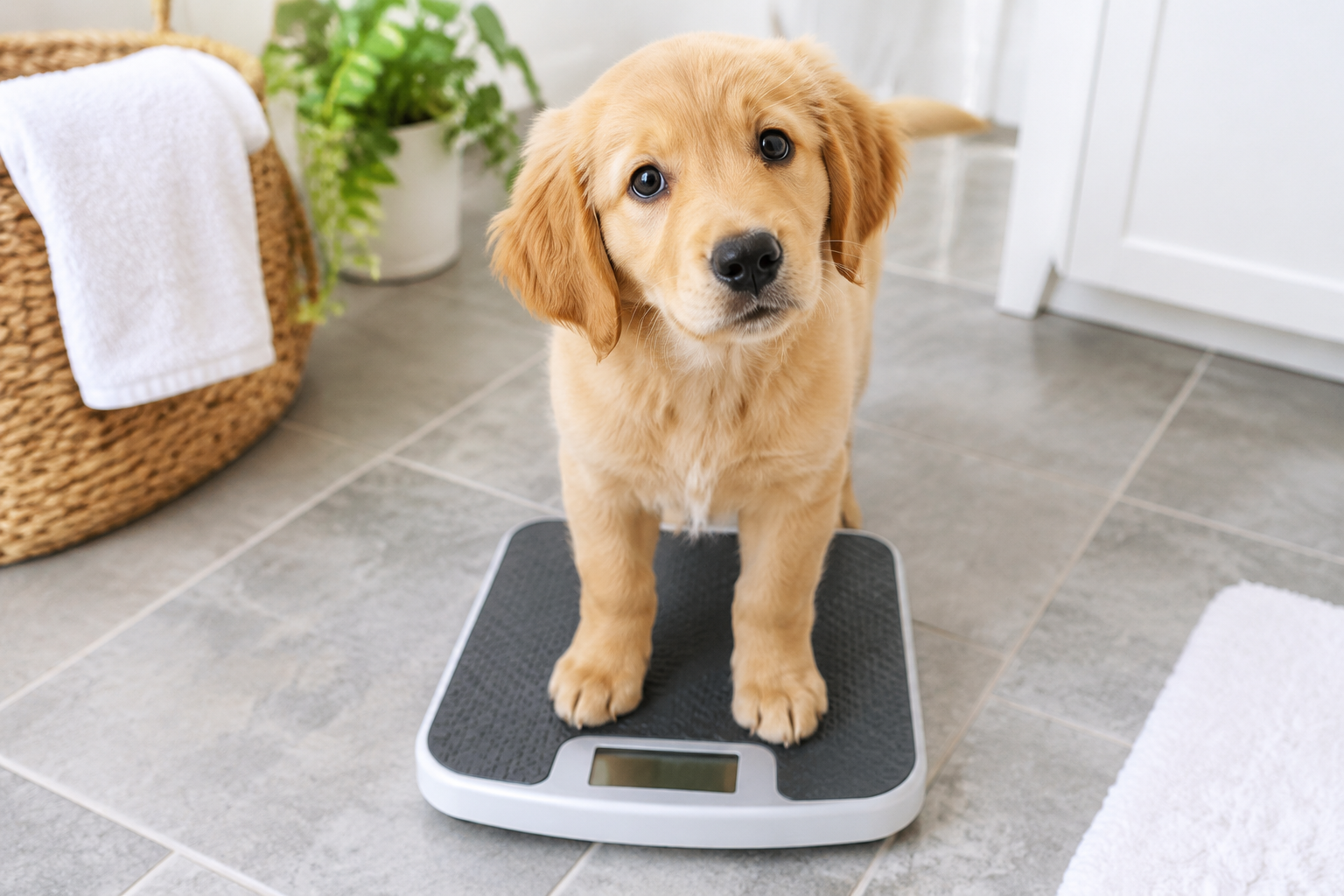
You do not need complicated equipment to follow your puppy’s growth. Consistent measurements are more useful than an expensive scale or frequent estimates based on appearance.
For a puppy older than the newborn stage, try this simple routine:
Use the same scale each time. Switching between scales can introduce small measurement differences.
Weigh your puppy at approximately the same time of day, preferably under similar conditions.
Record the age and weight together. Include the date so you can compare measurements over several weeks.
Check the weekly trend rather than reacting to every individual number.
A notebook or basic spreadsheet is enough. Record pounds or kilograms consistently, and avoid mixing the two without clearly labeling each entry.
What does a healthy trend look like?
Generally, you want to see a gradual upward pattern that makes sense for your puppy’s breed, age, body condition, and growth stage. The increases may be larger during one period and smaller during another.
A single week with little noticeable change does not necessarily tell the whole story. Scale placement, movement, recent meals, and normal measurement variation can affect an individual reading.
However, a puppy with repeated flat measurements, a falling weight trend, or a clear departure from its previous growth pattern should be checked by a veterinarian. Do not wait for obvious physical changes before asking about a persistent lack of gain.
A veterinarian can compare the puppy’s measurements with an appropriate growth chart and consider body condition, feeding, and overall development together.
When gain is too fast
More weight gain is not automatically better. The goal is healthy, steady development rather than getting a puppy to its adult size as quickly as possible.
This matters particularly for large and giant breeds. Excessive food intake can encourage overly rapid growth and excess body weight, placing additional stress on developing bones and joints.
Feed an appropriate complete and balanced puppy diet, including a large-breed growth formula when suitable for your dog’s expected adult size. Avoid adding supplements or increasing portions simply because you want to see a bigger number on the scale.
Your puppy’s body condition matters just as much as its weight. You should be able to feel the ribs beneath a light covering of fat, without the body looking excessively thin or heavily padded.
A puppy that gains steadily while maintaining a healthy body condition is generally a better goal than one that gains as much weight as possible.
Frequently asked questions
How much weight should a puppy gain per day?
For newborn puppies, a general reference is around 5%–10% of current body weight per day after the initial adjustment period. The percentage naturally changes as puppies mature. For puppies several months old, weekly measurements are generally more useful than trying to establish a daily target. Breed, age, and expected adult size all affect the amount gained.
How much weight should a puppy gain in a month?
There is no universal monthly amount. A young puppy can gain a substantial share of its current weight in a month, while an older puppy approaching adult size may gain considerably less. A toy puppy might add only a small number of ounces, while a giant-breed puppy could add several pounds. Compare the monthly change with the puppy’s previous growth pattern rather than using one number for every dog.
Should puppies gain weight every day?
Newborn puppies should generally gain weight steadily each day, which is why daily weighing is recommended during their first couple of weeks. Older puppies do not need to show a measurable increase every single day. Their weight can fluctuate slightly between measurements. Look for a consistent upward trend over several weeks, and contact your veterinarian about repeated flat or falling measurements.
How fast do puppies gain weight after 6 months?
Growth usually becomes slower after six months, but the amount of remaining development depends on adult size. Toy and small breeds may be approaching their final weight, whereas medium, large, and giant breeds may continue gaining. As a broad reference, size-specific growth curves suggest roughly 0.5%–2% of current body weight per week during the 6–12-month period, with larger breeds tending toward the higher end. Individual results vary.
What is normal weight gain for a puppy in kg?
The same percentage-based approach works in kilograms as it does in pounds. For example, a puppy weighing 5 kg that gains 5% in a week adds approximately 0.25 kg. A 30 kg puppy gaining the same percentage adds 1.5 kg.
These examples show why there is no single normal number of kilograms per week. The puppy’s current weight, age, breed, and expected adult size all matter. Use the percentage as a way to understand the growth pattern, not as an exact feeding or weight-gain prescription.
Conclusion
How much weight a puppy should gain per week depends on how big the dog is expected to become and how old the puppy is today. Young puppies generally grow quickly, while growth gradually slows as they approach adult size. Toy breeds usually finish earlier, and giant breeds may continue developing well beyond their first birthday. Weigh your puppy consistently, keep a record of the trend, and focus on steady, healthy development rather than chasing the fastest possible weight gain. When the trend repeatedly stalls, falls, or seems unusual for your puppy’s age and size, ask your veterinarian to review it.