Puppy not gaining weight: the short answer
When a puppy is not gaining weight as expected, the first things to check are how much food they are actually eating, whether their food provides enough calories for growth, and whether something needs checking by a vet.
Sometimes the answer is surprisingly simple. A puppy may need a slightly larger portion, more frequent meals, or a quieter place to eat. Other times, an underlying health issue may be affecting their growth.
Before changing the diet, confirm that your puppy really is under-gaining. Puppies do not all grow at the same speed, and looking at their body is not always a reliable way to judge progress. Fluffy coats, different body shapes, and normal growth stages can make it difficult to tell.
Start with regular weigh-ins over one to two weeks. Record the numbers, check the overall trend, and compare your puppy’s progress with an appropriate growth chart.
If your puppy is losing weight, seems unwell, or is a newborn that is not gaining, contact a veterinarian rather than waiting to collect more measurements.
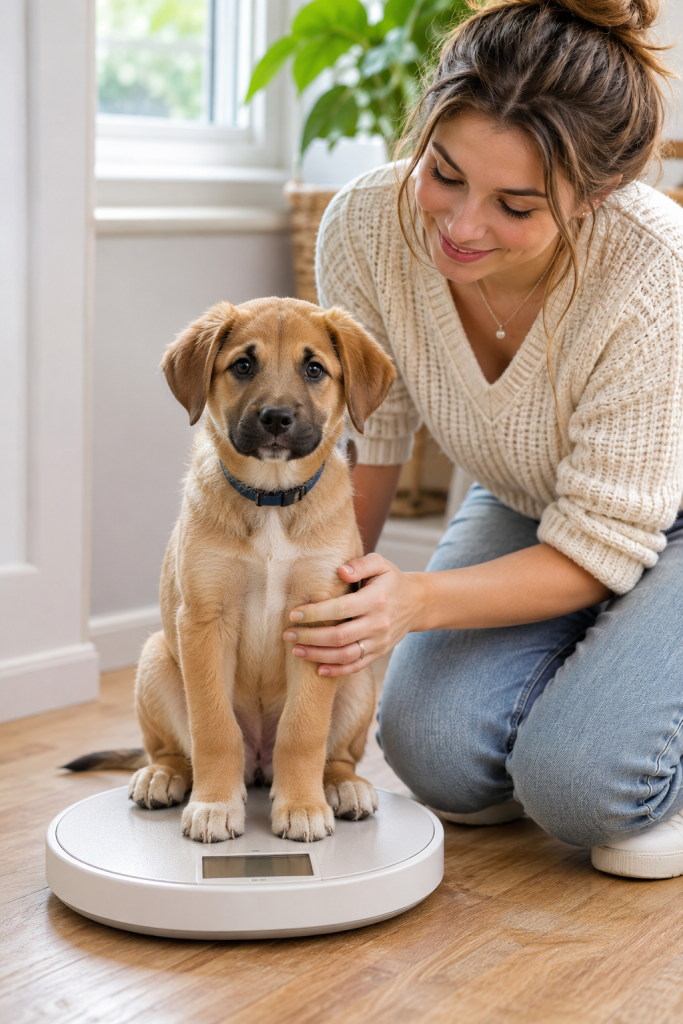
How to tell if your puppy really isn’t gaining enough
A puppy that looks small compared with another dog of the same age is not necessarily underweight. Breed, expected adult size, sex, and individual growth patterns all influence how quickly a puppy develops.
The best starting point is a consistent weighing routine.
Weigh your puppy once a week. Try to use the same scale, at roughly the same time of day, preferably before a meal. Record the weight in a notebook or spreadsheet so you can compare measurements over time.
For very small puppies, a digital pet or kitchen scale with sufficient capacity can work well. Larger puppies may need a suitable pet scale or veterinary scale.
Look for a gradual upward trend rather than expecting the same amount of weight gain every week. Compare the measurements against a growth chart appropriate for your puppy’s expected adult size. A chart designed for a small-breed dog may not tell you much about a growing Great Dane.
Check body condition, too.
A fluffy puppy can look round while actually having a fairly lean body underneath. Instead of relying on appearance alone, gently feel their body:
Ribs: You should generally be able to feel the ribs without pressing hard. They should not feel buried under a thick layer of fat, but prominent, sharply visible ribs can indicate that your puppy is too thin.
Waist: Looking from above, there should usually be a gentle narrowing behind the ribs.
Abdomen: Looking from the side, a slight upward tuck behind the rib cage is generally expected.
These checks are useful alongside weight records, not as a replacement for them. Your veterinarian can assess body condition more accurately if you are unsure.
The important distinction is whether your puppy is following a reasonable growth pattern for their size. A naturally petite puppy gaining steadily may be doing perfectly well, while a larger puppy whose weight has stopped progressing deserves closer attention.
Common reasons a puppy is not gaining weight
Several everyday factors can explain slow weight gain. Looking at the feeding routine and recent changes is a sensible place to start.
| Possible reason | Clues it fits | First step |
|---|---|---|
| Not enough food for their current weight | Finishing every meal quickly but remaining very lean | Recheck the daily portion against current weight and age |
| Food too low in calories for growth | Eating normally but receiving an adult or less energy-dense food | Check the food’s nutritional statement and calories per cup |
| Competition at mealtimes | Other puppies or dogs finish the food first | Feed separately and observe the entire meal |
| Recent changes | Weight gain slowed after rehoming, a food switch, or a routine change | Review the feeding routine and keep meals consistent |
| Intestinal worms or parasites | Poor growth, loose stools, a dull coat, or no obvious symptoms at all | Discuss parasite screening and prevention with a vet |
| High activity levels | A very energetic puppy gets plenty of exercise but remains lean | Review daily calorie intake and adjust appropriately |
Not enough food for a growing puppy is one of the first possibilities to investigate. Puppies grow quickly, and a portion that worked a few weeks ago may no longer be enough.
Food quality and calorie content matter, too. Two puppy foods can have different amounts of energy in the same measured serving.
Mealtime competition is easy to overlook. In a home with several dogs, a puppy may appear to eat normally while another dog quietly takes some of their food.
A recent move or food transition can also disrupt normal eating habits. Some puppies eat less while adjusting to a new home, schedule, or feeding environment.
Parasites are another possibility worth discussing with a veterinarian. Intestinal parasites can interfere with normal growth, and some puppies show few obvious signs. Stool testing is one way a veterinary team can investigate this possibility.
Finally, active puppies may need more calories than less active puppies of similar size. Their feeding allowance should reflect their individual needs rather than relying on a general estimate.
Check the food and the amounts first
Before adding snacks or changing foods, review exactly what your puppy eats each day.
Start with the feeding chart on the food packaging. Check the recommended portion for your puppy’s current weight and age, taking expected adult size into account where the manufacturer provides that guidance.
Remember that feeding charts are starting points, not guarantees. Two puppies with the same current weight may need different amounts depending on their activity, body condition, and growth stage.
Next, check the food itself.
Look for a complete and balanced nutritional statement indicating that the food is suitable for puppy growth. Large-breed puppies should receive food specifically formulated to support growth in large-size dogs.
A food intended primarily for adult maintenance may not provide the appropriate energy and nutrient balance for a growing puppy.
Weigh the food instead of eyeballing it.
This is one of the easiest improvements to make.
A cup filled generously can contain more food than a level cup. Different kibble shapes also settle differently, making visual measurements less consistent.
Use a kitchen scale to weigh the daily portion in grams. Divide that amount between meals and keep track of treats and training rewards.
For the next week, record:
- Total food offered each day.
- Food left uneaten.
- Treats and additional snacks.
- Weekly body weight.
- Any noticeable changes in appetite or digestion.
This gives you a much clearer picture of what your puppy is actually consuming.
Feeding changes that help a puppy gain
Once you have checked the food and feeding amount, a few adjustments may help your puppy move toward a healthier growth pattern.
Increase the measured portion gradually. If your puppy appears healthy and the current portion is below the appropriate feeding recommendation, make a modest, measured adjustment over several days.
Avoid suddenly doubling the food. The aim is to provide enough energy for steady growth, not to encourage rapid weight gain.
Offer smaller, more frequent meals. Some puppies do better with another small meal rather than larger portions at existing mealtimes.
Younger puppies have relatively small stomachs and can benefit from having their daily food allowance divided into several meals. The number of meals should suit their age and individual needs.
Choose a complete puppy food with suitable energy content. If the current food is intended for adult dogs or does not provide appropriate nutrition for growth, discuss a suitable complete puppy formula with your veterinarian.
Check calories per cup or per 100 grams when comparing products. A calorie-dense food can provide more energy in a smaller portion, but the overall nutritional balance matters just as much.
Make mealtimes quieter. Feed your puppy away from other pets if competition is a possibility. Give them enough time to finish without being interrupted, and observe whether they actually eat their entire portion.
Keep the routine consistent. Use regular feeding times and measure portions in the same way each day. Avoid constantly adding table scraps, rich treats, or supplements to encourage eating.
A complete puppy food should provide the nutrients needed for growth when fed in an appropriate amount. Additional vitamins and minerals are not automatically helpful and may upset the nutritional balance.
Remember that the aim is healthy, gradual growth. Overfeeding, particularly in large-breed puppies, can encourage excessive growth and unwanted weight gain.
Newborn and very young puppies: different rules
Newborn puppies need closer monitoring than older puppies.
Unlike an older puppy, which may be weighed weekly, a newborn should generally be weighed every day. Very young puppies are growing quickly, and even a short period without appropriate weight gain can be concerning.
A newborn puppy that is not gaining weight needs prompt veterinary input. Do not try to solve the problem by independently changing milk concentrations or experimenting with feeding supplements.
Contact a vet promptly, especially if the puppy is weak, restless, not nursing properly, or seems unusually quiet.
When a puppy not gaining weight needs a vet
Not every slow-growing puppy has a serious problem, but certain signs should not be ignored.
Contact your veterinarian when you notice:
- Weight loss: A puppy that is losing weight rather than gaining needs veterinary assessment.
- No progress for two weeks: If an older puppy has not gained weight for two weeks despite receiving an appropriate, measured diet, arrange a checkup.
- Vomiting or diarrhoea: Digestive problems alongside poor weight gain need attention.
- Low energy: A puppy that seems unusually tired, weak, or less interested in normal activities should be assessed.
- Loss of appetite: Refusing meals or eating substantially less than usual is a reason to contact your vet.
- A very young puppy not gaining: Newborns need prompt attention when weight gain stops.
Do not wait two weeks when your puppy has additional symptoms or is visibly getting thinner.
Your vet can review the weight history, check body condition, assess the feeding plan, and decide whether further checks are needed. These might include a stool examination for parasites or other investigations based on the puppy’s condition.
There are things only a vet can check for. Trying to correct unexplained weight loss simply by increasing food can delay finding the actual problem.
Frequently asked questions
Why is my puppy not gaining weight but eating?
Eating regularly does not necessarily mean your puppy is receiving enough calories. Their portions may be too small for their current size, or the food may not provide enough energy for growth.
Other possibilities include competition at mealtimes, high activity levels, or something affecting normal digestion and nutrient absorption. Parasites are one example a vet can check for.
Start by weighing the food and puppy consistently. Arrange a veterinary check if the weight trend remains flat or your puppy seems unwell.
How long should I wait before worrying?
For an otherwise happy, active older puppy, one or two weeks of consistent weigh-ins can help show whether weight gain is genuinely slowing.
However, don’t use that period as a reason to delay veterinary advice if your puppy is losing weight, has digestive symptoms, or has a reduced appetite.
A newborn puppy that is not gaining weight needs prompt attention rather than a weekly monitoring approach.
Can worms stop a puppy gaining weight?
Yes. Intestinal worms and other parasites can interfere with normal growth and may contribute to poor weight gain.
Some puppies also have loose stools, a dull coat, or a swollen-looking abdomen, although obvious symptoms are not always present.
A veterinarian can recommend appropriate stool testing and parasite treatment. Avoid giving random over-the-counter deworming products without checking that they are suitable for your puppy’s age and weight.
Why is my Lab puppy not gaining weight?
A Labrador puppy follows the same basic growth principles as any other breed. Check the amount of food, the calories in the formula, daily activity, and whether the puppy is actually finishing each meal.
Labradors can vary in size, so comparing your puppy with another Lab of the same age is not particularly reliable.
Use an appropriate growth chart, record weekly weights, and have your vet assess body condition if you are concerned.
What if my puppy stopped gaining weight at 6 months?
Growth naturally begins to slow for many puppies around this age. A puppy may no longer gain weight as rapidly as they did during their first few months.
This does not automatically mean something is wrong. Small breeds may be approaching adult size, while large and giant breeds can continue growing for considerably longer.
Continue monitoring weight and body condition. A healthy, appropriately proportioned puppy with a gradually slowing growth curve may simply be maturing. A puppy that loses weight or stops growing unexpectedly should be checked by a vet.
Conclusion
When a puppy is not gaining weight, start with accurate measurements rather than judging by appearance. Weekly weigh-ins, a suitable growth chart, and a hands-on body condition check can help you understand whether your puppy is following a reasonable growth pattern.
Next, review the food, measure portions accurately, and make sure your puppy has a peaceful, consistent feeding routine. Small adjustments may help when the problem is simply an inadequate daily food allowance.
Most importantly, don’t assume that every growth problem can be solved with more food. Weight loss, persistent lack of progress, digestive symptoms, low energy, and poor appetite deserve veterinary attention. Newborn puppies that fail to gain weight need prompt care.
The goal is not to make your puppy bigger as quickly as possible. It is to support steady, healthy development as they grow.