
Watching a Yorkshire Terrier puppy grow is exciting, but their tiny size can make it difficult to tell whether they are gaining weight as expected. One Yorkie may weigh barely a pound at eight weeks, while another puppy of the same age may be noticeably heavier.
This Yorkie growth chart gives you practical puppy weight ranges in pounds and kilograms, from eight weeks through adulthood. You will also learn how to estimate your Yorkie’s adult size, when growth usually slows, and which changes deserve a conversation with your veterinarian.
Remember that these ranges are guides, not strict targets. Your puppy’s inherited size, overall health, and body condition matter more than matching a number in a chart.
Yorkie growth chart: weight by age
Yorkshire Terriers are a toy breed, so even small differences in weight can be noticeable. The following chart offers approximate planning ranges for puppies following a typical growth pattern toward an adult weight of 4–7 pounds.
| Age | Weight range in lbs | Weight range in kg |
|---|---|---|
| 8 weeks | 1–2 lbs | 0.45–0.91 kg |
| 12 weeks | 1.5–3 lbs | 0.68–1.36 kg |
| 4 months | 2–4 lbs | 0.91–1.81 kg |
| 5 months | 2.5–4.5 lbs | 1.13–2.04 kg |
| 6 months | 3–5 lbs | 1.36–2.27 kg |
| 7 months | 3.5–5.5 lbs | 1.59–2.49 kg |
| 8 months | 4–6 lbs | 1.81–2.72 kg |
| 9 months | 4–6.5 lbs | 1.81–2.95 kg |
| 10 months | 4–7 lbs | 1.81–3.18 kg |
| 11 months | 4–7 lbs | 1.81–3.18 kg |
| 12 months | 4–7 lbs | 1.81–3.18 kg |
| Adult | Typically 4–7 lbs | Typically 1.81–3.18 kg |
These are general estimates, not an official AKC puppy-weight chart or scientifically defined percentile ranges. Puppies can fall outside them and still develop normally. Growth also does not follow a perfectly straight line, and the ranges overlap because individual Yorkies mature at different rates.
The American Kennel Club (AKC) breed standard states that a Yorkshire Terrier must not exceed 7 pounds. That is a show-breed standard, however, rather than a universal health cutoff. A dog weighing more than 7 pounds is not automatically unhealthy.
How to weigh a Yorkie puppy at home
A digital kitchen scale can work well for a very small puppy. Place a lightweight, stable container on the scale, zero it out, and gently place your puppy inside while supervising them closely. Never leave a puppy unattended on an elevated surface.
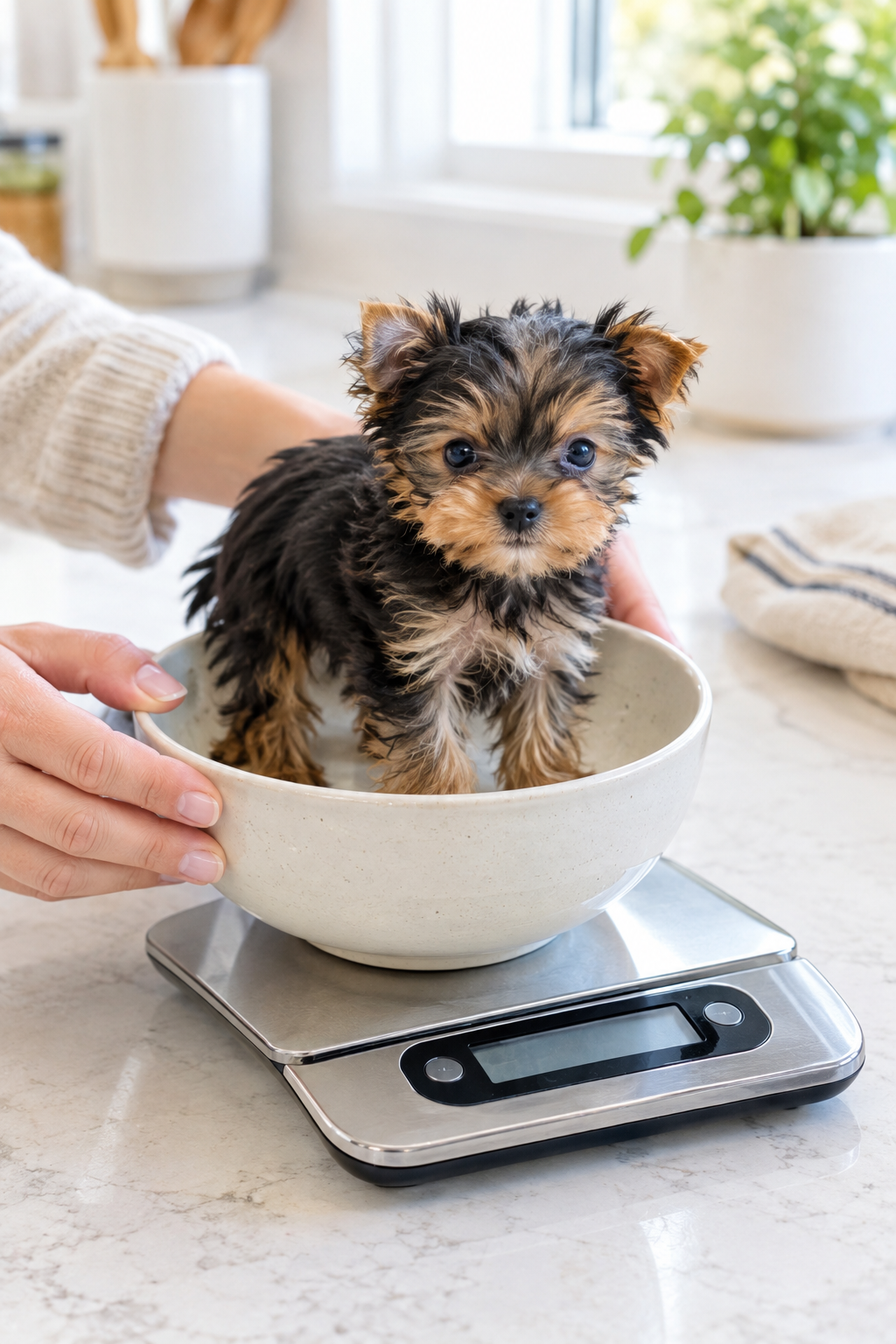
For a puppy that cannot sit still or has outgrown the kitchen scale, use a pet or baby scale with a secure, level platform. Weigh your puppy at roughly the same time each week, ideally under similar conditions, and record the results. Consistent measurements make growth trends easier to recognize.
How big will my Yorkie get? Estimating adult weight
There is no simple formula that predicts every Yorkie’s final weight. Two commonly used rules of thumb can provide a starting point, but treat the results as rough estimates rather than guarantees.
Rule 1: Double the weight at 12–14 weeks.
For example, a Yorkie weighing 2.5 pounds at 12 weeks would have a rough estimated adult weight of around 5 pounds.
Rule 2: Triple the weight at 8 weeks.
A puppy weighing 2 pounds at eight weeks would have a rough estimated adult weight of around 6 pounds.
Neither calculation accounts reliably for every genetic background, growth pattern, or health issue. The estimates can be off by a meaningful amount, especially for very small puppies. They are best used as starting points, not predictions you should try to make your puppy match.
Your puppy’s parents are usually a better clue. Ask the breeder for the mother’s and father’s mature weights, if available. Their sizes and the sizes of related dogs can help you understand whether your Yorkie is likely to remain especially small or grow toward the upper end of the usual range.
What about teacup Yorkies?
“Teacup Yorkie” is an unofficial marketing term, not a separate AKC-recognized size variety. It generally refers to exceptionally small Yorkshire Terriers, often expected to weigh under about 4 pounds as adults.
Very small Yorkies can be more fragile and may face increased risks from injuries, low blood sugar, and difficulty maintaining normal body temperature. A particularly tiny puppy is not necessarily healthier or more desirable than a Yorkie of typical size. Focus on health, responsible breeding, and appropriate veterinary care rather than a miniature label.
When do Yorkies stop growing?
Most Yorkies complete the bulk of their weight gain by around 8–10 months, with adult weight typically becoming clearer by about 12 months. As a toy breed, a Yorkie generally matures faster than a large-breed puppy.
Growth usually slows noticeably as the puppy approaches maturity. You may find that your Yorkie gains weight more slowly between six and ten months than during the earliest weeks of puppyhood.
Some dogs may still change slightly in body composition after their height and length have largely stabilized. Muscle development, changes in activity, and ordinary fluctuations in body condition can affect their weight, too.
If your puppy seems to have stopped growing much earlier than expected, that alone does not establish a problem. Look at the full picture, including appetite, energy, weight history, and veterinary examinations.
For a broader overview of puppy development across breeds, see When Do Puppies Stop Growing?.
What affects a Yorkie’s final size?
Several factors help determine whether your Yorkie finishes toward the smaller or larger end of the expected range.
Genetics and parents’ size. Inherited traits are a major influence on adult weight. Parents’ mature sizes and family history can offer useful clues, although puppies from the same litter will not always grow identically.
Sex. Male and female Yorkies can differ slightly in mature size, but there is considerable overlap. Sex alone cannot tell you what an individual puppy will weigh as an adult.
Nutrition. A complete and balanced diet formulated for puppies supports healthy development. Too little food can compromise growth, while excessive calories can contribute to unhealthy weight gain. Feed according to your puppy’s needs and veterinary guidance rather than trying to reach the top of the chart.
Neutering timing. The timing of neutering can influence aspects of canine growth and development, but it is not a dependable way to predict a Yorkie’s final weight. Discuss the appropriate timing with your veterinarian.
Health during the first months. Parasites, digestive problems, illness, and inadequate nutrition can interfere with expected growth. A puppy that consistently fails to gain weight deserves attention, particularly if other symptoms are present.
For another breed-specific estimate, try the Yorkie Weight Calculator. Use its result as an estimate of likely adult size, not a substitute for tracking your puppy’s actual growth.
Is my Yorkie growing normally?
The most useful question is not whether your Yorkie matches one particular number. It is whether your puppy is following a reasonably steady growth pattern while remaining active, eating appropriately, and maintaining a healthy body condition.
Weigh your puppy weekly and keep a simple record of the date, age, and weight. A single measurement outside the chart is usually less informative than several weeks of measurements showing a consistent plateau or decline.
You can also check your puppy’s body condition. You should generally be able to feel the ribs with gentle pressure without seeing them sharply protrude. Viewed from above, your Yorkie should have a discernible waist behind the ribs, and the abdomen should tuck upward when viewed from the side. A long coat can hide these features, so use your hands rather than relying on appearance alone.
Contact your veterinarian if your Yorkie repeatedly fails to gain weight, loses weight unexpectedly, has a poor appetite, or develops persistent vomiting or diarrhea. A vet can evaluate whether the puppy’s growth pattern reflects normal individual variation or a medical concern.
Extra caution is warranted with very young or exceptionally tiny Yorkies. Toy-breed puppies, especially those under 12 weeks, can be susceptible to hypoglycemia, meaning dangerously low blood sugar. Weakness, unusual lethargy, wobbling, tremors, collapse, or seizures require urgent veterinary attention.
Do not wait for a puppy to fall below a particular chart weight before seeking help. Symptoms and changes in behavior are more important than any single number.
Yorkie growth chart FAQs
How much should a 12-week-old Yorkie weigh?
The approximate range in this chart is 1.5–3 pounds (0.68–1.36 kg). A healthy puppy may fall outside that range depending on genetics and individual growth. Look at the trend over time rather than treating the range as a requirement.
How big will a 2-pound, 8-week-old Yorkie get?
Using the rough tripling rule, 2 pounds at eight weeks suggests an adult weight of about 6 pounds. That is only a starting estimate. Your Yorkie’s adult weight could differ, and the parents’ sizes, health, and subsequent growth will provide more useful context.
Do male and female Yorkies differ in size?
They can differ slightly, but the difference is not consistent enough to predict an individual dog’s weight. Both males and females can mature within the typical 4–7-pound range.
What is the standard Yorkie weight?
The AKC breed standard says a Yorkshire Terrier must not exceed 7 pounds (about 3.18 kg). Many adult Yorkies weigh roughly 4–7 pounds, although an individual dog may be smaller or larger. The standard describes the breed ideal rather than defining the health of every individual.
My Yorkie is bigger than the chart. Is that OK?
Often, yes. Growth charts are guides, and some Yorkies naturally grow larger than the listed ranges. A slightly heavier dog may be perfectly healthy if the body condition is appropriate. If weight is rising quickly, your puppy appears overweight, or you notice other changes, ask your veterinarian to assess growth and nutrition rather than restricting food on your own.
Final thoughts
A Yorkie growth chart can help you understand what to expect as your puppy matures, but it cannot predict the future perfectly. Most Yorkshire Terriers approach their adult size during the first year, and their parents’ size can help you form a reasonable expectation.
Record your puppy’s weight regularly, provide balanced nutrition, and pay attention to energy, appetite, and body condition. If growth stalls or your tiny puppy seems unwell, seek veterinary guidance instead of relying on the chart alone.
Your Yorkie does not need to match every range exactly to be thriving. Healthy, steady development matters more than reaching a particular number on the scale.
By Jennifer, Founder and Owner of CanineCalc
Jennifer is a dog owner and researcher who develops practical tools and educational resources to help people understand canine growth. She is not a veterinarian, breeder, or certified trainer.