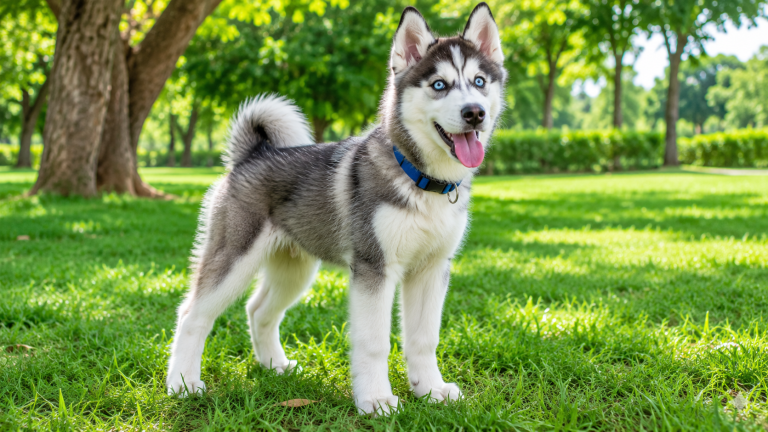
Pomsky full grown: the short answer
A full-grown Pomsky typically stands around 25–38 cm (10–15 inches) tall at the shoulder and weighs approximately 7–17 kg (15–38 lb). These are broad estimates, not fixed breed standards. Some Pomskies fall outside these ranges, depending on their parents, genetics, and generation.
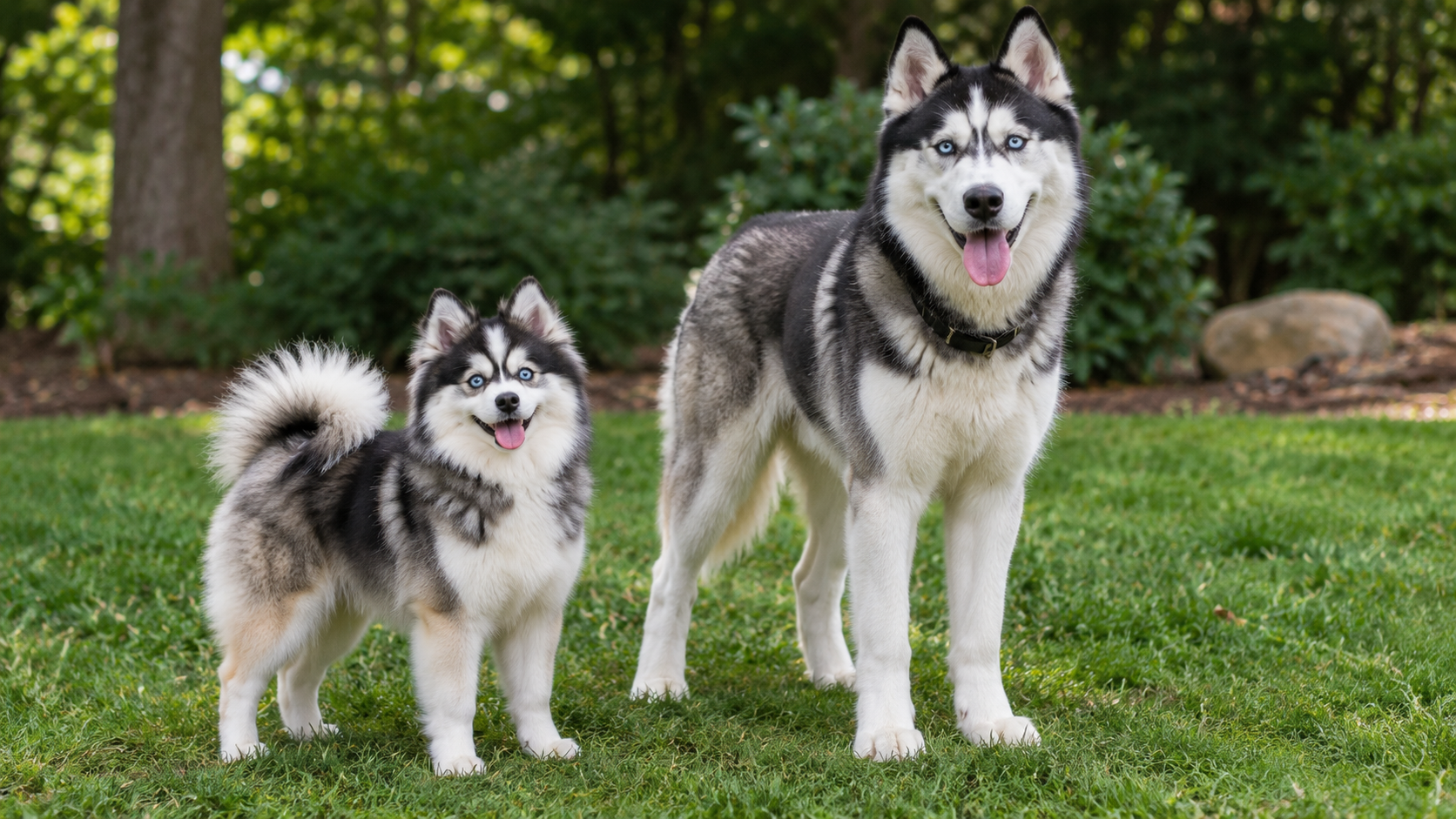
A Pomsky is a cross between a Pomeranian and a Siberian Husky. Since one parent is a tiny companion dog and the other is a considerably larger working breed, their puppies can grow into surprisingly different-sized adults.
In general:
- F1 Pomskies: Often trend toward the larger end, particularly when they inherit more of their Husky parent’s build.
- F1b Pomskies: May be smaller when crossed back to a Pomeranian, although individual results vary.
- F2 and later Pomskies: Can inherit different combinations of traits, so their adult size is not necessarily predictable from generation alone.
Most Pomskies reach close to their adult height by around 12 months. They may continue developing muscle, chest width, and overall body condition until approximately 18 months.
Why full-grown Pomskies vary so much in size
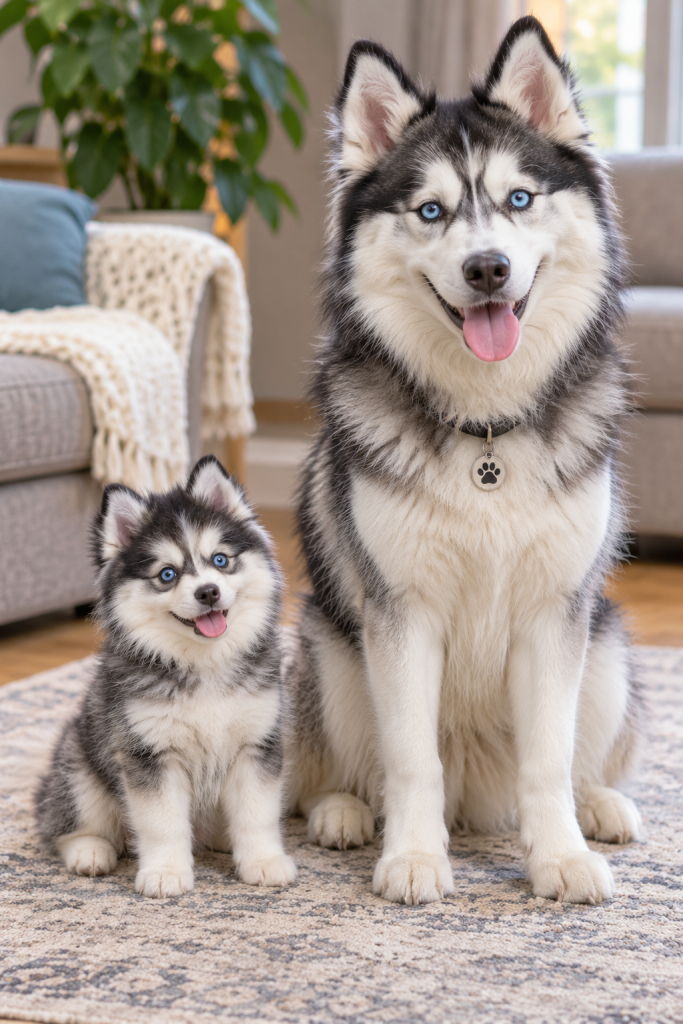
The biggest reason is the substantial size difference between the parent breeds.
An adult Siberian Husky commonly weighs around 16–27 kg (35–60 lb), depending on sex and build. A Pomeranian, by comparison, generally weighs just 1.4–3.2 kg (3–7 lb).
That’s a considerable genetic difference for one crossbreed.
A Pomsky puppy can inherit more of its Husky parent’s height and frame, more of its Pomeranian parent’s compact build, or a combination of both. Even puppies from the same litter can develop differently.
Generation also provides some useful context.
Here is what the common generation labels mean:
- F1: A first-generation cross between a Siberian Husky and a Pomeranian. These puppies have one parent from each breed.
- F1b: A first-generation Pomsky crossed back with one of the original parent breeds, commonly a Pomeranian. This increases the expected Pomeranian ancestry.
- F2: Two F1 Pomskies crossed with each other. Their puppies can inherit different combinations of traits from both breeds.
- F3 and later: Further-generation Pomskies produced through subsequent breeding combinations.
These labels describe ancestry, not a guaranteed adult size. An F1b puppy is not automatically tiny, and an F2 puppy is not necessarily smaller than an F1.
Be cautious with claims such as guaranteed mini, teacup-sized, or a precise adult weight based only on a puppy’s age. A breeder can discuss the parents’ measurements and previous litters, but genetics cannot provide an exact size promise for an individual puppy.
For a useful comparison with the larger parent breed, see our Siberian Husky weight chart. It helps put the Husky side of the Pomsky’s genetic background into perspective.
Full-grown Pomsky size chart
The following table gives broad planning estimates for adult Pomskies. These are illustrative ranges rather than official breed-standard measurements or scientifically established generation averages.
| Generation | Typical adult height | Typical adult weight | What that size is like to live with |
|---|---|---|---|
| F1 | 30–38 cm (12–15 in) | 9–17 kg (20–38 lb) | Often a small-to-medium dog with a more substantial frame |
| F1b (Pomeranian backcross) | 25–33 cm (10–13 in) | 7–13 kg (15–29 lb) | May be more compact and easier to carry when necessary |
| F2 and later | 25–38 cm (10–15 in) | 7–17 kg (15–38 lb) | Can vary considerably depending on the parents and inherited traits |
There is considerable overlap between these ranges. An F1b with a larger Husky-leaning parent may grow bigger than an F1 from smaller parents.
Height is measured from the floor to the top of the shoulder, not to the top of the head or ears.
For everyday planning, think about more than weight. A 12 kg (26 lb) Pomsky with a sturdy frame may feel quite different from a similarly weighted dog with a lighter build.
The most useful information is the combination of adult weight, height, body structure, and healthy body condition.
Pomsky growth timeline: puppy to full grown
Pomskies generally grow fastest during their first several months. Their height gain gradually slows as they approach adulthood, although their bodies may continue filling out.
Here is a general look at the development stages.
| Age | What is typically happening |
|---|---|
| 8 weeks | Puppies are still very small and have considerable growing ahead. Their adult size is difficult to judge from appearance alone. |
| 3 months | Rapid growth is usually underway. Legs, body length, and overall proportions may change noticeably. |
| 6 months | Many Pomskies have gained much of their eventual height, but they are not necessarily finished growing. |
| 9 months | Height growth is slowing for many puppies. Their adult proportions are becoming easier to recognize. |
| 12 months | Most are close to their adult height. Some may still look lean or slightly puppy-like. |
| 18 months | Many have developed more of their adult muscle, chest, and overall body shape. |
These milestones are approximate. Individual development depends on inherited size, nutrition, health, and other factors.
If you want to follow your puppy’s development more closely, use our puppy growth chart predictor. It can help put current measurements into context, although no calculator can know exactly how a mixed-breed puppy will develop.
When do Pomskies stop growing?
Most Pomskies reach most of their adult height by approximately 12 months.
However, reaching adult height does not mean every part of the body has finished developing.
During the following months, you may notice:
- A broader chest and more developed shoulders.
- More muscle and a less puppy-like body shape.
- Changes in coat fullness and seasonal shedding.
- Gradual changes in overall weight as the dog matures.
Many Pomskies continue filling out until around 18 months, although smaller, Pomeranian-leaning dogs may mature earlier.
Neutering can also affect growth and development, depending on the dog’s age and individual circumstances. There is no single ideal timing for every Pomsky. Discuss the decision with your veterinarian, taking the dog’s size, health, and development into account.
If your Pomsky seems to stop gaining weight or growing unusually early, consider the overall picture rather than assuming something is wrong based on age alone. Your veterinarian can assess whether development is appropriate.
How to estimate YOUR Pomsky puppy’s adult size
There is no completely reliable formula for predicting a Pomsky’s final weight. However, some clues are considerably more useful than others.
1. Check the parents’ and grandparents’ sizes
This is generally the best starting point.
Ask about the actual adult height and weight of both parents. If the parents are available, their size and overall build provide useful context.
Grandparent measurements can also help, particularly when a puppy comes from a multigenerational Pomsky line.
A puppy with a relatively small Pomeranian parent and a smaller Husky parent may have a different expected size from one whose Husky parent is particularly large.
Remember that parent measurements are clues, not guarantees.
2. Track your puppy’s weight over time
A single weigh-in tells you very little about adult size. A series of measurements is much more useful.
Weigh your puppy consistently, ideally at similar times and under similar conditions. Record the measurements weekly or at regular intervals.
Look at the overall growth pattern rather than reacting to one unusually high or low measurement.
Our guide to how big your puppy will get explains the different ways to estimate adult size and why predictions should be treated as ranges.
3. Use generation as a supporting clue
Knowing whether your puppy is F1, F1b, or F2 helps explain its ancestry.
A Pomeranian backcross may have a greater chance of inheriting a smaller frame, but the actual size of the parents matters more than relying on the generation label alone.
4. Treat paw size as a weak clue
You may have heard that puppies with enormous paws will become enormous dogs.
Paw size can offer a little context, but it is not a dependable adult-size predictor. Some puppies have disproportionately large paws during normal development, while others grow into substantial adults without especially oversized feet.
Use actual weight trends and family measurements instead.
Keeping a full-grown Pomsky at a healthy weight
Pomskies can inherit the energy and appetite of their Husky parent while having a much smaller body.
That makes portion control important. A dog that looks fluffy and substantial may still need less food than its appearance suggests.
A few everyday habits can help:
- Measure meals: Use a consistent measuring cup or kitchen scale rather than estimating portions by eye.
- Adjust food to activity: A highly active Pomsky may need different portions from one that spends most of the day indoors.
- Check body condition: You should generally be able to feel the ribs without pressing hard. They should not be buried under a thick layer of fat, nor should they be sharply visible.
- Watch the waist: Viewed from above, a healthy adult dog usually has a visible waist behind the ribs. From the side, the abdomen generally rises toward the back legs.
- Keep exercise appropriate: Walks, play, and mental enrichment should match your individual dog’s age, fitness, and energy level.
Don’t use the Pomsky size chart as a target that every dog must reach. A naturally smaller Pomsky does not need to gain weight to match the average, and a larger-framed dog is not automatically overweight.
The goal is a healthy body condition, not a particular number on the scale.
If you are unsure about portions or whether your dog is carrying too much weight, your veterinarian can help assess body condition and recommend an appropriate feeding plan.
Pomsky full-grown questions and answers
How big do Pomskies get when fully grown?
Most full-grown Pomskies stand approximately 25–38 cm (10–15 inches) at the shoulder and weigh around 7–17 kg (15–38 lb). Some fall outside these broad ranges because the parent breeds differ considerably in size.
How much should a full-grown Pomsky weigh?
A typical adult Pomsky may weigh around 7–17 kg (15–38 lb). The appropriate weight depends on its height, frame, genetics, and body condition. A smaller dog can be perfectly healthy below this range.
At what age is a Pomsky fully grown?
Most Pomskies are close to their adult height by around 12 months. They may continue developing muscle and filling out until approximately 18 months, depending on their inherited size and individual development.
Do F1 Pomskies get bigger than F1b Pomskies?
F1 Pomskies often trend larger because they have one full Siberian Husky parent. F1b Pomskies crossed back to a Pomeranian may trend smaller. However, parental size and individual inheritance matter more than the generation label alone.
Is my Pomsky full grown at 6 months?
Usually not. A six-month-old Pomsky may already have gained much of its eventual height, but there is generally more growth ahead. Most continue developing toward their adult height over the following months and may fill out until around 18 months.
Conclusion
A full-grown Pomsky can be a compact companion or a noticeably sturdier small-to-medium dog. The difference comes down largely to inherited traits, parental size, and the particular combination of Husky and Pomeranian characteristics.
Use generation as a starting point, check the parents’ actual measurements, and track your puppy’s growth over time. Most importantly, judge your adult Pomsky by its healthy body condition rather than trying to make it fit a particular weight on a chart.
With realistic expectations, you’ll have a much better idea of the adult dog your puppy is developing into.