
Veterinary Disclaimer: This article provides general canine developmental estimates for healthy dogs on balanced diets. It does not replace individualized diagnostic care or evaluate underlying health conditions.
Your puppy’s current weight can tell you something about their future size, but a single measurement cannot tell the whole story. That’s where a puppy growth chart predictor helps: age, breed, family size, and the pattern of weight gain all matter.
A puppy growth chart predictor helps estimate how large your puppy might become and provides a starting point for tracking development. Use it alongside regular weigh-ins and your veterinarian’s guidance, especially if your puppy’s growth seems unusually slow or fast. Try it with our puppy size calculator to get a planning estimate in seconds.
What Is a Puppy Growth Chart Predictor?
A puppy growth chart predictor estimates a dog’s likely adult weight using its current age, weight, and expected size category. It helps owners plan and track development rather than diagnose health problems. A prediction becomes more informative when you enter accurate measurements and repeat them over time instead of relying on one reading.
According to Salt et al. (2017), researchers developed canine growth standards using records from more than six million young dogs seen at US veterinary clinics. Their published charts compare a puppy’s body weight with growth centiles for different size groups. The research supports monitoring a puppy’s growth trajectory, although population-level charts cannot predict every individual dog precisely. Read the published study.
How to Use CanineCalc’s Puppy Size Calculator
To estimate your puppy’s adult size with our puppy growth chart predictor:
- Enter your puppy’s current age (in weeks) and weight in the calculator.
- Select the expected size class: small, medium, large, or giant.
- Review the estimated adult weight, the ±15% planning range, and the growth-progress readout.
- Record your puppy’s weight under similar conditions each week, or as your veterinarian advises.
- Discuss a falling weight trend or an unexplained plateau with your veterinarian.
Puppy adult-weight estimator
Use current age, weight and expected size class to produce a broad planning range.
CanineCalc’s puppy growth chart predictor — the Puppy Size Calculator — is designed to use size-class growth patterns and provide an approximate adult-weight estimate with a practical ±15% planning range. Treat that range as an estimate, not a guarantee or a validated measure of statistical confidence.
What the estimate tells you: a plausible planning range for your puppy’s eventual size.
What it cannot tell you: whether your puppy is healthy, whether they are getting the right nutrition, or whether an underlying medical problem is affecting growth.
Quick note: a puppy’s measurements are only as useful as the information entered. Check that their age and weight are correct and use consistent measurement units.
How to Read a Puppy Growth Chart by Age and Breed
Puppies do not all grow at the same speed. Smaller dogs generally reach their adult size sooner, while large and extra-large dogs may continue developing for considerably longer.
The American Kennel Club (AKC) provides approximate growth milestones based on the percentage of adult size reached at different ages. These milestones offer useful context, but they are not exact targets for every puppy. See the AKC puppy growth chart.
Approximate adult-size milestones
The following table reproduces the AKC’s approximate percentages for four adult-weight groups.
| Age | Small (0–20 lb) | Medium (21–50 lb) | Large (51–100 lb) | Extra-large (100+ lb) |
|---|---|---|---|---|
| 6 months | 75% | 66% | 60% | 50% |
| 9 months | 90% | 85% | 75% | 65% |
| 12 months | 100% | 95% | 85% | 80% |
| 15 months | 100% | 100% | 95% | 90% |
| 18 months | 100% | 100% | 100% | 100% |
Source: American Kennel Club. Percentages are approximate guidelines, not veterinary growth standards or guarantees for individual dogs.
These figures show why age alone is not enough. A six-month-old small-breed puppy may be approaching adult size, while a similarly aged large-breed puppy can have considerably more growing to do.
Why Breed Matters—and Why It Is Not the Whole Answer
Breed is useful when estimating adult size because it gives you a starting point. However, puppies of the same breed can differ, and mixed-breed puppies may be difficult to classify based on appearance alone.
The research by Salt and colleagues found that size-category growth standards agreed reasonably well with breed-specific growth curves for most of the breeds studied. This suggests that size categories can be useful, although they do not remove all individual variation.
Here’s the important part: growth isn’t always predictable.
For mixed-breed puppies, consider the known size of their parents, their current measurements, and the direction of their growth. When family information is unavailable, a puppy growth chart predictor can still provide a useful starting estimate — just reassess it as your puppy matures.
When Should Puppies Reach Adult Size?
The timeline varies by expected adult size.
Small breeds: often reach their adult size earlier, with many approaching full size at around 6–8 months.
Medium breeds: may continue growing toward roughly 12 months.
Large and giant breeds: often need 12–18 months, and some very large dogs may continue developing until around 24 months.
These are general ranges. Height, skeletal development, muscle mass, and weight do not necessarily stop changing at the same time. The AKC discusses these differences in its guide to when dogs stop growing.
How Accurate Is a Puppy Growth Chart Predictor?
An adult-weight estimate from a puppy growth chart predictor is most useful when you understand its limitations. Calculators apply assumptions to your puppy’s measurements; they do not observe every aspect of your dog’s development.
Some owners prefer breed-specific charts because breed can be a strong clue to eventual size. That’s a reasonable starting point for a puppy with known ancestry. For mixed breeds, however, a size-based estimate combined with repeated measurements may be more practical than choosing a breed chart simply because the puppy looks similar.
Quick Comparison
| Option | Best For | Key Benefit | Limitation |
|---|---|---|---|
| Interactive puppy predictor | Estimating adult size | Combines supplied measurements with a growth model | Depends on the information and assumptions used |
| Breed-specific growth chart | Puppies with known breed and family history | Provides a more tailored reference | Individual puppies may differ from the typical curve |
| General age-and-size chart | Understanding broad milestones | Easy to compare developmental stages | Does not account for every individual difference |
| Veterinary growth chart review | Monitoring growth and health | Adds clinical assessment and context | Requires a veterinary professional to interpret concerns |
Interactive puppy predictor vs. growth chart: a predictor can help with a personalized estimate, while a static chart makes broad milestones easier to compare. Veterinary growth monitoring adds clinical context. The key distinction is that a prediction offers a possible outcome, whereas a growth chart helps put ongoing measurements into context. For the most tailored estimate, run your puppy’s latest numbers through a puppy growth chart predictor.
What the Research Tells Us About Growth Patterns
Salt et al. (2017) developed growth standards using body-weight records from more than six million young dogs in the United States. The published standards cover five weight-based size categories, with curves for dogs up to 40 kg. Their work provides a research-backed reference for comparing a puppy’s measurements over time, but it does not establish an exact adult weight for every dog. Read the published study.
A later study examined growth patterns in healthy dogs and dogs with abnormal body condition or diseases affecting growth. Centile-line crossing during growth was uncommon in healthy dogs, while changes in growth patterns occurred more frequently in dogs with abnormal growth or body condition. A change in the curve can be a reason to investigate, not a diagnosis by itself.
What most simple guides skip is the value of repeated measurements. If your puppy falls outside a broad average once, that alone does not prove a problem. A persistent change in their growth pattern deserves more attention than a single number. Feeding each new measurement into a puppy growth chart predictor keeps the estimate current.
How to Track Your Puppy’s Weight Correctly
A simple tracking routine can make a puppy growth chart predictor more useful. You don’t need complicated equipment; you need reasonably consistent measurements and records.
1. Weigh your puppy consistently
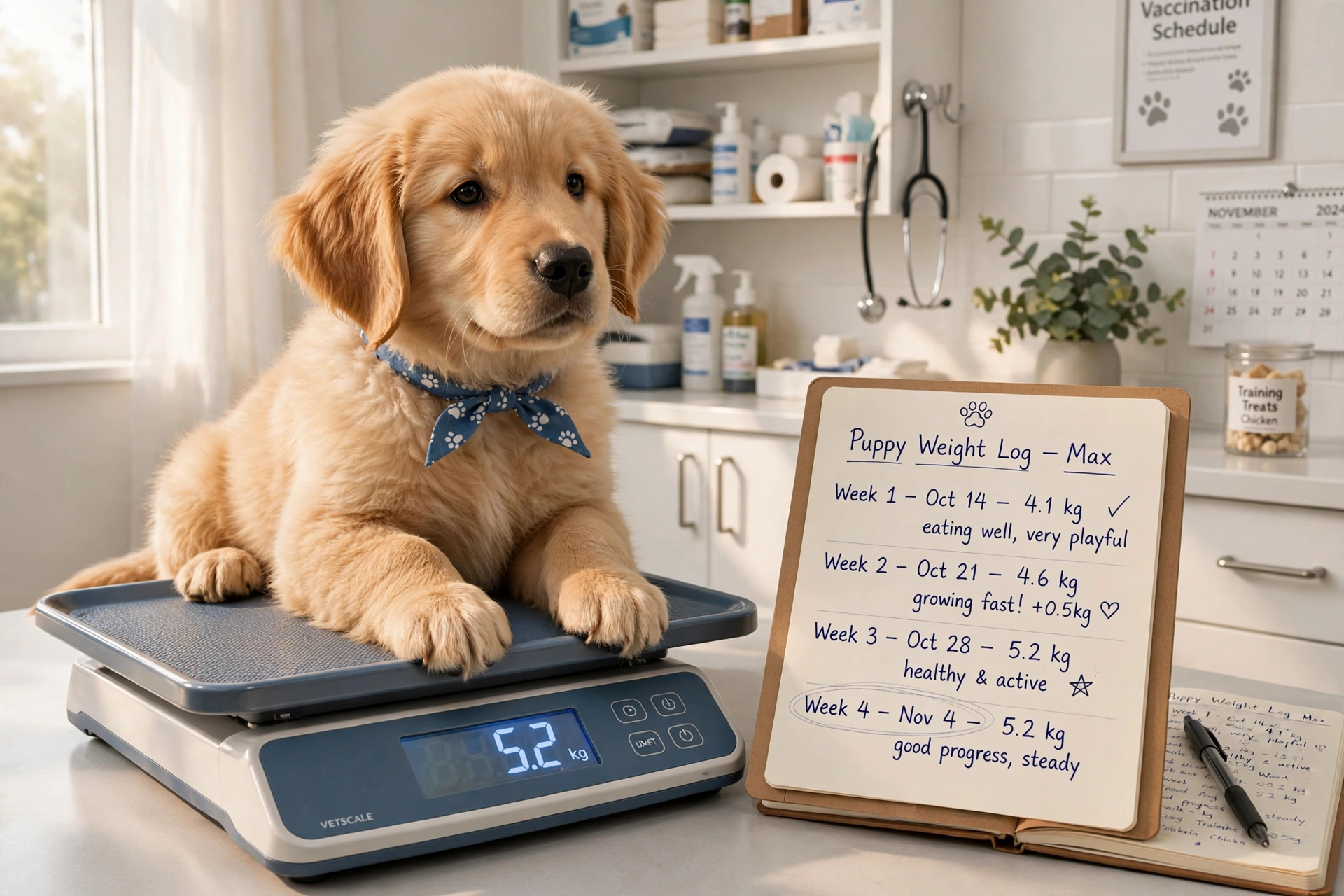
Use the same reliable scale when possible. For a small puppy, an appropriate pet or digital scale may make weighing easier. Larger puppies can be weighed on a suitable pet scale or with help from a veterinary clinic.
Try to weigh your puppy under similar conditions each time. Differences in timing, a full stomach, or inconsistent equipment can make comparisons less useful.
2. Record age and weight together
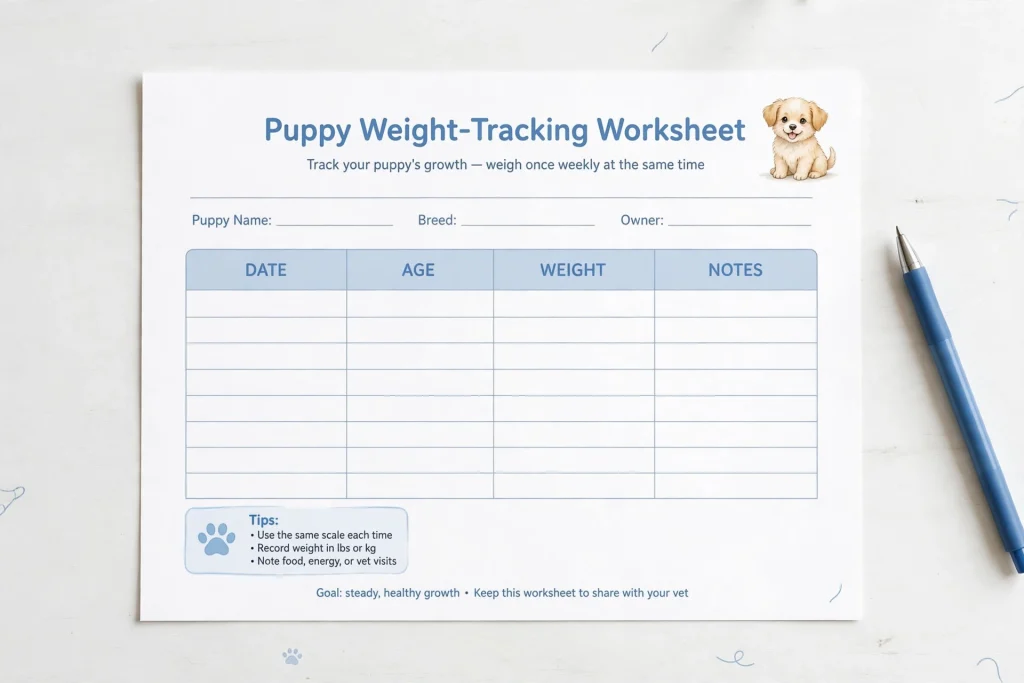
Create a simple log containing your puppy’s date of birth or estimated age, measurement date, weight, and any relevant observations.
For example:
| Measurement date | Age | Weight | Notes |
|---|---|---|---|
| Week 1 | 12 weeks | Record actual weight | First baseline |
| Week 2 | 13 weeks | Record actual weight | Compare with baseline |
| Week 3 | 14 weeks | Record actual weight | Check the overall trend |
| Week 4 | 15 weeks | Record actual weight | Review any unexpected change |
These are illustrative entries, not recommended weights for a puppy of any particular breed. Your own puppy’s measurements should fill the table.
3. Compare the trend, not just one result
A puppy’s weight should be considered alongside age, body condition, appetite, activity, and the expected growth pattern for that dog.
A short plateau may require context rather than an immediate change to the feeding plan. However, repeated lack of growth or falling weight warrants veterinary advice. Veterinary nutrition guidance, such as the AAHA nutrition and weight-management guidelines, recommends close monitoring of weight gain in growing puppies, with feeding guidance adjusted as needed.
What to Do If Your Puppy Is Above or Below the Chart
A puppy growth chart predictor is a reference—not a verdict. The next step depends on the overall pattern and your puppy’s condition.
If your puppy weighs less than expected
First, verify the measurement and age information. Then compare the result with an appropriate breed or size reference.
Avoid automatically increasing food because a puppy falls below an online estimate. A lower weight may reflect normal variation, but inadequate nutrition, parasites, or other medical problems may also affect growth.
Trying to predict your puppy’s adult size? Here’s what to know.
If your puppy weighs more than expected
A higher number on the scale does not automatically mean your puppy is overweight. Breed, body frame, development, and body condition all influence how a weight should be interpreted.
Ask your veterinarian to assess your puppy’s body condition and feeding plan before restricting food. Growing puppies need appropriate nutrition, and large-breed puppies have specific dietary requirements during development. The AKC covers feeding alongside growth in its puppy development guide.
When Should You Contact a Veterinarian?
Seek veterinary advice if your puppy is repeatedly failing to gain weight, losing weight unexpectedly, or showing a concerning departure from their usual growth pattern.
Contact a veterinarian promptly if weight changes occur with a poor appetite, persistent vomiting or diarrhea, unusual tiredness, or other signs of illness. Very young puppies can be especially vulnerable, so do not rely on an online calculator to assess a sick puppy.
Published charts may differ in their assumptions, populations, and size categories. The most defensible approach is to use them as reference points, keep consistent records, and let a veterinarian interpret persistent or worrying changes.
Frequently Asked Questions About Puppy Growth Charts
How do I estimate my puppy’s adult weight?
Enter your puppy’s current age and weight into a puppy growth chart predictor and provide the requested breed or size information. Use its result as an estimate, then compare it with subsequent measurements and appropriate growth references.
How often should I weigh my puppy?
Weekly measurements can help track a growing puppy’s weight trend. Use a consistent scale and similar conditions, and follow your veterinarian’s advice if your puppy is very young or has a health concern. Feed each new reading into a puppy growth chart predictor to see how the trend compares with age-based expectations.
Can I use a puppy growth chart for a mixed-breed dog?
Yes. A size-based chart or predictor can provide a useful starting estimate. Because mixed-breed ancestry can be uncertain, continue tracking measurements rather than treating the result as a fixed adult weight.
Why is my puppy smaller than the growth chart suggests?
Breed variation, inaccurate age or weight information, nutrition, and medical conditions can all influence growth. Verify your measurements, monitor the trend, and consult your veterinarian if your puppy repeatedly falls behind or loses weight.
When should a puppy stop growing?
Smaller breeds often reach adult size earlier, while large and giant breeds may continue developing for 12–24 months. The exact timeline varies, and physical maturity does not always occur at the same time as skeletal growth. To see how your puppy compares at each stage, run their numbers through a puppy growth chart predictor.
Conclusion: Use Your Puppy’s Growth Chart as a Guide
A puppy growth chart predictor can make it easier to estimate adult size, understand age-related milestones, and keep an organized record of your dog’s development. Its real value comes from combining an initial estimate with consistent measurements and sensible follow-up.
Start with CanineCalc’s Puppy Size Calculator, record your puppy’s weight over time, and compare the pattern with an appropriate reference. If the trend concerns you, ask your veterinarian to assess it rather than trying to correct the numbers yourself.
Your puppy doesn’t need to match every line on an online chart. They need appropriate care, healthy development, and attention when something changes.