Last updated: October 2026
Bringing home a puppy is exciting. Guessing how big that puppy will become? That’s often a different story.
Maybe the shelter called your new rescue a medium-sized dog. Maybe its paws look enormous compared with the rest of its body. Or perhaps an online calculator gave you a number that seems wildly optimistic.
You want a useful estimate, not another guess.
The best starting point is your puppy’s current weight and age, interpreted using an appropriate growth chart. Breed information, parental size, and physical development can add context. No single clue guarantees an exact adult weight, especially for mixed-breed puppies.
This guide walks you through what to check, what to do first, and how to interpret the result without treating an estimate as a promise.
What Does It Mean to Predict How Big a Puppy Will Get?
How to tell how big a puppy will get means estimating its adult body size from information available while it is still growing. Useful clues include current weight, age, growth patterns, breed background, and parental size when known. These clues work best together, and the estimate becomes more informative as the puppy grows.
How accurate can your estimate be?
An estimate is a planning tool, not a guarantee.
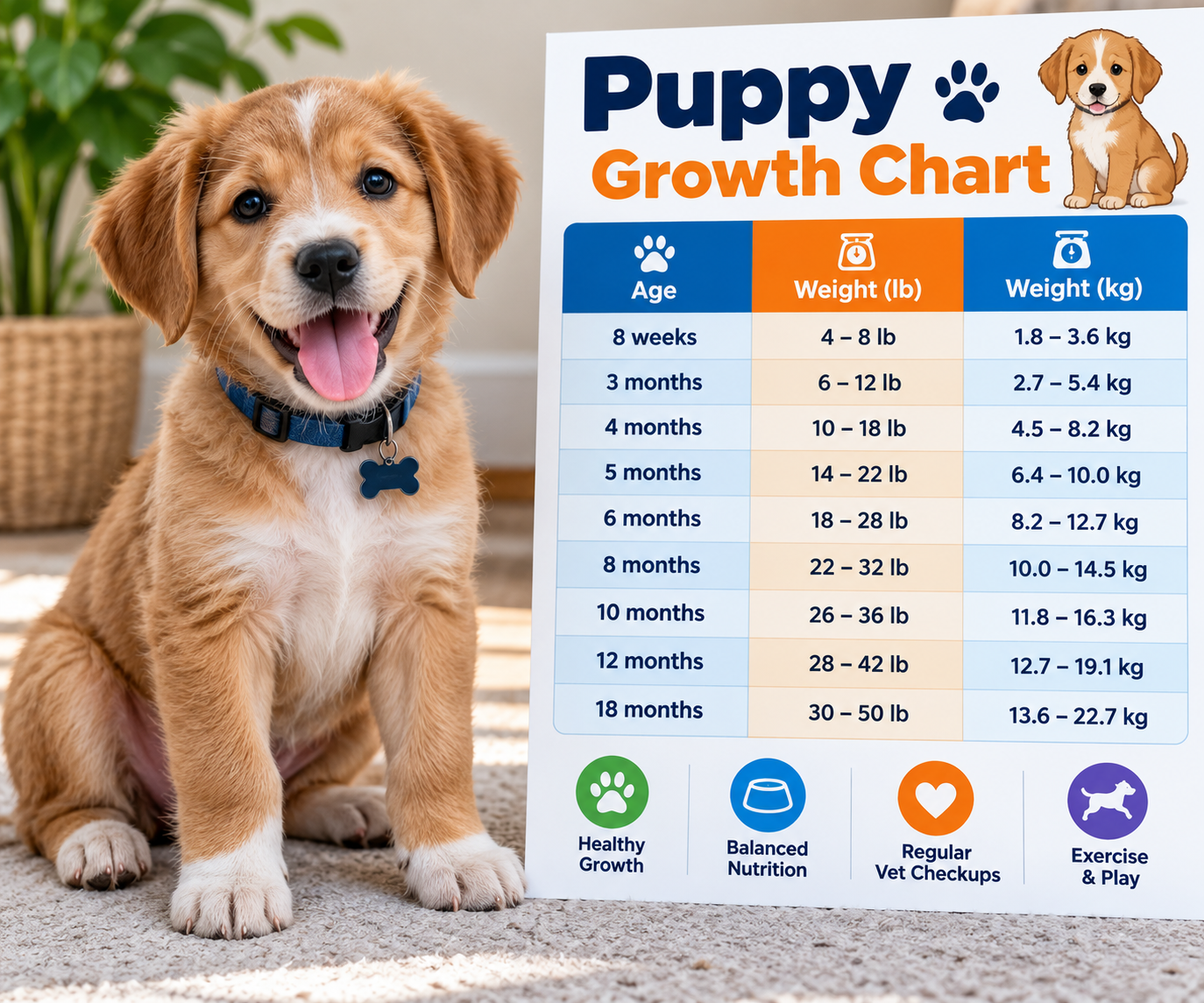
According to Salt et al. (2017), published canine growth standards use age-related growth curves to help assess how young dogs grow. These standards provide a research-based starting point for estimating adult size when a puppy’s breed mix is unknown.
The key is matching the puppy’s age and weight to an appropriate growth reference. A single weight measurement tells you less than several measurements taken over time, and an unsuitable growth curve can produce a misleading prediction.
Source: Salt et al. (2017), PLOS ONE — evidence-based canine growth standards.
Why mixed-breed puppies are harder to predict
A purebred puppy may have a breed-specific adult weight range to use as a reference. A mixed-breed puppy may inherit different body sizes, growth patterns, and proportions from its parents.
Studies differ in the methods used to classify canine growth, and a puppy’s background may be uncertain. That makes it sensible to use a range rather than rely on one exact number.
Here’s the thing: a useful estimate doesn’t have to be perfect to help you plan.
How to Estimate Your Puppy’s Adult Size in Three Steps
Wondering what size your dog will be as an adult? These clues help.
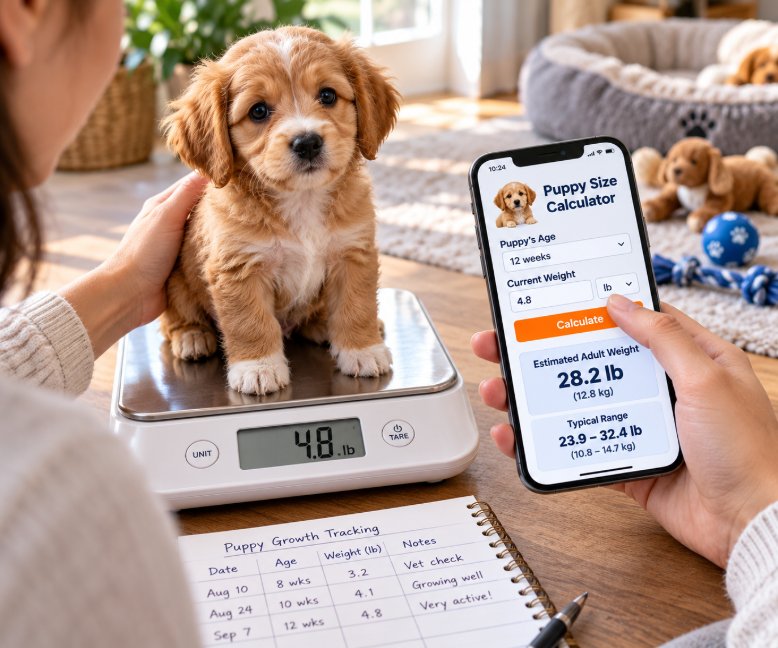
To estimate your puppy’s adult size, follow these steps:
- Weigh your puppy. Record its current weight as accurately as possible.
- Note its age. Use its birth date or the best available age estimate.
- Run a growth-curve estimate. Enter the age and weight into an appropriate puppy size calculator.
According to Salt et al. (2017), canine growth standards can help assess growth relative to age and size category. This approach is especially useful when breed information is missing, although an uncertain age or unusual growth pattern can affect the result.
Step 1: Get an accurate weight
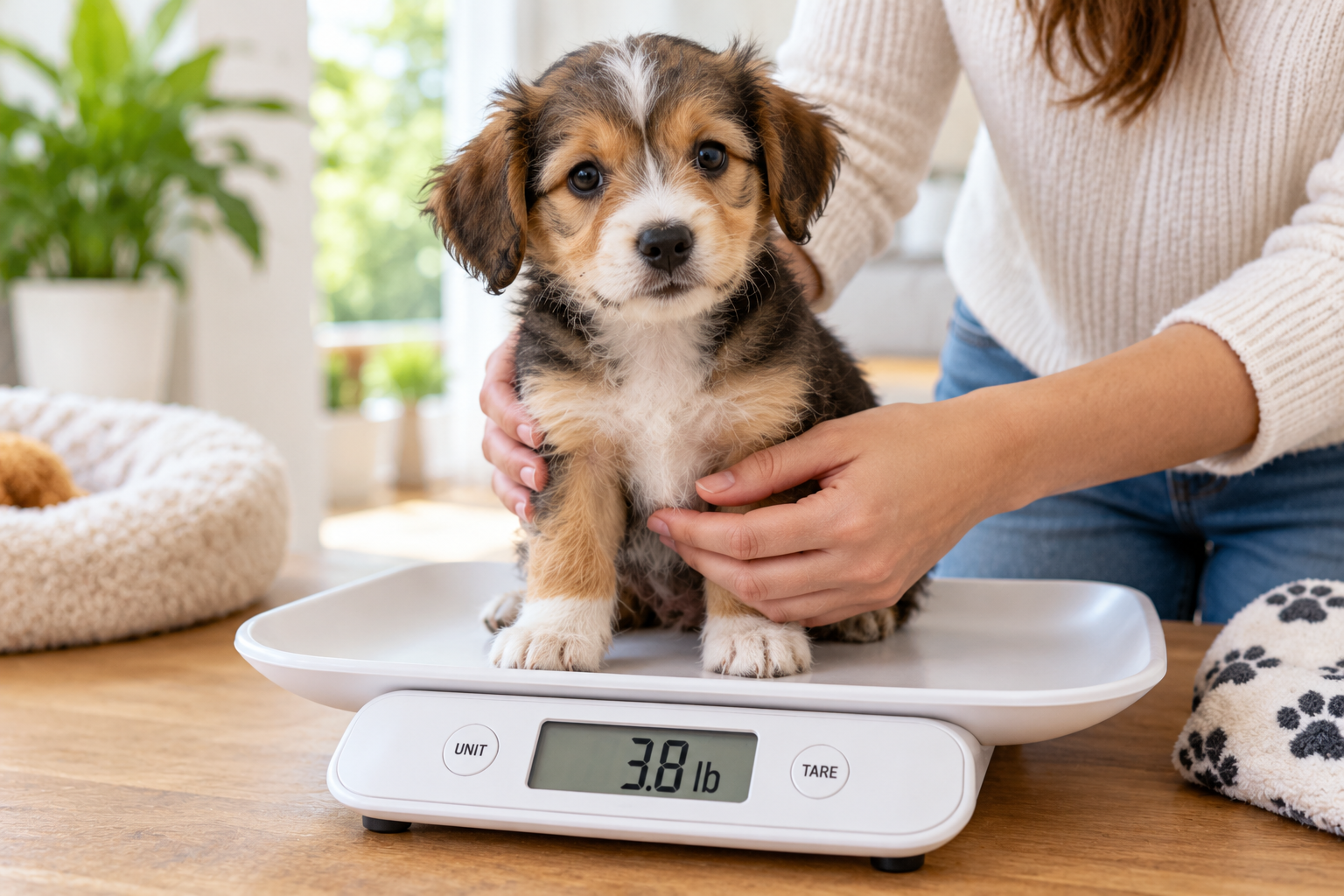
Use a pet scale if available. For a small puppy, you can also weigh yourself, then weigh yourself holding the puppy and subtract the first measurement from the second.
Repeat the measurement if the result seems unusual. Record the date alongside the weight so you can compare later measurements.
Step 2: Establish the puppy’s age
Age matters because puppies grow at different rates throughout development. A weight that is typical for one age can mean something different several weeks later.
If the exact birth date is unknown, ask the rescue organization what information it has. Record the age as an estimate rather than presenting it as certain.
Step 3: Use a growth-based calculator
The CanineCalc Puppy Size Calculator is designed to estimate adult size from current weight and age without requiring a known breed mix.
Try the CanineCalc Puppy Size Calculator to run your own numbers.
Enter the information carefully and treat the result as a planning range. If the puppy’s age is uncertain, the estimate should be interpreted with that uncertainty in mind.
Five Ways to Tell How Big Your Puppy Will Get
You don’t need to rely on one clue. Each method answers a slightly different question, and some are more useful than others when breed information is missing.
Use age and weight with a growth chart
This is the strongest practical starting point when you have reliable measurements and an appropriate reference chart.
Research published by Salt and colleagues in 2017 examined canine growth standards based on a large veterinary-clinic dataset. Age-specific growth curves help put a puppy’s weight into context instead of treating the same weight as meaningful at every stage.
Best for: Puppies with a reasonably reliable age and current weight.
Limitation: Growth patterns vary, and a chart cannot guarantee an individual puppy’s adult size.
Check the parents’ adult sizes
If both biological parents are known, their adult sizes provide useful context. A puppy whose parents are both small may be more likely to remain small than a puppy whose parents are large.
Mixed-breed inheritance is less predictable, however. A puppy may not end up at the midpoint between its parents, and a rescue’s breed labels may not be verified.
Best for: Puppies with known biological parents and reliable adult measurements.
Limitation: Parent size narrows the possibilities; it doesn’t settle the answer.
Look at breed background
Breed information can help you establish a plausible adult-size range. A reliable pedigree offers more specific context than a guess based on coat, ears, or face shape.
For mixed breeds, appearance alone cannot reliably establish the exact breed combination. DNA testing may provide additional information about ancestry, but ancestry results still do not determine an exact adult weight.
Best for: Puppies with a known breed background.
Limitation: A breed label or DNA result is not a precise growth forecast.
Track growth over several weeks
A series of measurements can reveal more than a single weigh-in. Record the puppy’s weight regularly under reasonably consistent conditions, then compare the pattern with an appropriate growth reference.
If the puppy’s weight changes unexpectedly, or growth appears to stall, ask a veterinarian to assess its overall health rather than assuming the change is simply part of its expected adult size.
Best for: Owners who can monitor growth over time.
Limitation: Growth trends need age-appropriate context; a few measurements alone cannot establish adult size.
Use paws and body proportions as supporting clues
Large-looking paws can make a puppy seem destined to become a large dog. Paw size does correlate loosely with adult size, but it is unreliable on its own.
Body proportions can also change during growth. A puppy may look lanky, have oversized-looking feet, or appear out of proportion for a period without those features revealing its final weight.
Best for: Adding context to other information.
Limitation: Appearance cannot replace age, weight, growth records, or reliable breed information.
That’s normal, too. Puppy growth rarely follows a perfectly straight line.
Quick Comparison
| Option | Best For | Key Benefit | Limitation |
|---|---|---|---|
| Age and weight growth chart | Most puppies with reliable measurements | Uses age-specific growth patterns | Depends on a suitable reference |
| Parents’ adult sizes | Puppies with known parents | Adds family-size context | Inheritance varies |
| Breed background | Puppies with reliable breed information | Provides a plausible size range | Breed labels may be uncertain |
| Repeated weight records | Puppies tracked over time | Shows the growth trend | Needs interpretation |
| Paw size and proportions | Supporting clues only | Easy to observe | Unreliable on their own |
Some popular rules sound convincing because they turn a complicated prediction into one easy calculation. The trouble is that simple rules can hide important differences in age, size category, and individual development.
Myth: Big paws mean a big adult dog
Not necessarily. Paw size correlates loosely with adult size, but it cannot reliably predict adult weight on its own. Use it as a minor clue, not your main method.
Myth: Doubling a puppy’s current weight always works
A fixed weight-doubling rule ignores the puppy’s age, growth stage, and expected adult size category. A calculation that seems plausible for one puppy may be misleading for another.
Use an age-appropriate growth chart instead of assuming the same multiplier applies to every dog.
Myth: One calculator result is a guaranteed adult weight
A calculator produces an estimate based on its inputs and method. If the puppy’s age is wrong, the weight is inaccurate, or the growth reference does not fit, the result may be off.
CanineCalc provides a practical planning range of approximately ±15% based on its stated approach. That range should not be interpreted as a universal scientific guarantee for every puppy.
What most guides skip: growth and health are connected
A puppy’s weight isn’t just a clue to future size. It is also part of monitoring development.
Some experts favor breed-based estimates when the puppy’s ancestry is known. That’s a reasonable approach for a puppy with reliable pedigree information. But if you’re dealing with an unknown mixed breed, age and weight interpreted through a suitable growth reference offer a more useful starting point than an unverified breed guess.
This guide covers practical adult-size estimation. It does not diagnose growth problems or replace an individual veterinary assessment.
What to Do Today and When to Recheck Your Estimate
You can start with three simple actions.
- Weigh your puppy and record the date.
- Write down its age, including whether that age is confirmed or estimated.
- Use the CanineCalc Puppy Size Calculator to obtain a growth-based adult-size estimate.
Then save the result. Recheck the estimate as your puppy grows and new measurements become available. Consistent records make it easier to spot changes than trying to remember how much your puppy weighed a month ago.
Quick note: if your puppy’s growth seems unusual, or you have concerns about its body condition, appetite, or development, contact your veterinarian. A size calculator cannot tell you whether growth is healthy.
For a deeper explanation of adult-size prediction methods, see How Big Will My Puppy Get.
Questions Puppy Owners Ask
Q: What’s the best way to predict my puppy’s adult size?
Start with accurate current weight and age, then compare them with an appropriate canine growth chart or growth-based calculator. Known parent sizes and reliable breed information can add useful context.
Q: How do I estimate my mixed-breed puppy’s adult weight?
Record its weight and age, then use a growth-based estimate that does not require breed information. Repeat measurements over time to see how its growth pattern develops.
Q: Should I trust my puppy’s paw size?
Treat paw size as a minor clue. It correlates loosely with adult size, but paws alone are unreliable for predicting final weight.
Q: Why does my puppy look bigger than its predicted adult size?
Puppies change proportions as they grow, and visual impressions can be misleading. Compare measured weight and age with an appropriate growth reference rather than judging size by appearance alone.
Q: When should I recalculate my puppy’s adult size?
Recheck when you have new, reliable weight measurements or better information about age or ancestry. If growth appears unusual, discuss the pattern with your veterinarian.
The Bottom Line
You don’t need to know every detail of your puppy’s ancestry to make a useful estimate.
Start with age and weight. Use a suitable growth reference, consider parental or breed information when it’s reliable, and treat physical appearance as supporting evidence rather than proof.
No method can promise an exact adult weight for every puppy. A sensible estimate, updated as your puppy grows, is a much better basis for planning than a guess based on paws alone.