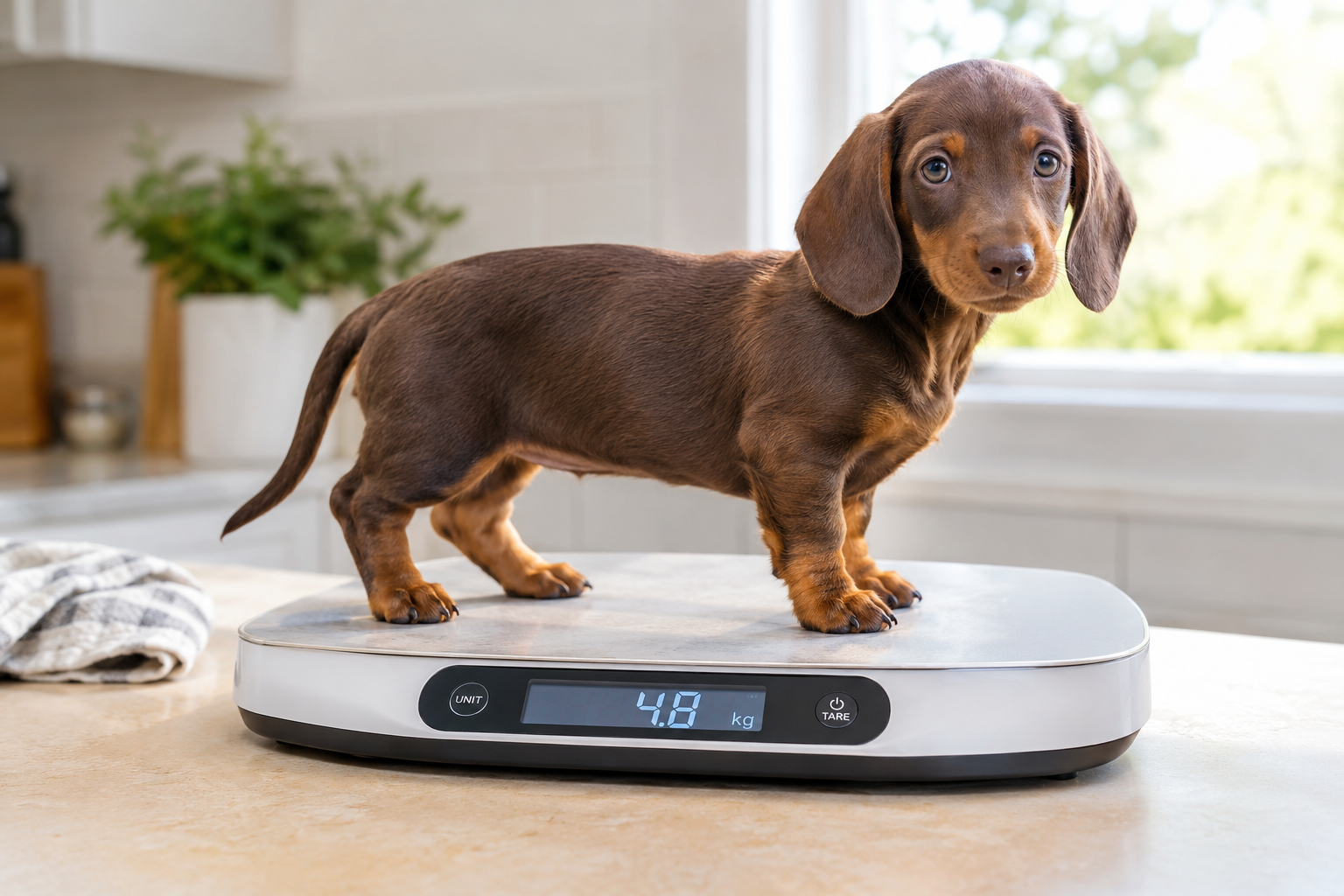
A Dachshund’s healthy weight depends on which size variety you have, how old your dog is, and how they’re built. A standard Dachshund can weigh considerably more than a miniature, and puppies from the same litter may grow at different rates. That makes a reliable dachshund weight chart a useful starting point when you’re tracking your puppy’s progress.
Below, you’ll find separate standard and miniature Dachshund weight charts for males and females, with estimates in pounds and kilograms. These are typical ranges, not official growth percentiles or guaranteed adult weights. The American Kennel Club (AKC) publishes adult size guidance, while research from WALTHAM researchers provides broader, evidence-based growth standards for puppies. Neither establishes an official, month-by-month Dachshund chart for each sex, so use the tables as a guide alongside your veterinarian’s advice.
Dachshund weight chart by age (standard)
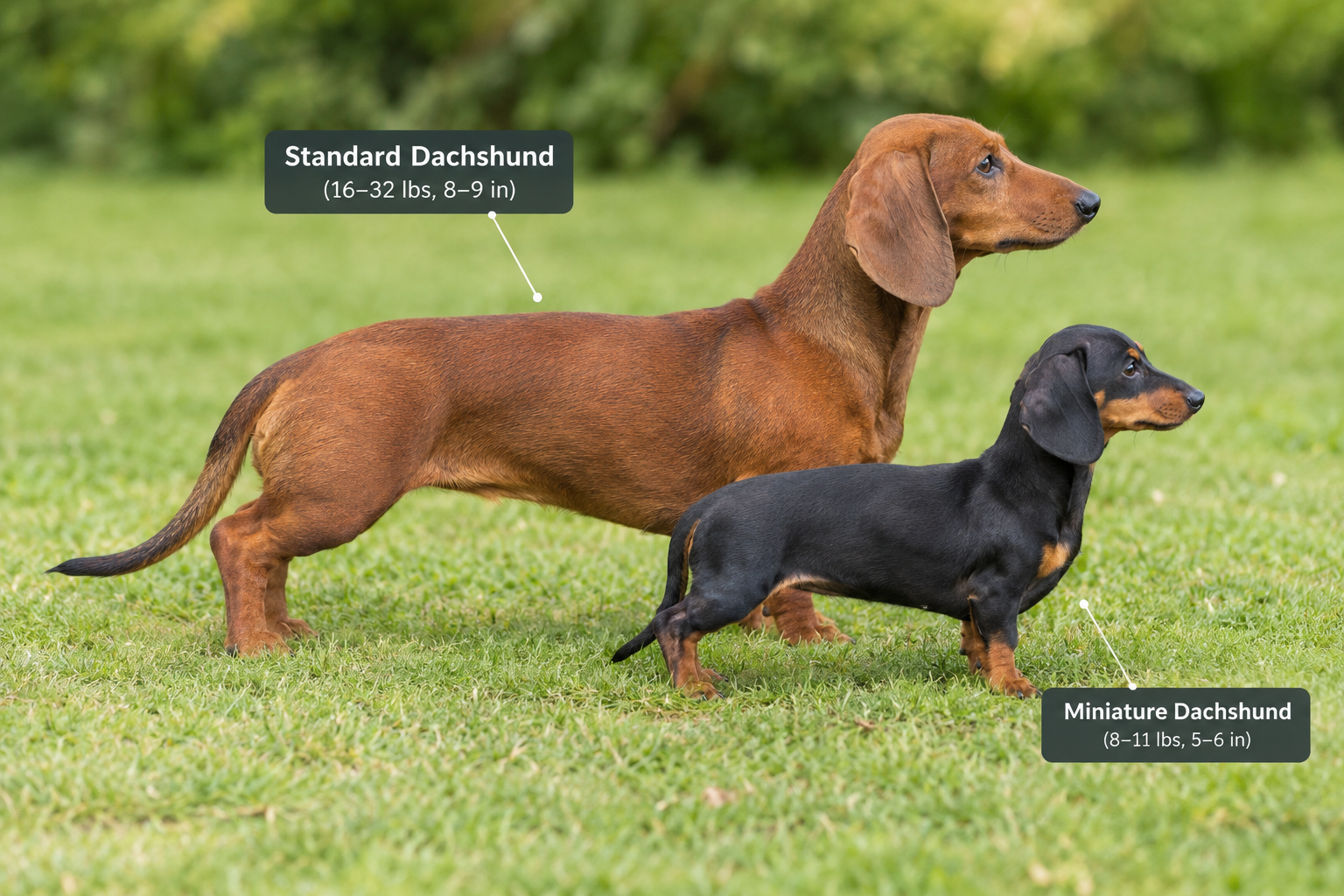
Standard Dachshunds usually weigh 16–32 pounds (7.3–14.5 kg) as adults. Some are naturally lighter than others, and family history plays a part in where an individual dog falls within that range.
| Age | Male (lb) | Male (kg) | Female (lb) | Female (kg) |
|---|---|---|---|---|
| 2 months | 4–8 | 1.8–3.6 | 3.5–7 | 1.6–3.2 |
| 3 months | 7–12 | 3.2–5.4 | 6–11 | 2.7–5.0 |
| 4 months | 9.5–16 | 4.3–7.3 | 9–14 | 4.1–6.4 |
| 5 months | 12–19 | 5.4–8.6 | 11–17 | 5.0–7.7 |
| 6 months | 14–22 | 6.4–10.0 | 12–20 | 5.4–9.1 |
| 7 months | 15–23 | 6.8–10.4 | 13–21 | 5.9–9.5 |
| 8 months | 15.5–24 | 7.0–10.9 | 14–22 | 6.4–10.0 |
| 9 months | 16–26 | 7.3–11.8 | 14–24 | 6.4–10.9 |
| 10 months | 16.5–28 | 7.5–12.7 | 15–26 | 6.8–11.8 |
| 11 months | 17–30 | 7.7–13.6 | 15–28 | 6.8–12.7 |
| 12 months | 16–32 | 7.3–14.5 | 16–32 | 7.3–14.5 |
| Adult | 16–32 | 7.3–14.5 | 16–32 | 7.3–14.5 |
These ranges overlap deliberately. The AKC does not publish separate male and female weight standards for this breed, so the sex-specific figures are practical estimates rather than official limits. Your puppy’s genetics, starting size, nutrition, and individual growth pattern can all affect the result. Weight should generally increase during puppyhood, but it won’t rise by exactly the same amount every month.
Dachshund weight chart by age (miniature)
Miniature Dachshunds are much smaller. Under the Dachshund Club of America’s breed standard, a miniature weighs 11 pounds (5 kg) or less at 12 months of age and older.
| Age | Male (lb) | Male (kg) | Female (lb) | Female (kg) |
|---|---|---|---|---|
| 2 months | 2.5–3.5 | 1.1–1.6 | 2.2–3.2 | 1.0–1.5 |
| 3 months | 4–5.5 | 1.8–2.5 | 3.5–5 | 1.6–2.3 |
| 4 months | 5.3–7 | 2.4–3.2 | 5–6.7 | 2.3–3.0 |
| 5 months | 6.4–8.4 | 2.9–3.8 | 6–8 | 2.7–3.6 |
| 6 months | 7.3–9.5 | 3.3–4.3 | 6.8–9 | 3.1–4.1 |
| 7 months | 7.8–10 | 3.5–4.5 | 7.3–9.5 | 3.3–4.3 |
| 8 months | 8.2–10.4 | 3.7–4.7 | 7.8–10.1 | 3.5–4.6 |
| 9 months | 8.4–10.8 | 3.8–4.9 | 8–10.5 | 3.6–4.8 |
| 10 months | 8.6–11 | 3.9–5.0 | 8.2–10.8 | 3.7–4.9 |
| 11 months | 8.8–11 | 4.0–5.0 | 8.4–11 | 3.8–5.0 |
| 12 months | 8.8–11 | 4.0–5.0 | 8.8–11 | 4.0–5.0 |
| Adult | 11 or less | 5.0 or less | 11 or less | 5.0 or less |
As with the standard chart, these are approximate growth ranges, not a diagnostic tool. The adult miniature limit is the breed-standard cutoff, not a requirement for every puppy to reach 11 pounds. A healthy miniature may finish well below that weight. The two sexes also share the same official size limit; their individual weights can overlap substantially.
All kilogram figures are rounded to one decimal place. For either variety, use the chart to follow your puppy’s trend rather than treating a range boundary as a pass-or-fail test.
Standard vs. miniature: which do you have?
In the United States, the main distinction is adult weight. Standard Dachshunds usually weigh 16–32 pounds, while miniatures weigh 11 pounds or less at 12 months and older. Dogs that finish between those ranges are sometimes informally called “tweenies,” but that isn’t a separate AKC size classification.
A puppy’s current weight cannot confirm which size it will become. A small standard puppy may weigh less than a larger miniature at the same age, so don’t classify your dog based on one weigh-in. Ask about the parents’ adult sizes if you have that information, then track growth over time. Your veterinarian can help assess whether your puppy is developing as expected.
Do the three coat types grow differently?
Dachshunds come in smooth, longhaired, and wirehaired varieties. Coat type changes the dog’s appearance and grooming needs, but it does not create a separate official weight chart. All three coat varieties follow the same standard-versus-miniature size distinction. A long coat can make a dog look fuller, so use a scale and your hands rather than judging weight by appearance alone.
When do Dachshunds stop growing?
Most Dachshunds reach close to their adult height and length by around 10–12 months, although individual timelines vary. Miniatures may reach their adult size sooner, while standard Dachshunds can continue gaining muscle and filling out around the chest after their height has largely settled.
The AKC’s puppy growth guidance explains that smaller dogs generally mature earlier than larger breeds. WALTHAM’s published growth research also uses different curves for male and female dogs across adult-size categories. These broad patterns are useful context, but neither source sets a precise maturity date for every Dachshund. Toy Poodles are another small breed that tends to mature early, and their owners can check a puppy’s progress with the tool for estimating a Toy Poodle puppy’s adult weight.
Males may finish heavier than females of similar breeding, but the difference isn’t reliable enough to predict an individual dog’s final weight. Genetics and the dog’s own growth pattern matter more than sex alone. If weight keeps climbing after growth has slowed, check body condition with your veterinarian rather than assuming the extra pounds are normal development.
Keeping a healthy weight
For a long-backed breed like the Dachshund, a healthy body condition matters alongside the number on the scale. Extra weight can increase strain on the body, and veterinary references identify excess weight as a concern for Dachshunds because of their susceptibility to spinal problems. It doesn’t mean that weight alone determines a dog’s risk, but maintaining a lean, well-muscled body is a sensible part of everyday care.
You can make a simple check at home:
- Feel the ribs: You should be able to feel them easily beneath a thin layer of fat without pressing hard.
- Look from above: There should be a visible waist behind the rib cage rather than a straight or bulging outline.
- Look from the side: The belly should tuck upward behind the ribs instead of hanging level with the chest.
- Track changes: Weigh your dog on a consistent schedule and record the result. A trend over several weeks is more informative than a single measurement.
These checks follow general body-condition guidance from VCA Animal Hospitals. A fluffy coat or a Dachshund’s natural shape can make visual estimates misleading, so combine what you see with what you feel. If your dog is losing weight unexpectedly, gaining rapidly, struggling to maintain weight, or showing changes in movement or comfort, contact your veterinarian. Don’t put a growing puppy on a restrictive diet without veterinary guidance.
Dachshund weight chart FAQs
How much should an adult Dachshund weigh?
A standard Dachshund usually weighs 16–32 pounds (7.3–14.5 kg). A miniature is 11 pounds (5 kg) or less at 12 months and older under the US breed standard. These are size guidelines, not a substitute for assessing body condition. A healthy weight for an individual dog depends on its frame and build.
Why is my Dachshund smaller or bigger than the chart?
Growth ranges are estimates, and healthy puppies don’t all follow the same line. Genetics, parental size, sex, nutrition, and individual development can affect weight. Compare repeated measurements and your dog’s body condition instead of worrying over a small difference from the table. Discuss persistent growth concerns or unexpected weight changes with your veterinarian.
How fast do Dachshunds grow?
Growth is generally fastest during the early months and slows as puppies approach adult size. Many Dachshunds are close to their adult height by around 10–12 months, although standards may continue filling out afterward. A steady growth trend matters more than hitting a particular number at an exact age.
When should I switch my Dachshund to adult dog food?
Many small and medium dogs transition to adult food around 10–12 months, but timing depends on maturity, growth, and individual needs. VCA’s feeding guidance recommends considering physical maturity when planning the change. Ask your veterinarian when to switch your Dachshund and how to make the transition gradually.
Does a male Dachshund always weigh more than a female?
No. Males may be heavier on average in some lines, but individual weights overlap. The AKC breed standard does not set separate male and female adult weight limits for standard or miniature Dachshunds. Parental size and body condition are more useful than assuming one sex must be heavier.
Conclusion
A dachshund weight chart can help you follow your puppy’s development, but no chart can predict every dog’s adult size exactly. Start with the correct standard or miniature table, record weights over time, and pay attention to body condition as your Dachshund grows. When the numbers and your dog’s condition don’t seem to match, your veterinarian is the best person to help interpret the difference.
About Jennifer: Jennifer is the founder and owner of CanineCalc. She is a dog owner and researcher who creates practical resources to help dog owners understand growth, size, and weight. Her goal is to make canine information easier to use in everyday care.