
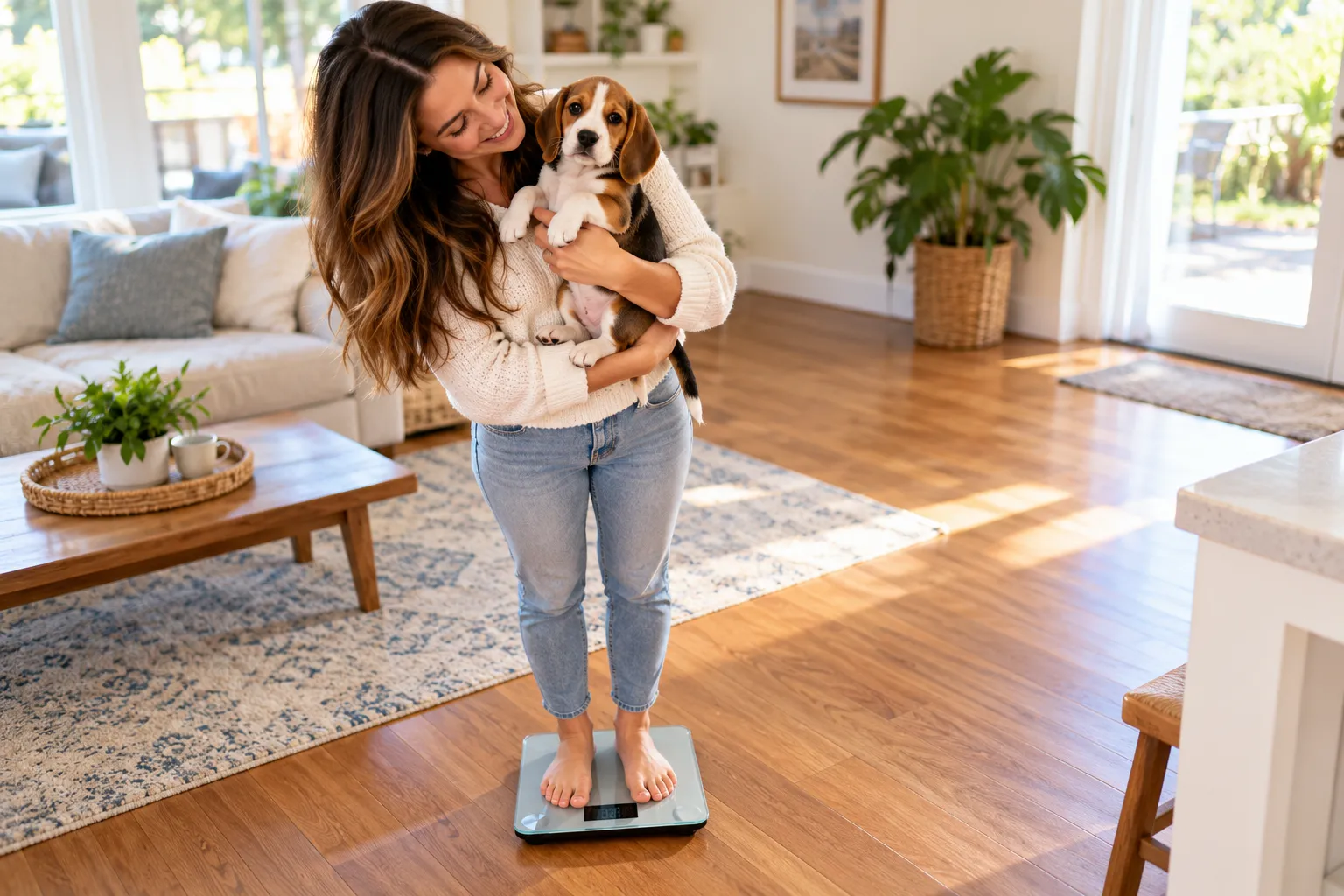
Step 1: Weigh your puppy at home
No pet scale? Use the tare method: weigh yourself holding your puppy, then weigh yourself alone.
Have a pet or kitchen scale?
Step 2: Estimate adult weight
Using the weight from Step 1, project your puppy's likely adult size.
A planning estimate, not a guarantee. Growth varies by breed, nutrition, and individual development — confirm with your veterinarian.
How the two-step tool works
Last updated: October 2026
Determine puppy weight means measuring a puppy’s current body weight and using its age and expected size class to estimate how much it may weigh as an adult. You can use a bathroom scale at home, then enter the measurement into a puppy weight calculator.
To determine a puppy’s current weight at home, weigh yourself alone, then weigh yourself while holding your puppy, and subtract the first reading from the second. According to PetMD’s veterinary guidance, this method can help when a dog is small enough to lift and hold still briefly. A level floor and consistent measurements help make the result more useful.
The CanineCalc Determine Puppy Weight tool combines two steps. First, it helps you calculate your puppy’s current weight using the tare method or enter a weight directly if you already have a measurement from a pet scale. Second, it estimates adult weight using the puppy’s age, from 6 to 78 weeks, and its expected size class: small, medium, large, or giant.
The tool also includes a realistic-weight guard at 200 lb (90 kg). This is a safeguard against implausible entries, not a statement about the maximum possible weight of every dog.
Why does size class matter? According to Salt et al. (2017), researchers analyzed bodyweight records from more than six million young dogs attending primary-care veterinary hospitals in the United States and developed evidence-based growth standards. Their findings support using age-related growth patterns and size categories as a framework, but they do not validate CanineCalc’s specific percentages or its ±15% planning range.
Most people assume a puppy’s age and breed can produce an exact adult-weight answer. In reality, growth is a process, and a single measurement cannot capture the entire trajectory.
The goal is a useful estimate, not a promise.
How to weigh a puppy at home with the tare method
The tare method calculates a puppy’s weight by subtracting your weight alone from your combined weight while holding the puppy. It is a convenient way to obtain a home measurement without buying a dedicated pet scale.
To weigh a puppy at home with a bathroom scale, first record your own weight, then hold your puppy and record the combined weight. Subtract the solo reading from the combined reading. PetMD describes this as a practical option for dogs small enough to lift; if the puppy struggles or the readings seem unreliable, use a pet or veterinary scale instead.
To weigh your puppy at home, follow these steps:
- Place the bathroom scale on a hard, level floor.
- Weigh yourself alone and record the result.
- Pick up your puppy securely and weigh yourself together.
- Subtract your solo weight from the combined weight.
- Repeat if the puppy moved or the reading changed unexpectedly.
Here’s the thing: a calm puppy makes the process easier, but safety matters more than getting a number immediately.
When it comes to puppy size, a few things make a real difference. Let the puppy settle before stepping on the scale, and ask another adult for help if you need support. Never force a frightened or struggling puppy to remain in your arms for a measurement.
Tare method examples
| Your weight holding puppy | Your weight alone | Puppy’s weight |
|---|---|---|
| 170 lb | 158 lb | 12 lb |
| 145 lb | 132 lb | 13 lb |
| 181 lb | 160 lb | 21 lb |
The arithmetic is straightforward: 170 − 158 = 12 lb. That 12 lb measurement is the value you’ll use in the adult-weight projection step.
You don’t need to buy a pet scale for a one-off check, and you can’t treat a projected number as a guarantee.
For the most consistent comparisons, use the same scale each time. Record the date, puppy’s age, and weight so you can track changes rather than relying on memory.
Can you determine puppy weight without a scale?
Without any weighing instrument, you cannot accurately determine a puppy’s current weight. You can make a rough visual guess, but appearance, breed assumptions, and how heavy a puppy feels when lifted are not reliable substitutes for a measurement.
If you don’t own a pet scale, you still have options. A bathroom scale can provide an estimate through the tare method. You can also ask a veterinary clinic whether you can bring your puppy in for a quick weigh-in.
For very small puppies, a suitable pet or baby scale can be more useful because a small change in weight represents a larger proportion of their total body weight. PetMD also advises confirming major discrepancies with a veterinary scale and avoiding the holding method when the dog struggles.
Bathroom-scale subtraction vs. a pet or veterinary scale: Subtraction is convenient for a one-time home estimate when your puppy can be held safely. A suitable pet scale or calibrated veterinary scale is preferable when small differences matter, the puppy is difficult to hold, or accurate monitoring is needed. Use the option that fits your puppy’s size and behavior.
Sources disagree about the accuracy of the holding-and-subtracting method. PetMD and a veterinarian’s answer published by Petco describe it as a usable home option, while Tufts University’s Petfoodology guidance cautions against relying on it because subtraction can be inaccurate. The sensible interpretation is to treat it as a practical estimate, not a replacement for a more precise measurement when accuracy matters.
Here’s the important part: growth isn’t always predictable.
How adult-weight projection works
Once you know your puppy’s current weight, the next step is estimating adult weight. CanineCalc uses the puppy’s current weight, age in weeks, and expected size class to select a growth fraction and project an adult weight.
The calculation is:
Projected adult weight = Current puppy weight ÷ Fraction of adult weight reached at the puppy’s age
For example, if a medium-size puppy weighs 12 lb at 16 weeks and has reached approximately 43% of its adult weight, the calculation is:
12 ÷ 0.43 = 27.9 lb
That produces a projected adult weight of approximately 27.9 lb.
The size class matters because small, medium, large, and giant puppies follow different growth patterns. Do not assume that a percentage used for one class applies to another.
What the size class tells the calculator
| Size class | Fraction of adult weight at 16 weeks | What it means |
|---|---|---|
| Small | Use the calculator’s small-class curve | The projection uses the growth pattern assigned to the selected class. |
| Medium | Approximately 43% in the example | A 12 lb puppy projects to about 27.9 lb as an adult. |
| Large | Use the calculator’s large-class curve | The medium-class percentage should not automatically be substituted. |
| Giant | Use the calculator’s giant-class curve | The selected class determines which growth fraction applies. |
Only the medium-class fraction is specified in the worked example above. The other class-specific percentages are not provided here, so they should not be guessed or presented as established figures.
The research by Salt and colleagues supports the general approach of interpreting growth through age-related curves and size categories. It does not establish that any particular calculator’s projection is accurate for every puppy.
The CanineCalc output includes a ±15% practical planning range around the projected adult weight. Use that range to understand plausible variation when planning for your growing puppy. It is not a statistically validated confidence interval.
Worked example and limitations
Suppose you weigh 170 lb while holding your puppy and 158 lb without the puppy. The difference is 12 lb, so the puppy’s current estimated weight is 12 lb.
Next, enter the puppy’s age of 16 weeks and choose the medium size class.
- Current weight: 12 lb
- Age: 16 weeks
- Expected size class: medium
- Growth fraction used: 0.43
- Projected adult weight: 12 ÷ 0.43 = 27.9 lb
Applying the tool’s ±15% planning range gives approximately 23.7–32.1 lb. This is a practical range for planning, not a statistical confidence interval.
What most guides skip is the difference between a projected adult weight and an assessment of healthy growth. A puppy can fall near a predicted number and still need attention if its growth pattern, appetite, or body condition raises concerns.
A single measurement is also less informative than repeated measurements collected consistently over time.
This guide covers weighing a puppy at home and estimating adult size. It does not diagnose medical conditions, establish an ideal body condition, or replace veterinary assessment. If the puppy’s weight changes unexpectedly or its growth appears to stall, consult your veterinarian.
For related guidance, see the CanineCalc puppy size calculator, the dog weight calculator, and the puppy growth chart predictor guide.
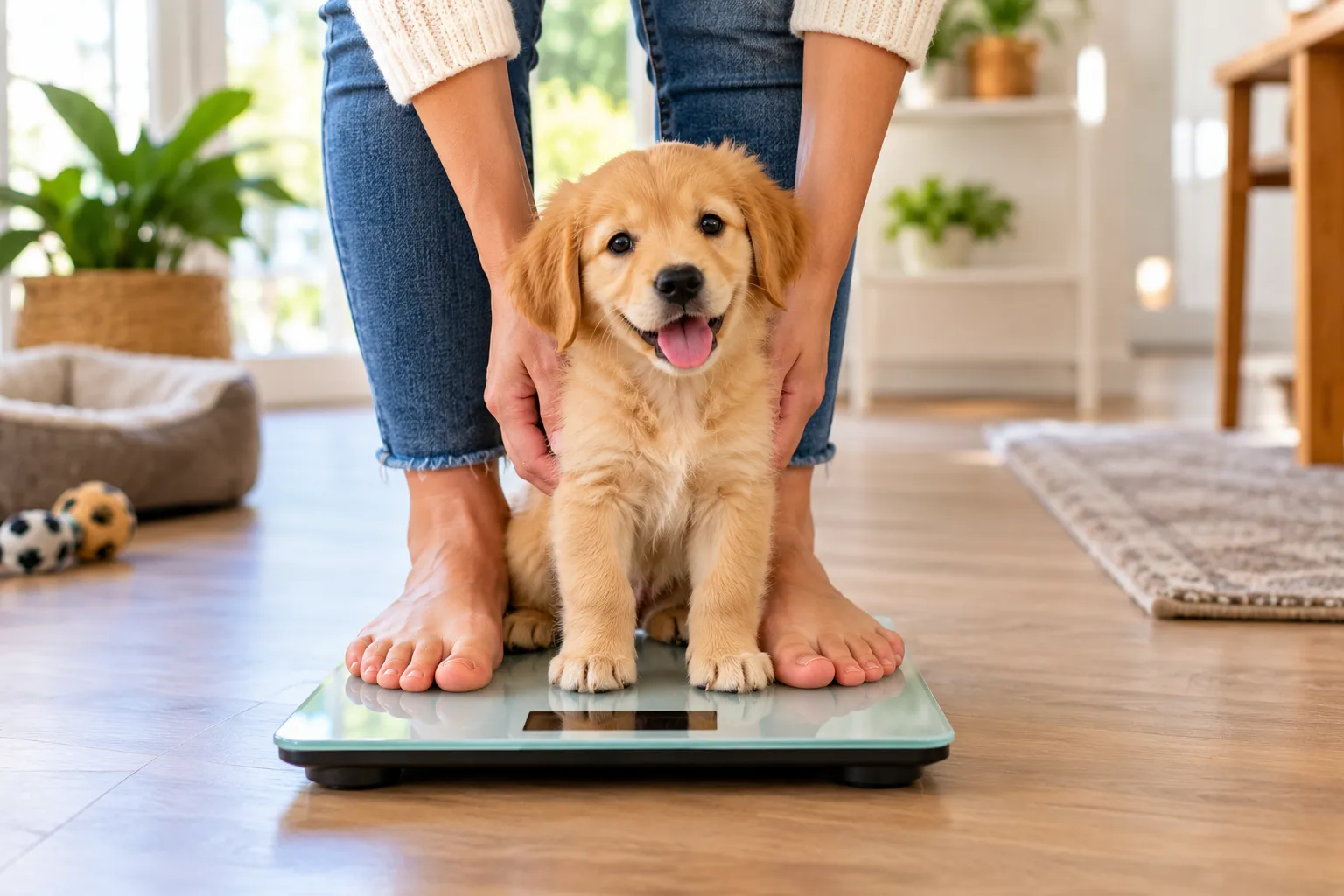
Source: Salt et al. (2017), PLOS ONE — evidence-based canine growth standards and size-category curves.
Related tools: puppy growth calculator, puppy size calculator, dog weight calculator.
Quick answers to common puppy-weight questions
Q: What’s the best way to determine puppy weight at home?
A: Weigh yourself alone, weigh yourself holding the puppy, and subtract the two readings. Use a suitable pet or veterinary scale when greater precision is needed.
Q: How do I calculate my puppy’s adult weight?
A: Divide the puppy’s current weight by the fraction of adult weight typically reached at its age for the selected size class. Treat the result as an estimate.
Q: Should I use my bathroom scale for a very small puppy?
A: You can try the tare method if you can safely hold the puppy still, but a suitable pet or baby scale may provide a more reliable measurement.
Q: Why does my puppy’s predicted adult weight change when I select another size class?
A: The calculator uses different growth curves for different size classes. Each curve can use a different fraction of expected adult weight at the same age.
Q: When should I confirm a home weight with a veterinarian?
A: Confirm the result when readings seem inconsistent, the puppy cannot be weighed safely, or weight changes and growth patterns raise concerns.
The practical next step is simple: measure your puppy, record its age, select the most appropriate size class, and use the resulting adult-weight projection as a planning estimate.
Written by Jennifer, founder of CanineCalc, a dog owner and researcher who creates practical calculation tools to help dog owners make sense of everyday questions about their pets.
Guides and tools by Jennifer, founder of CanineCalc.