

Puppy growth projection
See your puppy's projected weight week by week, from today to full size.
| Week | Age | Projected weight | % of adult |
|---|---|---|---|
| Enter details above | |||
Projections follow the same size-class curves as our other tools, extended across weeks. Individual growth varies — use as a planning guide, not a guarantee.
Most puppies finish growing between 12 and 18 months, and the exact timing depends mostly on size class.
How the week-by-week table works
Last updated: October 2026
A puppy growth calculator estimates a puppy’s future weight using its current weight, age, and expected size class. A week-by-week projection goes beyond adult weight to show how that estimate changes as your puppy matures.
How much will a puppy weigh each week? A week-by-week calculator estimates future weights from the puppy’s current weight, age, and expected size class, then applies a growth curve to each future age. According to Salt et al. (2017), growth patterns can be described with size-category curves for many breeds, although these standards are not individual guarantees.
What the calculator returns
The CanineCalc Puppy Growth Calculator, located above this article, provides an adult-weight estimate and a scrollable table showing projected growth over time.
Enter three details:
Current weight: Your puppy’s latest measured weight in pounds or kilograms.
Current age: An age between 6 and 52 weeks.
Size class: Small, medium, large, or giant.
The results include projected adult weight, age in months, projected weight at each listed week, and the percentage of estimated adult weight reached.
How the estimates are calculated
The calculator first estimates adult weight from the puppy’s current weight and the fraction of adult weight typically reached at its current age.
Estimated adult weight = Current weight ÷ Current fraction of adult weight
It then estimates future weights using the projected percentage of adult weight for each future week.
Projected weight = Estimated adult weight × Future fraction of adult weight
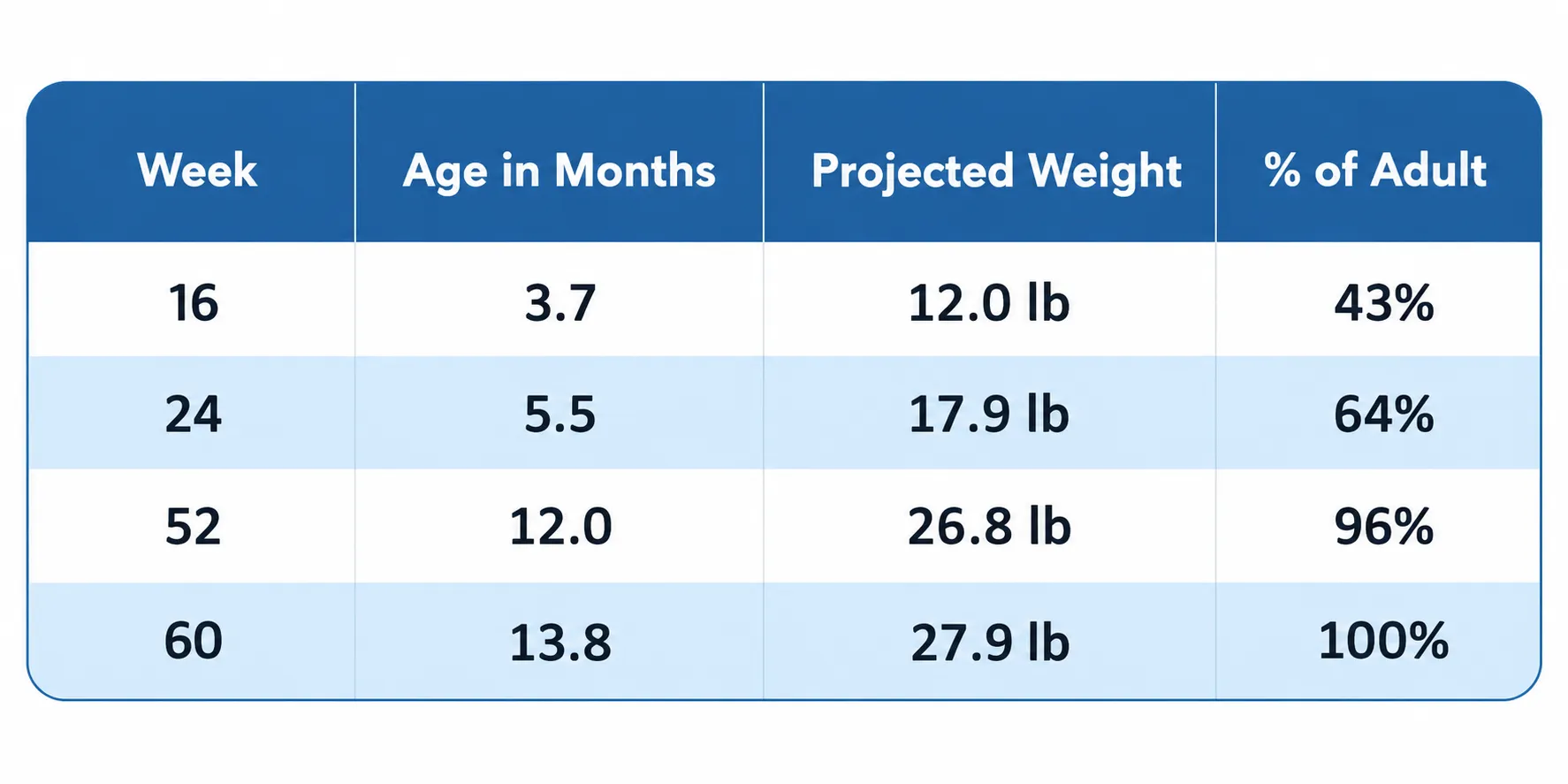
For example, a 16-week-old medium puppy weighing 12 pounds has an estimated adult weight of 27.9 pounds when the current-age fraction is 43%.
To create a puppy growth projection:
Enter the puppy’s current weight and age.
Select the expected size class.
Compare projected weights at future ages and review the percentage of adult weight.
The table uses two-week intervals, beginning at the puppy’s current age and continuing to the selected size class’s modeled maturity point.
Related: puppy growth chart predictor guide
Reading your puppy’s trajectory
A projected weight is useful. The pattern across several months is often more useful for planning.
How should you read a puppy’s growth projection? Start with the percentage of adult weight, then compare the estimate at each age instead of focusing on one number. The percentages show the model’s pace of growth: early increases may be larger, and later estimates often narrow toward maturity. A rising or flattening line is a planning signal, not a diagnosis.
Read the curve, not just the destination
Look at three things as you move down the table:
The rate of change: Compare successive projected weights to see how quickly the model expects your puppy to grow.
The percentage of adult weight: A puppy at 64% has more modeled growth remaining than one at 96%.
The flattening point: Smaller projected increases near maturity suggest that the model expects growth to slow.
Quick note: A flatter curve does not mean every puppy of that size will stop gaining weight at the same age.
When does puppy growth slow down? The answer depends on size: smaller dogs often approach adult weight earlier, while larger dogs can keep gaining later. Salt et al. describe maturity ranging from around 8–12 months for very small dogs to as long as 24 months for larger breeds, showing why a single age cutoff can mislead.
Use the trajectory for practical planning
A growth timeline helps turn an estimate into useful decisions. You can plan when to reassess crate size, compare harness measurements, and anticipate changing food requirements.
It also helps set expectations. A medium-sized puppy may continue gaining weight after six months, even when its early growth rate starts to slow.
The table is not a feeding prescription. Follow your veterinarian’s advice and your puppy food’s feeding guidance rather than increasing portions simply because the projected weight rises.
Single-number predictor vs. week-by-week projection
A single-number predictor is useful when you only need a quick adult-weight estimate. A week-by-week projection is better for planning purchases and tracking expected changes over several months because it shows intermediate milestones. Key difference: one estimates the destination; the other illustrates the modeled route.
The growth curve behind the numbers
A puppy growth chart calculator needs more than a final-weight guess to create a useful timeline. Its growth curve must account for how body weight usually changes at different stages of development.
What the research tells us
Salt and colleagues published Growth Standard Charts for Monitoring Bodyweight in Dogs of Different Sizes in PLOS ONE in 2017. Their observational study analyzed records from more than six million young dogs attending veterinary hospitals in the United States. The researchers developed evidence-based growth standards covering approximately 12 weeks to two years of age.
The study found that size-category curves described growth reasonably well for most of the breed-specific curves assessed. This supports the general idea of using size-based growth patterns rather than relying exclusively on one adult-weight formula.
However, the research does not validate every percentage used by CanineCalc. Its published standards involved breed, sex, and neuter-status combinations, and the study excluded mixed-breed dogs. CanineCalc simplifies the process into four size classes, so its output should be treated as a planning estimate rather than a clinical growth standard.
Source: Salt et al. (2017), PLOS ONE — peer-reviewed growth standards from 6M+ dogs.
When growth levels off by size
The following maturity points are the calculator’s modeled endpoints, not guaranteed dates when every dog stops growing.
| Size class | Reaches ~100% at | Expected curve pattern |
|---|---|---|
| Small | 52 weeks, about 12 months | Growth generally slows earlier, with smaller gains near the endpoint. |
| Medium | 60 weeks, about 14 months | The curve tapers toward maturity after earlier gains. |
| Large | 72 weeks, about 16.5 months | Growth may continue for longer before the model flattens. |
| Giant | 78 weeks, about 18 months | The model extends later, but some giant breeds may continue developing beyond this point. |
These endpoints provide a consistent framework for the calculator. They should not be interpreted as universal biological milestones, particularly for giant dogs.
Related: puppy size calculator
Worked example: 12-lb puppy at 16 weeks
A worked example makes the puppy weight projection easier to understand. The figures below follow the supplied medium-size model percentages.
Calculate the estimated adult weight
The starting details are: 12 pounds, 16 weeks, medium size class, 43% of adult weight.
The calculation: 12 ÷ 0.43 = 27.9069. Rounded to one decimal place, the estimated adult weight is 27.9 pounds.
This is an estimate derived from the growth model, not a guarantee that the puppy will reach exactly 27.9 pounds.
Sample week-by-week projection
Week 16 (now): 12.0 lb, 43% of adult. Week 24: 17.9 lb, 64% of adult. Week 52: 26.8 lb, 96% of adult. Week 60: 27.9 lb, 100% of adult.
The arithmetic checks out: 27.9 × 0.64 = 17.856 ≈ 17.9 lb. At week 52: 27.9 × 0.96 = 26.784 ≈ 26.8 lb.
Related: dog weight calculator
Spurts vs. smooth curves: what the table cannot show
Real puppies do not grow according to a perfectly smooth schedule. A calculator does.
Why real growth looks different
A puppy may gain weight quickly over one period, show little change at the next weigh-in, and then start gaining more rapidly again. Differences in breed mix, body condition, nutrition, activity, and health can affect the pattern.
Sources also differ in how precisely mixed-breed growth can be predicted. Breed-based standards offer detailed reference curves, while a generalized size-class calculator offers a simpler estimate.
More decimal places do not make a puppy growth estimate more accurate. A sensible planning estimate is better than false precision.
How to use the curve without overinterpreting it
For a fast-growing puppy, use the calculator to anticipate broad changes, then compare with actual measurements.
Use the calculator to anticipate broad changes, then compare those expectations with actual measurements taken consistently over time.
The trajectory matters more than any single cell in the table.
Limitations to know
This guide covers estimated body-weight progression using simplified size classes. It does not diagnose health problems, establish an ideal body condition, or replace breed-specific veterinary growth monitoring.
The tool works best for a healthy puppy whose likely size class is reasonably clear. It may be less informative for a mixed-breed puppy with uncertain adult size or a dog whose growth is affected by illness.
If your puppy loses weight unexpectedly, stops gaining weight over a concerning period, or shows changes in appetite, energy, or body condition, contact your veterinarian.
Related tools: puppy growth chart predictor, puppy size calculator, dog weight calculator.
FAQs about puppy growth calculators
What is the best way to estimate a puppy’s adult weight?
Use a calculator that considers current weight, age, and expected size class. A week-by-week table adds context by showing projected intermediate weights.
How do I calculate my puppy’s future weight?
Divide the current weight by the estimated fraction of adult weight reached at the current age. Multiply that adult estimate by the projected fraction for each future week.
Should I worry if my puppy is below the projected weight?
Not necessarily. Individual puppies vary. Track actual measurements and ask your veterinarian about persistent growth changes.
Why does my puppy’s growth curve flatten?
A flattening curve indicates that the model expects weight gain to slow as the puppy approaches maturity. Actual growth may be uneven.
When should I stop tracking my puppy’s weight?
Continue monitoring as advised by your veterinarian, including after the calculator’s projected maturity point when appropriate.
Written by Jennifer, founder of CanineCalc, a dog owner and researcher who creates practical calculation tools to help dog owners make sense of everyday questions about their pets.
Guides and tools by Jennifer, founder of CanineCalc.