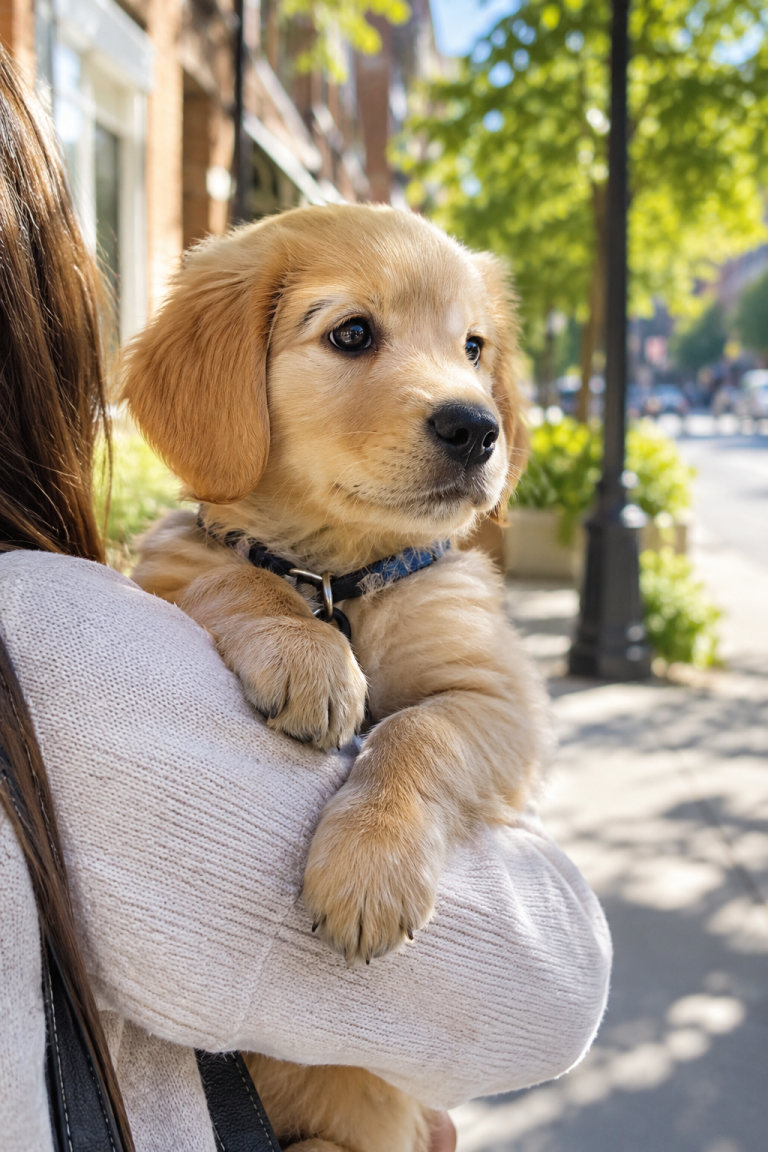
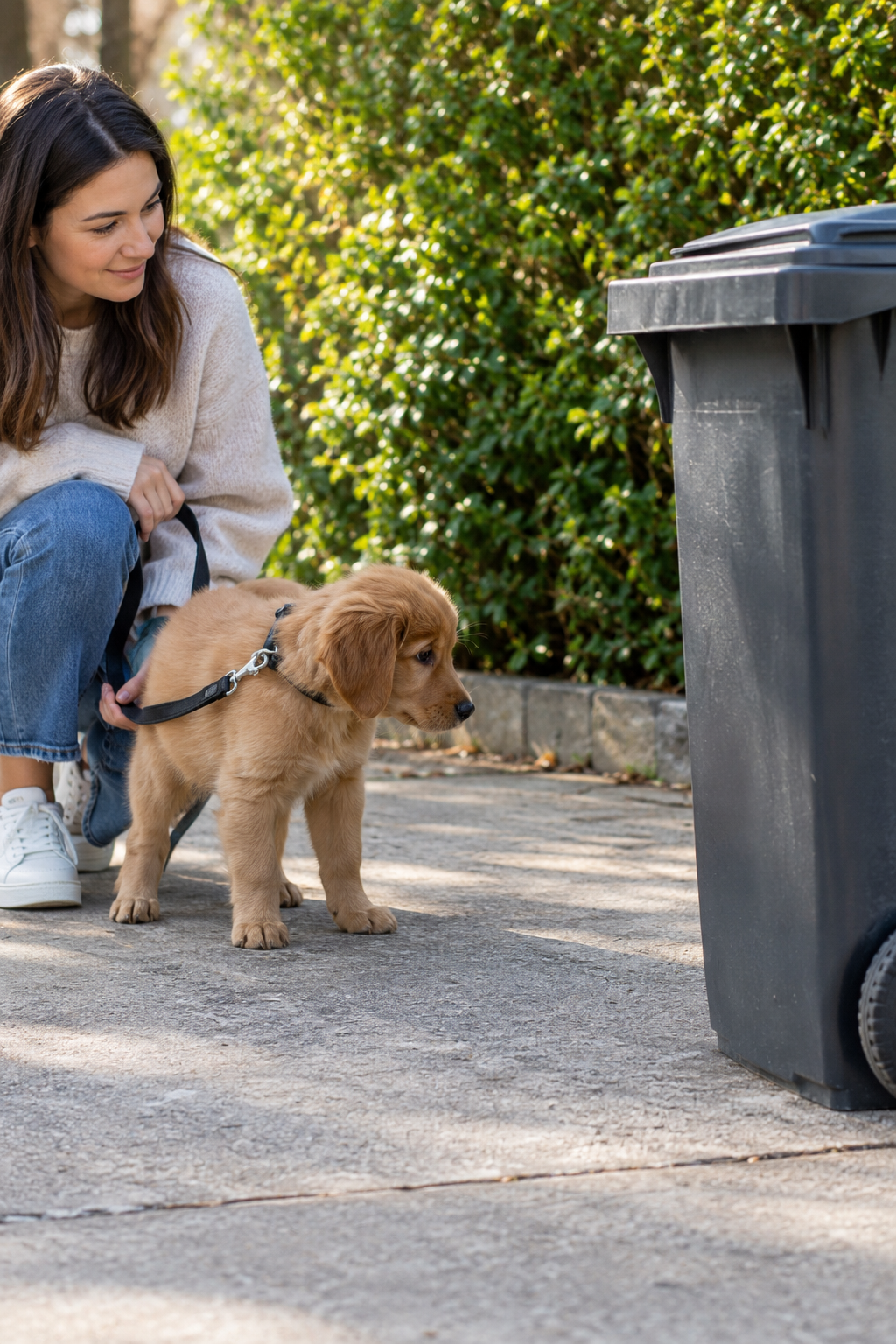
Your puppy used to walk past the trash can without a second glance. Now they bark at it, back away, or refuse to go near it. A friendly neighbor suddenly seems frightening, a garden statue looks suspicious, or an ordinary household noise sends your puppy scrambling for safety.
What changed?
Your puppy may be going through one of the fear periods in dogs, developmental stages when some puppies become unusually sensitive to unfamiliar or previously harmless things. It can be unsettling to watch a confident puppy suddenly act afraid, especially when you have worked hard to socialize them.
The good news is that these changes can be temporary. Understanding what’s happening and responding calmly can help your puppy feel safe while building confidence for the future.
What is a fear period?
A fear period is a developmental stage when a puppy may react more strongly to things that would not normally worry them. An object, person, sound, or experience that seemed perfectly ordinary yesterday can suddenly feel threatening.
These periods are commonly discussed in canine training and veterinary behavior resources. They’re associated with developmental changes in how puppies respond to their surroundings and learn about potential threats.
Think of it as a time when your puppy is particularly impressionable. A frightening experience may leave a stronger negative association than it would at another stage of development. For example, a puppy startled by a loud, unexpected noise might become wary of the place where it happened or similar sounds afterward.
Fear periods aren’t a sign that you’ve failed at training. They can affect puppies that have received plenty of positive socialization, too.
However, a fear period doesn’t mean every fearful behavior should be dismissed as a phase. Genetics, health, past experiences, and individual temperament can all influence a dog’s behavior. The aim is to recognize a possible developmental change while watching for signs that your puppy needs additional help.
When do fear periods happen?
Two commonly cited fear periods occur during puppyhood and adolescence. These age ranges are useful guidelines, not precise biological deadlines. Individual dogs can experience them differently, and some show very few noticeable changes.
| Developmental stage | Commonly cited age | What you might notice |
|---|---|---|
| First fear period | Around 8–10 weeks, sometimes described as extending to 11 weeks | Hesitation around new objects, people, sounds, or surroundings |
| Early puppyhood | Brief fear flare-ups can occur during the following months | Temporary sensitivity to experiences that previously seemed manageable |
| Second fear period | Roughly 6–14 months | New caution, startling, barking, or avoidance as your puppy enters adolescence |
The first fear period: around 8–10 weeks
This stage can coincide with the first weeks in your home. Your puppy may be adjusting to new people, rooms, outdoor environments, veterinary visits, and grooming experiences all at once.
Make these introductions as pleasant as possible. Keep handling gentle, offer treats, and give your puppy time to investigate rather than insisting that they meet everyone or explore everything immediately.
Puppy socialization is still important at this age. The goal is to offer safe, positive experiences without overwhelming your dog.
The second fear period: around 6–14 months
This later stage can be particularly confusing because your puppy may look nearly grown and already know many basic skills. Then adolescence arrives, and a familiar person, busy sidewalk, or ordinary object suddenly becomes concerning.
Smaller dogs may experience this stage earlier than larger dogs, while large and giant breeds can mature later. The timing and intensity vary, and there isn’t a calendar that predicts exactly when your individual puppy will change.
Some dogs barely show recognizable fear periods at all. Others have more noticeable changes that come and go.
Signs your puppy is in a fear period
The clearest clue is a sudden change in your puppy’s reaction to something they previously handled comfortably.
Common signs include:
- Barking at familiar things: A trash can, parked bicycle, garden statue, or household appliance suddenly seems threatening.
- Backing away or refusing to approach: Your puppy may freeze, retreat, or plant their feet when you approach a person or object.
- Raised hackles: The fur along the back may stand up during a startling or emotionally intense moment. This indicates arousal, not necessarily fear on its own.
- Startling at everyday sounds: Doors closing, traffic, dropped utensils, or distant voices may provoke a stronger reaction than usual.
- Clinginess: Your puppy may stay close to you, seek reassurance, or become reluctant to explore independently.
- Avoiding previously accepted people or places: Someone your puppy greeted happily last week may suddenly make them uncomfortable.
Pay attention to the whole body, not just barking. A lowered body, tucked tail, ears held back, repeated lip licking, or attempts to hide may suggest your puppy is uncomfortable.
Also consider the context. A puppy with limited positive exposure to the world may need carefully planned socialization, while a sudden behavioral change in a well-socialized puppy may fit a developmental fear stage.
Neither situation can be diagnosed from one behavior alone. Pain, illness, and specific frightening experiences can also cause new fears.
What to do during a fear period (and what to avoid)
Your goal is not to make your puppy brave by the end of the walk. It’s to help them experience the world without feeling trapped or overwhelmed.
1. Give your puppy more distance
If your puppy barks at a statue or backs away from a stranger, move far enough away that they can relax. Don’t shorten the leash and march them toward the trigger.
Distance reduces pressure and makes it easier for your puppy to observe without feeling threatened. You can always try again from a comfortable distance another day.
2. Let your puppy choose whether to approach
Give your puppy room to investigate when they feel ready. If they want to sniff an unfamiliar object, allow them to do so voluntarily. If they choose to retreat, respect that decision.
Don’t ask strangers to lean over your puppy, reach toward their face, or insist on petting them. A quiet opportunity to observe someone from a distance is often more useful than a forced greeting.
3. Pair the scary thing with good experiences
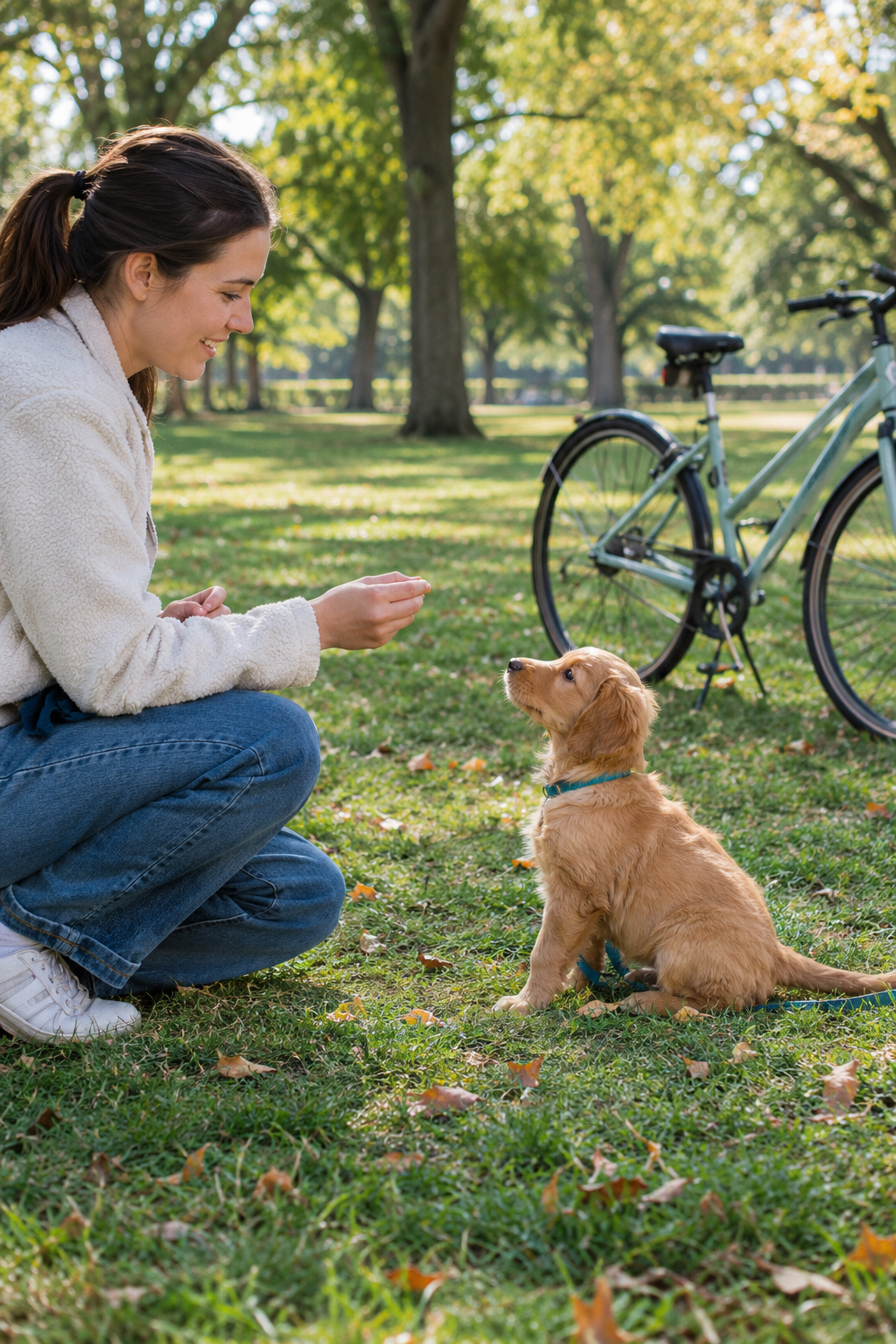
Counter-conditioning means helping your puppy develop a more positive association with something frightening. Food can be especially helpful.
For example, if your puppy notices a trash can from across the street, offer small pieces of a favorite treat while the trash can is visible. Keep enough distance that your puppy can still eat and remain reasonably relaxed.
Over several brief sessions, you may gradually work closer if your puppy remains comfortable. If they stop taking treats, become tense, or try to escape, increase the distance or end the session.
The point isn’t to lure your puppy closer than they’re comfortable going. It’s to make the experience feel safer.
4. Keep everyday life predictable
Familiar routines can help your puppy feel secure. Maintain regular opportunities for sleep, meals, toilet breaks, play, and gentle training.
If your puppy becomes frightened during a walk, choose a quieter route rather than turning every outing into a challenge. Continue offering new experiences, but adjust their intensity to suit your puppy.
For practical guidance, see when can a puppy go outside?, which covers puppy socialization and safer outdoor outings.
You may also notice more accidents when stress disrupts your puppy’s normal habits. Keep toilet breaks consistent and revisit housebreaking a puppy if your puppy’s routine starts slipping.
5. Avoid flooding and punishment
Flooding means exposing a frightened dog to an intense version of the thing they’re afraid of, with little opportunity to escape. Taking your puppy into a crowded festival to force them to get used to people can backfire.
Avoid dragging your puppy toward a trigger, forcing interactions, punishing fear-related barking, or deliberately creating overwhelming experiences such as fireworks or packed events for practice.
Punishment can make a frightening situation feel even more threatening. It may also teach your puppy that warning signals such as growling are unsafe to express, without making the underlying fear disappear.
What about vet visits, grooming, and elective procedures?
Whenever practical, avoid combining a fear period with unnecessary, highly stressful first-time experiences. For example, you might postpone a nonessential full grooming session while practicing gentle brushing and handling at home.
For elective surgery or other medical procedures, discuss timing and preparation with your veterinarian rather than automatically rescheduling. Never delay medically necessary care without veterinary guidance. A clinic may be able to arrange calmer handling, breaks, or other accommodations.
You don’t need to stop socializing your puppy. You need to make socialization positive, gradual, and appropriate for their comfort level.
Fear period vs. a real behavior problem: when to get help
It’s reasonable to monitor a mild, temporary fear response, but don’t assume every behavior concern will disappear with age.
Contact your veterinarian or a qualified, reward-based behavior professional if:
- Fear keeps escalating or spreads to more people, places, and everyday situations.
- Your puppy growls, snaps, or lunges when someone approaches or tries to handle them.
- Your puppy remains persistently fearful rather than gradually recovering.
- Your puppy shuts down, hides for extended periods, or becomes too frightened to eat, play, explore, or follow normal routines.
A sudden behavior change deserves particular attention if your puppy also seems painful, unusually tired, reluctant to move, or sensitive to touch. A veterinary examination can help rule out medical causes.
For significant fear or aggression, ask your veterinarian about referral to a veterinary behaviorist or an appropriately credentialed behavior consultant who uses reward-based methods. Getting help early is not an admission of failure. It gives your puppy a better chance to learn safer, more comfortable responses.
Does the fear period end?
Often, yes. A fear flare-up is commonly described as lasting around one to three weeks, although there is no fixed duration. Some puppies settle within days, while others experience several waves of sensitivity, particularly during adolescence.
With patient handling and positive experiences, many puppies return to their usual confidence. However, you shouldn’t assume that all fear automatically disappears when a particular age passes.
A frightening experience can create an association that lasts beyond the developmental window. Conversely, calm, gradual exposure can help your puppy learn that a previously worrying situation is safe.
Keep observing your dog rather than counting down to a specific date. If fear persists, worsens, or interferes with daily life, seek professional guidance instead of waiting for the stage to end.
Most importantly, your puppy doesn’t need you to prove that a trash can is harmless. They need to know they can look, move away, and explore at their own pace while you help them feel secure.
Final thoughts
Fear periods can make puppyhood feel unpredictable, but a sudden burst of caution doesn’t erase everything your puppy has learned. Give your dog space, reward comfortable interactions, maintain familiar routines, and avoid forcing frightening experiences.
Your response matters because it helps shape how your puppy learns to handle uncertainty. And remember that asking for veterinary or behavioral help is always appropriate when fear becomes persistent or intense.
Confidence grows through safe experiences, patience, and trust, not through pressure.
By Jennifer, founder and owner of CanineCalc. Jennifer is a dog owner and researcher who writes practical, research-informed guides to help people better understand their dogs. She is not a veterinarian, breeder, or certified trainer.