
Veterinary Disclaimer: This article explains how to evaluate puppy weight prediction methods. It provides general information about canine growth estimates, not veterinary advice for an individual puppy’s health or development.
Last updated: October 2026
You enter your puppy’s age and weight into three calculators. One predicts a 25-pound adult dog, another says 35 pounds, and a third suggests 45 pounds.
Which one should you believe?
The honest answer is that the biggest number, the most precise number, and the calculator claiming to be the most accurate aren’t automatically right. You need to examine how each tool makes its prediction, what evidence supports its method, and whether its estimates have been tested against dogs’ actual adult weights.
For owners comparing online tools, that distinction matters more than another confident headline.
What Does “Most Accurate Puppy Weight Calculator” Actually Mean?
A most accurate puppy weight calculator is an online estimator that uses a puppy’s age and current weight, sometimes alongside breed or expected size, to project likely adult weight. Genuine accuracy means testing predictions against actual adult outcomes and disclosing the method and errors—not simply producing a confident number.
How accurate are puppy weight calculators? They can provide useful planning estimates when the puppy’s age and weight are reliable and the model fits the dog’s likely size. According to Salt et al. (2017), evidence-based growth standards can describe healthy weight trajectories, but their research did not validate any specific website’s adult-weight predictions.
That difference is crucial.
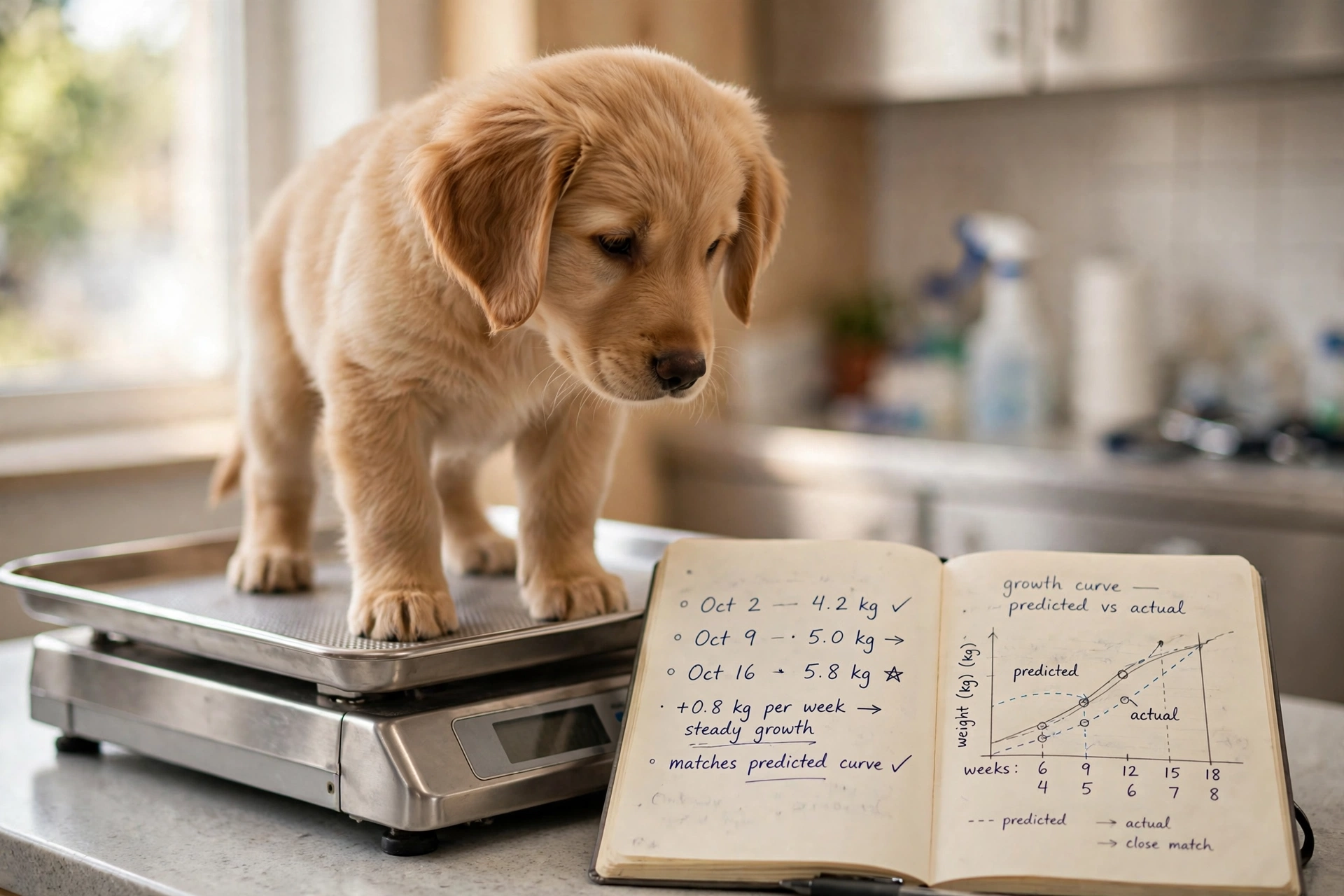
A growth chart describes how puppies tend to grow. An adult-weight prediction estimates where one particular puppy may finish. These are related tasks, but success at the first does not prove success at the second.
What the Research Actually Establishes
The peer-reviewed study Growth standard charts for monitoring bodyweight in dogs of different sizes, published in PLOS ONE in 2017, analyzed records from more than six million young dogs attending veterinary hospitals in the United States. Researchers developed over 100 growth charts using combinations of breed, sex, and neuter status, then evaluated whether size-category charts could reasonably represent breed-specific growth patterns.
The results supported size-category growth charts for monitoring healthy growth in many dogs. However, the charts were developed for growth monitoring, not as a head-to-head benchmark for online calculators predicting adult weight. Read the published study.
The researchers also identified limitations. Mixed-breed dogs were excluded from the study’s breed-based analysis, and the standards did not cover dogs with adult weights above 40 kg. Further validation was needed before the charts could become a clinical growth-monitoring tool.
The practical lesson is simple: a large research dataset is valuable, but it doesn’t automatically establish the accuracy of every calculator built from it.
Which Puppy Weight Prediction Method Is Most Trustworthy?
The most trustworthy method depends on what you need. For an individual puppy, a veterinarian’s interpretation of repeated weights, breed information, body condition, and growth history can provide valuable context. For an online estimate, growth-curve interpolation has a stronger biological basis than assuming that a puppy will keep gaining weight at today’s rate.
According to Salt et al. (2017), growth patterns in many dogs could be represented through size-category curves instead of requiring a separate chart for every breed. That supports the use of structured growth models — a puppy size estimator, for example — but it does not establish a universal accuracy ranking for commercial calculators.
Different methods answer slightly different questions. Use the table to decide which evidence deserves the most attention in your situation.
| Option | Best For | Key Benefit | Limitation |
|---|---|---|---|
| Veterinary assessment with serial weights | Individual puppies with a known growth history | Combines measurements with clinical context | Depends on available records and professional assessment |
| Growth-curve interpolation | Puppies with reliable age, weight, and a plausible size category | Accounts for changes in growth rate over time | Model fit and individual variation still affect results |
| Breed-specific adult-weight charts | Puppies with a reasonably well-established breed | Provides a useful adult-size baseline | Breed averages cannot predict every individual dog |
| Doubling rules and simple multipliers | A quick, informal approximation | Easy to calculate | Can oversimplify growth and produce misleading estimates |
Growth-curve interpolation vs. doubling rules: interpolation uses an age-related growth pattern rather than assuming a constant rate of weight gain. Doubling rules are quicker, but their usefulness depends on the puppy’s age, breed, and size. Neither approach guarantees the final adult weight.
Why Growth Curves Are Different From Simple Formulas
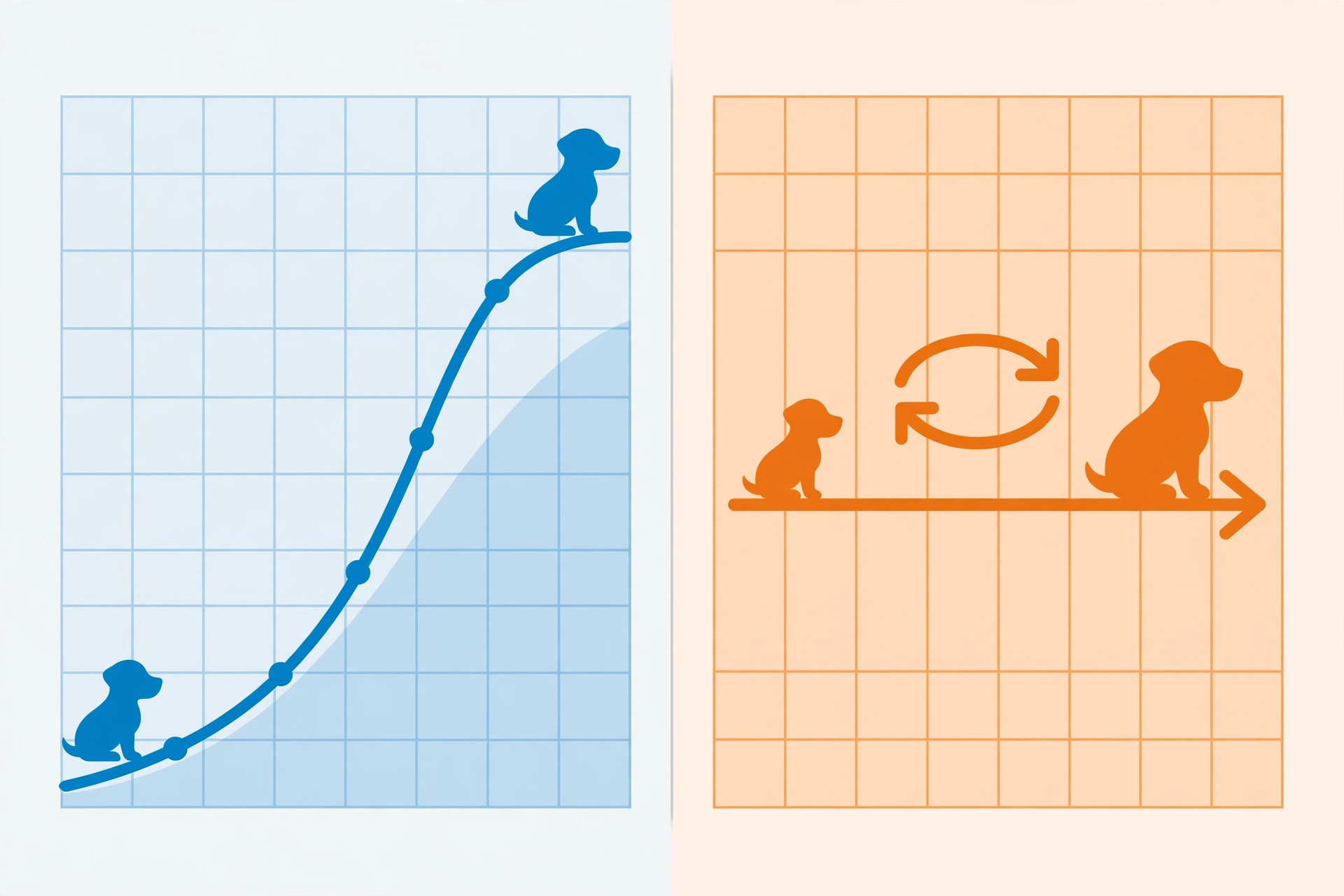
Puppies generally grow faster earlier in life, with their growth rate slowing as they mature. A formula that projects today’s rate of weight gain into the future can miss that change.
For example, one commonly circulated formula estimates adult weight by dividing current weight by age in weeks and multiplying by 52. It is easy to calculate, but it assumes a simple linear relationship between age and weight.
The flaw is visible in the math itself: the formula assumes weight gain stays constant week after week, but real puppies grow fastest early and slow down as they mature. A constant-rate projection therefore overshoots for most dogs—no dataset needed to see why.
A growth model that reflects changing growth rates is a better starting point than a constant-rate shortcut. Its actual predictive accuracy still needs to be measured separately.
What Makes a Growth Model Credible?
A credible model should explain:
- Which age and weight measurements it accepts.
- How it assigns a puppy to a size category or breed group.
- Whether the data represent healthy dogs and include relevant populations.
- How its predictions were compared with actual adult weights.
- How much the estimates tend to miss by, including the uncertainty range.
What most guides skip is the distinction between model construction and model validation. Data used to build a model do not, by themselves, demonstrate how well the finished calculator performs on dogs that were not used to build it.
Why Do Different Puppy Weight Calculators Disagree?
Two calculators can return different answers because they may use different formulas, datasets, age assumptions, breed averages, size categories, or prediction intervals. Even when both tools use real veterinary records, they can produce different results if their input populations and definitions of accuracy differ.
Here’s the thing: a number without a method is difficult to evaluate.
Published Accuracy Claims Need Context
Some newer calculator publishers do disclose more of their methods than older, formula-only tools.
When a publisher claims validation, the disclosures that matter are: how many dogs were tested, whether they were held back from model fitting, what counted as an adult outcome, and how often real adult weights fell inside the stated interval. Testing against adult-weight outcomes beats citing dataset size alone—but publisher-reported figures still aren’t independent proof one calculator beats another.
The figures are not directly comparable without examining how each dataset was selected, how predictions were generated, what counted as an adult outcome, and how the intervals were calculated. They are publisher-reported results, not independent proof that one calculator is universally superior.
Sources can appear to disagree because a peer-reviewed growth-standard study may evaluate healthy growth trajectories, while a calculator publisher may evaluate errors in predicted adult weight. Those are different outcomes. For the narrow question of adult-size prediction, tests against actual adult weights are more direct evidence.
Point Estimates, Ranges, and Realistic Expectations
Suppose the most accurate puppy weight calculator predicts an adult weight of 30 pounds. That number may look precise, but it doesn’t tell you how often similar predictions are wrong or how far they tend to miss.
A second calculator might predict 32 pounds with an estimated range of 26–39 pounds. The second result is more transparent about uncertainty, even though the estimate alone doesn’t prove that its method is better.
The most accurate puppy weight calculator is the one that reports a useful, evidence-supported range rather than a precise-looking number without showing its errors. Some owners may prefer a single figure, but an unsupported level of precision can create false confidence.
That’s normal, too. Puppy growth rarely follows a perfectly straight line.
How to Judge a Puppy Weight Calculator Before Trusting It
To evaluate the most accurate puppy weight calculator, follow these steps:
- Enter the puppy’s age and current weight accurately.
- Check whether the model considers breed or expected adult size.
- Read how the calculator generates its estimate.
- Look for tests against dogs’ actual adult weights.
- Review the error range and limitations before relying on the result.
How CanineCalc Approaches Puppy Weight Prediction
The CanineCalc Puppy Size Calculator uses size-class growth-curve interpolation and provides a practical ±15% planning range. This gives readers a structured estimate and an explicit uncertainty range instead of presenting an adult-weight figure as a guarantee.
Puppy adult-weight estimator
Use current age, weight and expected size class to produce a broad planning range.
That range needs careful interpretation, though. Unless independent validation establishes how often real adult weights fall within it, ±15% should be treated as the calculator’s stated planning guidance rather than a proven error rate.
For example, if the tool estimates 30 pounds, a simple ±15% planning calculation gives a range of approximately 25.5–34.5 pounds. That is an illustration of the stated range, not a guarantee that the puppy will mature within those limits.
Quick reminder: The most accurate puppy weight calculator is an educational planning tool. It cannot diagnose poor growth, explain unexplained weight changes, or replace veterinary assessment.
Trying to predict your puppy’s adult size? Here’s what actually works: compare the methods, inspect the uncertainty ranges, and check whether the estimates have been validated against real adult dogs.
What to Do When the Breed Is Unknown
Mixed-breed puppies are harder to predict because parentage and adult size may be uncertain. A size-class model can still offer a useful starting point, but an uncertain size classification can affect the result. For a dedicated guide, see our mixed-breed puppy weight calculator.
A fair counterargument is that breed-specific charts may be better when the puppy’s breed and lineage are well established. That’s a reasonable baseline for a puppy with reliable breed information, but a breed average shouldn’t override an individual’s observed growth pattern.
When possible, keep a record of repeated weights. Look at the trend instead of treating one measurement as the entire story. Our puppy growth chart predictor guide shows how to monitor weight changes over time.
If your puppy’s still young, don’t assume the current curve won’t change; later measurements can alter the estimate as more of the growth pattern becomes visible.
When an Online Estimate Is Not Enough
The most accurate puppy weight calculator is designed to estimate size, not diagnose a growth problem. If your puppy’s weight trajectory changes unexpectedly, or you have concerns about feeding, body condition, or development, discuss the pattern with a veterinarian.
This approach works best when your puppy has a reasonably reliable age, accurate weight measurements, and a plausible size category. It will be less informative when age and parentage are unknown or the dog’s likely adult size falls outside the model’s scope.
This guide covers online adult-weight estimates and how to evaluate their evidence. It does not replace a veterinary assessment of an individual puppy’s growth or health.
Frequently Asked Questions About Puppy Weight Calculator Accuracy
What’s the best way to predict my puppy’s adult weight?
Start with accurate age and weight measurements, a suitable growth model, and breed or size information where available. A veterinarian can help interpret repeated measurements. No single method guarantees an individual puppy’s final adult weight.
How do I know whether a puppy weight calculator is accurate?
Look for validation against actual adult weights, a clear description of the test population, and disclosed prediction errors. A large source dataset is useful, but it does not prove that the finished model predicts adult weight accurately.
Should I trust a calculator that claims ±15% accuracy?
Treat the figure as a planning range unless testing explains what it measures and how often estimates fall within it. A stated range alone does not establish that the calculator consistently achieves that level of accuracy.
Why does my puppy get different estimates from different calculators?
Calculators may use different growth curves, breed assumptions, datasets, and formulas. Their ranges may also represent different statistical measures. Compare the methods and validation evidence instead of choosing whichever result looks most precise.
Why can’t I directly compare two calculators’ accuracy figures?
The figures are not directly comparable without examining how each dataset was selected, how predictions were generated, what counted as an adult outcome, and how the intervals were calculated. Publisher-reported results are not independent proof that one calculator is universally superior.
When should I ask a veterinarian about my puppy’s growth?
Seek veterinary advice if your puppy’s weight pattern changes unexpectedly or you have concerns about body condition, nutrition, or development. A calculator estimates size; it cannot determine whether a particular growth pattern is healthy.
The Practical Takeaway
The most accurate puppy weight calculator is not necessarily the one with the boldest claim or the largest dataset. Look for a transparent growth method, relevant inputs, testing against actual adult weights, and an uncertainty range whose meaning is clearly explained.
CanineCalc’s growth-curve approach offers a structured starting point, but its planning range should not be confused with independently proven predictive accuracy. Use estimates to inform expectations, track your puppy’s growth over time, and rely on veterinary guidance when individual health concerns arise.