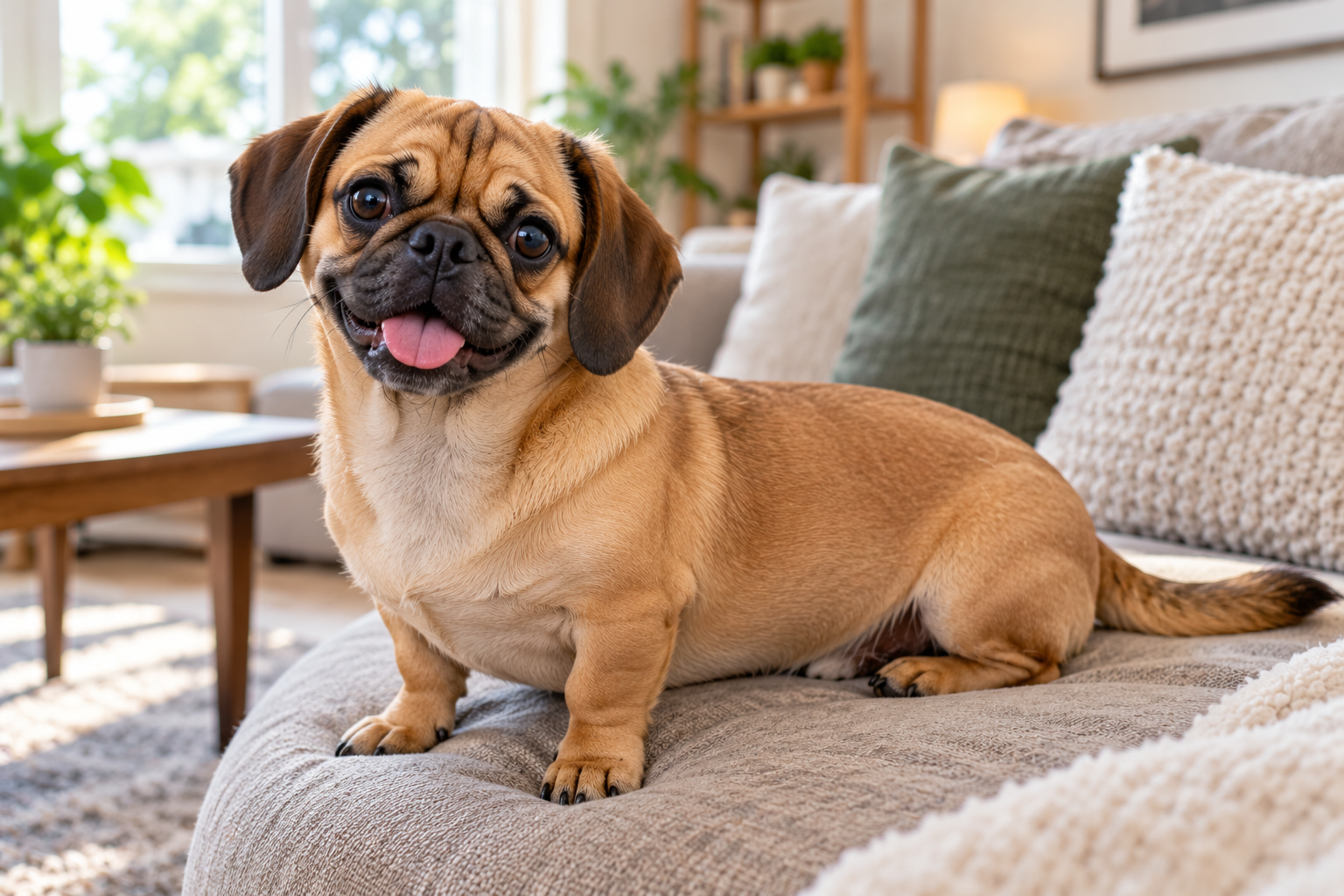
A pug dachshund mix, often called a Daug, is a small companion dog that combines the Pug’s affectionate, playful personality with the Dachshund’s longer body, short legs, and independent streak. A typical Daug may weigh around 15–20 pounds and stand 11–13 inches tall, although these are estimates rather than guaranteed adult measurements. Individual dogs can fall outside that range, depending on their parents and inherited traits.
Daugs are often people-focused, entertaining companions who can adapt to apartment living. However, their compact bodies come with important considerations, particularly weight management, breathing if they inherit a short muzzle, and back care if they inherit a Dachshund-like build. Understanding those trade-offs helps you decide whether this mix fits your household and daily routine.
Pug dachshund mix at a glance
| Feature | General expectation |
|---|---|
| Common name | Daug |
| Parent breeds | Pug and Dachshund |
| Typical adult weight | Around 15–20 pounds |
| Typical adult height | Around 11–13 inches |
| Lifespan | Roughly 12–15 years as a broad planning estimate |
| Coat | Usually short, with possible variation |
| Temperament | Affectionate, playful, alert, sometimes stubborn |
| Exercise needs | Moderate, adjusted to the individual dog |
| Shedding | Usually noticeable despite a short coat |
| Best suited to | Owners seeking a small, affectionate companion |
The Daug is a mixed-breed dog rather than a standardized breed with a single official size or appearance. The figures above are practical estimates based on the parent breeds, not a formal Daug breed standard.
Pugs are typically compact dogs weighing 14–18 pounds under the American Kennel Club standard. Dachshunds vary more noticeably in size: standard Dachshunds generally weigh 16–32 pounds, while miniature Dachshunds are 11 pounds or under at 12 months of age.
That difference matters because a Daug with a miniature Dachshund parent may be smaller than one whose Dachshund parent is standard-sized. There is no guarantee that every puppy will land in the same weight range.
Daug size and weight: what to expect
A Daug commonly has a small, sturdy frame, but its proportions can lean toward either parent. Some look compact and broad like Pugs; others have the longer body and lower stance associated with Dachshunds.
Pug vs. Dachshund vs. Daug
| Trait | Pug | Dachshund | Typical Daug estimate |
|---|---|---|---|
| Adult weight | 14–18 lb | Miniature: 11 lb or under; standard: usually 16–32 lb | Around 15–20 lb |
| Height and build | Compact, square body | Low to the ground, long body, short legs | Often small and sturdy, potentially longer than a Pug |
| Body proportions | Broad, compact | Elongated | Variable blend of both |
| Coat | Short and smooth | Smooth, longhaired, or wirehaired | Often short if the smooth-coated traits are inherited |
| Face | Usually short muzzle | Usually longer muzzle | May range from moderately short to more elongated |
The key to predicting a Daug’s adult size is understanding which traits it inherits. A puppy with a miniature Dachshund parent may remain relatively small, while one with a larger Dachshund parent may develop a heavier or longer frame. Even puppies from the same litter can grow differently.
Height is also affected by leg length and body proportions. A dog can weigh more than expected without being particularly tall, especially if it inherits a broad chest or solid build.
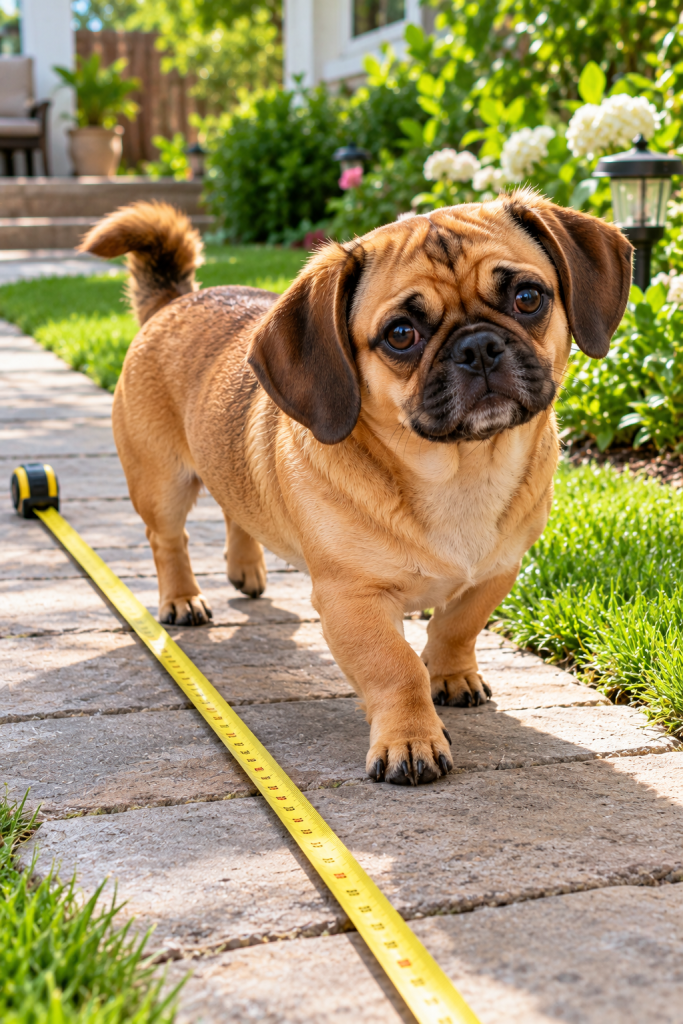
Daug weight chart by age
There is no universally accepted Daug growth chart. The table below is an illustrative guide for a puppy expected to finish around 15–20 pounds, not a breed-specific growth standard.
| Age | Very rough weight guide |
|---|---|
| 8 weeks | 2–4 lb |
| 3 months | 4–7 lb |
| 6 months | 8–14 lb |
| 9 months | 11–18 lb |
| 12 months | Often approaching adult size, roughly 15–20 lb |
Actual growth can differ substantially, especially when one parent is a miniature Dachshund and the other comes from a different size range. Many small dogs approach their adult height before their bodies finish filling out. Puppy growth also depends on nutrition, health, and individual development.
For a more individualized estimate, use the CanineCalc mixed-breed size tool: https://caninecalc.com/puppy-size-calculator/
If you already have a Dachshund and want to compare growth patterns, the Dachshund weight chart is available here: https://caninecalc.com/dachshund-weight-chart/
What does a Daug look like?
The Daug’s appearance depends on how its parent breeds combine. There is no single body shape or facial expression that every puppy will share.
Body: Many Daugs look longer than a typical Pug but stockier than a Dachshund. They may have short legs, a solid chest, and a body that sits relatively close to the ground. Others are more compact, particularly when the Pug’s proportions are more prominent.
Coat and color: A short, smooth coat is common, although coat texture and length can vary. Colors may include fawn, tan, black, cream, brown, or combinations and markings inherited from either parent. A short coat does not mean a Daug will be low-shedding or suitable for people with dog allergies.
Face: Some Daugs have the Pug’s round eyes, broad head, and shortened muzzle. Others have a longer nose that looks more like a Dachshund’s. A less-flat face can change the dog’s appearance, but appearance alone cannot establish whether its breathing will be healthy.
Ears and tail: Ears often fold downward, although their size and shape vary. The tail may curl over the back like a Pug’s, remain straighter, or fall somewhere between the two. These details are inherited traits, not reliable ways to predict temperament or health.
Temperament: pug clown meets dachshund stubborn
A Daug may combine the Pug’s sociable, playful nature with the Dachshund’s curiosity and independent thinking. Many enjoy being close to their people, joining household activities, and relaxing nearby once they have had enough activity.
The Pug influence may show up as a comical expression, a fondness for attention, and a desire to be included. The Dachshund side may contribute alertness, determination, and an interest in following interesting scents. Some Daugs are more laid-back, while others are busy little observers who want to investigate everything.
Training can require patience. A Daug may understand a cue but decide that another activity is more interesting. Short sessions, rewards, consistency, and early socialization can help build reliable habits. Harsh corrections are unlikely to make training more enjoyable or cooperative.
Barking is another possibility. Dachshunds were developed as hunting dogs and may be vocal when they notice movement or unfamiliar sounds. A Daug may bark at the door, during excitement, or when seeking attention, although individuals differ.
Some may also struggle when left alone for long stretches. A people-focused dog needs opportunities to learn comfortable independence rather than relying on constant company. Temperament is shaped by inherited traits, early experiences, training, and the individual dog, so neither parent breed can predict the outcome perfectly.
Exercise and daily life
Most Daugs need moderate daily activity, not an intense exercise routine. Short walks, sniffing opportunities, gentle play, and small training games can provide a useful balance of movement and mental stimulation.
Match activity to the individual dog’s stamina and body structure. If your Daug has a very short muzzle, ask your veterinarian what level of exercise is appropriate, particularly during warm or humid weather. Do not assume that heavy panting or noisy breathing is simply part of the breed.
Weight control is especially important. Both parent breeds can be prone to gaining excess weight, and extra pounds can put additional strain on a dog with a long back or compact frame. Measured meals, sensible treat portions, regular movement, and routine weight checks help keep daily care manageable. Your veterinarian can help you judge an appropriate body condition and feeding plan.
Back-friendly habits are worth building early. Use a ramp or stable pet steps where appropriate, discourage repeated jumping from beds and sofas, and support your dog carefully when lifting it. These are general precautions, not a guarantee against spinal problems.
Daugs can adapt well to apartments because they are small and do not generally need a large yard. Still, they need walks, enrichment, training, and companionship. A small home is not a substitute for daily attention.
Health watchpoints from both parents
Mixed-breed dogs do not automatically inherit every health issue associated with their parents, but they can inherit relevant physical traits and risks. A Daug’s actual needs depend on its build, family history, and overall health.
Breathing: The Pug’s short muzzle can be associated with brachycephalic obstructive airway syndrome (BOAS), a group of airway problems that can affect breathing and tolerance for exercise or heat. A Daug with a noticeably shortened muzzle deserves particular attention to breathing comfort. Cornell University’s BOAS overview explains how shortened facial structure can affect airflow.
Back and spinal health: Dachshunds have a long-backed, short-legged build associated with increased concern about intervertebral disc disease (IVDD). A Daug with similar proportions may also warrant careful back-friendly handling and weight management. The American College of Veterinary Surgeons’ IVDD information provides general background on this condition.
Eyes: Pugs have prominent eyes, which can be more exposed to irritation or injury. If a Daug inherits large, prominent eyes, discuss routine eye care and any concerns with a veterinarian.
Weight: Both parent breeds can become overweight, and excess weight may compound concerns involving breathing, joints, and the back. Body condition is more useful than the scale alone for judging whether an individual dog is maintaining a suitable weight.
A veterinarian can help you understand which concerns are most relevant to your dog’s actual anatomy and history. This overview is general information, not a diagnosis or treatment plan.
Is a Daug right for you?
A Daug may suit someone who wants a small, affectionate companion and can offer daily walks, rewarding training, and plenty of company. Their size can make them practical for smaller homes, and their playful personalities may add life to a household without requiring a highly athletic lifestyle.
Think carefully, however, if you need a dog that is exceptionally easy to train, must tolerate long periods alone every day, or needs to be low-shedding for allergy-related reasons. A Daug may be vocal, determined, and more attached to its people than your schedule comfortably allows.
Families should also consider the dog’s individual temperament and teach children to handle it gently. A small dog with a long back should not be treated like a toy or encouraged to leap from furniture. Respectful handling and appropriate supervision matter more than the dog’s size.
Frequently asked questions
What is a pug dachshund mix called?
A Pug-Dachshund mix is commonly called a Daug. The name is informal, and the mix does not have one standardized appearance, size, or temperament.
How big does a Daug get?
A typical estimate is around 15–20 pounds and 11–13 inches tall. These figures are not guarantees. The size of the Dachshund parent, inherited proportions, and individual growth can all affect adult measurements.
How long do Daugs live?
A rough planning estimate is about 12–15 years, although individual Daugs may live shorter or longer. Genetics, body condition, lifestyle, and veterinary care all influence a dog’s overall health and longevity.
Are Daugs good family dogs?
They can be affectionate, playful family companions, particularly in homes where children understand gentle handling. Suitability depends on the individual dog’s temperament, socialization, and ability to live comfortably with the family’s routine.
Do Daugs bark a lot?
Some do. The Dachshund side may contribute alert barking and vocal behavior, but barking levels vary. Consistent training, enrichment, and appropriate responses to triggers can help encourage calmer habits.
Final thoughts
The Pug Dachshund mix can be a loving, entertaining small companion, but its size and appearance are not completely predictable. Expect a dog that may weigh around 15–20 pounds, while allowing for variation in build, muzzle length, coat, and personality. The most important everyday considerations are maintaining a healthy weight, providing steady companionship and moderate activity, and paying attention to breathing and back-friendly handling when relevant.
About Jennifer: Jennifer is the founder of CanineCalc, a dog owner and researcher who develops accessible dog-care and size resources. She is not a veterinarian, breeder, or certified trainer. This article is intended for general informational purposes and does not replace guidance from your veterinarian.